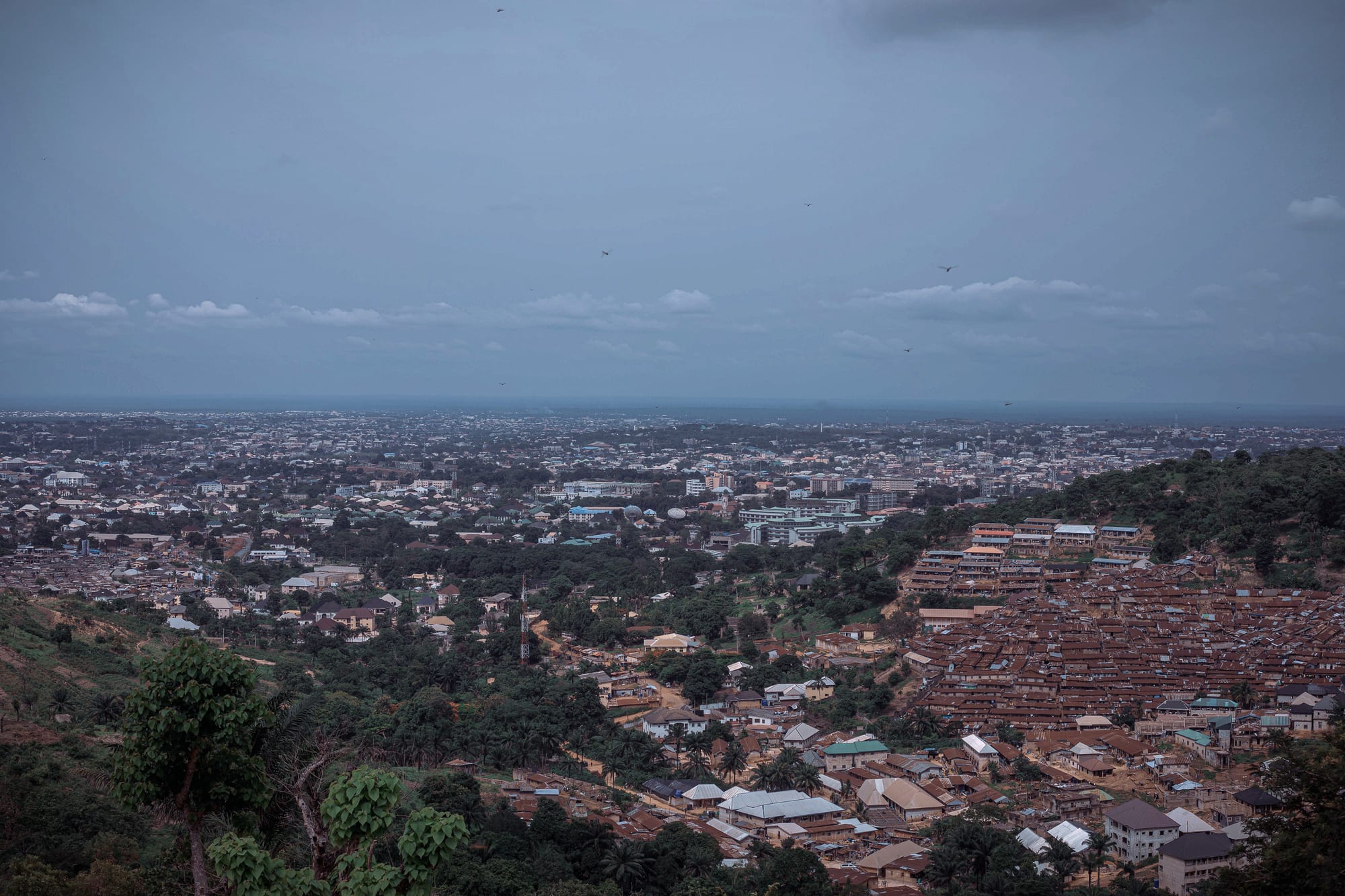
View from a green hillside over the rooftops of Enugu stretching to the horizon under a grey evening sky

Nigeria

Enugu, Owerri & the Southeast

Enugu, the Coal City of south-eastern Nigeria, seen from a hill above the city. (DeStrangeImages / Wikimedia Commons · CC BY-SA 4.0)

The Igbo heartland east of the Niger, covering Abia, Anambra, Ebonyi, Enugu and Imo — a densely settled land of palm-fringed farmland, trading cities and hills, shaped by the ancient Nri and Igbo-Ukwu cultures, the Biafran war and an entrepreneurial spirit felt in the markets of Onitsha and Aba.

Explore Enugu, Owerri & the Southeast

History

The southeast has been densely settled for thousands of years. At Igbo-Ukwu in Anambra, excavations uncovered intricate bronzes long dated to the 9th century, with later samples reaching into the 13th. The nearby kingdom of Nri, whose priest-king the Eze Nri held ritual authority across much of Igboland, was an important religious centre for centuries, but most Igbo communities governed themselves through village assemblies, elders and title societies rather than kings.

In the era of the Atlantic slave trade, the Aro people of Arochukwu, in present-day Abia, built a trading network backed by a famous oracle, and many enslaved people shipped from the Bight of Biafra came from the region. Britain broke Aro power in a military expedition of 1901–1902. In 1929 thousands of women in the Aba area rose against colonial taxation in the Aba Women's War. Coal found near Enugu in 1909 created a new city, and in 1949 police killed striking miners at the Iva Valley mine.

Enugu became capital of the Eastern Region and, in 1967, of Biafra, whose secession under Odumegwu Ojukwu followed massacres of Igbo in the north. Federal forces took Enugu that year, and the Biafran government retreated through Umuahia and Owerri until its surrender in January 1970, after a war in which vast numbers died, most from starvation. Reconstruction was slow, and a sense of marginalisation has fed renewed separatist movements in the 21st century.

Culture & Customs

The southeast is the homeland of the Igbo, and Igbo is spoken throughout alongside English and Pidgin, with marked dialect differences from one area to the next. The region is strongly Christian, mainly Catholic and Anglican, with a fast-growing Pentecostal presence, while traditional practices remain woven into family life.

Hospitality begins with the breaking of kola nut, offered to guests with prayers by the eldest man present. The new yam festival, Iri ji, marks the harvest in villages across the region, and masquerades, mmanwu, representing ancestral spirits, perform at festivals and funerals. Chieftaincy and titles, such as the ozo title in Anambra, still carry prestige, and the saying Igbo enwe eze — "the Igbo have no king" — reflects a long tradition of decentralised, republican government.

The region is famous for its enterprise: the apprenticeship system known as igba boi, in which young traders learn under a master before being set up in business, has built networks of Igbo merchants across Nigeria and beyond. Chinua Achebe, born in Ogidi in Anambra, portrayed Igbo society in Things Fall Apart, and the University of Nigeria at Nsukka is a major intellectual centre. Highlife music, weddings with elaborate bride-price ceremonies and Christmas homecomings are central to social life.

Daily Life

The southeast is one of the most densely populated parts of Africa. Onitsha and Aba are the great commercial cities, with greater Onitsha among Nigeria's largest urban areas; Enugu, the administrative centre, has several hundred thousand; Owerri, Umuahia, Abakaliki, Awka and Nnewi are the other main towns. Many villages have emptied as people moved to Lagos, Abuja and abroad, yet homes are still built in ancestral villages.

Trade and small-scale manufacturing are the backbone of the economy. Aba's Ariaria market is among the country's largest, Nnewi is a centre for motor parts and vehicle assembly, and Onitsha's markets distribute goods across the country. Ebonyi is known for rice growing and salt, and palm oil and cassava sustain the countryside.

Days in the cities are busy with trading, traffic and church. Gully erosion, poor roads, insecurity and "sit-at-home" orders linked to separatist agitation affect everyday life, as has the case of Nnamdi Kanu, leader of the separatist group IPOB, who was re-arrested in 2021 and sentenced to life imprisonment on terrorism charges in 2025. The December homecoming season, with its weddings, burials and festivals, is the busiest time of year.

Food

Igbo cooking is built around soups eaten with swallows such as pounded yam, fufu or garri. Ofe onugbu is a bitterleaf soup thickened with cocoyam; ofe oha uses the tender leaves of the oha tree; and ofe nsala, the "white soup", is a light pepper soup made without palm oil, often with catfish. Egusi and ogbono soups are eaten here as across the south.

Abacha, sometimes called African salad, is an Igbo speciality: shredded dried cassava tossed with palm oil, fermented oil-bean slices called ugba, fish and vegetables. Nkwobi is cow foot served in a spicy, thick palm-oil sauce, and isi ewu, spiced goat's head, is a favourite bar dish. Okpa, a steamed pudding of Bambara nut flour and palm oil, is widely eaten. Roasted yam with palm oil and pepper sauce is sold at roadsides.

Palm wine, nkwu, is the traditional drink, tapped fresh each day and shared at ceremonies, and kola nut is offered to guests. Beer, malt drinks and zobo are also widely drunk.

Attractions & Natural Wonders

Enugu sits beneath the Udi hills and makes a pleasant base, with its old colonial-era areas, the Nike Lake resort and the hilly countryside around it. Nearby, the Ngwo pine forest shelters a cave and waterfall, and the Awhum waterfall, with a monastery above it, lies in the Udi hills outside the city. Nsukka's university town is within reach.

Owerri, the Imo capital, is the region's leisure city, with hotels, lounges and nightlife, and the Mbari tradition of sculpted mud houses dedicated to the earth goddess Ala belongs to the Owerri Igbo. Oguta Lake, west of Owerri, is the largest natural lake in Imo State and was a Biafran naval base during the war.

In Anambra, Onitsha's markets stretch along the Niger and the main market is an experience in itself, while the Ogbunike Caves — a series of chambers, tunnels and streams in a forested valley — are sacred to the local community and visited during an annual festival. The Igbo heartland also includes the historic Nri and Igbo-Ukwu area, Arochukwu with the shrine of its old oracle in Abia, and the lakes and salt deposits of Ebonyi, where rice fields cover the plains around Abakaliki.

Cities in Enugu, Owerri & the Southeast

Planning basics

Budget

The southeast is noticeably cheaper than Lagos or Abuja. Hotels in Enugu and Owerri are reasonably priced, street food and local restaurants are inexpensive, and shared taxis and buses link the towns. Costs rise during the Christmas season, when huge numbers of people return home to their villages and hotels fill.

Daily Budget Midrange
USD 90–210 (good hotel in Enugu or Owerri, restaurants, a car with driver)
Daily Budget Shoestring
USD 30–55 (guesthouse, local canteens, shared taxis and buses)

Book rooms early for late December, when the region's diaspora returns home and prices and traffic climb.

Safety

Security in the southeast has worsened since about 2020. Separatist agitation for Biafra has been accompanied by attacks by armed "unknown gunmen" on police stations and officials, kidnapping for ransom, and "sit-at-home" orders on some Mondays that shut towns down. Some foreign governments advise against travel to parts of the zone. Armed robbery and road crime are further risks, especially after dark.

Check for sit-at-home days before travelling, move only in daylight with a trusted local driver, and avoid political gatherings. Check current official travel advice before travelling.

Climate

Hot and humid, with a long rainy season from about April to October and a dry season from November to March, when the harmattan brings dusty haze and cooler nights. Enugu's hills are slightly cooler than the lowlands. Heavy rain feeds serious gully erosion in parts of Anambra and Imo.

Summer
rainy and humid, 23–30°C, with frequent downpours
Winter
dry season, 20–34°C, with harmattan haze and cooler nights

Transportation

Enugu's Akanu Ibiam International Airport and Owerri's Sam Mbakwe Airport have domestic flights, and Anambra has its own airport near Umueri. Roads link the main towns in one to three hours, though potholes and heavy traffic around Onitsha and Aba slow journeys. The Second Niger Bridge, opened in 2022, eased the crossing between Asaba and Onitsha.

Fly into Enugu or Owerri rather than making the long drive, and travel between towns only in daylight.

Best Time to Visit

November to February is the dry season and the time of homecomings, weddings, masquerades and village festivals, peaking at Christmas and New Year. New yam festivals follow the harvest around August and September, when roads can be muddy from the rains.