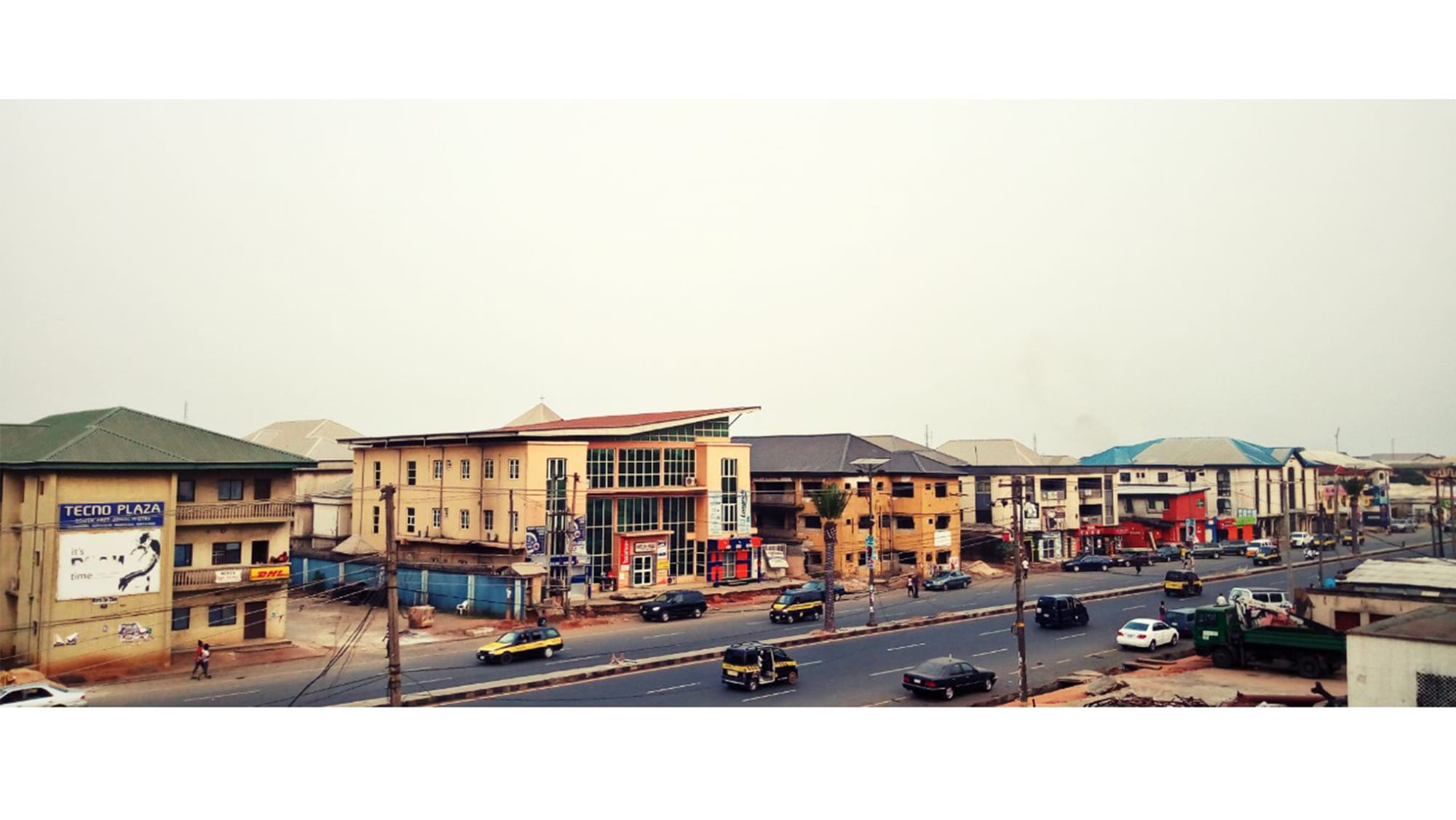
A wide dual carriageway through Owerri lined with two- and three-storey shop buildings, with yellow taxis and cars under a hazy white sky

Enugu, Owerri & the Southeast, Nigeria

Owerri

A main road through Owerri, lined with shops and small commercial buildings. (EMEKA OKECHUKWU / Wikimedia Commons · CC BY-SA 4.0)

The capital of Imo State in south-eastern Nigeria, a green, low-rise city on the Otamiri River in the Igbo heartland. Long a market and administrative town, it held the Biafran government briefly near the end of the civil war, and today lives on government, three campuses, trade and a leisure trade of hotels, lounges and bars that draws visitors from across the southeast.

Neighbourhoods

  • Owerri Municipal and Douglas Road
    • First-time visitors
    • Shopping
    • Close to transport

    The compact old centre, built around the Imo State government offices and the roundabouts that organise the city. Douglas Road and Wetheral Road carry most of the banks, shops and eating places, and the main markets are a short ride away.

    Open in Maps
  • Ikenegbu
    • Best for food
    • Nightlife
    • Hotels

    A leafy residential quarter just north of the centre that has filled with guesthouses, restaurants, bars and lounges. Much of the city's evening life happens along its layout roads, and it is within walking distance of the government area.

    Open in Maps
  • New Owerri
    • Quiet and residential
    • Modern developments

    The planned extension laid out to the south-east, with wide roads, government housing, newer estates and offices. It feels spacious and unfinished in places, and it is the part of the city that has grown fastest.

    Open in Maps
  • Aladinma
    • Quiet and residential
    • Local life

    A well-established housing area popular with civil servants and professional families, with its own small shops, churches and eateries. It sits close enough to the centre for short trips in but keeps a suburban calm.

    Open in Maps
  • Nekede
    • Students
    • Parks and animals

    A community on the south-western edge of the city, on the road towards the Otamiri River, best known for its polytechnic and for the state zoological garden nearby. Student life gives the area cheap food and a young crowd.

    Open in Maps

Things to do

Culture and landmarks

  • Mbari Cultural and Art Centreattraction

    A compound of sculpted clay figures in the style of the Owerri Igbo mbari houses, which were built as offerings to the earth goddess Ala and left to decay.

    Open in Maps
  • Dan Anyiam Stadiumattraction

    The city's main stadium, used for football and public events, and the place where Owerri gathers for league matches.

    Open in Maps
  • Imo State Universityattraction

    The state university, whose campus in the city gives Owerri much of its student population and its bookshops and cheap canteens.

    Open in Maps
  • Assumpta Cathedrallandmark

    The Catholic cathedral of Owerri, mother church of the archdiocese and dedicated to the Assumption of the Virgin Mary.

    Open in Maps

Campuses on the edge of town

  • Federal University of Technology Owerriattraction

    A large federal technical university south of the city, bounded by the communities of Ihiagwa, Eziobodo and Obinze, whose students shape the area around it.

    Open in Maps

Short trips from the city

  • Oguta Lakeattraction

    A broad freshwater lake west of Owerri, used as a marine base by the Biafran army during the civil war and now a quiet place for boats and lakeside walks.

    Open in Maps
  • National War Museum, Umuahiamuseum

    A museum in Abia State built around the underground bunker that housed the Biafran radio station, with armour, aircraft and improvised weapons in its grounds.

    Open in Maps
  • Arochukwuattraction

    The town of the Aro people, whose oracle underpinned a wide trading network broken by a British expedition in 1901–02, with the cave shrine still shown to visitors.

    Open in Maps

Seasonal events

  • New yam festivalAugust and September

    The harvest festival of Igbo communities, marked in villages around Owerri with the first yams, masquerades and dancing.

  • Christmas homecoming seasonDecember

    The weeks when Owerri fills with families returning from Lagos, Abuja and abroad for weddings, burials and village ceremonies, and hotels and roads are at their busiest.

  • Masquerade performancesdry season, November to February

    Mmanwu masquerades representing ancestral spirits appear at festivals and funerals in the communities around the city.

Eat and drink

Long-standing places and food districts in Owerri. Hours, ratings and directions come from your maps app, always current.

Owerri classics

  • Nkwobi and isi ewu barsneighborhood

    Cow foot in a thick, spicy palm-oil sauce and spiced goat's head are the dishes Owerri's bars are built around, eaten in the evening with cold drinks.

    Open in Maps
  • Abacha stallsmarket

    Shredded dried cassava dressed with palm oil, ugba oil-bean slices, fish and garden egg leaves, sold from stalls and roadside tables through the afternoon.

    Open in Maps

Markets and food streets

  • Ekeonunwa Marketmarket

    A central market for foodstuffs, palm oil, dried fish and household goods, busy from early morning.

    Open in Maps
  • Relief Marketmarket

    One of the city's main trading markets, with produce, provisions and prepared food sold from stalls and the streets around it.

    Open in Maps
  • Ikenegbu eating streetsneighborhood

    The densest concentration of restaurants, grills and bars in Owerri, running from pepper soup joints and suya stands to sit-down places serving rice and soups.

    Open in Maps

Experience Owerri

History

Owerri grew from a group of Igbo farming and trading communities on the Otamiri River. Like most of Igboland it had no king: authority rested with lineage heads, elders and title societies, and the traditional rulers recognised in the city today belong to a later, colonial-era pattern of appointed chiefs. The British reached the area early in the twentieth century and made the settlement a divisional headquarters, adding a court, a prison and a mission station.

The town's modern significance dates from the civil war. As federal forces took Enugu and then Umuahia, the Biafran government retreated, and Owerri became the last capital of the secessionist state in late 1969. The city itself changed hands and was besieged, and much of it was damaged before the surrender in January 1970. Reconstruction was slow, and for years afterwards Owerri was a modest administrative town.

It was the creation of Imo State in 1976, with Owerri as its capital, that transformed the place. Government offices, a state university, a polytechnic at Nekede and a federal university of technology brought money, students and building work, and the New Owerri extension was laid out to the south-east. Successive state governments have left their mark in roundabouts, statues and half-finished projects. Since 2020 the city has felt the wider insecurity of the southeast, including attacks on official buildings and the Monday sit-at-home orders that periodically shut the markets.

Culture & Customs

Owerri is Igbo and Catholic, and both shape daily behaviour. Church is central: the cathedral and the parish churches fill on Sundays, and weddings, burials and child-naming ceremonies are large, expensive and carefully staged, with matching aso ebi cloth worn by family groups. Funerals in particular can draw hundreds of people back from Lagos, Abuja and abroad.

The surrounding countryside is the home of the mbari tradition, in which a community built a house full of painted clay figures — the earth goddess Ala, ancestors, animals, figures of the modern world — as an offering, then left it to weather away. The Mbari centre in the city keeps the practice visible. Masquerades, mmanwu, appear at festivals and funerals in the villages around, and the new yam festival marks the harvest. Kola nut opens any formal visit, broken and prayed over by the eldest man present.

Owerri's other reputation is for leisure. The city has an unusually large number of hotels, lounges and bars for its size, and it draws people from across the southeast for weekends, live highlife and hip hop, football on screens and long evenings over nkwobi. Title-taking, the igba boi trading apprenticeship and a strong sense of Igbo identity run through social life, as does the memory of the civil war, which is discussed openly and often.

Daily Life

Owerri is a medium-sized city: the three local government areas that make up Owerri were estimated at about 1.4 million people in 2016, and the built-up area has spread well beyond the old town into Nekede, Egbu and the New Owerri estates. It is young, with three large institutions of higher education, and its population swells in December.

Government is the largest employer, followed by trade, education and the hotel and hospitality business. Ekeonunwa and Relief markets handle food and goods, small workshops and shops line the main roads, and many households depend on remittances from relatives in Lagos, Abuja, South Africa, Britain and the United States. Electricity from the grid is unreliable, so generators run behind most shops and hotels, and many streets have their own boreholes.

The day starts early, with church services, school runs and market trading before the heat, and slows in the afternoon before the bars fill in the evening. Heavy rain floods low-lying roads, and gully erosion is a recurring problem in the wider state. Since 2020 the Monday sit-at-home orders associated with separatist agitation have disrupted schools, markets and transport, and insecurity and the cost of living dominate conversation.

Food

Owerri eats the Igbo kitchen of the southeast. Soups are the centre of a meal, served with a swallow — pounded yam, garri or fufu — taken by hand. Ofe onugbu, bitterleaf soup thickened with cocoyam, is the local favourite; ofe oha is made with the young leaves of the oha tree; and ofe nsala, the white soup, is a light pepper soup made without palm oil, often with catfish. Egusi, melon-seed soup, and ogbono are eaten everywhere, and one soup, ofe owerri, carries the town's own name.

The city's own speciality is bar food. Nkwobi — cow foot simmered and dressed in a thick, orange palm-oil sauce with utazi leaf — and isi ewu, the spiced goat's head served in the same sauce, are what people order in the evening, and Owerri's lounges have a reputation across the southeast for both. Abacha, shredded dried cassava tossed with palm oil, fermented oil-bean ugba, fish and vegetables, is eaten cold as an afternoon dish. Okpa, a steamed pudding of Bambara-nut flour, is a morning food, and roasted yam or plantain with pepper sauce is sold at roadside grills.

Palm wine, nkwu, tapped fresh and drunk the same day, is the ceremonial drink and is presented at weddings; kola nut accompanies it. Beer, malt drinks, the hibiscus infusion zobo and chapman, a bittersweet mixed soft drink, fill the bars.

Planning tools

Budget

Owerri is inexpensive by Nigerian standards, though its hotel trade is large and prices climb steeply in December, when the diaspora returns home and rooms are scarce. Local food is very cheap, and the main variable cost is transport: a car with a driver is the usual way for visitors to move around and reach places outside the city.

Daily Budget Midrange
USD 90–210 (good hotel, restaurants, a car with driver)
Daily Budget Shoestring
USD 30–55 (guesthouse, local canteens, shared taxis and keke tricycles)

Book rooms well ahead for late December, and agree the day rate for a car and driver in advance.

Best Time to Visit

November to February, the dry season, is the most comfortable time and the season of weddings, funerals, masquerades and homecomings, peaking around Christmas. The new yam festivals fall in August and September, in the wet months, when roads outside the city can be muddy and journeys slow.

Suggested Number of Days

The city itself is small and a day or two covers it. Three or four days allow for the lake to the west and the towns of the wider southeast. Travelling by road rather than flying, or arriving in the December season, adds time.

First Visit
1–2 days
With Surroundings
3–4 days

Transportation

Shared taxis, minibuses and keke napep tricycles cover the city for small fares, and motorcycle okadas work the outer roads, though they are restricted in places and are the least safe option. Most visitors hire a car with a driver for the day. Traffic builds around the central roundabouts and the markets in the late afternoon.

Agree fares before setting off, avoid motorcycle taxis, and travel between towns only in daylight.

Airport & Station Connections

Sam Mbakwe International Cargo Airport, at Ngor Okpala about 25 kilometres south-east of the centre, has flights to Lagos and Abuja and is the usual way in. Enugu's international airport is about two hours away by road. Long- distance buses from Lagos, Abuja and Port Harcourt run to motor parks in the city, and Port Harcourt is roughly three hours south by road.

Walkability

The central area around the government offices, Douglas Road and Ikenegbu can be covered on foot, and distances there are short. Beyond it the city spreads out along wide roads with broken pavements, open drains and fast traffic, so most journeys are made by tricycle or car. Walking after dark is not usual.

Safety

Owerri is a busy state capital, but security in the southeast has worsened since about 2020, with armed attacks on police stations and officials, kidnapping for ransom, and "sit-at-home" orders on some Mondays that close shops, markets and roads across the zone. Some foreign governments advise against travel to parts of the southeast. Armed robbery and road crime are further risks, especially after dark.

Check for sit-at-home days before travelling, move only in daylight with a trusted local driver, and avoid political gatherings. Check current official travel advice before travelling.

Climate

Hot and humid all year, with a long rainy season from about April to October and a dry season from November to March. Owerri is among the wetter parts of Nigeria, and downpours are heavy and sudden in the wet months; the harmattan brings dusty haze and cooler nights around December and January.

Summer
rainy and humid, about 23–30°C, with frequent heavy downpours
Winter
dry season, about 20–34°C, with harmattan haze and cooler nights

Local Customs

This is an Igbo city and a strongly Christian one, mainly Catholic: Sunday mornings belong to church, and dress for services and for visits to older people is formal. Kola nut is broken and prayed over when guests are received, elders are greeted first and by title, and chieftaincy titles are used carefully. English and Igbo are both spoken, with Pidgin as the everyday shorthand.

Tipping is not expected but small amounts are appreciated; dress modestly away from the bars and lounges; ask before photographing people, masquerades, police or government buildings.

Common Payment Methods

The currency is the naira. Bank branches and ATMs cluster along Douglas Road and Wetheral Road, though foreign cards work unpredictably and withdrawal limits are low. Hotels and larger restaurants take cards; markets, tricycles and small eateries are cash only, and bank transfers from local accounts are widely used. Bringing US dollars to change is normal practice.