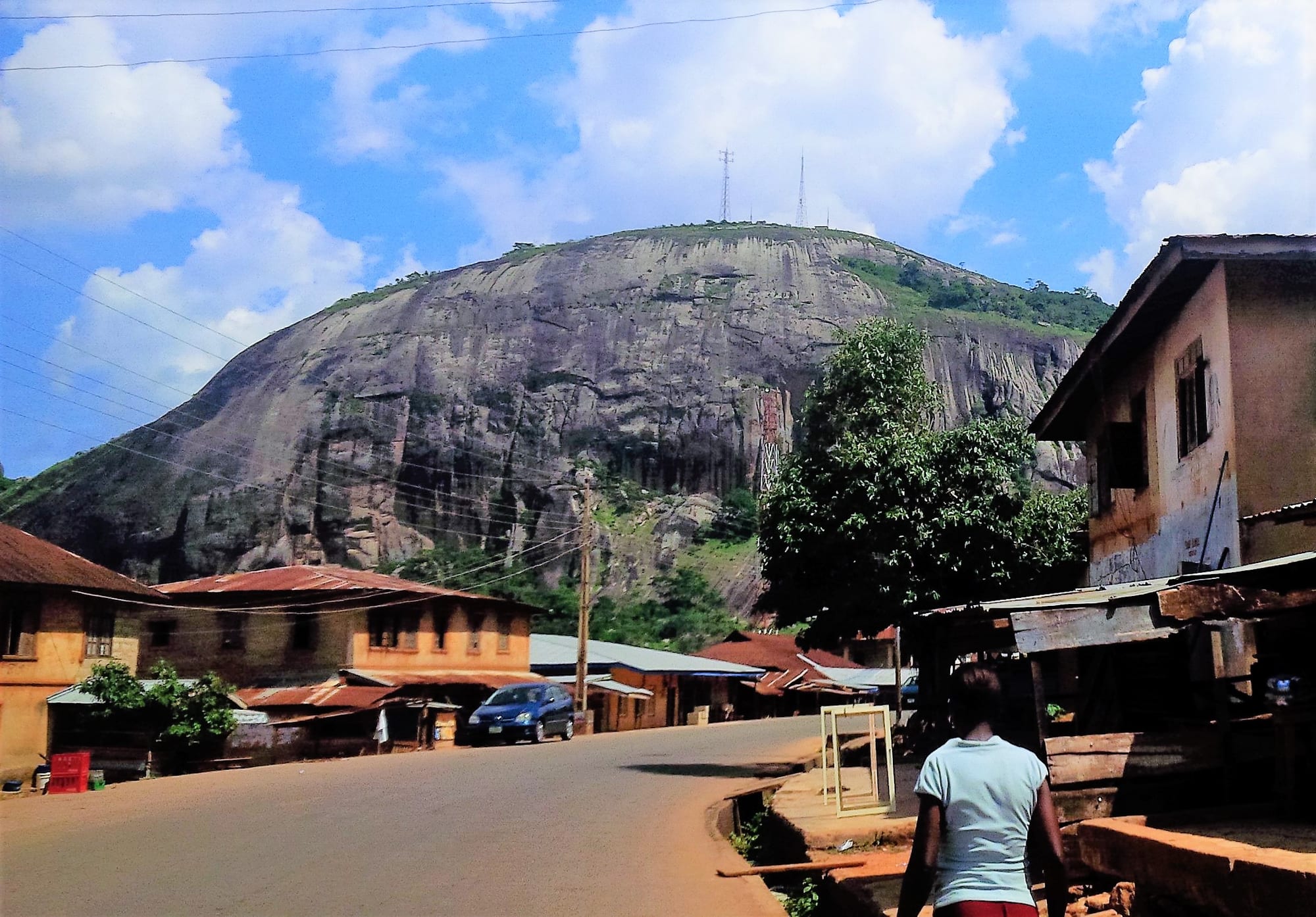
A huge bare granite dome rising behind houses with rusty roofs and a curving road under a blue sky with white clouds

Nigeria

Lagos & the Southwest

The Idanre Hills rising above the town of Idanre in Ondo State. (Victor Akinfala / Wikimedia Commons · CC BY-SA 4.0)

Nigeria's Yoruba heartland, running from the lagoons and megacity of Lagos inland through Ogun, Oyo, Osun, Ondo and Ekiti — the country's commercial engine, home of the ancient kingdoms of Ife and Oyo, and a land of forested hills, granite outcrops and sacred groves.

Explore Lagos & the Southwest

History

The Yoruba trace their origins to Ile-Ife, where, in their tradition, the world was created and Oduduwa founded the first kingdom. Between roughly 1200 and 1400 Ife's artists cast naturalistic bronze and terracotta heads that astonished European scholars when they were unearthed in the 20th century, and the Ooni of Ife remains a revered figure among Yoruba rulers.

From the 17th century the Oyo Empire, a cavalry power on the northern savanna, dominated the region and profited from the Atlantic slave trade through the coast. Oyo collapsed in the early 19th century amid civil wars and pressure from the Sokoto Caliphate to the north, and refugees founded new cities: Ibadan grew from a war camp into a military power, and the Egba people settled beneath Olumo Rock at Abeokuta in about 1830.

Britain annexed Lagos in 1861 and extended control inland by the 1890s. Lagos served as Nigeria's capital from independence until the move to Abuja in 1991, and the old Western Region, led by Obafemi Awolowo, introduced free primary education in the 1950s. Military governments later carved it into today's states, from Lagos State in 1967 to Ekiti in 1996. Lagos has since grown into one of the world's largest cities, and in 2020 it was the centre of the #EndSARS protests against police brutality, which were suppressed by the military, leading to the deaths of protesters at the Lekki toll gate.

Culture & Customs

The southwest is overwhelmingly Yoruba, and Yoruba is spoken everywhere alongside English and Pidgin, with Lagos also home to people from every part of the country. Religion is famously mixed: Muslims and Christians live side by side, often within the same family, and traditional worship of the orisa — Osun, Sango, Ogun and others — survives in shrines, festivals and the Ifá system of divination.

Every town has its oba, and royal installations, anniversaries and festivals remain major events. The Osun-Osogbo festival each August draws worshippers and visitors to the grove, and Lagos Island's Eyo festival brings out white-robed masqueraders. Egungun masquerades, representing ancestral spirits, appear across the region.

Social life revolves around the owambe, the lavish party for weddings, birthdays and funerals, where guests wear aso ebi in matching fabric and dance to live bands. Abeokuta is known for adire, indigo-dyed cloth, and aso oke, a hand-woven fabric, is worn for ceremonies. Musically the region gave Nigeria juju, fuji and Afrobeat, created by Fela Kuti, who was born in Abeokuta, as was the Nobel laureate Wole Soyinka. Respect for elders runs deep: younger Yoruba traditionally greet their seniors with a bow or, for men, by prostrating.

Daily Life

Lagos dominates: estimates of its population vary widely but run well above 15 million, spread from the older business district on Lagos Island to Victoria Island, Ikoyi, the fast-growing Lekki peninsula and the vast mainland. Ibadan, with several million people, is the second city; Abeokuta, Osogbo, Ile-Ife, Akure, Ado-Ekiti and Ogbomosho are important centres.

Lagos is Nigeria's commercial, financial, media and creative capital, home to banks, fintech start-ups, Nollywood studios and the Apapa ports, and the Dangote refinery on the Lekki coast has added a major industrial project. Ogun State has become an industrial belt of factories along the roads out of Lagos, while inland the economy rests on cocoa, cassava, yams, trade and public employment, and universities in Ibadan and Ife draw students from across the country.

The Lagos day begins before dawn to beat the traffic, the "go-slow", and many commuters spend hours crossing the bridges from the mainland. Generators hum wherever the grid fails, danfo minibuses and okada motorbikes fill the streets, and the working week ends in parties, church services and mosque prayers. Flooding, housing costs and the cost-of-living crisis since 2023 dominate conversation.

Food

The southwest's signature meal is amala, a dark swallow made from yam flour, served with ewedu, a slippery jute-leaf soup, and gbegiri, a bean soup — a combination especially associated with Ibadan and Oyo. Pounded yam with egusi or efo riro, a rich stew of leafy greens, palm oil and meat or fish, is eaten throughout the region.

Ofada rice, a local unpolished rice from Ogun State, comes with ayamase, a green pepper stew with assorted meats. Lagos is known for ewa agoyin, soft mashed beans served with a dark, oily pepper sauce and bread, while the Ijebu area makes ikokore, a water-yam pottage. Moin moin and akara are breakfast staples, and dodo Ikire, a snack of overripe plantain fried with pepper, is sold along the roads near Ikire in Osun.

Evenings bring asun, spicy smoked goat, and suya at roadside grills. Palm wine is tapped in the countryside, and cold beer, zobo and chapman fill the bars of Lagos, where restaurants also serve every cuisine in Nigeria and much of the world.

Attractions & Natural Wonders

Lagos is the starting point: the markets and colonial-era streets of Lagos Island, the art galleries of Victoria Island and Ikoyi, the Nike Art Gallery and Lekki Conservation Centre with its long canopy walkway, and the beaches of the Lekki peninsula and Tarkwa Bay. The New Afrika Shrine in Ikeja continues Fela Kuti's music venue. West of the city, Badagry keeps the memory of the slave trade in its museums and the path to the "Point of No Return" on the beach.

Inland, Abeokuta's Olumo Rock offers caves, shrines and views over the city, and Ibadan has its hilltop Bower's Tower, the Cocoa House and the University of Ibadan. In Osun State, the Osun-Osogbo Sacred Grove, a UNESCO World Heritage Site, shelters shrines and the sculptures made by Susanne Wenger and local artists along the river, while Ife keeps the palace of the Ooni and a museum of its ancient heads. The Erin-Ijesha waterfall tumbles down a forested hillside in the same state.

Further east, the hills become higher. The Ikogosi Warm Springs in Ekiti, where a warm and a cold stream meet, are set in forest, and Idanre Hill in Ondo State rises in bare granite domes above an old hilltop town reached by hundreds of steps. Old Oyo National Park protects savanna and the ruins of the Oyo Empire's capital.

Cities in Lagos & the Southwest

Planning basics

Budget

The southwest has Nigeria's widest price range. Lagos is the country's most expensive city — hotels on Victoria Island, Ikoyi and Lekki, restaurants and secure transport are priced for business travellers — while Ibadan, Abeokuta, Osogbo, Akure and Ado-Ekiti are far cheaper for rooms, food and transport. Street food and buka canteens keep eating costs low anywhere.

Daily Budget Midrange
USD 110–290 (mid-range hotel in Lagos, restaurants, app taxis or a car with driver)
Daily Budget Shoestring
USD 35–65 (simple hotel outside Lagos, buka meals, shared transport)

Stay close to where the day's business is in Lagos, since crossing the city can take hours; prices drop sharply once outside it.

Safety

The southwest is generally the most accessible part of Nigeria for visitors, but Lagos has real street crime: robbery, phone snatching and carjacking, especially after dark and in traffic. Kidnapping for ransom has occurred on some rural highways, particularly in forested parts of Ondo, Ekiti and Ogun, and state security networks such as Amotekun patrol the countryside. Demonstrations can turn violent quickly.

Avoid road travel after dark, keep phones out of sight in traffic, use trusted drivers between cities and stay away from protests. Check current official travel advice before travelling.

Climate

Hot and humid all year, with more rain along the coast than inland. The main rains run from about April to July, a drier spell usually follows in August, and a second wet season comes in September and October. The harmattan brings a light haze from December to February, weaker here than in the north, and Lagos floods after heavy downpours.

Summer
wet and humid, 24–30°C, with the heaviest rain in June and July
Winter
dry season, 25–34°C, hazy during the harmattan

Transportation

Murtala Muhammed Airport in Lagos is Nigeria's main international gateway, and domestic flights link Lagos with Ibadan and other cities. A standard-gauge railway runs between Lagos and Ibadan, and Lagos has urban rail lines, ferries across the lagoon, BRT buses and app taxis. The Lagos–Ibadan expressway is the main road inland; journeys to Osogbo, Akure or Ekiti take several hours by car.

Use app taxis or a hired car with a known driver in Lagos, and plan around rush-hour traffic on the bridges between the islands and the mainland.

Best Time to Visit

November to February is the most comfortable and the busiest socially: "Detty December" fills Lagos with returning diaspora, concerts and parties. The Osun-Osogbo festival takes place in August, during the brief lull in the rains. June and July bring the heaviest rain and the worst Lagos flooding.