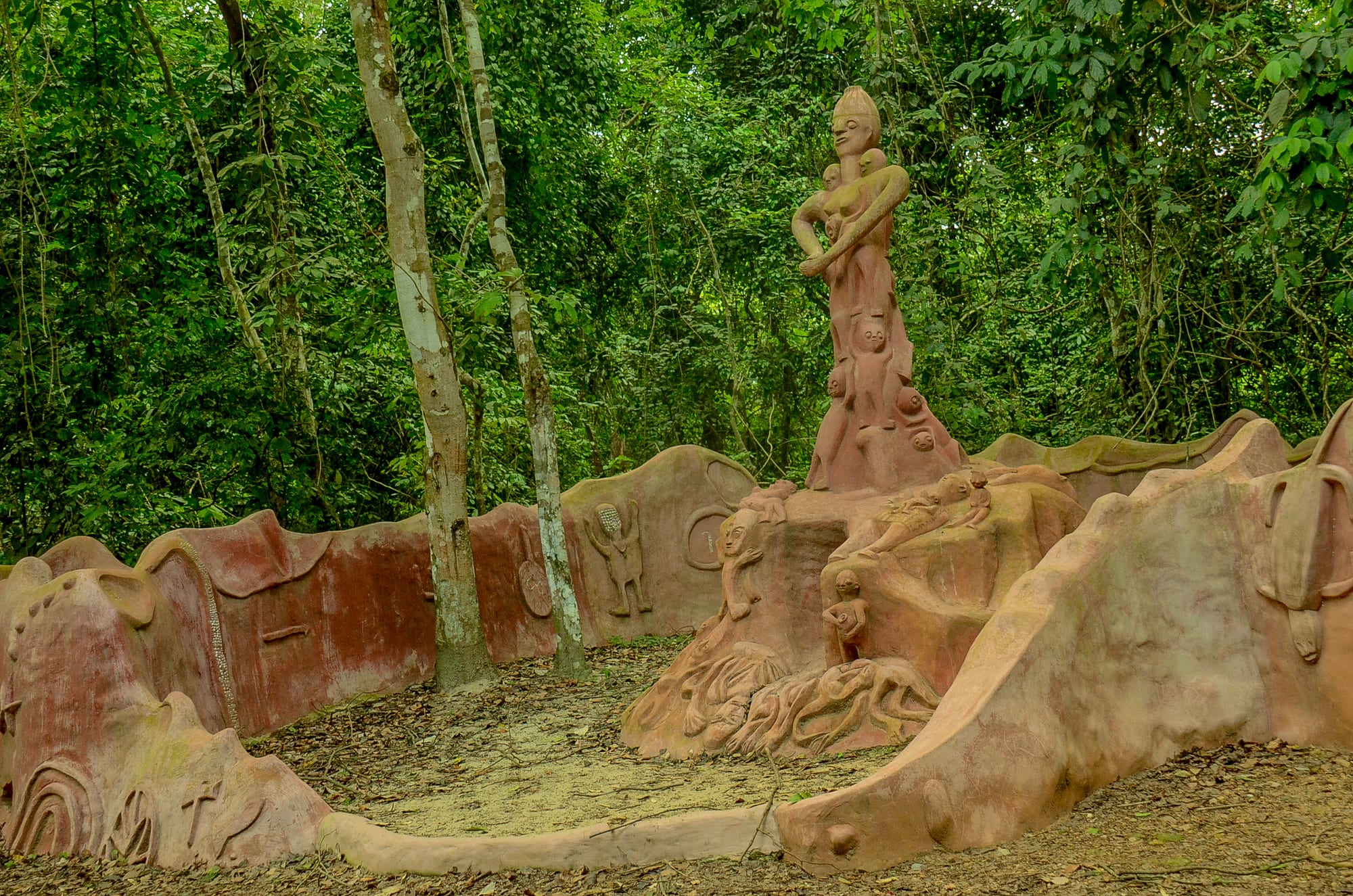
Curving earth-coloured sculpted walls and a tall figure carrying a child, standing among tall trees in dense green forest

Lagos & the Southwest, Nigeria

Osogbo

Sculpted shrine walls and figures in the Osun-Osogbo Sacred Grove outside Osogbo. (Oloyedejuwonlo / Wikimedia Commons · CC BY-SA 4.0)

The capital of Osun State in Nigeria's Yoruba southwest, a market and government town on the Osun river. It is known above all for the sacred grove on its edge, a forest of shrines and modern sculpture dedicated to the river goddess Osun, and for the school of artists that grew up around it in the 1960s.

Neighbourhoods

  • The old town and Oja Oba
    • Historic district
    • Markets
    • Local life

    The centre of Osogbo, laid out around the Ataoja's palace and the Oja Oba, the king's market. Narrow streets of low houses, cloth stalls and food sellers fill the area, and traditional festivals begin and end here.

    Open in Maps
  • Okefia
    • First-time visitors
    • Close to public transport

    The modern commercial strip of banks, offices, hotels and eating places along the main road through town, and the easiest base for anyone without their own transport.

    Open in Maps
  • The Ilesa road and the grove side
    • Quiet and residential
    • Close to the sacred grove

    The edge of town where the streets thin out towards the forest along the Osun river. The sacred grove lies a short drive from here, and the area is quieter than the market quarters.

    Open in Maps

Things to do

The grove and the river

  • Osun-Osogbo Sacred Grovelandmark

    A UNESCO World Heritage Site since 2005 — a stretch of dense forest along the river holding shrines to Osun and other orisa, sculpted gateways and large cement figures raised from the late 1950s onwards.

    Open in Maps

Markets and town life

  • Oja Obamarket

    The king's market in the old town, its main building said to be the former Oba's palace, selling cloth, food, herbs and household goods.

    Open in Maps
  • Osun State Universitylandmark

    The state university, founded in 2006, whose main campus and teaching hospital bring students and staff into the town.

    Open in Maps

Short trips from the town

  • Edeattraction

    An old Yoruba town about 15 km west, seat of the Timi of Ede, standing on the Osun river where the roads from Osogbo, Ogbomosho and Ile-Ife meet.

    Open in Maps
  • Ilesaattraction

    The seat of the Owa Obokun and the centre of the Ijesa Yoruba, about 30 km east, a gold-mining and trading town with a long royal tradition.

    Open in Maps
  • Ile-Ifeattraction

    The city Yoruba tradition treats as the birthplace of the world, seat of the Ooni, and the source of the naturalistic bronze, stone and terracotta sculptures made there between about 1200 and 1400.

    Open in Maps
  • Erin-Ijesha Waterfallsattraction

    Also known as Olumirin, a waterfall dropping in seven stages down a wooded hillside, climbed by steps cut beside the water.

    Open in Maps

Seasonal events

  • Osun-Osogbo festivalAugust

    A month of rites in August, opening with the traditional cleansing of the town and ending with a procession that carries offerings from the palace to the river, led by the Arugba, a young woman of royal lineage who bears the sacred calabash, and drawing worshippers, spectators and visitors from across Nigeria and abroad.

  • Egungun masqueradesmid-year, with dates set locally

    Masquerades representing ancestral spirits dance through the old quarters in heavy layered cloth to drumming.

  • Christmas and the December homecomingDecember

    Families return from Lagos and abroad for weddings, burials, church services and parties, the busiest social weeks of the year.

Eat and drink

Long-standing places and food districts in Osogbo. Hours, ratings and directions come from your maps app, always current.

Markets and food streets

  • Oja Obamarket

    Stalls of yam, peppers, palm oil, dried fish and locust bean seasoning, with cooked-food sellers dishing out rice, beans and swallow along the edges.

    Open in Maps
  • Okefia eating placesneighborhood

    The main road through town has buka canteens, bakeries and grills serving amala with ewedu and gbegiri, pounded yam with egusi, and suya after dark.

    Open in Maps
  • Roadside dodo Ikire stallsmarket

    The Osun speciality of overripe plantain fried hard with chilli, sold in wrapped bundles along the roads west of town towards Ikire.

    Open in Maps

Experience Osogbo

History

Osogbo grew from a settlement beside the Osun river, founded when people from the town of Ipole moved to the riverbank in search of reliable water. Tradition holds that as they cleared the ground they disturbed the goddess Osun, who agreed to protect them in return for annual offerings — a pact the town has honoured ever since in the festival each August, and which explains the grove that survived while forest elsewhere was cleared. The town's ruler carries the title Ataoja, from a phrase describing the king feeding fish from his hand in the river.

Osogbo's place in Yoruba history was fixed around 1840, when the armies of Ibadan turned back an Ilorin force here, checking the southward expansion of the Ilorin Emirate, a vassal of the Sokoto Caliphate. In the colonial period the railway from Lagos to the north passed through the town, and Osogbo became a trading centre for cocoa and a textile town, with dyeing pits worked in the old quarters.

The town's modern reputation began around 1960. The German writer Ulli Beier, in Nigeria since 1950, lived in Ede, Ilobu and Osogbo, and the Austrian artist Susanne Wenger settled in the town in 1961. Wenger became a priestess of Osun, and with local artists rebuilt the grove's decayed shrines in sculpted cement and wood, while workshops around the Mbari Mbayo club, founded in 1962 by Beier and the dramatist Duro Ladipo, trained a generation of painters and printmakers known as the Osogbo school. Osogbo became capital of the newly created Osun State in 1991, and the grove was inscribed as a World Heritage Site in 2005.

Culture & Customs

Osogbo is a town where the old Yoruba religion is practised openly alongside Islam and Christianity, and often by the same families. Osun, the river goddess associated with fertility, healing and fresh water, is the centre of it, and her priesthood, her shrines and the votary maid who carries the calabash to the river each August are part of civic life as much as of worship. The festival draws visitors and worshippers from abroad, among them followers of the Brazilian and Cuban religions in which Osun is honoured, carried across the Atlantic in the slave trade.

The other strand is art. The New Sacred Art movement, in which Susanne Wenger and local artists remade the grove's shrines, gave the town a body of large, strange, organic sculpture unlike anything else in West Africa. The workshops of the 1960s produced painters, printmakers and batik artists, and Nike Davies-Okundaye, who spent part of her childhood here, built her adire and textile training centres on the same tradition. Studios and dyeing yards still work in the town.

Everyday manners are Yoruba: greetings are long and precede any business, elders are greeted with a bow or by prostrating, and the Ataoja and his chiefs are treated with formality. Drumming and the talking drum accompany ceremonies, and weddings and funerals are large public occasions with matching aso ebi cloth.

Daily Life

Osogbo is a state capital of moderate size — about 200,000 people across the two local government areas that make up the town, and still growing as government and university work draws people in. Most are Yoruba, and Muslim and Christian communities live side by side.

The state government is the biggest employer, with its secretariat, the university and the teaching hospital, and the rest of the economy rests on trade and small workshops: cloth dyeing and tailoring, carpentry, motor repairs, printing and food processing. The farmland around the town produces cocoa, cassava, yams and maize, and much of it passes through the markets. The grove supports guides, craft sellers and hotels, especially in festival season.

Days follow the market rhythm, starting early and slowing in the afternoon heat. Most people live in low compounds with rusted iron roofs in the old quarters, or in bungalows in the newer estates spreading along the roads out of town. Power cuts are frequent and small generators are common. Delayed salaries and pensions in the state service have been a long-running grievance, and the cost of food and fuel since 2023 dominates conversation, as it does across the country.

Food

Osogbo eats the food of the Yoruba interior. Amala, the dark swallow made from yam flour, is served with ewedu, a slippery soup of jute leaves, and gbegiri, a smooth bean soup, with a red pepper stew poured over and goat meat, beef or the cow skin called ponmo alongside. Pounded yam and eba, made from cassava grains, come with egusi made from ground melon seeds or with efo riro, a stew of leafy greens in palm oil.

The local rice of the southwest, ofada, is unpolished and slightly sour in flavour and is served wrapped in leaves with ayamase, a stew of green peppers and assorted meats. Osun's best-known snack is dodo Ikire, overripe plantain chopped with chilli and fried until almost black, which comes from the town of Ikire west of Osogbo and is sold in wrapped bundles along the roads.

Mornings bring akara, fried bean fritters, and moin moin, the same beans steamed into a pudding, often with pap made from fermented maize. Street grills sell roasted plantain called boli with groundnuts, and suya, the thin spiced beef skewers, in the evening. Palm wine is tapped in the villages around, and zobo made from dried hibiscus, kunu from millet and cold beer fill the bars along the main roads.

Planning tools

Budget

Osogbo is inexpensive. Hotel rooms, meals and transport all cost a fraction of Lagos prices, and the town's markets and canteens are cheap. Costs rise in August, when the Osun-Osogbo festival fills the available rooms and visitors come from across Nigeria and abroad.

Daily Budget Midrange
USD 60–130 (comfortable hotel, restaurant meals, a car with driver)
Daily Budget Shoestring
USD 20–40 (guesthouse, buka meals, shared taxis and keke tricycles)

Rooms should be arranged well ahead for the August festival, when demand across the town is far higher than usual.

Best Time to Visit

August, for the Osun-Osogbo festival, which falls during a drier spell between the two rainy seasons and is the one time the town is full. For quieter visits, November to February is the dry season, hazy with harmattan and cooler at night. June, July, September and October bring the heaviest rain.

Suggested Number of Days

A day covers the grove, the market and the town centre. Two or three allow the old Yoruba towns and the waterfall nearby. Festival time needs longer, since the programme runs over much of the month.

First Visit
1 day
With Surroundings
2–3 days

Transportation

Shared taxis, minibuses and keke napep tricycles cover the town and cost very little, with okada motorbikes on shorter runs. App-based taxis are limited. The grove lies on the edge of town and is easiest reached by taxi or a hired car, which is also the practical way to visit the towns around.

Agreeing a fare before setting off is normal, and hiring a taxi for a half day is the simplest way to reach the grove and return.

Airport & Station Connections

Osogbo is reached by road, most often from Ibadan, about 90 km to the south-west, or from Lagos, around 200 km away, on journeys of several hours by bus or hired car. Ilorin and Akure have the nearest airports with domestic flights, and the town is on the old narrow-gauge railway line, which carries little traffic.

Walkability

The centre around the palace and Oja Oba is compact and can be walked, though pavements are patchy and open drains line the roads. The sacred grove is some way out of the centre and needs transport, and the walking inside it is on forest paths, which are muddy in the rains.

Safety

Osogbo is a quiet town by Nigerian standards, and visitors are common in the festival season. Petty theft in crowded markets and during festival processions is the main risk, and road travel, particularly after dark or on rural highways where robbery and kidnapping for ransom have occurred, is the more serious one.

Avoid road travel after dark, keep phones out of sight in traffic, use trusted drivers between cities and stay away from protests. Check current official travel advice before travelling.

Climate

Tropical and humid all year, with two rainy periods separated by a drier spell in August, and a dry season from November to March when harmattan haze arrives from the north. Inland nights are a little cooler than on the coast.

Summer
wet and humid, about 22–30°C, with heavy rain in June, July, September and October
Winter
dry, about 20–34°C, hazy and cool at night during the harmattan

Local Customs

The grove is a working place of worship as well as a heritage site, and shrines, priests and worshippers should be treated accordingly; guides explain where visitors may and may not go. Greetings matter, elders are greeted with a bow or, for men, by prostrating, and modest dress is usual away from the university area.

Take a guide at the grove, ask before photographing shrines, worshippers or festival participants, and avoid touching carvings or entering shrine enclosures uninvited.

Common Payment Methods

The currency is the naira. Hotels and larger shops accept cards through POS terminals and bank transfers, but markets, taxis, guides and canteens want cash, and ATMs can run short during the festival. Foreign cards work less reliably than in Lagos, so carry naira.