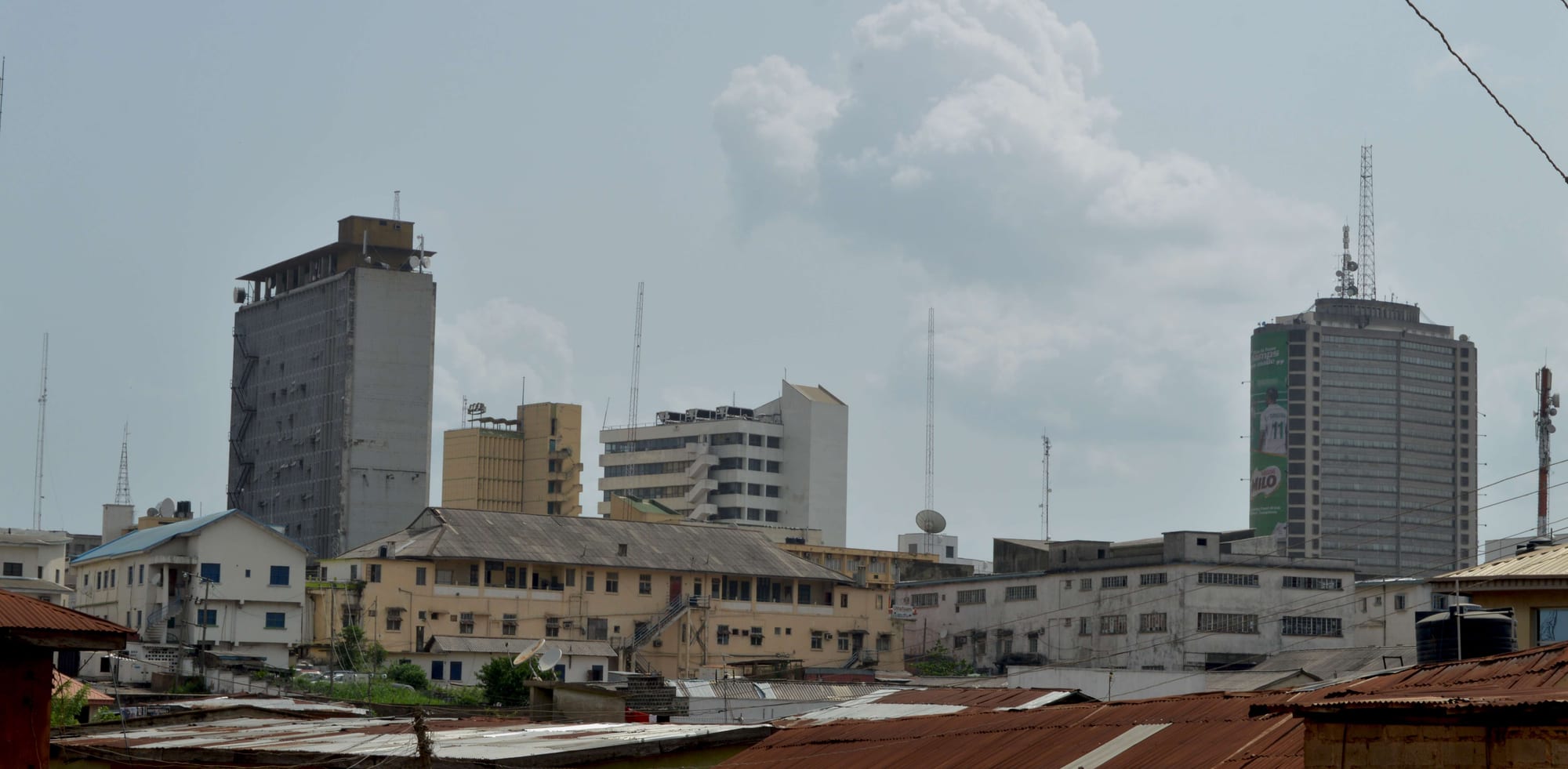
A tall office tower and several smaller concrete blocks rising behind low buildings and corrugated iron roofs, under a bright sky with a tall cloud

Lagos & the Southwest, Nigeria

Ibadan

The Cocoa House tower above the rusting roofs of central Ibadan. (Omoeko Media / Wikimedia Commons · CC BY-SA 4.0)

A large Yoruba city on a cluster of hills about 120 km inland from Lagos, founded as a war camp in the early 19th century and grown into one of the biggest cities in West Africa. Its low brown-roofed quarters spread for miles around a handful of landmarks — the Cocoa House tower, Bower's Tower, Mapo Hall and Nigeria's oldest university.

Neighbourhoods

  • Dugbe
    • First-time visitors
    • Markets
    • Close to public transport

    The colonial-era commercial centre, laid out around the railway and still the city's business heart. The Cocoa House stands here, the big Dugbe market spreads through the surrounding streets, and banks, printers and bookshops fill the blocks between.

    Open in Maps
  • Mapo and the old city
    • Historic district
    • Local life

    The original hill quarters around Mapo Hall and the Oja'ba market, where compounds of low houses with rusted roofs run down every slope. This is the oldest and densest part of Ibadan and the seat of its traditional chieftaincy.

    Open in Maps
  • Bodija
    • Best for food
    • Quiet and residential
    • Markets

    A planned residential estate north of the centre that has become one of the city's better-off districts, with wide streets, restaurants and the large Bodija market selling foodstuffs from across the region.

    Open in Maps
  • Agbowo and the university area
    • Students and nightlife
    • Quiet and residential

    The area along the Ibadan–Oyo road around the University of Ibadan, busy with students, bookshops, cheap eating places and hostels. The campus itself is wooded and calm, with its zoological garden and botanical grounds.

    Open in Maps
  • Jericho
    • Quiet and residential
    • Close to hospitals

    A leafy western district of government housing, clubs and clinics, developed from the colonial reservation. It sits close to Eleyele and makes a quiet base away from the noise of the central markets.

    Open in Maps

Things to do

Famous landmarks

  • Cocoa Houselandmark

    A 26-storey tower at Dugbe financed by cocoa earnings and commissioned in 1965, the first skyscraper in West Africa and the tallest building in Nigeria until 1979, still the symbol of the city.

    Open in Maps
  • Mapo Halllandmark

    The colonnaded colonial town hall of 1929, standing on Mapo Hill above the old quarters, used for civic ceremonies and looking out over the roofs.

    Open in Maps
  • Bower's Towerviewpoint

    A stone tower of 1936 on Oke Are hill, climbed by an internal staircase for the widest view over the city and the hills around it.

    Open in Maps
  • University of Ibadanlandmark

    Nigeria's first university, opened in 1948, with a wooded campus of modernist buildings, a zoological garden and a chapel and mosque facing each other.

    Open in Maps

Museums and culture

  • International Institute of Tropical Agricultureattraction

    A large agricultural research campus on the northern edge of the city, set in grounds with a lake and forest and visited for its birdlife.

    Open in Maps
  • Agodi Gardenspark

    A public park and botanical garden of some 61 hectares, with lawns, water features and a small zoo of monkeys, peacocks and turtles.

    Open in Maps

Markets

  • Bodija Marketmarket

    The city's main food market, where yams, grain, palm oil, peppers and dried fish arrive from across the southwest in bulk.

    Open in Maps
  • Dugbe Marketmarket

    A sprawling market of cloth, hardware and household goods filling the streets around the old railway station and the Cocoa House.

    Open in Maps

Short trips from the city

  • Ile-Ifeattraction

    The city Yoruba tradition treats as the place of creation, seat of the Ooni, with a palace and a museum holding copies and originals of its famous bronze and terracotta heads.

    Open in Maps
  • Oyoattraction

    The town founded when the old Oyo capital fell, seat of the Alaafin and known for its calabash carving and leatherwork.

    Open in Maps
  • Old Oyo National Parkpark

    A national park of wooded savanna protecting wildlife and the remains of Oyo-Ile, the walled capital abandoned in the 1830s.

    Open in Maps

Seasonal events

  • Egungun masqueradesmid-year, varying by family lineage

    Masquerades representing ancestral spirits appear in the old compounds, dancing to drums in heavy layered cloth.

  • Christmas and the December homecomingDecember

    The quietest traffic and the busiest social calendar of the year, when families return from Lagos and abroad for weddings, church services and parties.

Eat and drink

Long-standing places and food districts in Ibadan. Hours, ratings and directions come from your maps app, always current.

Ibadan classics

  • Amala joints around Mokola and Bodijaneighborhood

    Ibadan is the home of amala with ewedu and gbegiri, and the city's best-known kitchens are plain rooms serving it with goat meat, beef and stockfish.

    Open in Maps
  • Bodija Marketmarket

    Yams, palm oil, locust bean seasoning and dried fish sold in quantity, with cooked-food stalls along the edges.

    Open in Maps

Food streets

  • Dugbeneighborhood

    Buka canteens, bakeries and suya grills serve the office and market crowds around the Cocoa House.

    Open in Maps
  • Agbowo and the university gateneighborhood

    Student eating — rice and stew, beans and plantain, roasted corn in season and beer bars that fill after dark.

    Open in Maps

Experience Ibadan

History

Ibadan grew out of the wars that followed the collapse of the Oyo Empire. In 1829 a mixed force of Yoruba warriors from Oyo, Ife and Ijebu made camp among the hills at a spot already known as Eba Odan, "by the edge of the grassland", and the camp never dispersed. It became a republic of war chiefs rather than a kingdom, governed by titled soldiers who rose by achievement rather than birth — an unusual arrangement that still shapes the city's chieftaincy, in which senior chiefs advance through the ranks to the throne.

Through the 19th century Ibadan was the dominant military power of Yorubaland, checking the southward advance of the Sokoto Caliphate's forces at the battle of Osogbo in the 1840s and extending its own control over neighbouring towns. The long Kiriji war ended in 1886 under British mediation, and Ibadan came under British protection in 1893.

The railway from Lagos reached the town at the beginning of the 20th century and turned it into the trading centre of the cocoa belt; Dugbe grew around the station. Ibadan became the capital of the Western Region, and the wealth of the cocoa years paid for the University College in 1948, Mapo Hall, the Western Nigeria television service — the first in Nigeria, launched in 1959 — and the Cocoa House in 1965. It remained the regional capital until the creation of Oyo State in 1976 and is now one of the largest cities in Nigeria, still sprawling outwards along its roads.

Culture & Customs

Ibadan is proudly Yoruba and proudly unpolished: a city of warriors' descendants that likes to contrast its plain speech with Lagos glamour. Its chieftaincy system is followed closely in the local press, since the succession of the Olubadan and the senior chiefs runs by a ladder of titles rather than by family line, and installations fill the old quarters with drumming and processions.

The University of Ibadan gave the city a central place in Nigerian intellectual life. Wole Soyinka, Chinua Achebe, Christopher Okigbo and J. P. Clark all passed through it, the Mbari Club of the 1960s brought writers and artists together here, and the university, the research institutes and a long publishing tradition keep a scholarly tone unusual in a Nigerian city.

Music runs through everyday life, particularly the praise-singing traditions: juju, fuji and the older apala and sakara styles are played at parties and owambe celebrations, where guests wear matching aso ebi cloth. Egungun masquerades still appear in the old compounds, and the festivals of the old quarters fill them with drumming and processions. Respect for elders is strict, greetings are elaborate and unhurried, and a visitor who learns a few Yoruba greetings will be met warmly.

Daily Life

Estimates put about 4.3 million people in the metropolitan area, which covers some 3,080 square kilometres and makes Ibadan the largest city in Nigeria by land area; the built-up area keeps spreading north and east along the main roads. Almost everyone is Yoruba, with Muslims and Christians in roughly equal numbers.

Trade is the main business: Bodija and Dugbe supply food and goods to a wide hinterland, and thousands of small workshops make furniture, clothing and building materials. Government offices, the university, the teaching hospital and research institutes such as the International Institute of Tropical Agriculture employ many more, and cocoa, cassava and maize from the surrounding farmland still pass through the city.

Life divides between the old quarters, where extended families share compounds of low houses with rusted iron roofs, and the newer estates — Bodija, Akobo, Jericho, Oluyole — of bungalows behind gates. Mornings start early, markets run from dawn, and the afternoon heat slows everything before evening trading picks up again. Power cuts are constant and generators are standard in shops and homes. Flooding along the small rivers that cross the city has caused serious damage more than once, and the cost of food and fuel dominates conversation.

Food

Ibadan is the capital of amala, the dark, smooth swallow made from yam flour, and it is eaten here with a pair of soups poured together: ewedu, a green jute-leaf soup with a slippery texture, and gbegiri, a smooth soup of skinned beans, over which a red stew of peppers and palm oil is ladled with goat meat, beef, stockfish or cow skin called ponmo. Asking for amala "abula" means the whole combination in one bowl.

Beyond it, the city eats the wider Yoruba repertoire: pounded yam with egusi made from melon seeds, efo riro of leafy greens in palm oil, ofada rice from the forest belt served with a green pepper stew of assorted meats, and jollof rice at every celebration. Breakfast is akara bean fritters with pap, moin moin steamed bean pudding, or bread from the bakeries around Dugbe.

Roadside eating is good. Roasted plantain called boli is sold with groundnuts, maize is roasted over charcoal in season, and suya grills set up at dusk along the main roads. Palm wine comes in from the villages, and the local snack dodo Ikire, overripe plantain fried hard with pepper, is sold along the roads towards Osun State. Cold beer, zobo made from hibiscus and kunu from millet fill the bars.

Planning tools

Budget

Ibadan is markedly cheaper than Lagos. Hotel rooms, restaurant meals and taxis all cost less, and the city's food markets and buka canteens are among the cheapest places to eat in the southwest. The main expense for visitors is a car with a driver, since the city is very spread out.

Daily Budget Midrange
USD 70–150 (comfortable hotel, restaurant meals, a car with driver)
Daily Budget Shoestring
USD 25–50 (simple hotel or guesthouse, buka meals, shared taxis and keke tricycles)

Rooms and meals cost roughly half what they do in Lagos, so a night here can be a cheap break in a trip through the southwest.

Best Time to Visit

November to February, the dry season, is the most comfortable, with hazy harmattan mornings and cooler nights. March and April are hot before the rains arrive. The heaviest rain falls from June to July and again in September and October, when unpaved streets turn to mud.

Suggested Number of Days

One or two days are enough for the landmarks, the markets and the university. Three or four allow the old Yoruba towns north and east of the city as well. How much fits into a day depends mostly on traffic.

First Visit
1–2 days
With Surroundings
3–4 days

Transportation

Shared taxis, minibuses and keke napep tricycles cover the city, with okada motorbikes on shorter routes. App-based taxis operate but are less widespread than in Lagos. The city is large and low-rise, so almost every trip needs a vehicle, and the roads around the central markets are congested for most of the day.

Hiring a car with a driver for the day is the simplest way to see scattered sights, and fares in shared taxis are agreed before setting off.

Airport & Station Connections

Most visitors arrive by road from Lagos, about 120 km away on the Lagos–Ibadan expressway, which takes anything from two to four hours depending on traffic. A standard-gauge railway opened in 2021 runs the same route to a station at Moniya on the northern edge of the city. Ibadan also has a small airport with limited domestic flights.

Walkability

The old quarters around Mapo Hall and the market lanes are walkable and rewarding, as is the university campus, but the city as a whole is far too spread out to cross on foot. Pavements are patchy, open drains line many roads, and the hills make for steep going in the heat.

Safety

Ibadan is generally calmer than Lagos and violent crime against visitors is uncommon, but petty theft and phone snatching happen in crowded markets and in traffic. Roads are the main hazard, and rural highways in the wider region have seen robbery and kidnapping for ransom. Demonstrations can turn violent quickly.

Avoid road travel after dark, keep phones out of sight in traffic, use trusted drivers between cities and stay away from protests. Check current official travel advice before travelling.

Climate

Tropical and humid, a little less so than on the coast, with a long wet season and a dry season from November to March. Temperatures stay high all year and the harmattan brings dusty haze and cooler nights around January.

Summer
wet and humid, about 22–30°C, with heavy downpours in June and July
Winter
dry, about 21–34°C, hazy and cooler at night during the harmattan

Local Customs

This is a deeply Yoruba city, and greetings are taken seriously: younger people greet elders with a bow, and men traditionally by prostrating. Christianity and Islam are both strong and often found within one family, and traditional worship survives in the old quarters. Dress is modest away from the university area, and bargaining in markets is expected.

Ask before photographing people, shrines or market stalls, greet before asking for anything, and accept that a small tip is expected for guidance or parking help.

Common Payment Methods

The currency is the naira. Bank transfers and card payments through POS terminals work in hotels, supermarkets and larger restaurants, but markets, canteens and transport run on cash. Foreign cards are accepted less reliably than in Lagos, so bring naira from a city bank or US dollars to change.