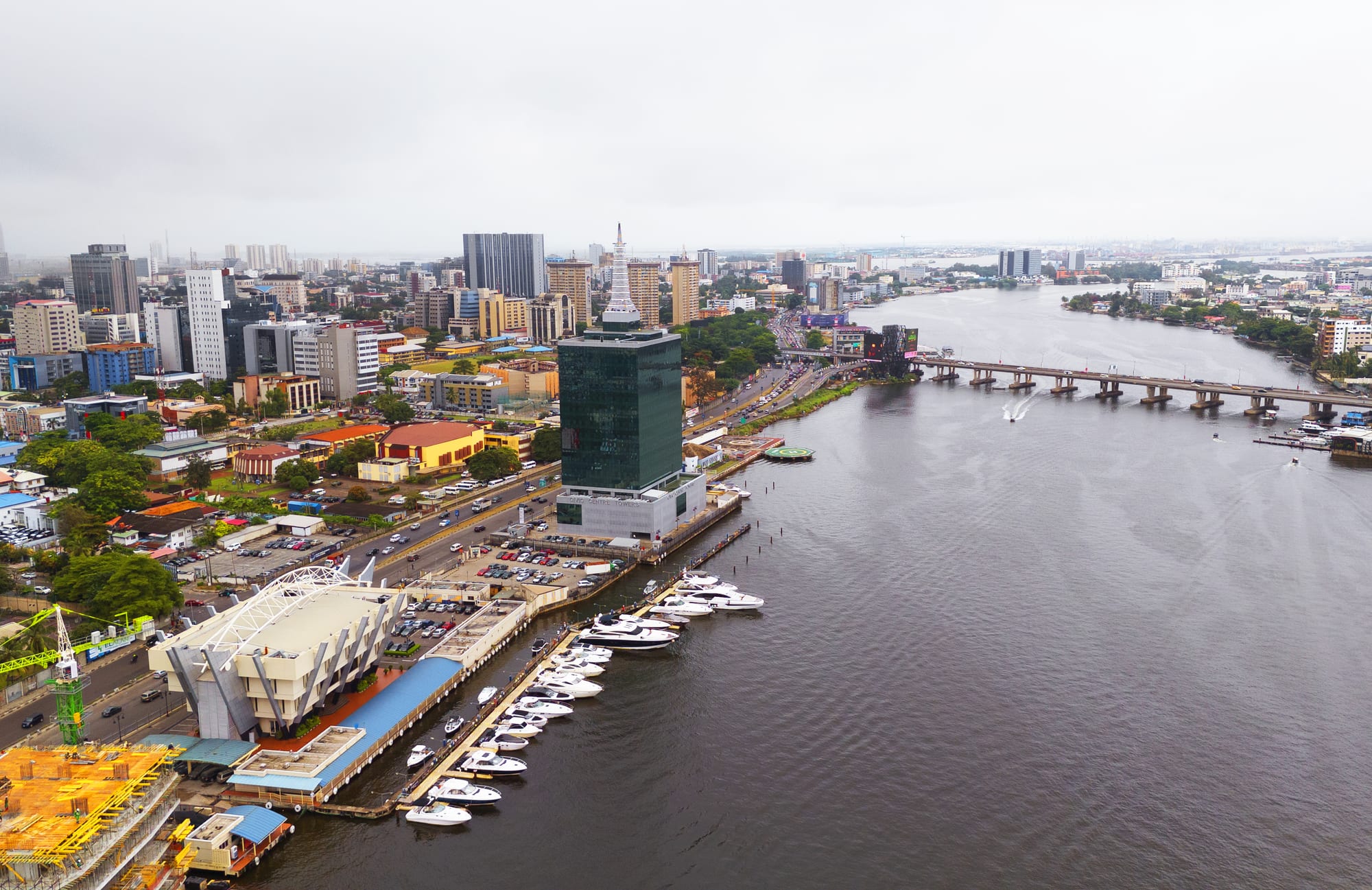
Aerial view of high-rise towers and low buildings along a wide grey waterway, with yachts moored at a marina and a long road bridge crossing in the distance

Lagos & the Southwest, Nigeria

Lagos

Victoria Island and its marina on the creek that divides it from Ikoyi in Lagos. (Ayorinde Ogundele / Wikimedia Commons · CC BY-SA 4.0)

Nigeria's largest city and commercial capital, built across a lagoon and a string of islands on the Atlantic coast of the southwest. A Yoruba settlement that became a British colony in 1861 and the national capital until 1991, it is now one of the world's biggest urban areas — a centre of banking, Nollywood, Afrobeats and art, famous equally for its energy and its traffic.

Neighbourhoods

  • Lagos Island
    • Historic district
    • Markets
    • First-time visitors

    The old town and the original colonial business district, packed with banks, churches, mosques and the trading streets around Balogun Market. The oba's palace, the national museum at Onikan and Freedom Park are all here, and the streets are dense, loud and best walked in the morning.

    Open in Maps
  • Victoria Island
    • First-time visitors
    • Best for food
    • Nightlife

    A reclaimed island east of Lagos Island that holds most of the city's offices, embassies, galleries and hotels. Restaurants and bars line Akin Adesola and Adeola Odeku streets, and the Atlantic beaches are a few minutes away.

    Open in Maps
  • Ikoyi
    • Quiet and residential
    • Architecture

    The greenest and most expensive part of Lagos, laid out with wide, tree-lined streets of colonial-era bungalows now being replaced by towers. It sits between Lagos Island and Victoria Island and is linked to Lekki by the Lekki-Ikoyi Link Bridge.

    Open in Maps
  • Lekki
    • Beaches
    • Nightlife
    • Modern development

    A long sand peninsula running east along the ocean, the fastest-growing part of the city. Gated estates, shopping malls, private beaches, the Lekki Conservation Centre and the Nike Art Gallery line the single main road, which is notorious for congestion.

    Open in Maps
  • Ikeja
    • Close to the airport
    • Local life
    • Music

    The capital of Lagos State, on the mainland beside Murtala Muhammed Airport. Government offices, the Computer Village electronics market and the New Afrika Shrine are here, along with many mid-range hotels used by travellers avoiding the island traffic.

    Open in Maps
  • Yaba and Surulere
    • Students and nightlife
    • Best for food
    • Local life

    Adjoining mainland districts either side of the university and teaching-hospital belt. Yaba has become the centre of the city's technology start-ups and has a large clothes market; Surulere is residential and is known for the national stadium and for its street food.

    Open in Maps

Things to do

Famous landmarks

  • Tinubu Squarelandmark

    An open square in the middle of Lagos Island, named after the 19th-century merchant and political figure Efunroye Tinubu, long a focus of public gatherings.

    Open in Maps
  • Cathedral Church of Christ, Marinalandmark

    The Anglican cathedral on the Marina, begun in 1924 and completed in 1946, the oldest Anglican cathedral in the Church of Nigeria.

    Open in Maps
  • Iga Idunganranlandmark

    The palace of the Oba of Lagos on Lagos Island, the seat of the city's traditional ruler since the 17th century.

    Open in Maps
  • Tafawa Balewa Squarelandmark

    A ceremonial square on the site of the old racecourse, redeveloped for the independence celebrations of 1 October 1960, framed by gates carrying huge sculpted horses and eagles.

    Open in Maps
  • Third Mainland Bridgelandmark

    The 11.8 km causeway across the lagoon linking the mainland to the islands, the longest bridge in Africa until 1996 and a daily bottleneck for commuters.

    Open in Maps
  • Lekki-Ikoyi Link Bridgelandmark

    The first cable-stayed bridge built in Nigeria, over the creek between Ikoyi and Lekki, commissioned in 2013 and lit at night, with a walkway used by joggers.

    Open in Maps
  • National Theatrelandmark

    A domed building at Iganmu shaped like a military cap, completed in 1976 for the FESTAC black arts festival and re-dedicated in 2025, after a long renovation, as the Wole Soyinka Centre for Culture and the Creative Arts.

    Open in Maps
  • Eko Atlanticneighborhood

    A district being built on land reclaimed from the Atlantic beside Victoria Island, behind a long sea wall intended to hold back coastal erosion.

    Open in Maps

Museums and galleries

  • Nigerian National Museummuseum

    The national collection at Onikan, founded in 1957, holding Nok terracottas, Benin royal regalia, Igbo-Ukwu bronzes and ethnographic material from across the country.

    Open in Maps
  • Freedom Parkpark

    The site of the colonial-era Broad Street prison on Lagos Island, converted into a walled garden and arts space with an amphitheatre, exhibitions and live music.

    Open in Maps
  • Nike Art Gallerymuseum

    A large private gallery in Lekki founded by the textile artist Nike Davies-Okundaye, with several floors of Nigerian painting, sculpture and adire cloth.

    Open in Maps
  • Kalakuta Republic Museummuseum

    Fela Kuti's former house in Ikeja, preserved with his rooms, clothes and records as a museum to the creator of Afrobeat.

    Open in Maps

Markets

  • Balogun Marketmarket

    The great cloth and goods market of Lagos Island, spilling from Balogun Street into the surrounding lanes and sold from stalls, shopfronts and head trays.

    Open in Maps
  • Computer Villagemarket

    A dense electronics market in the Otigba area of Ikeja where phones, parts and repairs are traded, described as the largest ICT accessories market in Africa.

    Open in Maps

Beaches, parks and the lagoon

  • Lekki Conservation Centrepark

    A 78-hectare reserve of protected coastal swamp forest in Lekki, established in 1990, with the longest canopy walkway in Africa above the trees, monkeys and birdlife.

    Open in Maps
  • Tarkwa Baybeach

    A sheltered beach on an island near the harbour mouth, reached only by boat from Victoria Island or the Marina, popular for swimming and surfing.

    Open in Maps
  • Makokoneighborhood

    A large waterfront community of houses on stilts above the lagoon, mainly of Egun fishing families, usually seen from the water with a local guide.

    Open in Maps

Music and nights out

  • New Afrika Shrineattraction

    The open-sided music hall in Ikeja run by Fela Kuti's family, successor to his original Shrine and the home of Felabration each October.

    Open in Maps
  • National Stadium, Surulereattraction

    The stadium built in 1972 for the All-Africa Games, for decades the home of the Super Eagles and of national athletics, left derelict from the early 2000s until renovation work began in 2022.

    Open in Maps

Short trips from the city

  • Badagryattraction

    A coastal town of heritage museums, a first-storey building of 1845 and the path across the creek to the beach known as the Point of No Return.

    Open in Maps

Seasonal events

  • FelabrationOctober

    A week of concerts at the New Afrika Shrine and across the city marking Fela Kuti's birthday, with performances by Afrobeat and Afrobeats musicians.

  • Eyo festivalirregular, announced in advance

    A procession of masquerades in white robes and broad hats through Lagos Island, held to honour a departed oba or chief rather than on a fixed date.

  • Detty DecemberDecember

    The end-of-year season when the diaspora returns and the city fills with concerts, festivals, beach parties and weddings.

  • Lagos International Jazz FestivalApril

    Concerts around International Jazz Day at venues across the city, mixing Nigerian and visiting musicians.

Eat and drink

Long-standing places and food districts in Lagos. Hours, ratings and directions come from your maps app, always current.

Markets and food streets

  • Balogun Market and the Lagos Island lanesmarket

    Between the cloth stalls, hawkers sell agege bread, roasted plantain, akara and bean pudding — the everyday eating of the old town.

    Open in Maps
  • Yaba street foodneighborhood

    Buka canteens and roadside grills around the market and the university serve amala with ewedu and gbegiri, ofada rice and suya after dark.

    Open in Maps
  • Lekki and Victoria Island restaurantsneighborhood

    The city's widest choice of sit-down dining, from Nigerian kitchens to Lebanese, Indian, Chinese and Italian places, concentrated along Adeola Odeku and the Lekki-Epe road.

    Open in Maps

Drinks and nights out

  • New Afrika Shrineneighborhood

    Fela Kuti's family's music hall, where pepper soup, grilled fish and beer are served at long tables while bands play.

    Open in Maps
  • Oniru and the Lekki beach barsneighborhood

    Grilled fish, asun and chapman are the standard order at the bars strung along the ocean beaches east of Victoria Island.

    Open in Maps

Experience Lagos

History

Lagos began as a Yoruba settlement on an island in the lagoon, settled by Awori people and known to them as Eko. From the late 15th century Portuguese traders reached the harbour and gave it the name Lagos, and the town grew as a port of the Kingdom of Benin's western reach, ruled by its own oba. In the first half of the 19th century it was one of the busiest slave-trading ports on the coast.

In 1851 a British naval force intervened in a dispute over the throne and bombarded the town; ten years later, in 1861, the oba ceded Lagos and it became a British colony. Freed slaves returning from Brazil and Cuba, the Amaro, settled in what became the Brazilian Quarter and left a distinctive architecture of storeyed houses with decorated facades, while Sierra Leonean Saro returnees formed an educated elite. Lagos became the capital of the colony of Nigeria and remained the national capital after independence in 1960.

The oil boom of the 1970s pulled in migrants from every part of the country and the city spread across the lagoon and the mainland far faster than any plan could follow. The federal capital moved to Abuja in 1991, but Lagos kept the banks, the ports and the media. Since the 2000s the state government has pushed large infrastructure schemes — bus lanes, bridges, urban rail and the reclaimed district of Eko Atlantic — while the population has continued to climb.

Culture & Customs

Lagos is the cultural motor of West Africa. Fela Kuti created Afrobeat here in the late 1960s and turned his Shrine into a platform against military rule; his sons Femi and Seun still perform in the family's New Afrika Shrine in Ikeja, and the city's studios now produce the Afrobeats sound of Wizkid, Burna Boy, Davido and Tems that fills clubs worldwide. Nollywood, one of the most prolific film industries anywhere, is largely made and screened here.

The art scene is strong and growing, with commercial galleries on the islands, the Nike Art Gallery's several floors in Lekki, an art fair each year and the arts programme at Freedom Park. Literature has deep roots too: much of modern Nigerian publishing runs through the city.

Traditional life continues alongside all this. The Oba of Lagos holds court at Iga Idunganran, the white-robed Eyo masquerades come out for the funeral rites of important figures, and Christian churches and mosques stand side by side, often within one family. Weekends belong to the owambe — the party for a wedding, birthday or funeral, where guests wear aso ebi in matching cloth, live bands play and money is sprayed over the dancers. Lagosians are direct, fast-talking and proud of the hustle their city demands, and Nigerian Pidgin is the language that crosses every group.

Daily Life

Lagos State counted about 9 million people at the 2006 census, and estimates in 2025 put the built-up city at between 17 and 21 million, making it the most populous urban area in Africa. Most residents live on the mainland — Ikeja, Agege, Mushin, Yaba, Surulere, Ajegunle — and many commute daily to the islands where much of the formal work is.

The economy is the most diversified in Nigeria: banking and fintech, the Apapa and Tin Can ports that handle much of the country's imports, oil company head offices, Nollywood, music, advertising and an enormous informal sector of traders, mechanics and artisans. The Dangote refinery on the Lekki coast has added heavy industry to the mix.

The day starts before dawn to beat the go-slow, and many people spend three or four hours a day in traffic. Generators run where the grid fails, water and drainage are uneven, and flooding after heavy rain is a recurring problem in a city built barely above sea level. Housing costs on the islands are extreme and the gap between them and the mainland is the city's defining social fact. Conversation since 2023 has turned on inflation, fuel prices and the cost of getting to work.

Food

Lagos eats everything Nigeria makes, and its own speciality is ewa agoyin: soft mashed beans served with a dark, oily fried-pepper sauce and agege bread, a dense white loaf sold in plastic wrappers. Amala, the dark swallow of yam flour, comes with ewedu, a slippery jute-leaf soup, and gbegiri made from beans, usually with goat meat or beef — the standard order in a buka, the no-frills canteen found on every mainland street.

Ofada rice, unpolished and local, is served with ayamase, a green pepper stew loaded with assorted meats and wrapped in leaves. Jollof rice appears at every celebration, and pounded yam goes with egusi, made from melon seeds, or efo riro, a stew of leafy greens in palm oil. Breakfast is often akara bean fritters, moin moin steamed bean pudding, or pap.

Evening belongs to the grills. Suya — thin beef skewers rubbed with the peppery spice mix yaji — is cut on newspaper at roadside stalls, and asun, smoked goat tossed with chilli and onion, is a bar staple. Fresh fish, croaker or tilapia, is grilled whole at the beach bars along the Lekki coast. To drink there is cold beer, palm wine from the countryside, zobo made from hibiscus, and chapman, the bittersweet red mixer that every Lagos bar makes its own way.

Planning tools

Budget

Lagos is the most expensive city in Nigeria. Hotel rooms on Victoria Island, Ikoyi and Lekki are priced for business travellers, restaurant bills there match European ones, and transport eats into a budget because distances are long and journeys slow. Street food, buka canteens, buses and shared transport remain very cheap, so two visitors can spend wildly different amounts in the same week.

Daily Budget Midrange
USD 110–290 (mid-range hotel on the islands, restaurants, app taxis or a car with driver)
Daily Budget Shoestring
USD 45–80 (simple mainland hotel or guesthouse, buka meals, BRT buses and shared taxis)

Staying near the day's business saves both money and hours in traffic, and eating where local office workers eat costs a fraction of the island restaurants.

Best Time to Visit

November to February, the dry season, is the most comfortable and the busiest socially, with December bringing concerts, festivals and returning diaspora. March and April are hot and humid before the rains. June and July bring the heaviest downpours and street flooding, and a shorter wet spell returns in September and October.

Suggested Number of Days

Two or three days cover the main areas of a city where most of the time goes on moving between them. Four or five allow the coast west of the city and the beaches reached by boat. Traffic, not distance, decides how much fits into a day.

First Visit
2–3 days
With Surroundings
4–5 days

Transportation

Yellow danfo minibuses and okada motorbikes carry most people, alongside a BRT bus network on dedicated lanes, ferries across the lagoon and two urban rail lines, the Blue Line along the Lagos–Badagry corridor, opened in 2023, and the Red Line on the mainland, opened in 2024. Visitors mostly use app-based taxis, which are widespread and cheap by international standards. Journeys across the bridges at rush hour can take hours.

Allow far more time than the distance suggests, travel between the mainland and the islands outside rush hour where possible, and treat okada motorbike taxis as risky, as several parts of the city restrict them.

Airport & Station Connections

Murtala Muhammed International Airport at Ikeja is one of the busiest in Africa, with long-haul flights from Europe, the Middle East and North America, wide African connections and a separate domestic terminal. It lies roughly 20 km from Victoria Island, which can mean anything from forty minutes to two hours by road. Long-distance buses run to every part of the country, and a standard-gauge railway links Lagos with Ibadan.

Walkability

Lagos is not a walking city as a whole, but parts of it work well on foot: the grid of Lagos Island between the Marina and the markets, the streets of central Victoria Island, and the Lekki-Ikoyi bridge walkway. Elsewhere pavements are missing or blocked, open drains line the roads and the distances are long. Crossing the bridges or moving between the mainland and the islands requires a vehicle or a ferry.

Safety

Lagos is the most visited part of Nigeria and most visits pass without incident, but street crime is real: robbery, phone snatching through car windows in slow traffic, and carjacking, particularly after dark. Scams targeting foreigners are common, and demonstrations can turn violent quickly. Flooding blocks roads after heavy rain, and photographing airports, bridges, military sites and police draws trouble.

Avoid road travel after dark, keep phones out of sight in traffic, use trusted drivers between cities and stay away from protests. Check current official travel advice before travelling.

Climate

Hot, humid and tropical all year, with little variation in temperature and a great deal in rainfall. The long rains run from about April to July, a drier spell usually follows in August, and a second wet season comes in September and October. Harmattan haze reaches the coast weakly between December and February.

Summer
wet and humid, about 24–30°C, with the heaviest rain and flooding in June and July
Winter
dry and warmer by day, about 25–33°C, sometimes hazy during the harmattan

Local Customs

Greetings matter and are never rushed; younger Yoruba traditionally greet elders with a bow, and men by prostrating. Both Christianity and Islam are practised seriously and dress in public is generally modest, though the islands are relaxed. Alcohol is sold freely. People are quick with a joke and hard bargaining in markets is normal and expected.

Ask before photographing people, markets or waterfront communities, never photograph soldiers, police, airports or government buildings, and expect small tips, known as a 'dash', for helpful service.

Common Payment Methods

The currency is the naira. Card payments through POS terminals and bank transfers are widely used in Lagos, more so than anywhere else in the country, but market traders, danfo conductors and small canteens want cash, and periodic cash shortages happen. Foreign cards are accepted less reliably and ATM withdrawal limits are low, so many visitors bring US dollars to change.