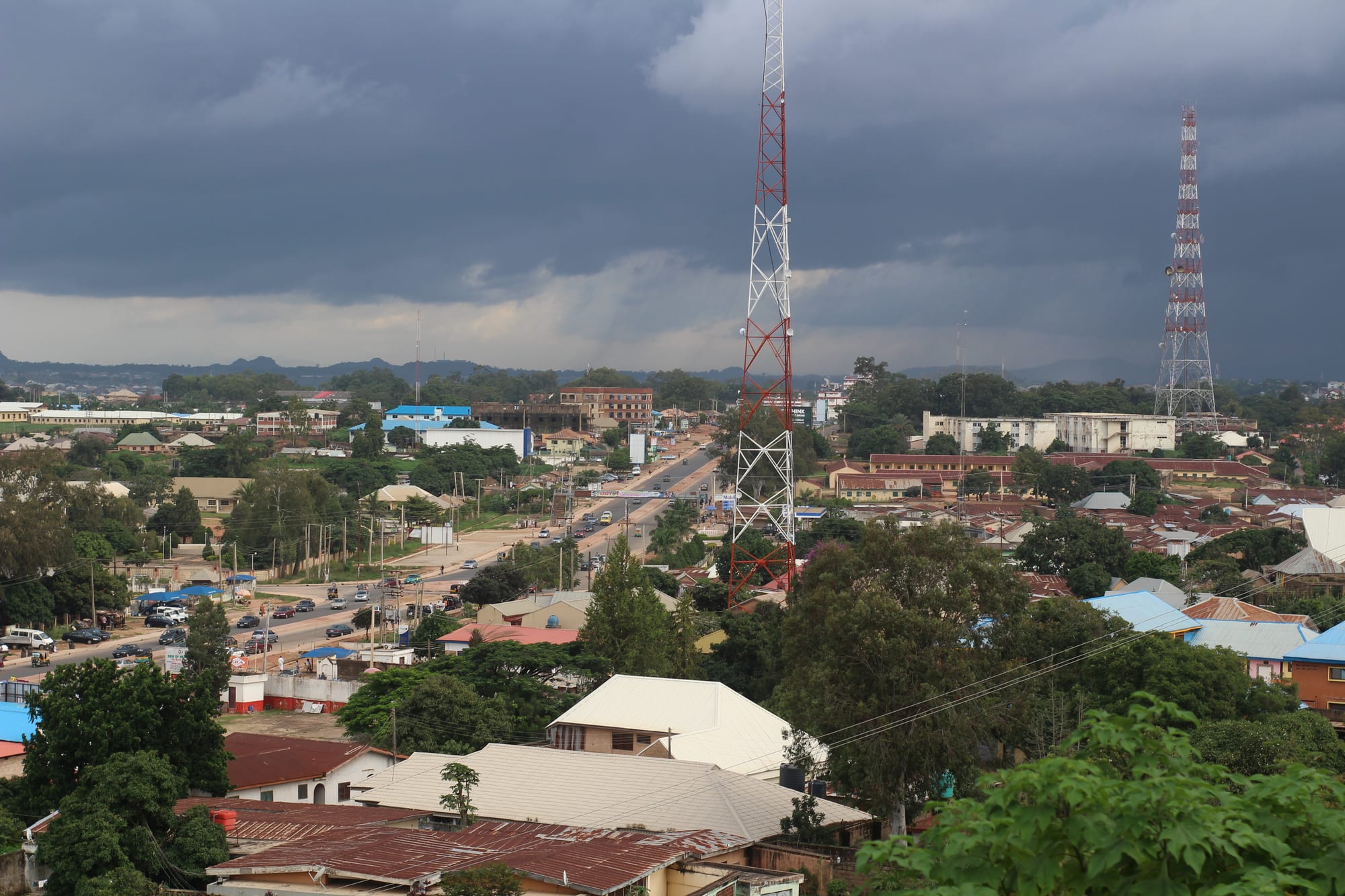
A low-rise African city of tin roofs and trees spreading towards distant hills, with two lattice masts rising above it under a dark storm sky

Abuja & the Middle Belt, Nigeria

Jos

Jos seen looking south over the city towards the hills of the Jos Plateau. (Daudajos / Wikimedia Commons · CC BY-SA 4.0)

The capital of Plateau State in central Nigeria, set on the Jos Plateau at around 1,200 metres, where the air is cooler than in most of Nigeria. Tin mining under British rule built the modern town from the early 20th century, leaving mining ponds around it. Its museum, rocky hills and wildlife park sit beside a city marked by intercommunal violence since 2001.

Neighbourhoods

  • The city centre and Terminus
    • First-time visitors
    • Markets
    • Close to public transport

    The commercial heart of Jos, named after the old railway terminus, where the main market area, banks, offices and transport parks are concentrated. It is busy and walkable in parts, with traffic and traders filling the main roads through the day.

    Open in Maps
  • Rayfield
    • Quiet and residential
    • Green surroundings

    A spread-out residential and government district in the south of the city, known for large compounds, gardens and old mining ponds. Several of the city's hotels and official residences are here, and it is quieter than the centre.

    Open in Maps
  • Bukuru
    • Local life
    • Markets

    A busy town south of Jos that has effectively merged with it along the expressway, with its own large market and a strong tin-mining past. It is the main centre of the Jos South area.

    Open in Maps
  • Naraguta and the university area
    • Students
    • Quiet and residential

    The northern edge of the city, where the University of Jos has its main campus. Student housing, small shops and eateries line the roads towards the older Naraguta settlement.

    Open in Maps

Things to do

Museums and history

  • Jos Museummuseum

    The national museum of Jos, established in 1952 by the archaeologist Bernard Fagg, best known for its terracotta figures of the Nok culture; it also administers the Museum of Traditional Nigerian Architecture, an open-air display of traditional building styles, and a pottery hall.

    Open in Maps
  • Jos Main Marketmarket

    The city's best-known market building, set up under the old Benue-Plateau State government and gutted by fire in 2002; it has not been rebuilt, but the trading streets around it in the centre remain the commercial focus of the plateau.

    Open in Maps

Parks and viewpoints

  • Jos Wildlife Parkpark

    A wooded park on the edge of the city holding Nigerian wildlife in enclosures and open ground, among granite boulders typical of the plateau.

    Open in Maps
  • Shere Hillsviewpoint

    A range of hills and rock formations about 10 kilometres east of the city, the highest ground on the Jos Plateau and a long-standing walking destination.

    Open in Maps
  • Jos Plateauviewpoint

    The upland that gives the city its cool air and its scenery of granite outcrops, old tin workings and high farmland.

    Open in Maps

The city

  • University of Joslandmark

    A federal university founded in the 1970s, whose campuses on the northern side of the city shape much of local student life.

    Open in Maps

Short trips from the city

  • Riyom Rocklandmark

    The balanced granite formations near the town of Riyom, south-west of Jos, where boulders stand stacked on top of one another.

    Open in Maps

Eat and drink

Long-standing places and food districts in Jos. Hours, ratings and directions come from your maps app, always current.

Markets and food districts

  • Jos main market area, Terminusmarket

    The central trading area of the city, where plateau produce — potatoes, carrots, cabbages, tomatoes and acha — is sold alongside grains, dried fish and spices.

    Open in Maps
  • Bukuru marketmarket

    The big market of the town south of Jos, busy with farm produce brought down from the surrounding plateau villages.

    Open in Maps
  • Restaurants around Rayfieldneighborhood

    The quieter southern district where many of the city's sit-down restaurants and hotel kitchens are found, serving both northern and southern Nigerian food.

    Open in Maps

Street food

  • Evening suya grillsrestaurant

    Charcoal grills set up along the main roads after dark, selling thin skewers of spiced beef dusted with peppery yaji, a northern Nigerian staple.

    Open in Maps

Experience Jos

History

The Jos Plateau was farmed and settled long before the modern city existed, by Berom, Anaguta, Afizere and other communities whose villages ring the site. The tin lay in the plateau's granites, and it was tin that brought the British. Prospectors arrived in the first years of the 20th century, mining companies followed, and a settlement grew beside the workings at Naraguta and then at the site of present-day Jos, which became the administrative and commercial centre of the tin field.

A railway reached the plateau under colonial rule, carrying ore to Lagos and Port Harcourt for export and giving the town its Terminus district; the line no longer carries traffic. Labourers came from across northern Nigeria and beyond, and the cool climate drew colonial officials and missionaries, who built schools, hospitals and rest houses. Open-cast mining stripped large areas and left the chain of ponds that still stand around Bukuru and Rayfield. When the industry declined after independence, Jos turned to administration, education and farming, and in 1976 it became the capital of the new Plateau State.

For decades the city had a reputation as one of Nigeria's most relaxed and mixed towns. That changed in 2001, when serious communal violence broke out, and further outbreaks followed over the years that came after, with attacks in the city and in rural parts of the state. Thousands of people have been killed across the state since then, and neighbourhoods that were once mixed have become more separated along religious lines. The city continues to function as the state capital and the plateau's commercial centre.

Culture & Customs

Jos sits on the fault line between Nigeria's Muslim north and Christian south, and its population reflects that: Berom, Anaguta and Afizere communities of the plateau, Hausa and Fulani families settled for generations, and migrants from every part of the country. Hausa is the common language of the street, English the language of offices and schools, and the plateau's own languages are spoken at home and in the villages around.

Music and broadcasting have deep roots here. The Nigerian Film Corporation and the national film institute are based in the city, and Jos has produced musicians and gospel groups known across the country, while local radio stations play a large part in daily life. Churches of every denomination and long-established mosques stand across the city, and the calendar is shaped by both Christian and Muslim festivals.

Plateau communities keep harvest celebrations, masquerade traditions and dances tied to the farming year, and the Nok terracottas displayed in the city's museum give the region a place in the wider story of West African art. Jos also has a strong sporting culture, with football followed closely and the hills used by runners and hikers. Manners are formal and unhurried: greetings come before business, elders are deferred to, and the subjects of land, religion and indigene status are approached carefully in a city where they carry political weight.

Daily Life

About 900,000 people lived in Jos at the 2006 census, and the city has grown since, with Bukuru and the settlements along the expressway forming a continuous built-up area. The city is a government town — the state secretariat, courts and agencies are among the largest employers — alongside the University of Jos, teaching hospitals, schools and a long list of colleges that draw students from across the north.

Farming underpins much of the economy. The plateau's cool climate suits potatoes, tomatoes, carrots, cabbages and strawberries, which are trucked to Abuja, Kano and Lagos, and acha, the small grain known in English as fonio, is grown here as almost nowhere else. Tin mining continues on a small, informal scale in the old fields, and trade, transport and services fill much of the rest of the working day.

Mornings begin early, with markets opening at first light and traffic building along the Bukuru expressway. Electricity supply is unreliable, so generators and increasingly solar panels are common, and water supply is uneven. The biggest issues facing residents are insecurity in the rural parts of the state, the displacement it has caused, the cost of food and fuel since 2023, and unemployment among a young and well-educated population.

Food

Jos eats from both halves of Nigeria. Northern staples are everywhere: tuwo, a stiff porridge of rice, maize or millet, eaten with miyan kuka made from dried baobab leaves; masa, small fermented rice cakes cooked in a dimpled pan; kosai, fried bean fritters; and suya, thin beef skewers rubbed with the peppery yaji spice mix and grilled over charcoal in the evenings. Southern dishes are equally common, from pounded yam and egusi soup to jollof rice and fried plantain.

What sets the plateau apart is its produce. Irish potatoes, cabbages, carrots, green beans, tomatoes and strawberries grow in the cool highland soils and appear on local plates far more than elsewhere in the country. Acha, or fonio, a tiny ancient grain, is cooked as a porridge or served like rice with soup and is closely associated with the region. Roasted maize and roasted yam are sold at roadsides in season.

To drink there is kunu, a lightly spiced millet drink, zobo made from dried hibiscus, fura da nono, balls of millet dough crumbled into fermented milk sold by Fulani women, and sweet tea served at small stalls. Plateau fruit — guavas, mangoes and citrus — is sold by the roadside, and the city's tea and coffee culture is stronger than in most of Nigeria.

Planning tools

Budget

Jos is considerably cheaper than Abuja. Local food, market shopping and shared transport cost little, and hotels are modest in price by Nigerian standards. The main expense for a visitor is a car with a trusted driver, which most arrangements for moving around the city and the plateau rely on.

Daily Budget Midrange
USD 90–180 (better hotel, restaurants, a car with driver)
Daily Budget Shoestring
USD 30–55 (simple hotel, local eateries, shared taxis and keke within the city)

Carry cash in naira, as card acceptance outside the larger hotels and supermarkets is limited, and agree the cost of a driver for the day in advance.

Best Time to Visit

November to February, the dry season, is the most comfortable, with warm days and genuinely cool nights, although the harmattan brings dust and can delay flights. The rains from April to October turn the plateau green and fill the waterfalls, and March and April are the hottest months.

Suggested Number of Days

The museums, the wildlife park and the city centre fit comfortably into one or two days. Adding the hills, rock formations and waterfalls of the plateau takes three or four, and depends heavily on arranging transport and on which rural areas are considered safe at the time.

First Visit
1–2 days
With Surroundings
3–4 days

Transportation

Shared taxis and minibuses run along the main roads, and three-wheeled keke napep are the common short-distance transport within the city. Motorcycle taxis have been restricted at times. Most visitors move around with a hired car and driver, and journeys along the Jos–Bukuru expressway carry the city's heaviest traffic.

Arrange transport through a hotel or a trusted local contact rather than hailing vehicles on the street, and avoid travelling on rural roads after dark.

Airport & Station Connections

Yakubu Gowon Airport serves the city, but domestic flights are intermittent, so many travellers fly to Abuja instead and continue by road, a journey of several hours. Long-distance buses and shared cars link Jos with Abuja, Kaduna, Bauchi and Makurdi.

Walkability

The centre around Terminus can be covered on foot, and distances between the market area, offices and transport parks are short. The rest of the city is spread out, with wide roads, heavy traffic and few pavements, so walking between districts is uncommon; the museum complex, the wildlife park and Rayfield all need a vehicle.

Safety

Jos and rural Plateau State have seen repeated intercommunal violence since 2001, and attacks on villages in the wider state have killed many people. The city has periods of calm and periods of tension, and a strong security presence, and governments advise against travel to parts of the zone. Ordinary urban crime, including robbery after dark, is also a risk.

Stay within central Abuja or travel with trusted local guidance, avoid rural areas of Benue, Plateau and Niger States, and never drive between cities at night. Check current official travel advice before travelling.

Climate

The plateau's altitude of about 1,200 metres makes Jos markedly cooler than the lowlands, with a single rainy season from about April to October and a dry season from November to March.

Summer
rainy season, roughly 16–27°C, with frequent afternoon storms and cool, damp evenings
Winter
dry and dusty harmattan, roughly 12–30°C, with hazy days and nights that can feel cold

Local Customs

Jos has large Christian and Muslim communities living in a city where religion and ethnicity are closely tied to local politics, so these subjects are handled with care in conversation. Greetings are unhurried and elders are addressed with respect. Modest dress is expected in both churches and mosques, and in the markets.

Ask before photographing people, markets, security posts or places of worship, and follow local guidance on which areas to visit. Tipping is not expected but small amounts are appreciated.

Common Payment Methods

The currency is the naira. Cash is the basis of daily spending, and small notes are useful in markets and for transport. Cards are accepted in larger hotels and supermarkets, bank transfers are widely used by residents, and ATMs in the centre often limit withdrawals on foreign cards.