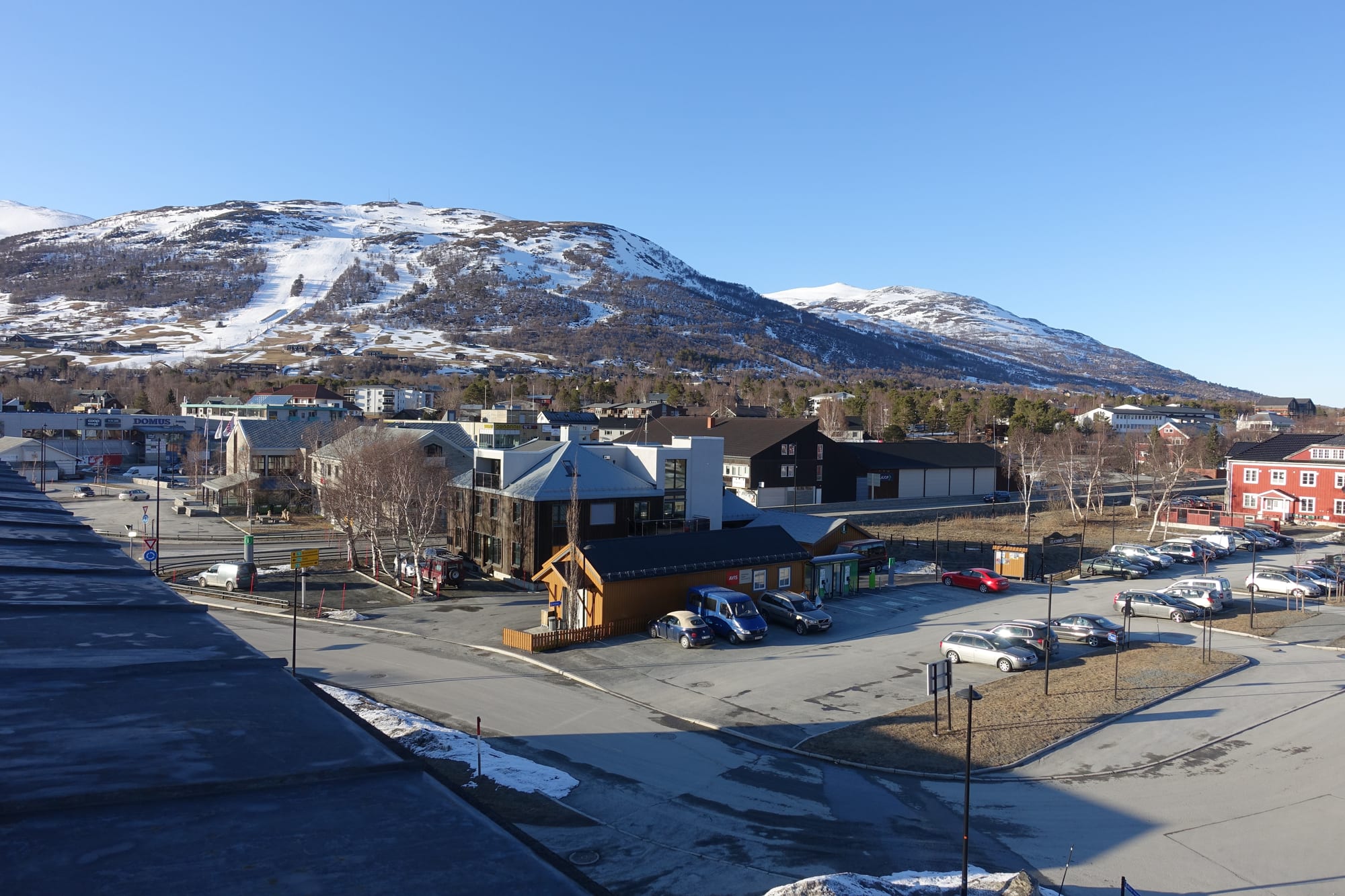
Low buildings and car parks in central Oppdal below a snow-streaked mountain with ski runs under a clear blue sky

Trøndelag, Norway

Oppdal

Central Oppdal beside the railway station in April, with the ski slopes on the mountainside behind. (Wolfmann / Wikimedia Commons · CC BY-SA 4.0)

A mountain village of about 4,600 people in the south of Trøndelag, at the meeting of the roads from Trondheim, the Dovre Mountains and the west coast. Iron Age farms and a pilgrim route made it; since the first ski lift opened in 1952 it has become one of Norway's main winter-sport resorts, ringed by national parks.

Neighbourhoods

  • Oppdal centre
    • First-time visitors
    • Close to public transport

    The compact commercial centre where the E6 and the road to Kristiansund meet, around the railway station on the Dovre line. Shops, a mall, the municipal offices and the bus station are here, and the village museum lies a short walk away.

    Open in Maps
  • Vangslia and the ski slopes
    • Skiing
    • Hiking

    The mountainside on the north side of the village, where the lifts of the ski centre start. Vangslia is the main entrance to the slopes, and the older Hovden lift sits within walking distance of the centre; cabins and holiday flats spread up the hillside.

    Open in Maps
  • Vang
    • Historic district
    • Quiet and residential

    The farm district just west of the village along the road to the coast, with the white wooden Oppdal Church of 1651 and a large field of Iron Age and Viking Age grave mounds among the fields.

    Open in Maps

Things to do

In the village

  • Oppdal Churchlandmark

    A white cruciform wooden church at the Vang farm, built in 1651 to replace an earlier stave church and the main church of the parish.

    Open in Maps
  • Vang burial fieldlandmark

    Remains of more than 700 pagan grave mounds, where jewellery and other objects from the British Isles have been found — evidence that Viking-Age Oppdal took part in long-distance trade.

    Open in Maps
  • Oppdal Village Museummuseum

    An open-air museum of about 30 buildings showing farm life from the late 16th to the mid-20th century, with collections on skiing, schools and hunting and fishing gear.

    Open in Maps
  • Oppdal Stationtransit hub

    The station on the Dovre line, opened in 1921 when the railway was extended from Dombås to Trondheim — the line that opened the valley to tourism.

    Open in Maps

Skiing and the mountains

  • Oppdal Ski Centerattraction

    Norway's largest ski resort by area, spread over five areas and four mountains with about 56 km of runs; its first slope, at Hovden, opened in 1952.

    Open in Maps

Short trips from the town

  • Gjevillvatnetpark

    A lake in the Trollheimen range, in a valley regarded as one of the most scenic in Norway, with hiking and cross-country ski trails and a cruise boat in summer.

    Open in Maps
  • Dovrefjell–Sunndalsfjella National Parkpark

    A mountain national park of about 1,690 square kilometres around Snøhetta, home to wild reindeer and the musk oxen brought to Dovrefjell in 1947.

    Open in Maps
  • Trollheimentrail

    The mountain range west of the village, whose south-eastern part lies within Oppdal and which is crossed by marked hiking routes between mountain huts.

    Open in Maps

Seasonal events

  • Ramaskrikautumn

    A horror film festival held each autumn at the village's culture house, named in 2018 among the world's best genre film festivals by MovieMaker Magazine.

  • Constitution Day17 May

    Norway's national day, celebrated with parades and national dress — and in Oppdal not unusually with snow on the ground.

Eat and drink

Long-standing places and food districts in Oppdal. Hours, ratings and directions come from your maps app, always current.

Oppdal classics

  • Soddrestaurant

    Trøndelag's traditional soup: cooked mutton and meatballs of lamb or beef in a clear broth, with potatoes and carrots boiled separately and added at the table.

    Open in Maps
  • Karskcafe

    The Trøndelag drink of coffee mixed with home-distilled spirit, sometimes with a spoon of sugar.

    Open in Maps

Food districts

  • Oppdal centreneighborhood

    The cafés, restaurants and supermarkets around the station and the main road, busiest in the ski season.

    Open in Maps

Experience Oppdal

History

Oppdal was first settled some time before 600 CE, and by then there were about 50 farms in the valley, with around 20 more added in the Viking Age. The more than 700 grave mounds at Vang, which have yielded jewellery and other objects from the British Isles, show a community that was relatively wealthy and took part in Viking trade, much of its prosperity probably coming from game; reindeer trapping ditches can still be seen in the surrounding mountains. The name comes from the old Oppdal farm, Uppdalr in Old Norse, meaning the upper valley.

The valley lay at a crossroads of routes from Trondheim, the Dovrefjell mountains and the west coast, and in the Middle Ages it was a stop for pilgrims walking to St Olav's shrine at Nidaros. King Eystein had mountain stations built along the route to give them food and shelter. The Black Death hit Oppdal particularly hard: farms were abandoned, and long afterwards only 35 farms and about 350 people remained. People were still dying of hunger as late as 1742.

Fortunes turned in the 17th century. By 1665 about 2,200 people lived here, and the present church at Vang had been built. Population growth in the 19th century outstripped the land, and many emigrated to the United States, until the Dovre railway, completed in 1921, brought jobs and tourists. During the Second World War Oppdal was one of the locations of the German prisoner-of-war camp Stalag 380. The first ski lift opened in 1952, beginning the growth of today's resort, and in 2018 the municipality became part of the new Trøndelag county.

Culture & Customs

Oppdal's identity is rooted in farming and the mountains. The local dialect is central to the work of the writer Inge Krokann, who was born here, and the village has produced a composer, a jazz bassist, a sculptor and a number of cross-country skiers and curlers. The coat of arms, three white triangles meeting in a Y, is nicknamed vegamot, the meeting of ways, after the three roads that join here — a reminder that the valley has always been a gathering place.

Since the 18th century the community has invested heavily in education, building small rural schools and, more recently, a high school, and archaeological finds suggest less pronounced economic divisions here than elsewhere in Norway, with communal efforts to share burdens through hard centuries. Oppdal lies on the Nidaros Path, the pilgrim road to Trondheim.

Winter sport shapes the calendar, with the ski centre at the heart of village life from winter into spring. Each autumn the culture house hosts Ramaskrik, a horror film festival with an international reputation. Constitution Day on 17 May is celebrated as everywhere in Norway, often with snow on the ground.

Daily Life

About 4,600 people live in the village (2024) and about 7,400 in the whole municipality, one of the largest in Norway by area and mostly mountainous, with large areas above the tree line. The population of the municipality has grown in recent years. The village is the administrative centre, with the municipal offices, a school, a mall and shops around the station and the E6.

The main industries are agriculture, tourism and some light manufacturing, and there is a slate quarry. Oppdal has the largest sheep population of any municipality in Norway: about 45,000 sheep are put out to graze in the mountains each summer on heather and alpine meadows. Around 1,161 square kilometres of mountain have been held since time immemorial as a common by local farmers, giving them the right to hunt, fish and rent out cabins.

The year divides into the ski season, when the slopes and holiday cabins fill, and the summer grazing and hiking season. The local newspaper, Opdalingen, first published in 1934, covers Oppdal and neighbouring Rennebu three times a week. In 2001 the municipality's drinking water was named the best in Norway.

Food

Oppdal shares the food of Trøndelag. The region's festive dish is sodd, a soup of cooked mutton with meatballs of lamb or beef in a clear, fragrant broth; in the proper way of serving, the potatoes and carrots are boiled separately and added at the table, where everyone plates their own. It is served on festive occasions such as weddings and confirmations.

The other Trøndelag classic is karsk, a drink of coffee and home-distilled spirit, sometimes with a spoon of sugar. Tradition has it that a coin is placed in the cup, coffee poured in until the coin disappears, and spirit added until it can be seen again — although in practice the coin stays hidden.

With about 45,000 sheep on its summer pastures, Oppdal is sheep country. Norway's traditional breads include lefse and flatbrød. In the village itself, eating out centres on the cafés and restaurants around the station and the main road, which are busiest in the ski season.

Planning tools

Budget

Oppdal is priced like the rest of Norway. Accommodation costs most in the ski season, around winter holidays and Easter, and lift passes and ski hire add to a winter trip; summer, when hiking and the mountains are free, is the cheaper time. Supermarkets in the centre keep self-catering in cabins manageable.

Daily Budget Midrange
USD 210–400 (hotel or rented cabin, restaurant dinners, lift pass or a guided mountain trip, a hire car)
Daily Budget Shoestring
USD 85–140 (campsite or cabin share, supermarket food, local buses and trains)

Self-catering in a cabin is the usual way to keep costs down; the Hovden lift can be reached on foot from the centre without a car.

Best Time to Visit

Winter and spring for skiing, when the lifts are running and snow can last into May. Summer suits hiking in Trollheimen and the Dovrefjell mountains, musk-ox safaris on the plateau and the lake boat on Gjevillvatnet, though it is also the wettest season. Autumn brings the Ramaskrik film festival.

Suggested Number of Days

Two or three days cover the village and a taste of the mountains. Skiing holidays and hiking trips usually run to a week, and anyone heading into the national parks needs extra days, depending on the weather.

First Visit
2–3 days
With Surroundings
4–6 days

Transportation

The village centre is small and walkable. A ski bus serves the slopes in winter, buses run along the main roads and partly connect with the trains, and a car makes it far easier to reach the lakes, valleys and trailheads. The E6 runs through the centre and National Road 70 leads west towards Kristiansund.

Winter tyres and care on icy mountain roads are essential; watch for moose and reindeer on country roads, especially in the dark months.

Airport & Station Connections

Most visitors arrive by train or car. Oppdal Station is on the Dovre line between Oslo and Trondheim, served by express trains in both directions and by a few commuter trains to Trondheim. By road, the E6 crosses the Dovre Mountains from the south and continues north to Trondheim. The main airport for the region is Trondheim's at Værnes.

Walkability

The centre is compact and flat enough to walk, with the station, shops, museum and the Hovden lift close together. Vang and the church lie a little way west along the main road, and the wider ski area and the mountain trailheads need a car, the ski bus or a long walk.

Safety

Norway has among the lowest crime rates in the world. In Oppdal the hazards are the mountains: changeable weather, avalanches on steep slopes off the groomed runs, cold and icy roads in winter, and musk oxen on Dovrefjell, which can be dangerous if approached.

Keep a wide distance from musk oxen, check the weather and avalanche forecasts before mountain trips, and drive slowly on icy roads. Check current official travel advice before travelling.

Climate

A boreal climate, slightly continental, with spring the driest season and summer the wettest. Annual precipitation is only about 600 mm, and for an inland place at around 600 metres above sea level the winters are fairly mild — but long, and snow on the 17 May national day is not unusual.

Summer
the wettest season; the highest temperature on record is 30.1°C, in July 2019
Winter
long and snowy but fairly mild for the altitude; the record low is −26.1°C, from February 2010

Local Customs

Oppdal is a farming and resort community with its own dialect, used by the writer Inge Krokann. Norway is informal and egalitarian, the right to roam allows walking on uncultivated land, and alcohol is sold through a state monopoly and is expensive. Close farm gates and keep dogs under control in summer, when large flocks of sheep graze the mountains.

Give grazing sheep, reindeer and musk oxen a wide berth, and leave trails and huts as they were found.

Common Payment Methods

The currency is the Norwegian krone (NOK). Norway is close to fully cashless: cards and the Vipps app are used for everything, although staffed shops have been required by law to accept cash since October 2024. A contactless Visa or Mastercard works everywhere.