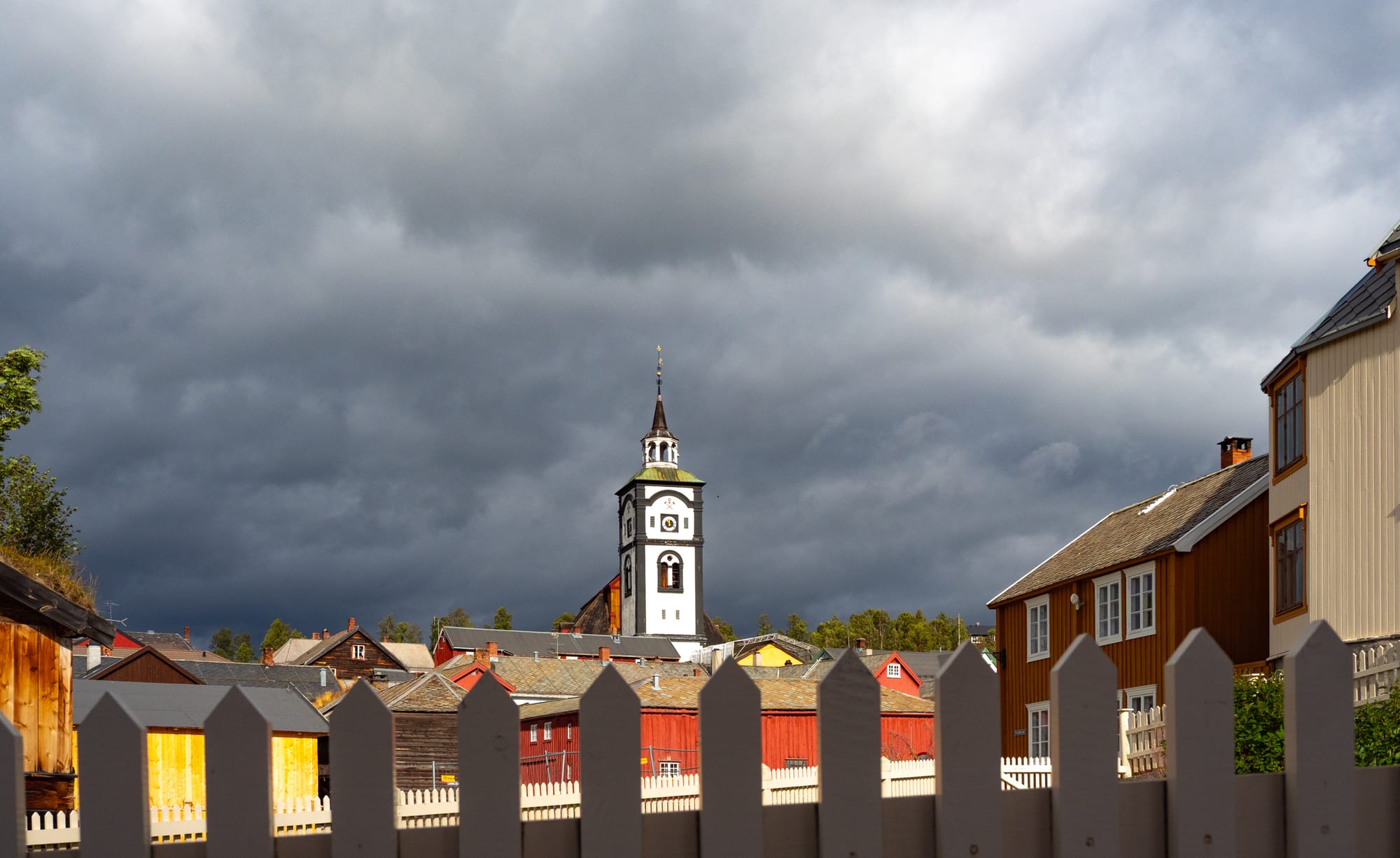
Red, brown and yellow wooden houses behind a white picket fence, with Røros church's white tower under dark storm clouds

Trøndelag, Norway

Røros

Old wooden houses in Røros, with the tower of Røros Church of 1784 rising behind. (Sivbenteu / Wikimedia Commons · CC0)

A small copper-mining town on a high plateau in eastern Trøndelag, near the Swedish border, where mining ran for 333 years until 1977. Its streets of dark log houses, slag heaps and the white stone church of 1784 have been a UNESCO World Heritage Site since 1980, and people still live and work in the old buildings.

Neighbourhoods

  • Bergmannsgata and Kjerkgata
    • First-time visitors
    • Historic district
    • Cafés

    The two main streets of the old mining town, called Storgata and Litjgata in the local dialect, climbing towards the church. Large timber merchants' and officials' houses with courtyards line them, many of them still homes, shops, galleries and cafés.

    Open in Maps
  • The smelting works and slag heaps
    • Museums
    • Industrial heritage
    • Photography

    The lower end of town along the little river Hyttelva, where a rebuilt copy of the old smelting works stands beside the grey slag heaps left by three centuries of copper production, with small miners' houses nearby.

    Open in Maps

Things to do

The mining town

  • Røros Churchlandmark

    Bergstadens Ziir, 'the ornament of the mining town', an octagonal whitewashed stone church of 1784 paid for by the mining company, with around 1,600 seats one of the largest churches in Norway.

    Open in Maps
  • Smelthyttamuseum

    A copy of the old smelting works, rebuilt on its site after the original burned down in 1975, which has housed the Røros Museum's collections since 1988.

    Open in Maps
  • Bergmannsgataneighborhood

    The broad main street of the town, lined with large log buildings from the 17th and 18th centuries.

    Open in Maps

Mines and the plateau

  • Olavsgruvaattraction

    Olav's Mine, a copper mine outside the town that worked until 1972–73, now one of the Røros Museum's visitor sites.

    Open in Maps
  • Aursundenattraction

    A lake about 22 kilometres long in the municipality, often cited as the source of the Glomma, Norway's longest river, with villages along both shores.

    Open in Maps

Short trips from the town

  • Femundsmarka National Parkpark

    A national park formed in 1971 beside Femunden, the second-largest natural lake in Norway, popular for canoeing and fishing.

    Open in Maps
  • Forollhogna National Parkpark

    An area of gentle mountains with summer farms still in use, an important range for wild reindeer.

    Open in Maps

Seasonal events

  • Rørosmartnanlate February

    The winter market, first held in 1854, which runs from the second-to-last Tuesday of February to the Saturday, opens with the arrival of around 80 horse-drawn sleds and draws tens of thousands of visitors.

  • Eldenlate July to early August

    An outdoor musical theatre performance staged every summer since 1994, recalling the Swedish soldiers who froze to death in the mountains in the winter of 1718–19.

  • Christmas marketDecember

    The town's Christmas market, held in December.

Eat and drink

Long-standing places and food districts in Røros. Hours, ratings and directions come from your maps app, always current.

Røros classics

  • Reindeer and mooserestaurant

    Reindeer and moose meat are the town's own specialities.

    Open in Maps
  • Cafés in the old townneighborhood

    Cafés and small food shops in the old houses of Bergmannsgata and Kjerkgata, where local bread, cheeses, cold cuts and gravlaks make a typical meal.

    Open in Maps

Experience Røros

History

Before the mines, the plateau around Røros was used by the Southern Sámi for reindeer herding, with only scattered settlement. In 1644 permission was given to work a copper lode in the mountains nearby, and in 1646 the town was granted royal privileges as a bergstad, a mining town, with rights over a circle of land around the first mine known as the Circumference. Røros and the silver town of Kongsberg are Norway's only two historic mining towns of this kind.

The young town suffered in the wars with Sweden. Swedish troops burned it in 1678 and 1679, and in 1718 General De la Barre seized it and its copper. When King Charles XII was killed that winter, the Swedish army retreated across the mountains north-west of Røros, and more than 3,000 soldiers died in the cold. From 1740 several mines yielded well, and the copper works entered its greatest period. The smelters consumed so much wood and charcoal that much of the forest on the plateau was cut down. Dynamite arrived in 1870, the Røros Line railway in 1877 and electric power for the mines in 1897.

Johan Falkberget's novels made the miners known to all Norwegians at the start of the 20th century, telling the town's story from the bottom of the social ladder. Mining ended in 1977 after 333 years. The town was added to the World Heritage list in 1980, and the listing now covers the whole of the mining town and the Circumference.

Culture & Customs

Røros lives with its history in plain sight. About 80 historic wooden houses survive, most of them built around courtyards, and many keep their dark pitch-coated log walls. The church of 1784, Bergstadens Ziir, "the ornament of the mining town", was paid for by the mining company and belonged to it until 1865, when it became public property. Locally the two main streets, officially Bergmannsgata and Kjerkgata, are called Storgata and Litjgata.

The year turns on two events. Rørosmartnan, the winter market first held in 1854, opens in late February with the arrival of around 80 horse-drawn sleds and draws tens of thousands of visitors to its market and cultural events. In summer Elden, an outdoor musical theatre staged every year since 1994, remembers the Swedish soldiers who froze to death in the winter of 1718–19. A Christmas market is held in December.

Røros is also part of the Southern Sámi homeland: the town's Sámi name is Plaassja, and in 2022 the municipality was given the co-official Sámi name Rosse. Artists and craftspeople are numerous, selling pottery, handicrafts and reindeer and sheep skins. The town has served as a film location, among others for Joseph Losey's version of Ibsen's A Doll's House and for the Swedish television series about Pippi Longstocking.

Daily Life

The town had 3,909 inhabitants in 2024, and the whole municipality about 5,700, spread over a large area of plateau, lakes and mountains. Many people still live and work in the 17th- and 18th-century buildings that make up the World Heritage town, so the old streets are a working community rather than an open-air museum.

With the mines closed, visitors arrive by the railway and by a small airport with flights to Oslo, and the Røros Museum's sites draw about 70,000 visits a year. The area has long been used by the Southern Sámi for reindeer herding, and the museum also cares for Southern Sámi cultural history.

Life here is shaped by altitude and cold. The town sits at about 630 metres on a gently sloping plateau of birch and pine near the tree line, and winters are long: snow lies on the ground from December into April, and the cold can be severe. In compensation the snow lasts well into spring, and the lakes of Aursunden and Femunden draw people out to canoe and fish in summer.

Food

Røros eats like a mountain town. Reindeer and moose meat are the local specialities, and a typical local meal is fresh bread with local cheeses, cold cuts and gravlaks. Local produce ranges from herbs, fish and game to cheeses, and the organic tjukkmjølk of Rørosmeieriet, a thick soured milk, carries a protected geographical name.

Regional dishes from Trøndelag appear here too. Sodd, a soup of cooked mutton and small meatballs of lamb or beef in a clear broth, with potatoes and carrots boiled separately and added at the table, is the region's festive dish. Karsk, coffee laced with moonshine and sometimes a spoonful of sugar, comes from Trøndelag as well.

Brown cheese, the sweet caramel-coloured whey cheese, is popular on Norwegian waffles. The cafés and small food shops in the old houses of Bergmannsgata and Kjerkgata are the places to find local bread and cheese. During Rørosmartnan in February, old dance music fills the town's cafés and venues from early in the day until late at night.

Planning tools

Budget

Røros is priced like the rest of Norway, and busiest and dearest during Rørosmartnan in February and the Christmas season in December, when rooms are scarce. The old town itself costs nothing to walk around; the mine tour and museum are the main paid sights.

Daily Budget Midrange
USD 210–380 (guesthouse or hotel, restaurant dinners, the mine tour and museum)
Daily Budget Shoestring
USD 85–140 (hostel, cabin or campsite, supermarket food, trains and buses)

Book months ahead for Rørosmartnan and December, and bring proper winter clothing rather than buying it locally.

Best Time to Visit

Two seasons suit Røros. Summer brings green plateau walks, lakes for canoeing and fishing, and the Elden performance. Winter is reliably cold and snowy, with the Christmas market in December, Rørosmartnan in late February and snow on the ground from December to early April.

Suggested Number of Days

A day or two covers the town, the church, the smelting works and the mine. Three or four days allow for the lakes, the national parks and longer hikes or ski tours on the plateau. Snow, cold and short winter days slow everything down.

First Visit
1–2 days
With Surroundings
3–4 days

Transportation

The town is small and walkable. Røros Station is on the Røros Line, which runs down the Gauldal valley towards Trondheim and south through Østerdalen to Hamar. Road 30 runs north towards Trondheim, and road 31 runs east to Sweden. A car is needed for the lakes and the national parks.

Take the train from Trondheim for the valley scenery; in winter drive slowly, as inland roads are often icy.

Airport & Station Connections

Røros Airport, 2 kilometres from the town, has scheduled flights to Oslo. Trains on the Røros Line connect the town with Trondheim and with Hamar, where there are connections to Oslo; there are no longer through trains to Oslo on the line. By road, the drive from Trondheim is about 150 kilometres.

Walkability

Excellent: the historic town is compact, and the two main streets, the church, the smelting works and the station are all a short walk apart. Streets slope gently up towards the church, and in winter they are packed with snow and ice for months.

Safety

Norway has among the lowest crime rates in the world. Røros is one of the coldest places in southern Norway, and severe cold is the real hazard: temperatures far below −20°C are possible in winter, and roads are often icy. Moose and reindeer on the roads are a risk in the dark.

Dress for severe cold between December and March, carry extra layers on the plateau even in summer, and drive slowly on icy inland roads. Check current official travel advice before travelling.

Climate

A subarctic climate on a plateau at about 630 metres, sheltered from the sea. Røros holds the record for the lowest temperature in the southern half of Norway, −50.3°C in January 1914. Snow on the ground is virtually guaranteed from December to early April, and the deepest recorded was 200 centimetres, in March 1956.

Summer
short and mild — the warmest month on record, July 2014, averaged 16°C, and the highest temperature recorded is 30.7°C, in July 2008
Winter
reliably and severely cold — even the mildest January on record, in 1973, averaged −2.8°C, and the town recorded −42°C as recently as January 2010

Local Customs

The old town is a lived-in World Heritage Site: most of the historic houses are private homes, and visitors keep out of courtyards unless they are open. Røros is part of the Southern Sámi homeland, and its Sámi name, Plaassja, sits beside the Norwegian one. Norwegian manners are egalitarian and understated.

Ask before photographing people, reindeer herds or Sámi gatherings; drinks stronger than 4.75 per cent alcohol are sold only by the state Vinmonopolet.

Common Payment Methods

The currency is the Norwegian krone (NOK). Norway is close to cashless: cards, contactless payment and the Vipps app, Norway's largest payment application, are widely used.