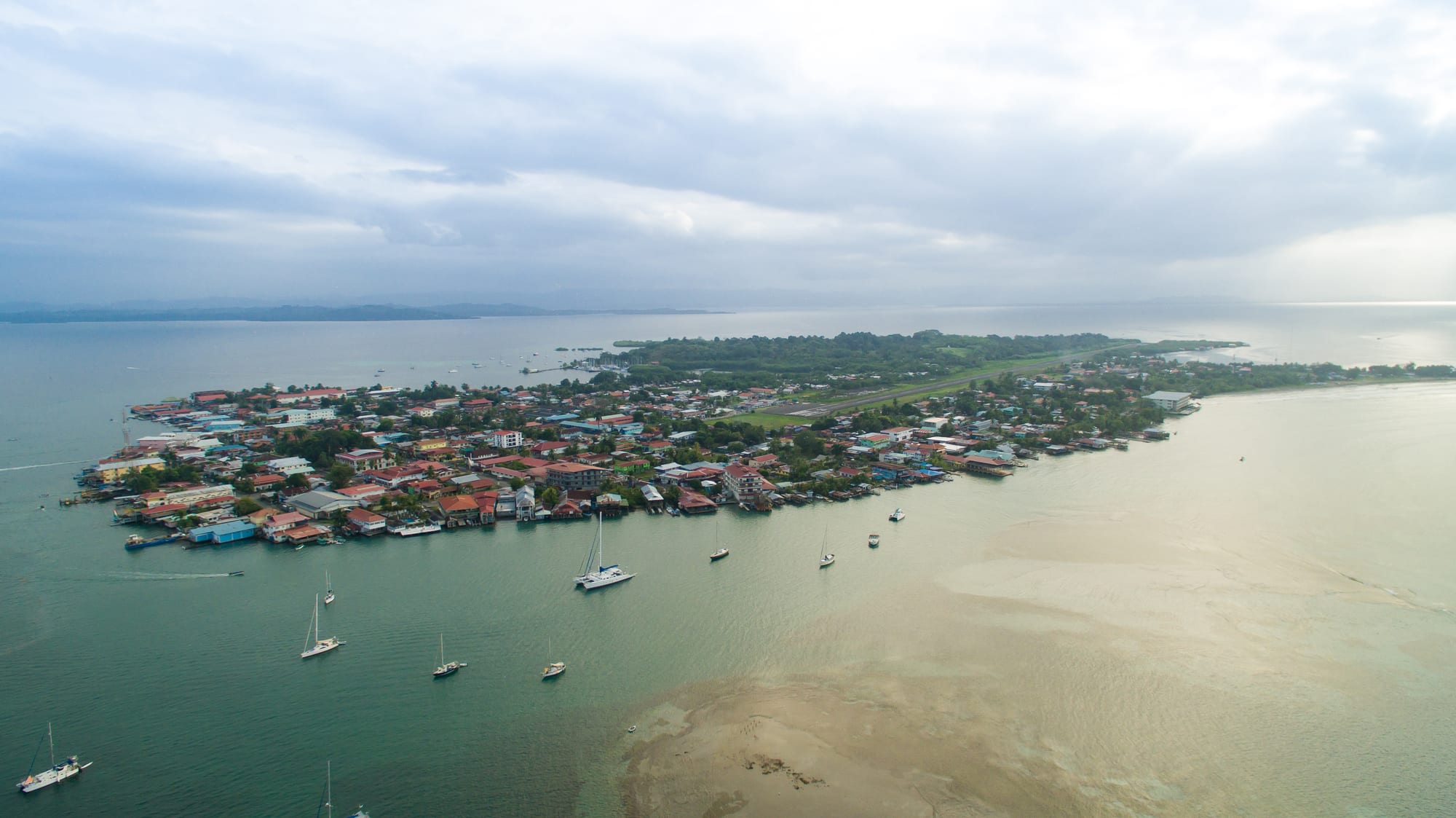
Aerial view of Bocas Town on Isla Colón

Bocas del Toro & Chiriquí, Panama

Bocas del Toro

Bocas Town from the air, on the southern tip of Isla Colón. (Dronepicr / Wikimedia Commons · CC BY 3.0)

Bocas Town, the capital of Bocas del Toro province, on the southern tip of Isla Colón in the Caribbean. Rebuilt after a fire in 1904, it is a small grid of wooden buildings, some on stilts over the water, shared by Afro-Caribbean islanders, Panamanians, foreign residents and backpackers, and the hub from which water taxis fan out to the beaches, reefs and marine park of the archipelago.

Neighbourhoods

  • Bocas Town
    • First-time visitors
    • Nightlife
    • Best for food

    A compact grid of avenues and streets on the southern tip of Isla Colón, with the main park, the government building, the market and the water-taxi docks. Restaurants, hotels and bars line the main streets, and several bars and clubs stand on stilts over the water.

    Open in Maps
  • Isla Carenero
    • Quiet and residential
    • Best for food

    A long, forested island without roads a few hundred metres east of Bocas Town, a short water-taxi hop away. Its waterfront restaurants and guest houses make it a quieter base with the town in sight.

    Open in Maps
  • Bluff and Boca del Drago
    • Beaches
    • Walks and nature

    The far sides of Isla Colón, reached by road. Bluff Beach is an unspoilt beach with a few places to stay, while Boca del Drago is the starting point for the walk to Starfish Beach.

    Open in Maps
  • Old Bank, Bastimentos
    • Local life
    • Beaches

    The only village on Bastimentos, a walking path lined with rustic buildings, a short water-taxi ride from Bocas Town. It is quieter and more local than Bocas, with a few restaurants and a path to Wizard Beach.

    Open in Maps

Things to do

On Isla Colón

  • Bluff Beachbeach

    An unspoilt beach on Isla Colón, popular with surfers, though swimming can be difficult.

    Open in Maps
  • Starfish Beachbeach

    A beach about 20 minutes' walk from Boca del Drago where starfish can be seen in the water, reached by bus or bicycle across the island and then on foot.

    Open in Maps
  • La Grutaattraction

    A bat cave in the interior of Isla Colón.

    Open in Maps
  • Bocas del Toro Research Stationattraction

    A Smithsonian Tropical Research Institute field station near Bocas Town, founded in 1998, where visiting scientists give lectures open to the public.

    Open in Maps

The nearby islands

  • Bastimentos Islandattraction

    A large, hilly island named by Columbus in 1502, with the village of Old Bank, rainforest trails, and beaches including Wizard Beach and Red Frog Beach.

    Open in Maps
  • Red Frog Beachbeach

    The most visited beach on Bastimentos, named after the small red strawberry poison-dart frogs of the forest behind it, reached by boat and a walk across the island.

    Open in Maps
  • Isla Bastimentos National Marine Parkpark

    A marine park created in 1988 covering about 13,000 hectares of reefs, mangroves, forest and islands, with nearly eighty kinds of coral and a turtle-nesting beach at Playa Larga.

    Open in Maps
  • Cayos Zapatillabeach

    Two uninhabited cays east of Bastimentos, inside the marine park and its most popular place to visit.

    Open in Maps
  • Dolphin Bayattraction

    A lagoon not far from Bocas Town with a resident population of wild dolphins.

    Open in Maps

Seasonal events

  • CarnivalFebruary or March, before Ash Wednesday

    Bocas is among the places in Panama that celebrate the national carnival.

  • Turtle nestingApril to September

    The months when four species of endangered sea turtle nest at Playa Larga in the marine park on Bastimentos.

  • Surf seasonNovember to April

    The peak season for the archipelago's surf breaks, among them Black Rock, Carenero and Wizard Beach.

Eat and drink

Long-standing places and food districts in Bocas del Toro. Hours, ratings and directions come from your maps app, always current.

Bocas classics

  • Bocas Town's main streetsneighborhood

    Restaurants line the main streets of the town, from Caribbean seafood to Thai, Italian and other international cooking, and food carts sell empanadas, fried chicken and patacones.

    Open in Maps
  • Isla Carenero waterfrontneighborhood

    The small island across the channel, home to some of the archipelago's best-regarded restaurants, reached by a short water-taxi ride.

    Open in Maps
  • Old Bankneighborhood

    Several small restaurants in the village on Bastimentos, serving Caribbean home cooking in a more local setting than Bocas Town.

    Open in Maps

Experience Bocas del Toro

History

Christopher Columbus sailed into these waters on his fourth voyage in 1502 and named Bastimentos, "provisions", across the channel from today's town. For centuries afterwards Spanish control was thin, and Bocas grew apart from the rest of Panama in language and rhythm, shaped by migrants from the West Indies.

In the early 20th century American fruit companies, above all the United Fruit Company, planted bananas on the mainland, built the port of Almirante across the bay and brought in West Indian workers. In 1904 a fire swept through Bocas, and the town had to be rebuilt; its population fell in the late 20th century, and its corregimiento counted only about 4,000 people in 2000.

Tourism brought a turnaround. In the 1990s the government declared Bocas del Toro a zone of tourism development of national interest, and the archipelago became one of Panama's main tourist areas, with more than 150,000 visitors a year to Isla Colón. The marine park was created in 1988 to protect the reefs, mangroves and turtle beaches, and the Smithsonian opened its research station just outside the town in 1998.

Culture & Customs

Bocas Town mixes Afro-Caribbean islanders, mainland Panamanians, Indigenous people, foreign residents and backpackers. Many islanders descend from West Indian migrants and speak Bocas del Toro Creole, a variety of Jamaican Patois, once dismissed as "guari-guari"; Caribbean Protestant churches reflect the same roots. The province borders the Ngöbe-Buglé comarca to the east, and Ngäbe people live on both sides of the Cordillera, and many work on the banana and coffee farms.

The town has a reputation as a party destination, with bars and clubs on stilts over the water, but its older life runs in parallel: the main park and the government building, churches, the market and the docks. Bocas also celebrates the national carnival.

The sea shapes the culture. Boats are the main way to get anywhere beyond the town, the island has a strong boating community and several marinas, and surfing, diving and snorkelling draw visitors year-round, with national and international surf competitions held on the breaks. Old Bank on Bastimentos, a short boat ride away, keeps a more local Caribbean village life.

Daily Life

About 6,700 people lived in Bocas del Toro in 2023, and the whole archipelago has about 13,000. The town is the administrative and commercial centre of the province and the seat of a Catholic diocese. Relatively few Panamanians live on Isla Colón, where housing is expensive; many who work on the island live on the mainland and commute by boat.

Tourism is the main industry. The town has more than fifty hotels, many restaurants and tour operators, and many small businesses depend on visitors, while fishing goes on under seasonal rules for shrimp and lobster and a ban on taking sea turtles or their eggs. The day follows the boats and the weather, and in the evening the bars and restaurants of the main streets fill up.

Basic services are stretched. A generator plant supplies power to Isla Colón, Carenero and Bastimentos, there is a public health clinic but limited medical care, and the town lacks a water treatment system; both the drinking water and the sea near town have high levels of bacteria.

Food

Bocas eats like the rest of the Caribbean coast. Rondón, a stew of fish or seafood with root vegetables cooked in coconut milk, is the signature dish, and coconut rice, fried fish and patacones, twice-fried slices of green plantain, are everyday food. Lobster appears in season, which runs from March to July under the fishing rules. Fresh coconut water and local beer are the everyday drinks.

Street food is simple and cheap. Food carts in town sell empanadas, fried chicken and patacones, and the price depends on where the cart stands and whom it is aimed at. For a sit-down meal, the main streets of Bocas Town have restaurants serving seafood and steak alongside the cooking of its foreign residents, from Thai to Italian.

Across the channel, Isla Carenero has some of the archipelago's best-regarded restaurants, and Old Bank on Bastimentos has a few small places cooking for the village. Fish, coconut, plantain and rice remain the base of island home cooking, whatever the visitors' menus offer.

Planning tools

Budget

Bocas costs more than mainland Panama. The town has cheap hostels and dozens of hotels, while lodges on the outer islands are expensive, and boat trips are the item that adds up: water taxis between islands are charged per person, and day tours to the marine park cost extra.

Daily Budget Midrange
USD 100–220 (boutique hotel or island lodge, restaurants, a snorkelling or island tour)
Daily Budget Shoestring
USD 40–70 (hostel bed, food carts and local restaurants, shared water taxis)

Agree water-taxi fares before boarding, share boat hire to split the cost, and carry cash for the outer islands.

Best Time to Visit

Bocas has no predictable dry season and rain falls in every month, but October, January and March are usually the driest. The surf peaks from November to April. Turtles nest in the marine park from April to September.

Suggested Number of Days

Three or four days give time for the town and a couple of boat trips around the islands. Five to seven suit divers, surfers and anyone combining the islands with the mainland. Rough seas or heavy rain can cancel boat trips, so a spare day helps.

First Visit
3–4 days
With Surroundings
5–7 days

Transportation

Bocas Town is small enough to walk. On Isla Colón, taxis are mostly yellow pickup trucks, and Transporte Colectivo minibuses and buses run to Bluff and Boca del Drago; bicycles can be hired. The other islands are reached only by private boat or water taxi from the town's docks.

Take boats only from licensed operators with life jackets, agree the price beforehand, and avoid crossings in rough weather.

Airport & Station Connections

Bocas del Toro 'Isla Colón' International Airport, also called José Ezequiel Hall, is about 1.5 km north-west of the town centre, with daily commuter flights from Albrook airport in Panama City and from San José in Costa Rica. By land, buses run from David over the mountains to Almirante, where water taxis and a car ferry cross to Bocas Town. The Sixaola–Guabito border crossing links the province with Costa Rica.

Walkability

The town is flat and laid out in a grid, with avenues running east to west and streets north to south, and almost everything in it is within walking distance. The beaches of Isla Colón are farther away and need a bus, taxi or bicycle; the other islands need a boat.

Safety

Panama is one of the safer countries in Central America, and the main tourist areas are generally fine with normal precautions. Bocas Town sees petty theft and bag snatching, occasional robberies on isolated beaches and paths, and drug-related crime linked to the coastal smuggling route. The natural hazards matter more: strong currents and rip tides at beaches such as Wizard Beach, and rough boat crossings.

Swim only on sheltered beaches, keep valuables locked away, walk isolated beach paths in company, and drink bottled water, since the town's water is not treated. Check current official travel advice before travelling.

Climate

A tropical rainforest climate, hot, humid and wet all year, with about 3,500 mm of rain a year and no predictable dry season. Temperatures hardly change through the year, and sunrise and sunset fall close to 6 am and 6 pm.

Summer
May to November: highs of 28–32°C and lows of 22–24°C, with heavy showers; September and October often drier
Winter
December to April: much the same warmth, 28–32°C by day, with January and March among the driest months

Local Customs

Bocas is relaxed and informal, but it is a working Caribbean town as well as a resort. Many islanders speak Bocas del Toro Creole, an English-based creole related to Jamaican Patois, alongside Spanish. Swimwear belongs on the beach and boats rather than in town, and a greeting before any question is expected in English or Spanish.

Ask before photographing people, especially in Old Bank and the Indigenous communities, cover up away from the beach, and leave a tip for boat crews and in sit-down restaurants where no service charge is added.

Common Payment Methods

Panama uses the US dollar as paper currency, with its own balboa coins of the same size and value. Hotels, dive shops and many restaurants in Bocas Town take cards, but water taxis, food carts, buses and taxis are paid in cash.