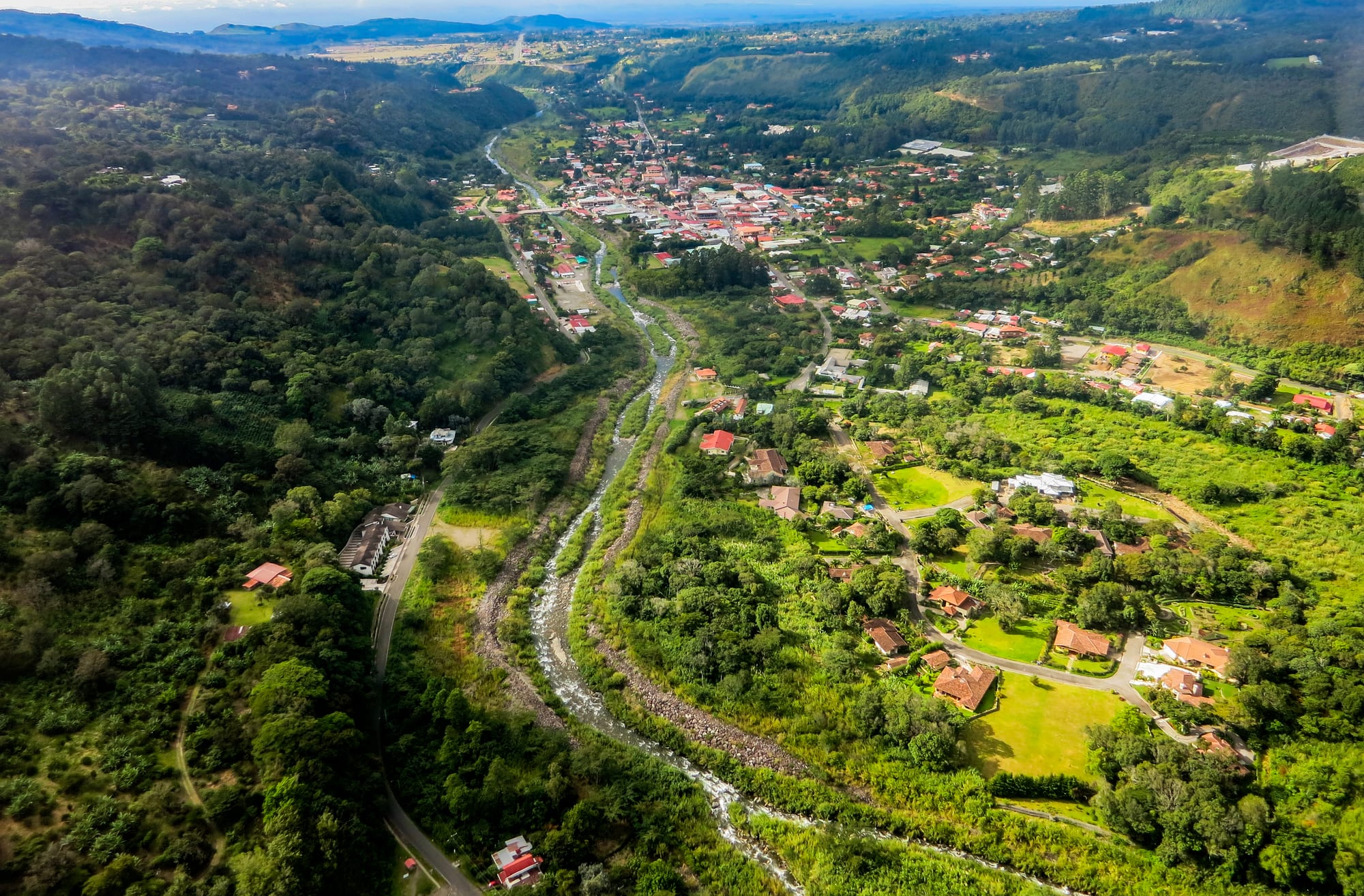
Aerial view of a green river valley with a rocky stream, scattered red-roofed houses and a town beyond

Bocas del Toro & Chiriquí, Panama

Boquete

Boquete and the valley of the Caldera River seen from the air. (FranHogan / Wikimedia Commons · CC BY-SA 4.0)

A small mountain town on the Caldera River in Panama's Chiriquí highlands, about 1,200 metres up on the eastern flank of Volcán Barú. Settled in the late 19th century by Panamanian farmers and European and American newcomers who planted coffee, it still lives mainly from agriculture, while its cool climate has drawn hikers, birdwatchers and a large community of foreign retirees.

Neighbourhoods

  • Bajo Boquete
    • First-time visitors
    • Close to public transport
    • Best for food

    The town centre and seat of the district, laid along the Caldera River. The central square, where buses from David arrive, the covered market, most restaurants, hostels and tour offices sit within a few blocks of the main street and the bridge.

    Open in Maps
  • Alto Boquete
    • Quiet and residential

    The area on the road down towards David, below the town centre, one of the district's most populous parts. Housing developments and newer homes, many of them aimed at foreign retirees, spread across the slopes.

    Open in Maps
  • The hill villages
    • Hiking
    • Coffee farms
    • Quiet and residential

    Above the town, small settlements such as Bajo Mono, Alto Quiel and Volcancito are scattered among coffee farms and forest. Local vans run loops up into them, and several of the area's trails start here.

    Open in Maps
  • Caldera
    • Hot springs
    • Rural Panama

    A thinly populated corregimiento to the south-east, down towards the plains, with thermal springs beside the Caldera River and rock carvings left by early inhabitants. It feels far more rural and traditional than the town.

    Open in Maps

Things to do

In and around town

  • Boquete marketmarket

    A covered market next to the central square, selling mostly fruit and vegetables grown in the valley.

    Open in Maps
  • Coffee farm toursattraction

    Many of the valley's coffee estates, large and small, show visitors how beans are grown, picked and processed, and end with a tasting of local coffees.

    Open in Maps
  • Los Ladrillosattraction

    A rock formation near the town with one of the few outdoor climbing walls in the country, used for rock climbing.

    Open in Maps

Trails and the volcano

  • Volcán Barúpark

    An active stratovolcano and Panama's highest point at 3,475 metres, protected as a national park since 1976. A long, steep track leads to the summit, where both oceans can occasionally be seen on a clear day.

    Open in Maps
  • Sendero Los Quetzalestrail

    The national park's best-known trail, running around the side of the volcano through cloud forest between Boquete and Cerro Punta, named after the quetzals that live along it. It was reported closed for reconstruction in 2024, so its status is worth checking locally.

    Open in Maps
  • Pipeline Trailtrail

    A forest walk above Bajo Mono that passes waterfalls and a very old tree, ending at a large waterfall that is fullest in the wet season.

    Open in Maps

Short trips from the town

  • Caldera hot springsattraction

    Thermal springs bubbling up beside the Caldera River in the lowlands below town, with prehistoric petroglyphs nearby.

    Open in Maps
  • Davidattraction

    The provincial capital on the plains to the south, the region's transport hub and its main city for shopping and services.

    Open in Maps
  • Gulf of Chiriquí National Marine Parkpark

    A marine park of some two dozen islands, coral reefs and mangroves on the Pacific coast, set up in 1994 and visited for snorkelling and, from August to October, humpback whales.

    Open in Maps

Seasonal events

  • Feria de las Flores y del CaféJanuary

    The Flower and Coffee Fair, one of the most important fairs in Panama, which grew out of a coffee festival first held in 1950 and took its present form in 1973.

  • Boquete Jazz & Blues FestivalFebruary or March

    A jazz festival founded in 2007, the second largest in the country after the one in Panama City.

  • Orchid fairMarch or April

    An exhibition of orchids, the second of the town's yearly celebrations of its flowers.

Eat and drink

Long-standing places and food districts in Boquete. Hours, ratings and directions come from your maps app, always current.

Boquete classics

  • Coffee tastingscafe

    Local coffee, including the prized Geisha variety, is served in cafés in town and at estate tasting rooms around the valley.

    Open in Maps
  • Fondas around the central squarerestaurant

    Simple local eateries serving Panamanian breakfasts such as fried hojaldras and set lunches of rice, beans and stewed meat.

    Open in Maps

Food districts and markets

  • Boquete marketmarket

    The covered market beside the central square, piled with the valley's vegetables, oranges and strawberries.

    Open in Maps
  • Restaurants on the main streetneighborhood

    Panamanian, Peruvian, Mexican and international restaurants, cafés and bakeries line the main street and the blocks around the square, many catering to the town's foreign residents.

    Open in Maps

Experience Boquete

History

People lived in the Boquete area long before the Spanish arrived. Archaeological studies date early farming settlements around Volcán Barú to between about 300 BC and AD 600, and petroglyphs carved into rocks at Caldera are a record of those villages. During the colonial period the steep highlands were cut off from the rest of the isthmus and served as a refuge for Ngöbe people from the centre of the country and for Miskito from the Caribbean coast. The name Boquete is Spanish for a gap or opening — the pass through which gold seekers once looked for a quicker way to the Pacific.

Settlement began in earnest only in the second half of the 19th century, when families came up from Bugaba, Gualaca and David, joined by a small number of immigrants from Europe — Yugoslavia, France and Germany among them — and from the United States, who started the first coffee plantations and farms. By the early 20th century there were hamlets at Lino, Quiel, Bajo Mono, Los Naranjos and Bajo Boquete. Remote from David, they asked for a district of their own, which was created in 1911. The first seat was Lino, but the capital moved to Bajo Boquete, a change made official in 1941.

A coffee festival began in 1950. On 9 April 1970 a severe flood killed eight people and affected one in three of the district's inhabitants; after the recovery the festival became the Flower and Coffee Fair in 1973. In recent decades a large residential development aimed at foreigners and the arrival of many retirees from North America and Europe turned a quiet farming valley into a well-known home for foreign residents, though agriculture, above all coffee, remains its main industry.

Culture & Customs

Boquete's culture is a mix of highland farming town and international retirement community. The Flower and Coffee Fair in January is one of the most important fairs in Panama, with flower displays, stalls and music, and an orchid fair follows later in the dry season. The town's patriotic parades in November, for the separation from Colombia and the other national holidays, are as much a part of the calendar as anywhere in the country.

The newcomers have added their own institutions. The Boquete Jazz & Blues Festival, founded in 2007, is the second-largest jazz festival in Panama after the capital's. A group of immigrants formed a theatre company in 2005, and its riverside venue in the centre became the town's first performance space in 2009; it later began staging plays in Spanish too. Its weekly Tuesday market and community meeting became a fixture where foreign and Panamanian residents trade and mix.

Beneath that, the district has three main communities: Ngöbe families from the mountains, many of whom work on the coffee farms; Panamanian townspeople whose families settled the valley; and foreign residents from North America and Europe. The relationship between them, and between old farming habits and new tourism, shapes much of local life. Coffee is a matter of pride, and the valley's estates have won international fame for the Geisha variety.

Daily Life

The Boquete district had about 22,400 inhabitants at the 2010 census, about 4,500 of them in the corregimiento of Bajo Boquete, the town centre, with Los Naranjos and Alto Boquete the other large settlements. Some 14 per cent of the population is of foreign origin, and more than 3,000 foreigners from over 30 countries live there permanently — Americans and Canadians above all, with large groups from Colombia, Venezuela and Europe.

Agriculture remains the main industry, despite the tourism boom. Coffee is the leading crop, and the valley's volcanic soil also grows flowers, vegetables, strawberries and oranges. The coffee harvest depends on seasonal Ngäbe pickers. Tourism and the expat community have brought a wave of hotels, restaurants, tour companies and building, with more than 50 places to stay in the district, from backpacker hostels to spa hotels.

The day starts early, with buses and pickups heading down to David and vans climbing to the farms. In the wet season afternoon rain is part of the routine. The pace of development is a local concern, along with the 2007 warning by geologists that Volcán Barú is still active and that an eruption could reach the town.

Food

Boquete eats like the rest of rural Chiriquí, with a richer mix of produce than most of Panama: the valley is one of the country's market gardens. Local fondas serve the Panamanian standards — rice and stewed beans, sancocho soup, stewed beef — and breakfasts of hojaldras, a fried bread, with eggs. Fresh fruit, from papaya and pineapple to the valley's strawberries, fills the covered market by the square, and strawberry sellers trade near the bus stop in the centre.

Coffee is the town's glory. It has been grown on the slopes since settlers laid out the first plantations in the late 19th century, and since the 2000s the Geisha variety, originally from Ethiopia, has made Boquete famous among coffee buyers, with lots selling for record prices at auction. Estate tours walk through the whole process from red cherry to roasted bean and finish with a tasting, and cafés in town serve beans from the surrounding valley.

The large foreign community has given the town a choice of restaurants unusual for its size, with Peruvian, Mexican and international cooking beside the fondas, and bakeries and cafés catering to residents as much as to visitors. Trout, farmed on the other side of the volcano, also appears on menus in the highlands.

Planning tools

Budget

Boquete is dearer than the rest of Chiriquí, because so many visitors and foreign residents live here, but it covers every budget, from backpacker hostels to spa hotels. Coffee tours, guided hikes, rafting, zip lines and jeep trips to the volcano summit are the main added costs; buses and food at local fondas stay cheap.

Daily Budget Midrange
USD 100–220 (boutique hotel or cabin, restaurant meals, a coffee tour or guided hike)
Daily Budget Shoestring
USD 40–70 (hostel bed, fonda meals, local buses and vans, self-guided trails)

Carry cash for vans, trail fees and small eateries, as cash machines are few outside the centre; many of the walks around town cost little or nothing.

Best Time to Visit

The dry months from December to April bring the clearest views from the volcano and the easiest trails, and January brings the Flower and Coffee Fair, when the town is at its busiest. The coffee harvest runs roughly from November to March. From May to November afternoons are often rainy, but the forest is greener and the rivers and waterfalls are at their fullest.

Suggested Number of Days

Two or three days suit a first visit to the town and the valley. Four or five allow for the volcano, which takes a long day or a night, the hot springs in the lowlands and the Pacific coast. Rain and cloud can wash out plans in the wet season, so allow a spare day then.

First Visit
2–3 days
With Surroundings
4–5 days

Transportation

The town centre is small and walkable. Local vans and minibuses leave from near the centre on loops up into the hill villages such as Bajo Mono, Alto Quiel and Volcancito, each showing its route on the windscreen, and taxis are cheap for short trips. Frequent buses run down the valley to David. Tour operators provide transport to the volcano, coffee farms and rafting rivers.

Mountain roads can be washed out in the rain, so a four-wheel-drive is the safer choice for a hire car, and roads have no pavements or safe shoulders for walking at night.

Airport & Station Connections

Boquete lies about 38 km north of David, the regional hub, and buses from David's terminal take a little over an hour. David has an airport with flights to Panama City, and long-distance buses link David with the capital in roughly eight hours. From Bocas del Toro the route runs by boat to Almirante and then by road over the mountains to David, or by private shuttle.

Walkability

The centre of Bajo Boquete is compact and easy on foot, with the square, market and main street close together and a walking path and park along the river. Pavements can be broken or uneven. The farms, trails and hill villages are spread across steep slopes, so reaching them usually needs a van, taxi or tour.

Safety

Panama is one of the safer countries in Central America, and the main tourist areas are generally fine with normal precautions. The Chiriquí highlands are generally safe; the real hazards are natural. Volcán Barú has steep trails and cold, fast-changing weather, and hikers have gone missing in the forests around the town. Near the summit temperatures can fall below freezing.

Hike Barú and the Boquete trails with a guide or in company, stay on marked paths, carry warm layers, water and food for the summit, and keep valuables locked away. Check current official travel advice before travelling.

Climate

Boquete's height gives it a temperate, spring-like climate, far cooler than the Pacific lowlands, with a dry season from about December to April and a wet season for the rest of the year. Daytime highs in Boquete reach about 28°C, and nights fall to around 15°C.

Summer
the wet season, May to November: about 15–25°C in Boquete, with frequent afternoon rain and cloud
Winter
the dry season, December to April: sunny and windy, with highs of up to about 28°C by day and around 15°C at night in Boquete

Local Customs

Boquete is unusually international for a Panamanian town, and English is widely spoken in hotels, cafés and tour offices, but Spanish is the language of the market, the buses and the farms. Many of the coffee pickers are Ngäbe people from the mountains, who come for the harvest. Dress is casual, with layers for the cool evenings.

Greet people with a 'buenos días' or 'buenas tardes' before asking for anything, ask before photographing people, including farm workers and Ngäbe families, and stay on paths on private coffee land.

Common Payment Methods

Panama uses the US dollar as paper currency, with its own balboa coins of the same size and value as US coins. Cards are accepted in many hotels, restaurants and tour offices in town, but buses, vans, fondas, market stalls and trail fees need cash. The town centre has cash machines; the surrounding villages have few.