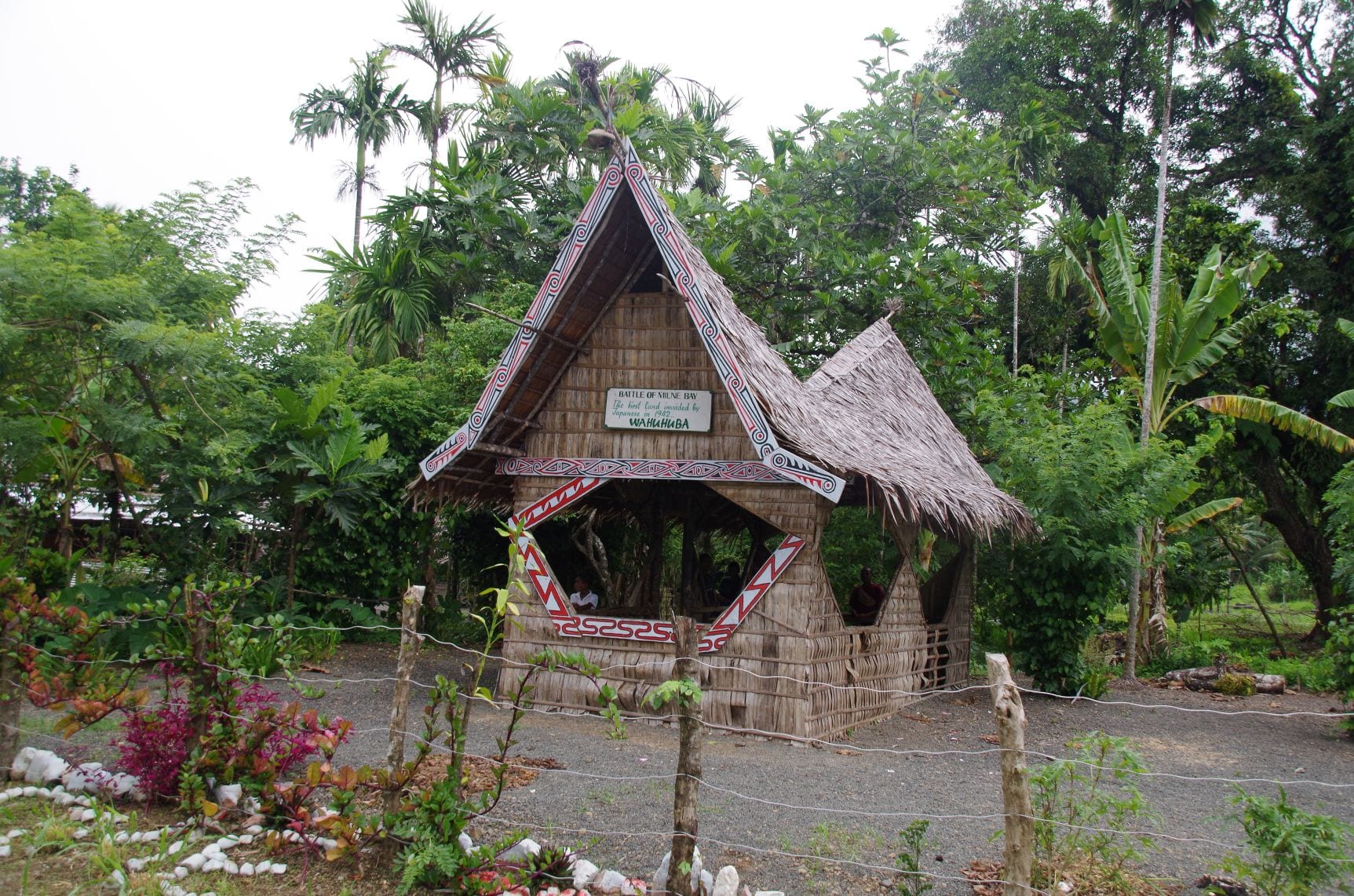
A thatched shelter with red and white painted gables standing on gravel among palms and banana plants

Port Moresby & the Southern Region, Papua New Guinea

Alotau

A thatched, painted shelter at a Battle of Milne Bay memorial site near Alotau. (Balou46 / Wikimedia Commons · CC BY-SA 4.0)

The capital of Milne Bay Province, a small harbour town on the north shore of Milne Bay at the eastern end of mainland Papua New Guinea. Built up after the Second World War, when the bay was the scene of an Allied victory in 1942, it is now the administrative centre of a province of hundreds of islands and the jumping-off point for its reefs, wrecks and canoe festival.

Neighbourhoods

  • The waterfront and main street
    • First-time visitors
    • Markets
    • Boats to the islands

    The centre of town runs along the shore of the bay: the market, shops, banks, provincial offices and the wharf where cargo ships, dinghies and dive boats load. Almost everything a visitor needs is within a few hundred metres of the water.

    Open in Maps
  • The slopes above town
    • Quiet and residential
    • Views over the bay

    Housing, schools, churches and the hospital climb the steep green hills behind the main street, with views down over the anchorage. This is where most residents live, and the streets are residential rather than commercial.

    Open in Maps
  • The bay road
    • Waterfront stays
    • Diving

    The coast road east and west of the centre passes guesthouses, lodges and small resorts set among coconut palms at the water's edge, several of them geared to divers. Distances are short but a vehicle or a lift is usually needed.

    Open in Maps
  • Gurney
    • Arrivals and departures
    • Wartime history

    The area around the airport a short drive north-west of town, built on one of the wartime airstrips defended in 1942. Plantations and villages line the road between it and the centre.

    Open in Maps

Things to do

Wartime history

  • Battle of Milne Bay siteslandmark

    A memorial park at the old battle site marks the ground where a mainly Australian garrison, with American engineers and anti-aircraft units in support, defeated a Japanese landing between 25 August and 7 September 1942.

    Open in Maps
  • Gurney Airporttransit hub

    The province's airport, on the site of a wartime airfield named Gurney Field in September 1942 after Squadron Leader C. R. Gurney, an Australian airman killed in a crash.

    Open in Maps

The bay and the town

  • Milne Bayattraction

    The sheltered deep-water bay the town sits on, more than 35 kilometres long and bounded north and south by the wooded Stirling Ranges; it was an Allied anchorage during the war, and its reefs, among the most biodiverse in the world, draw divers today.

    Open in Maps
  • Alotau Marketmarket

    The provincial market on the waterfront, where produce, fish and betel nut arrive by truck from the villages and by dinghy from the islands.

    Open in Maps

Short trips by boat

  • Samaraiattraction

    A tiny island east of the town that was the colonial district headquarters and, at its height, the Territory of Papua's second town after Port Moresby; its buildings were destroyed during the Second World War, and about 460 people now live on an island where little belies its past.

    Open in Maps
  • Nuakata Islandattraction

    A small mountainous island in the Goschen Strait east of East Cape, rising to 327 metres at Mount Tanorabwa, one of the island trips made by boat from the town.

    Open in Maps

Seasonal events

  • Kenu and Kundu FestivalNovember

    The province's canoe and drum festival on the Alotau waterfront, with racing war canoes, sailing canoes, kundu drumming and dance groups from the islands.

  • Battle of Milne Bay commemorationlate August and early September

    Services and wreath-laying at the memorials mark the anniversary of the 1942 fighting, sometimes with Australian veterans' families attending.

  • Independence Day16 September

    The national anniversary is marked with parades, sport, church services and sing-sing groups from around the province.

Eat and drink

Long-standing places and food districts in Alotau. Hours, ratings and directions come from your maps app, always current.

Markets and street food

  • Alotau Marketmarket

    Yams, taro, bananas, greens, coconuts, reef fish and betel nut, with cooked food and scones sold at the edges — the cheapest and most interesting eating in town.

    Open in Maps
  • Main street food stallsneighborhood

    Tables and kiosks along the waterfront street selling grilled fish, rice dishes, fried flour balls and cold drinks to shoppers and wharf workers.

    Open in Maps

Places to eat

  • Waterfront hotels and lodgesneighborhood

    The hotels and dive lodges along the bay run the town's restaurants, cooking reef fish, crab, chicken and vegetables from the market for guests and visitors.

    Open in Maps
  • Trade-store canteensneighborhood

    Small takeaways attached to the town's trade stores serve fried chicken, lamb flaps, rice and instant noodles, the everyday town food of Papua New Guinea.

    Open in Maps

Experience Alotau

History

The shores of Milne Bay and the islands beyond have been settled for thousands of years by Austronesian-speaking seafaring peoples whose canoes carried shell valuables, pigs, pots and yams between communities. In the islands east and north of the bay those voyages formed the kula ring, the ceremonial exchange of armshells and necklaces studied in the Trobriand Islands by the anthropologist Bronisław Malinowski during the First World War. Missionaries arrived in the second half of the 19th century, and the colonial administration of British New Guinea, and then Australian Papua, ran the area from Samarai, a small island port at the tip of the mainland.

Alotau itself is a modern town. In 1942 the bay became the site of one of the turning points of the Pacific war: Japanese troops landed near Ahioma at the end of August and were defeated over the following two weeks by Australian forces defending the newly built airstrips, with American engineers and anti-aircraft units in support, with the fighting ending on 7 September. It is often described as the first major battle of the Pacific war in which Allied troops decisively defeated Japanese land forces. Samarai's town had been destroyed on colonial orders for fear of Japanese occupation, and the port never recovered its former importance.

After the war the administration looked for a mainland site on the bay with room to grow, and in 1969 the headquarters were shifted from Samarai to Alotau, which grew steadily as the seat of government for Milne Bay Province, the more so after Papua New Guinea's independence in 1975. It remains a small town whose importance comes from the offices, wharf and airport that serve a province of scattered islands.

Culture & Customs

Milne Bay is one of the most maritime provinces in Papua New Guinea, and Alotau is where its many communities meet. The province has dozens of languages and a strong canoe culture: sailing canoes with crab-claw sails, long racing canoes paddled by village crews, and the kundu, the hourglass hand drum that gives the town's November festival half its name. The Kenu and Kundu Festival, held on the waterfront in November, has become one of the better-known cultural gatherings in the country.

Much of the province is matrilineal, with land and standing passing through women, which distinguishes it sharply from the Highlands. Yams remain a measure of wealth and a matter of pride in the islands, harvest seasons are marked with feasting and dancing, and the Trobriand Islands are known for their yams, their carving and their own boisterous version of cricket introduced by missionaries and remade with local rules. Christianity, Anglican and Catholic above all, is woven through daily life, and church choirs are a serious local art.

Manners in town are gentle and slow-moving. People greet one another before getting to the point, betel nut is shared, and news travels through family and church networks. Visitors are treated with curiosity and courtesy, and are expected to return it by asking before photographing, walking onto a beach or swimming off a village reef, all of which belong to someone.

Daily Life

Alotau is a small town, and the market, the wharf and the provincial offices set the rhythm of the day. Government administration, schools, the hospital, shipping, trade stores and the tourism and diving businesses provide most of the paid work. Beyond the town, families live from gardens, fishing, copra, cocoa and betel nut, with oil palm on some of the larger holdings, and cash comes from selling produce at the market or on the wharf.

Mornings are the busiest part of the day. Dinghies come in from the islands with fish and garden food, trucks arrive from the villages along the coast roads, and the market fills before the heat does. The afternoons are quieter, and by evening the streets are largely empty. Electricity and water supply are better than in much of the country but not reliable, and internet and phone coverage can be slow.

The province's difficulties are those of a scattered island population: getting patients, teachers, fuel and cargo to places reachable only by small boat, the cost of that transport, and the vulnerability of low islands and coastal villages to storms, king tides and rising seas. Young people leave for Port Moresby and Lae for work and study, and many come back.

Food

Milne Bay eats from the reef and the garden. Reef fish, trevally and tuna, octopus, crab and shellfish are grilled, boiled or cooked in coconut cream, and served with yam, taro, cassava, sago or boiled bananas. Greens such as aibika and pumpkin tips are simmered with coconut milk. Yams carry particular weight here, above all in the Trobriand Islands to the north, and a good harvest is displayed before it is eaten.

Celebration food comes out of the mumu, the earth oven in which pork, chicken, root vegetables and greens steam for hours under hot stones and banana leaves. Coconut is in almost everything, from the cream squeezed for fish stews to the young nut drunk as a cold drink. Sago, pounded and washed from palm pith, is eaten as a paste or as flat cakes, more often in the mainland villages than in town.

Town food is plainer: rice with tinned fish, instant noodles, fried chicken, lamb flaps and scones from a trade store. The market sells the good things, including seasonal mangoes, pineapples, pawpaw and galip nuts. Betel nut with mustard stick and lime is chewed everywhere, Papua New Guinean lager is the common drink, and Highlands coffee turns up in the hotel dining rooms along the bay.

Planning tools

Budget

Alotau is cheaper than Port Moresby but not cheap. The flight from the capital is the largest single cost, followed by accommodation, which ranges from mission and village guesthouses to dive lodges. Boat hire to the islands is charged by the dinghy and by the fuel it burns, so sharing with others makes a large difference. Diving is usually booked as a package with a lodge or liveaboard.

Daily Budget Midrange
USD 250–500 (bay-side hotel or dive lodge with meals, boat trips, a hired vehicle or transfers, flights from Port Moresby)
Daily Budget Shoestring
USD 90–160 (guesthouse or mission lodging, market food, shared dinghy or road transport)

Confirm accommodation and airport transfers in advance, and carry enough kina in cash for boat hire, which is rarely paid by card.

Best Time to Visit

Diving and boat travel are possible all year, but seas are calmest and the weather most settled in the shoulder months either side of the trade-wind season, roughly April to June and October to November. November brings the Kenu and Kundu festival, the province's biggest gathering, when rooms fill well ahead. The wetter monsoon months from December to March bring heavier rain and more disrupted small-boat travel.

Suggested Number of Days

A day or two covers the town, the market and the wartime memorials. Four to six suit island and reef trips, which depend on boats, weather and tides, and divers on a lodge package often stay a week. Spare days around domestic flights are wise.

First Visit
1–2 days
With Surroundings
4–6 days

Transportation

The town itself is small enough to cross on foot. Beyond it, PMV minibuses and open-back trucks run along the coast roads to villages and to East Cape on no fixed timetable, and hotels arrange vehicles for guests. Travel to the islands is by dinghy with an outboard, by dive boat or by small coastal ship, and there are no roads to the rest of the country.

Hire boats through a hotel or an established operator, check that life jackets, spare fuel and a radio or phone are aboard, and allow for trips being cancelled when the sea is rough.

Airport & Station Connections

Gurney Airport, about 11 kilometres north-west of the town, has flights from Port Moresby that take roughly an hour, and the drive in takes 20 to 30 minutes. Cargo and passenger ships call at the wharf from Port Moresby and Lae, and small boats connect the islands of the province. No road links Milne Bay to the capital.

Walkability

The centre is one of the easier Papua New Guinean towns to walk: a single main street along the water, with the market, shops, wharf and offices strung along it in a walk of fifteen or twenty minutes. The hills behind are steep, and lodges on the bay road are too far out to reach comfortably on foot in heat and humidity. Walking after dark is not advised.

Safety

Alotau is generally calmer than Port Moresby or the Highlands, and visitors are a normal sight in the town. Opportunistic theft, break-ins and alcohol-related trouble do occur, particularly at night and around paydays, and disputes over land and compensation occasionally close roads or village access. Sea travel in small open boats is the real hazard: squalls, engine failure and overloading have all caused deaths. Medical facilities are limited and serious cases are flown out.

Do not walk around town after dark, keep valuables out of sight, use boats and guides arranged through a lodge or operator, and carry insurance with medical evacuation cover. Check current official travel advice before travelling.

Climate

Hot, humid and rainy through the year, with no true dry season; Milne Bay is one of the wetter parts of the country. Temperatures change little between seasons, while wind and sea state matter more for travel than rainfall does.

Summer
the northwest monsoon, roughly December–March: humid, generally 24–31°C, with heavy showers and occasional squalls
Winter
the southeast trade season, roughly May–October: slightly cooler and breezier, generally 23–30°C, with choppier seas outside the bay

Local Customs

Milne Bay villages are largely matrilineal, and land, gardens and reefs all have owners, so visiting a beach, island or village is done with permission and usually with a host. Greetings are exchanged before business, dress is modest, and Sunday is quiet, with church attendance high across the province. Photographs of people, houses and canoes should be asked about first.

Tipping is not expected; a payment for a guide, boatman or landowner's permission is. Alcohol is drunk mainly at hotels and clubs, and betel nut chewing is widespread but banned in some public places.

Common Payment Methods

The currency is the kina (PGK). Hotels and larger lodges accept cards, though connections fail during power cuts; the market, PMV rides, boat hire and village guesthouses are cash only. Banks and a small number of ATMs are in the town centre, and there are none in the islands or villages, so cash for a whole trip is drawn before leaving town.