History
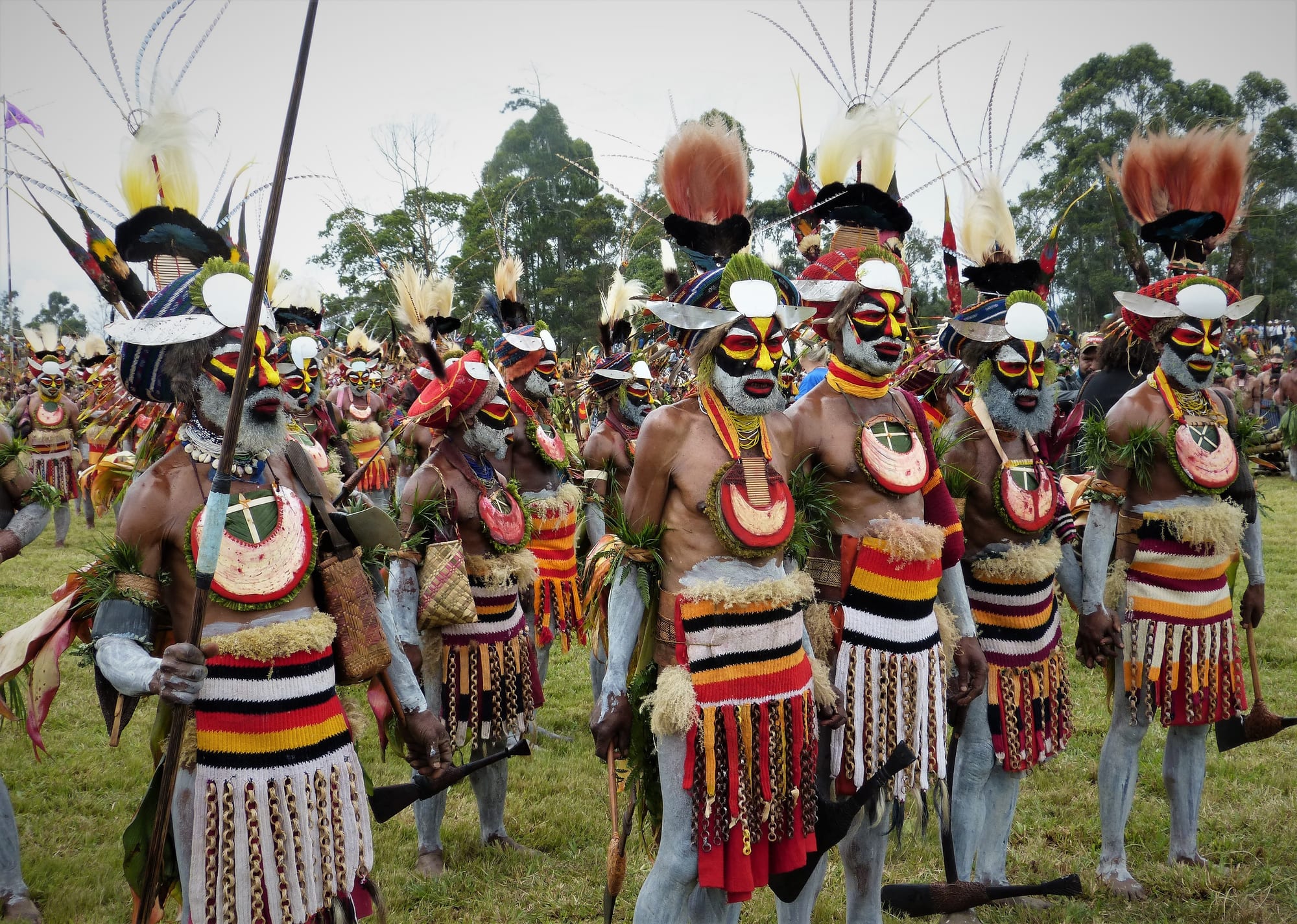
People reached New Guinea some 42,000 to 45,000 years ago, among the earliest human migrations beyond Africa and Asia, and in the Highlands they independently developed agriculture about nine thousand years ago, at Kuk, where the drainage ditches of those first gardens are now a World Heritage Site. Long isolation between valleys and islands produced one of the most fragmented societies on Earth — thousands of small clan-based groups, hundreds of unrelated languages, and cultures built on gift exchange, "big man" leadership, and cycles of warfare and payback. The Highlands, home to perhaps a million people, were unknown to the outside world until Australian gold prospectors walked into them in the 1930s.
Colonial partition split the island: the Dutch in the west, Britain and then Australia in the southeast as "Papua", and Germany in the northeast, which Australia seized in the First World War. In the Second World War, Japanese forces who landed in 1942 pushed toward Port Moresby over the Kokoda Track and were driven back in months of appalling jungle warfare, and Rabaul became a vast besieged Japanese base.
Australia administered the combined territory and handed it to independence, somewhat reluctantly on both sides, in 1975 under Michael Somare. Politics since has been formally democratic but chronically unstable, dominated by no-confidence votes and money politics. A civil war on Bougainville from 1988 to 1998, sparked by grievances over a giant copper mine, killed an estimated 15,000 to 20,000 people, though some estimates are far lower, and ended in a peace agreement and autonomy. A non-binding referendum in 2019 saw 98.3 per cent vote for independence; ratification by Papua New Guinea's parliament is unresolved, and the date Bougainville's leaders propose for independence has moved to 1 September 2030. A resource economy built on gold and liquefied natural gas has largely bypassed the rural majority, and recent years have brought escalating Highlands violence, the riots of January 2024 in Port Moresby and Lae in which about 22 people were killed, and the Enga landslide of May 2024, whose death toll is still disputed.
- Papua New Guinea: A Thousand Nations — The most linguistically diverse country on Earth — highland societies unknown to the outside world until the 1930s, a colony split between Germany, Britain and Australia, a Pacific War battleground, and a fragile democracy troubled by a secession war on Bougainville