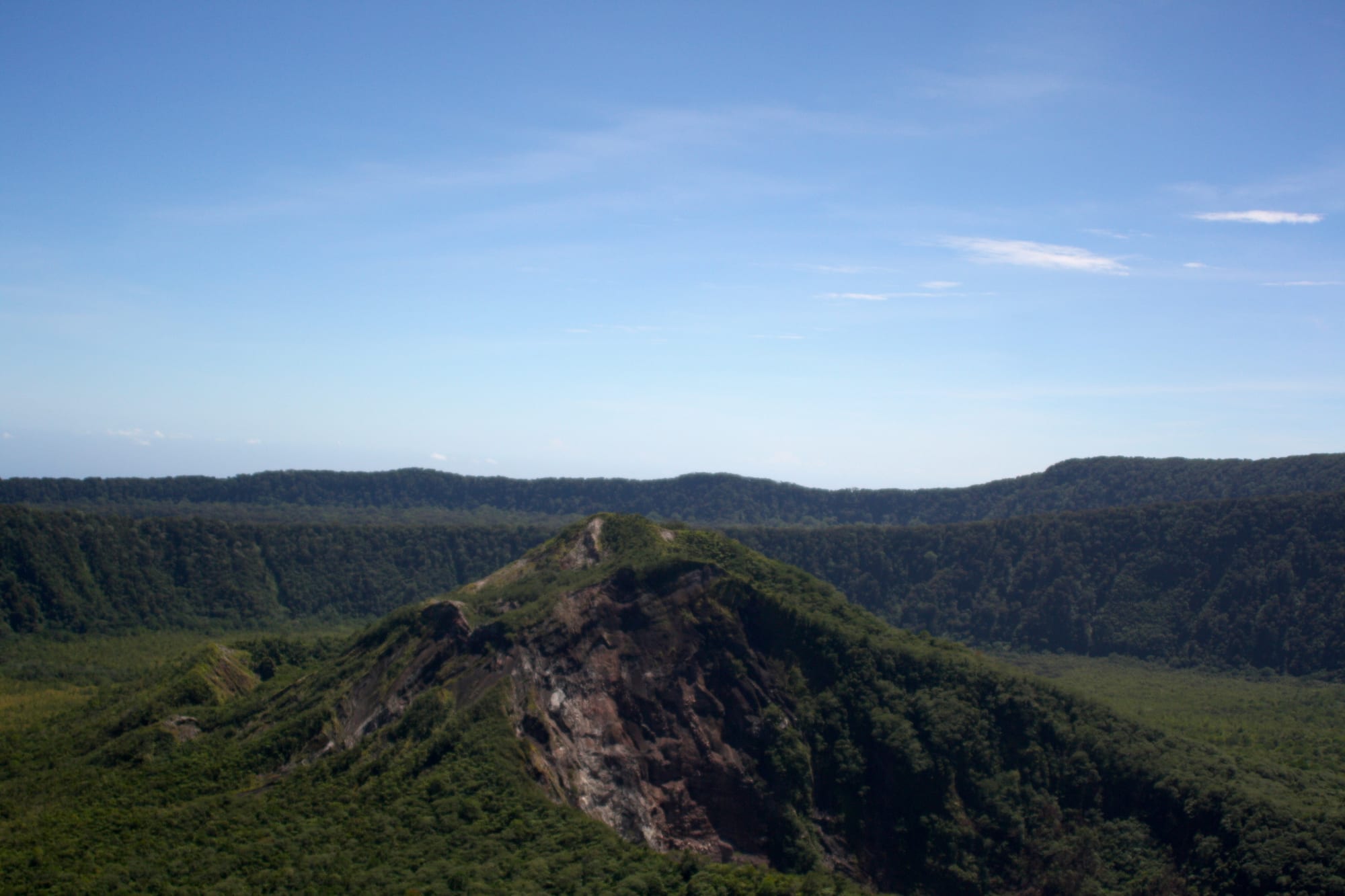
A forested volcanic cone with a bare rock face rising inside a wide, tree-covered crater under a blue sky

Papua New Guinea

Madang, the Sepik & the North Coast

The crater of Mount Uluman on Karkar Island, a volcanic island off the coast of Madang Province. (styko / Wikimedia Commons · CC BY-SA 3.0)

The northern mainland of Papua New Guinea, known as Momase, running from the industrial port of Lae and the Huon Gulf past Madang's reefs and volcanic islands to the great Sepik river and the Indonesian border at Vanimo — the former heart of German New Guinea and home to the country's most famous carving traditions.

Explore Madang, the Sepik & the North Coast

History

The Sepik basin is one of the oldest settled parts of New Guinea, and its river and swamp peoples — the Iatmul, Chambri, Abelam and many others — developed dense villages around sago, fishing and trade, along with some of the most elaborate ceremonial art in the Pacific. On the coast, trading networks linked the Madang islands with the mainland through canoe voyages exchanging pots, food and valuables.

The Russian scientist Nikolai Miklukho-Maklai lived on Astrolabe Bay near Madang in the 1870s. Germany annexed the northeast in 1884, and the German New Guinea Company set up at Finschhafen before moving its headquarters to Madang, then called Friedrich-Wilhelmshafen. Lutheran missionaries, starting with Johann Flierl in 1886, and Catholic missionaries shaped the coast. Australia seized the colony in 1914 and ran it as the Mandated Territory of New Guinea. In the 1920s and 1930s gold at Wau and Bulolo made Morobe the centre of an aviation-driven mining boom, and it was from Lae that Amelia Earhart took off on her last flight in 1937.

Japanese forces took Lae and Salamaua in 1942 and made Wewak a major base. Australian and American troops retook Lae in September 1943, including an airborne landing at Nadzab, and the Japanese army's surrender was signed near Wewak in 1945. Since independence Lae has become the industrial hub, while a tsunami struck the Aitape coast of West Sepik in 1998, killing more than 2,000 people.

Culture & Customs

The Sepik is famous for its haus tambaran, the spirit houses where men's ceremonial objects were kept and clan business was debated. Among the Iatmul, young men's initiation traditionally included cutting the skin of the chest, shoulders and arms to leave scars symbolising a crocodile's bite, and the crocodile remains a central ancestral figure. Carvers produce masks, story boards, figures and hooks for visitors and collectors, and the Abelam around Maprik are known for their painted spirit houses and yam cult.

Madang's islands and coast mix many small language groups. In Morobe, Lutheran Christianity is especially strong, and Kâte and Yabem, once used as mission languages, left their mark on older generations. West Sepik, also called Sandaun, shares a long border with Indonesia's province of Papua, and many families have ties across it.

Festivals are the best window into these cultures: the Sepik River Crocodile Festival and the Morobe Show in Lae. Rugby league is followed passionately, especially in Lae.

Daily Life

Lae is the country's second city and its industrial heart, with the largest port, factories, warehouses and the University of Technology; its population has grown fast through migration from the Highlands. Madang and Wewak are smaller provincial capitals, and Vanimo is a border town. Outside them, most people live in villages, growing gardens, processing sago, fishing and selling copra, cocoa, coffee, vanilla and betel nut.

Mining and processing are important: the Hidden Valley gold mine near Wau, the Ramu nickel and cobalt mine in Madang, and the proposed Frieda River copper project in West Sepik, which has raised concerns about the Sepik's health. Logging and oil palm bring cash and conflict over land.

On the Sepik, life follows the river: canoes carry people to school, church and market, and the rising and falling water shapes gardens and fishing. Current issues include crime and settlement growth in Lae, poor roads, and debates over mining on the Sepik.

Food

Sago is the staple along the Sepik and in much of the lowlands. Women wash starch from the pounded pith of the sago palm and cook it into pancakes, flat bread-like discs or a sticky jelly, eaten with fish, greens or coconut. River fish, prawns and smoked meat accompany it, and crocodile is still hunted in the Sepik.

On the Madang and Morobe coasts, fish and shellfish are cooked in coconut cream with greens such as aibika and served with taro, yam, bananas or rice, and the earth-oven mumu marks feasts. Galip nuts, from the canarium tree, are gathered and roasted in the lowlands, and breadfruit, mangoes and pawpaw fill the markets in season.

Lae's large market sells produce from the Highlands alongside coastal fish and betel nut, and Madang and Morobe grow cocoa and coffee. Town food is rice, tinned fish, noodles and fried chicken, washed down with SP lager or soft drinks.

Attractions & Natural Wonders

Around Madang, the reefs and lagoons offshore offer diving and snorkelling around coral reefs and small islands, with Kranket Island a short boat ride from town. The Coastwatchers Memorial lighthouse stands on the waterfront, and further out Karkar Island rises as a large volcano with a crater inside its summit.

The Sepik river runs through East Sepik past Iatmul villages such as Palimbei, where spirit houses and carving workshops can be visited by canoe from Pagwi or Angoram, and the Chambri Lakes spread across the floodplain of the middle river. Wewak, the provincial capital, has beaches and war memorials, and inland Maprik's towering Abelam spirit houses stand in the hills.

In Morobe, Lae has the Lae War Cemetery, where thousands of Allied servicemen are buried, and botanic gardens beside it. The Morobe coast stretches to Salamaua and Finschhafen, and the old gold road climbs to Wau and Bulolo. On the Huon Peninsula, the YUS Conservation Area protects Matschie's tree kangaroo. In the far west, Vanimo draws surfers to its reef breaks and beaches near the Indonesian border.

Cities in Madang, the Sepik & the North Coast

Planning basics

Budget

Costs are similar to the rest of the country: flights are the main expense, and secure hotels in Lae and Madang charge business rates. Madang has the widest choice for visitors, from dive resorts to simple guesthouses. Sepik trips mean hiring a motor canoe, fuel and a guide, which is cheaper shared among a group, and the Vanimo surf camps and village guesthouses are simple and modestly priced.

Daily Budget Midrange
USD 220–450+ (Madang resort or Lae hotel with driver, a dive package, or a guided Sepik canoe trip with flights)
Daily Budget Shoestring
USD 80–150 (village guesthouse or Sepik homestay, market food, a shared canoe or local boat)

Fuel is the biggest cost on the Sepik; agree the price of the canoe, driver and petrol before setting off.

Safety

Lae has serious violent crime, including armed robbery, carjacking and fighting between groups in its settlements, and the road from Nadzab and the Highlands Highway carry a risk of holdups. Madang and Wewak are generally calmer but still see robberies, especially after dark. The Sepik and the West Sepik interior are remote, with long distances to medical care, and the waters of the north coast can be rough for small boats.

Stay in secure hotels in Lae, avoid walking after dark in any town, use boats with life jackets and a spare engine, and carry insurance with evacuation cover. Check current official travel advice before travelling.

Climate

Hot and humid lowlands with heavy rain. Lae is one of the wettest towns in the country, with rain in every month, while Madang and the Sepik coast are wetter in the northwest monsoon and drier in the middle of the year. The Sepik floodplain swells in the wet season, covering grassland and gardens around the villages. Inland, the Finisterre and Saruwaged ranges rise to cool, cloudy mountains.

Summer
the northwest monsoon, roughly December–March: 24–32°C, heavy rain, Sepik floods and surf at Vanimo
Winter
roughly May–October: 23–31°C, calmer and drier on the Madang and Sepik coasts, but often wettest around Lae

Transportation

Lae is the end of the Highlands Highway and the country's main port, with its airport at Nadzab, about 56 km inland. A road links Lae to Madang, and a coastal road runs west from Wewak, but much of the region depends on flights, coastal boats and, on the Sepik, motor canoes from river towns such as Pagwi and Angoram. Vanimo is reached by air, and a road runs from there to the Indonesian border crossing.

Use a hotel or operator transfer between Nadzab airport and Lae, and plan Sepik trips with a guide who knows the villages.

Best Time to Visit

For the Sepik and Madang, the drier months from about May to October are easiest, with the Sepik River Crocodile Festival among the draws. Madang's diving is good through much of the year. Vanimo's surf season runs with the northwest monsoon swells, roughly from November to April. The Morobe Show in Lae draws cultural groups in October.