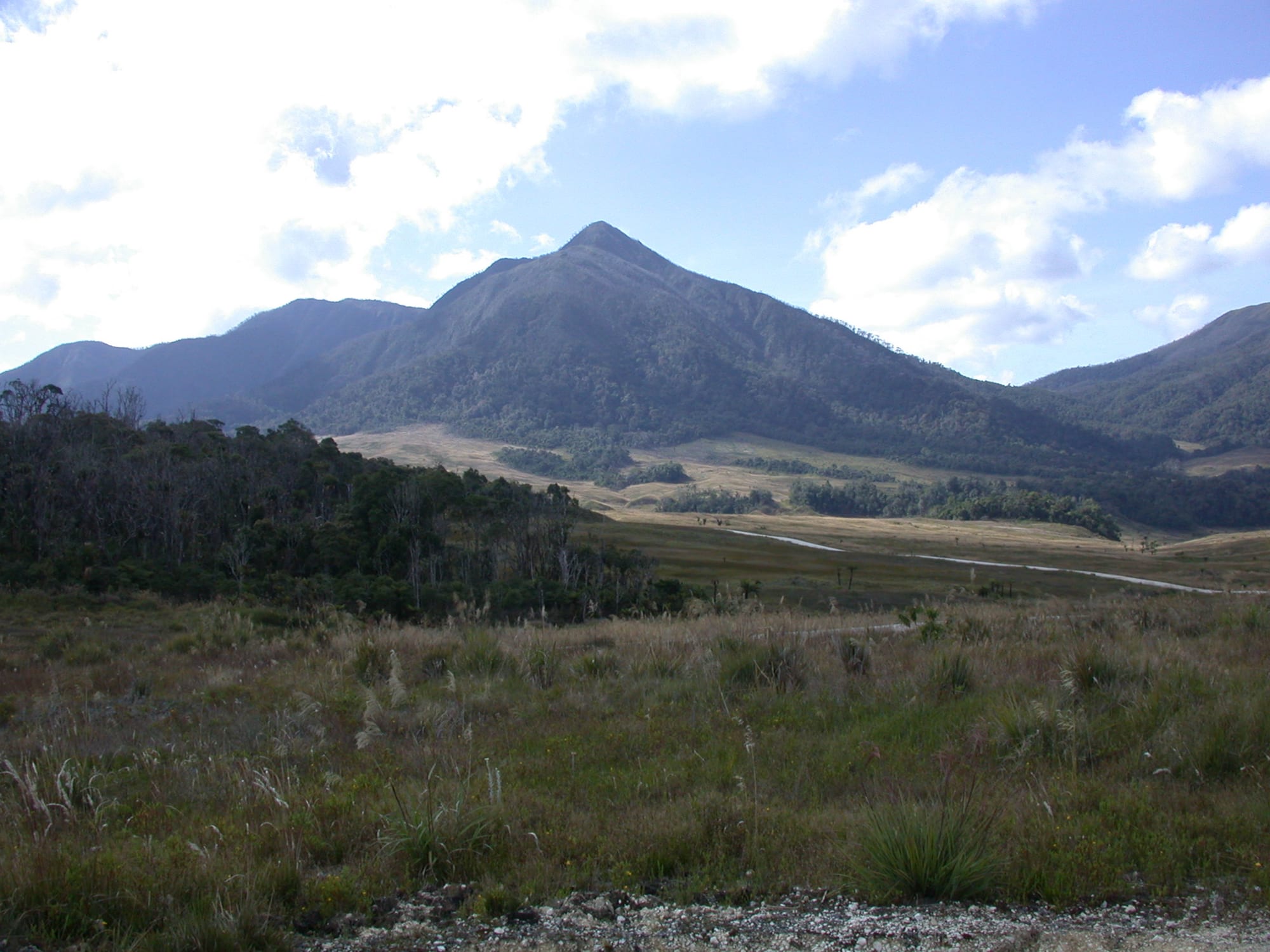
A forested mountain peak rising above open grassland and a winding gravel road under a partly cloudy sky

Papua New Guinea

The Highlands

Montane forest and grassland at the Tari Gap, on the mountain road into Hela Province. (sussexbirder / Wikimedia Commons · CC BY 2.0)

The mountainous spine of mainland Papua New Guinea, a chain of fertile valleys between 1,500 and 2,500 metres that holds a large share of the country's people — the land of early farming, the Goroka and Mount Hagen shows, the Huli of Hela and Mount Wilhelm, and of the tribal fighting that now troubles its western provinces.

Explore The Highlands

History

The Highlands valleys have been farmed for thousands of years. At Kuk Swamp in the Wahgi Valley, near Mount Hagen, drainage ditches and garden mounds show that people were cultivating taro, bananas and sugar cane long before contact with Asia — evidence that New Guinea was one of the world's independent centres of agriculture, recognised as a UNESCO World Heritage Site. The arrival of the sweet potato, probably within the last few centuries, allowed dense populations to grow and pigs to be raised in large numbers.

Outsiders assumed the interior was empty mountains until the 1930s, when Australian gold prospectors, including the Leahy brothers, and patrol officers such as Jim Taylor walked into the valleys and found around a million people. Missions, government patrol posts and airstrips followed, and coffee growing spread. Towns such as Goroka and Mount Hagen grew from those posts.

Since independence the Highlands have been a populous and politically assertive region, and the site of its largest resource projects: the Porgera gold mine in Enga, the Kutubu oil fields in the Southern Highlands and the Hides gas field in Hela, which feeds the PNG LNG project. Hela was carved from the Southern Highlands and Jiwaka from the Western Highlands in 2012. Clan warfare, once fought with bows and spears, has become far deadlier with guns, and in May 2024 a huge landslide buried villages in Enga, killing many people.

Culture & Customs

Highlands society is built on the clan, exchange and the big man, whose standing rests on the wealth he can gather and give away. Pigs are the central measure of wealth, and large ceremonial exchanges such as the moka of the Mount Hagen area and the tee of Enga once linked whole districts. Bride-price and compensation payments, now often in cash as well as pigs, still settle marriages, injuries and killings, and unpaid debts can spark fighting.

Each valley has its own language and style of dress. The Huli of Hela are known as wigmen for their elaborate wigs, decorated with bird-of-paradise feathers. The mud men of the Asaro valley near Goroka wear masks made of mud, and the Chimbu and Melpa peoples have their own elaborate headdresses of bird-of-paradise plumes. The Goroka Show, begun in 1956, and the Mount Hagen Show turned these traditions into great public gatherings of clan groups.

Christianity is strong — Lutheran, Catholic, Seventh-day Adventist and Pentecostal churches are all important — but belief in sorcery remains widespread, and accusations have led to violent attacks, mostly on women, that the state and churches are trying to stop.

Daily Life

Most Highlanders live in scattered homesteads among their gardens rather than in nucleated villages. Mount Hagen and Goroka are the main towns, each with perhaps a few tens of thousands of people; Kundiawa, Mendi, Wabag, Tari and the Jiwaka centres at Banz and Minj are smaller.

Sweet potato gardens, pigs and smallholder coffee are the base of the economy. Coffee cherries are sold to buyers along the roads in the harvest season, and fresh produce travels down the Highlands Highway to the coastal markets of Lae and Port Moresby. Mining and gas projects bring royalties, jobs and conflict over who is a landowner. Days start early with work in the gardens, and town markets fill in the morning with women selling vegetables and bilum string bags.

Current issues are sharp: population growth pressing on land, tribal fighting that has displaced whole communities, the cost of compensation disputes, poor roads, and violence against women. The 2024 Enga landslide showed how exposed villages on steep slopes are.

Food

Kaukau, the sweet potato, is the Highlands staple, eaten at almost every meal, roasted in the ashes or cooked in the mumu, the earth oven of heated stones in which pork, greens and vegetables steam under banana leaves. Pig killings for weddings, funerals and compensation feasts can involve dozens of animals.

Gardens also grow taro, bananas, sugar cane, corn, beans, cabbage and highland pitpit, a grass grown as a vegetable. In season the nut of the karuka, a highland pandanus, is roasted and eaten in large quantities, and marita, the red fruit of another pandanus, is made into an oily sauce in some areas. Introduced crops such as peanuts, carrots and broccoli now fill town markets.

Coffee is the region's great cash crop: arabica grown by smallholders and plantations around Goroka and in the Wahgi Valley, and exported for roasters abroad. Betel nut is trucked up from the coast and chewed everywhere, and beer is a central, and often troubling, part of town life.

Attractions & Natural Wonders

In the east, Goroka hosts the Goroka Show in September, while the Asaro valley nearby is where visitors meet the mud men. The Highlands Highway climbs from the lowlands over the Daulo Pass on the way to Chimbu, whose capital Kundiawa sits in a deep valley. From Keglsugl in Chimbu, climbers set out for Mount Wilhelm, the country's highest summit at about 4,500 metres, passing Lake Piunde on the way up.

Further west, the Wahgi Valley opens into a broad plain of coffee gardens between Chimbu, Jiwaka and Mount Hagen. The Kuk Early Agricultural Site lies on its edge, and Mount Hagen stages the Mount Hagen Show each August. Lodges in the surrounding forests are among the best places to watch birds of paradise display.

In Hela, the Tari valley is the heartland of the Huli, whose wigmen perform for visitors near Tari, and the high forest and grassland of the Tari Gap are famous for birds of paradise. The Southern Highlands hold Mount Giluwe, an old volcano and the country's second-highest mountain, and Lake Kutubu in its forested basin, while Enga, around Wabag, is among the most troubled of the Highland provinces.

Cities in The Highlands

Planning basics

Budget

The Highlands are rarely cheap to visit. Flights to Goroka or Mount Hagen are the usual way in, the few reliable hotels and lodges charge high rates, and most visitors travel with a guide and driver. Show weeks in Goroka and Mount Hagen push prices up and fill rooms months ahead. Village guesthouses on the Mount Wilhelm route and around Goroka are much cheaper, but still need a trusted local contact.

Daily Budget Midrange
USD 250–500+ (lodge or hotel, driver and guide, flights from Port Moresby, a show-week package)
Daily Budget Shoestring
USD 90–150 (village guesthouse or mission lodging, market food, a local guide arranged through a host)

Book show-week accommodation early, and treat a guide and driver as part of the cost of any Highlands trip rather than an extra.

Safety

The Highlands carry the country's most serious security problems. Tribal fighting between clans in Enga, Hela and the Southern Highlands is now fought with automatic weapons, has killed dozens of people in single attacks, and can close roads and towns without warning. Mount Hagen has high levels of violent crime, holdups occur on the Highlands Highway, and violence linked to sorcery accusations is reported across the region. Goroka and the Mount Wilhelm route are generally calmer, but conditions change quickly.

Do not travel to Enga, Hela or the Southern Highlands. Elsewhere in the Highlands, move only with a trusted guide and driver in daylight, and keep plans flexible. Check current official travel advice before travelling.

Climate

Altitude makes the Highlands far cooler than the coast: days are mild and nights cool to cold, with frost in the higher valleys. Rain falls in every month, often as afternoon showers, and cloud builds over the ranges by midday. El Niño years bring drought and killing frosts that destroy sweet-potato gardens, as in 1997, and Mount Wilhelm's summit can drop below freezing at night.

Summer
the wetter season, roughly December–March: 20–27°C by day around Goroka and Mount Hagen, frequent heavy afternoon rain and landslides
Winter
the drier season, roughly May–October: similar days, cooler clear nights around 10–13°C, colder and frosty at higher altitude

Transportation

Goroka and Mount Hagen have airports with flights from Port Moresby, and Tari and Mendi have smaller airstrips. The Highlands Highway runs from Lae up the Kassam Pass to Goroka, Kundiawa and Mount Hagen and on towards Wabag, Mendi and Tari. It is the region's lifeline but is potholed, prone to landslides, and at times closed by roadblocks, disputes and holdups. Public PMV minibuses are used by locals but are not safe for visitors.

Travel by road only with a trusted driver or operator, in daylight, and check the state of the highway on the day before setting out.

Best Time to Visit

The drier months from May to October are the easiest for road travel and for climbing Mount Wilhelm, and they bring the two great shows: the Mount Hagen Show in August and the Goroka Show in September, around Independence Day. Smaller festivals and sing-sings happen through the year. Summit attempts on Mount Wilhelm usually start in the small hours to reach the top before the cloud.