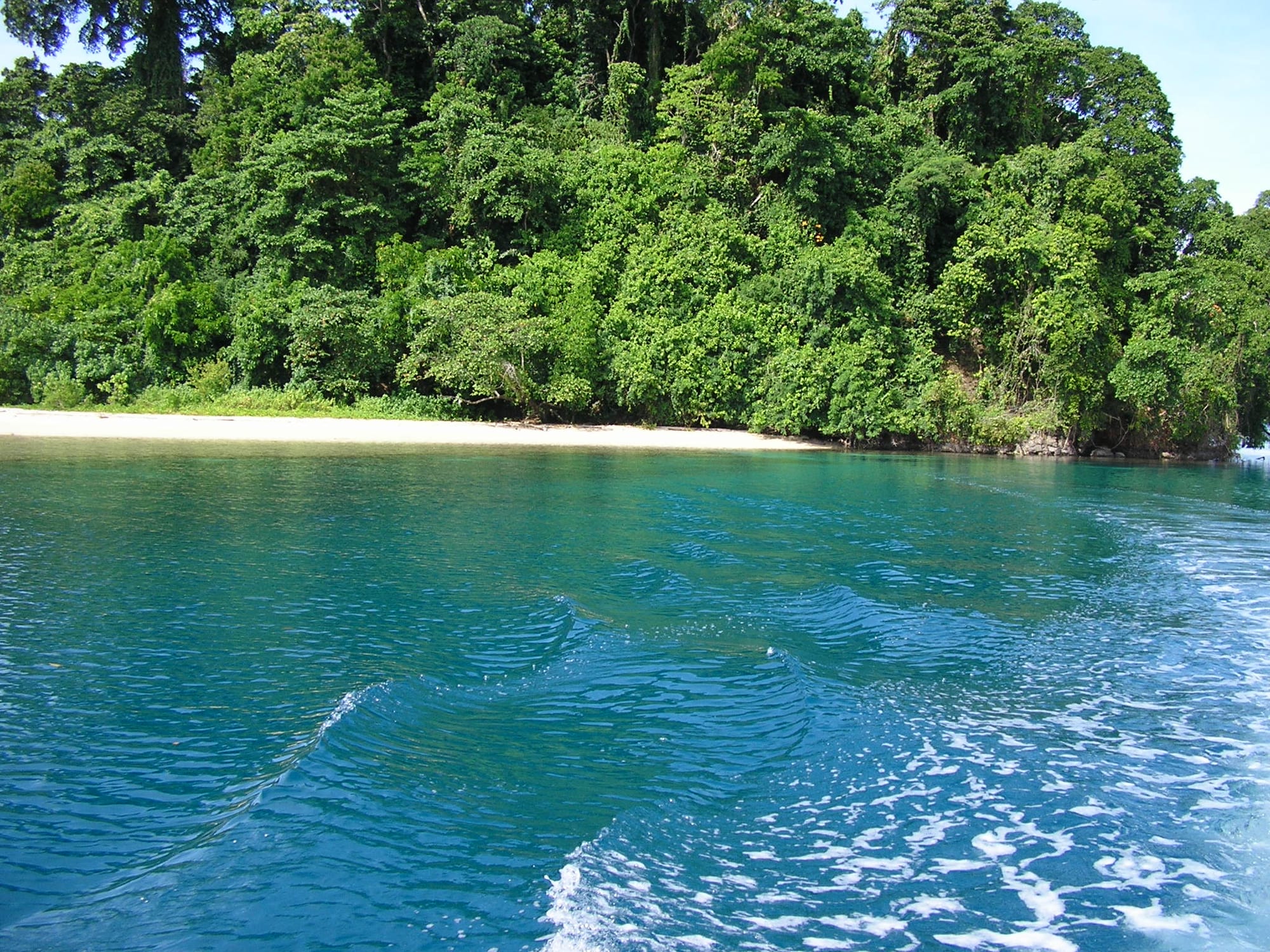
Clear turquoise water in front of a small white-sand beach backed by dense green rainforest

Papua New Guinea

The Islands Region

The beach and forest of Restorf Island in Kimbe Bay, off West New Britain. (Kimbe / Wikimedia Commons · CC BY-SA 3.0)

The islands off Papua New Guinea's northeast coast — New Britain, New Ireland and the Admiralty Islands of Manus in the Bismarck Archipelago, and Bougainville in the Solomon chain — a volcanic, reef-fringed region of cocoa and copra villages, the Tolai heartland around Rabaul, and the autonomous region of Bougainville.

Explore The Islands Region

History

The islands were settled tens of thousands of years ago, and New Ireland saw several waves of migration over the last 40,000 years. Much later, more than 3,000 years ago, the Lapita people, makers of distinctive stamped pottery, spread through the Bismarck Archipelago before voyaging on into the wider Pacific.

Germany annexed the Bismarck Archipelago in 1884, and plantations of coconut and cocoa spread over the Gazelle Peninsula of New Britain. The colonial capital moved from Kokopo, then Herbertshöhe, to Rabaul in 1910. Bougainville and Buka came under German control while the islands further south went to Britain, a line that still separates Bougainville from Solomon Islands. Australia took the colony in 1914. A volcanic eruption in 1937 killed hundreds of people around Rabaul.

In 1942 Japan captured Rabaul and turned it into its main base in the South Pacific, digging tunnels through the hills and garrisoning around 100,000 troops; Allied bombing isolated it until the war ended. Manus's Seeadler Harbour became a large American base, and in 1943 Admiral Yamamoto was shot down over southern Bougainville.

After independence, the Panguna copper and gold mine in central Bougainville became a source of anger over land, pollution and revenue. Violence over the mine closed it in 1989, and the conflict that followed, from 1988 to 1998, between Bougainvillean rebels and PNG forces and among Bougainvilleans themselves, killed an estimated 1,000 to 20,000 people. The 2001 peace agreement created an autonomous government, and in 2019 about 98 per cent of voters chose independence in a non-binding referendum. Independence still needs ratification by Papua New Guinea's parliament, which has not yet been given, and in 2026 Bougainville's leaders proposed 2030 as the target date. In 1994 Tavurvur and Vulcan buried much of Rabaul in ash, and the East New Britain capital moved to Kokopo.

Culture & Customs

The Tolai of the Gazelle Peninsula are one of the country's most influential peoples. Their tabu, shell money, still has a place in custom, and the masked tubuan and dukduk societies perform at key ceremonies. The Baining people of the interior are known for the fire dance, in which dancers in huge bark-cloth masks leap through flames, and both appear at the National Mask Festival.

New Ireland is famous for malagan, carved and painted wooden figures made for elaborate funeral ceremonies that honour the dead.

Bougainvilleans often identify with the western Solomon Islands, with which they share close languages and very dark skin colour. On Manus, the anthropologist Margaret Mead studied village life in the 1920s. Christianity is near-universal across the region, Catholic, United Church and Methodist traditions being especially strong.

Daily Life

Kokopo, which grew after the 1994 eruption, is the main town and the region's commercial centre; Rabaul is a smaller port town rebuilt around the ash. Kimbe is the hub of West New Britain's oil-palm industry, Kavieng is a quiet provincial town, and Lorengau is the Manus capital. On Bougainville, Buka is the seat of the autonomous government, while Arawa, badly damaged during the conflict, is rebuilding.

Most people live in coastal villages, growing gardens and selling cocoa, copra, betel nut and fish. Oil palm dominates West New Britain, logging has cleared large areas of New Britain and New Ireland, and the Lihir gold mine on an island off New Ireland is a major producer. Whether and how to reopen Panguna is a live debate on Bougainville, tied up with its future status.

From 2001 and again from 2012 Australia ran a detention centre on Manus for asylum seekers who had tried to reach Australia by boat. PNG's Supreme Court ruled it unconstitutional in 2016, and it closed in 2017.

Food

Island cooking uses coconut in almost everything. The best-known Tolai dish is aigir, chicken or pork with greens, taro and sweet potato, wrapped in banana leaves and cooked with hot stones and coconut cream. Reef fish, crab and shellfish are grilled or stewed in coconut milk, and bananas, taro, yams and breadfruit are the staples.

Around Rabaul, megapode birds bury their large eggs in the warm volcanic ground and leave the heat to incubate them. Galip nuts, from the canarium tree, are gathered in East New Britain and Bougainville and eaten roasted or raw.

Cocoa is the region's great cash crop, and Bougainville and the Gazelle Peninsula are both known for their beans. Kokopo's market sells fresh produce, smoked fish and betel nut, and lager is the everyday beer.

Attractions & Natural Wonders

In East New Britain, Rabaul and Kokopo sit around Simpson Harbour, beneath the active cone of Tavurvur and its twin Vulcan, whose 1994 eruption buried much of Rabaul. Wartime sites include the many kilometres of tunnels that the Japanese dug into the hills around the town.

In West New Britain, Kimbe Bay's diving draws visitors to coral reefs and reef-fringed islands, and Mount Ulawun rises on New Britain's north coast. New Ireland runs northwest to Kavieng, whose surf breaks work in the northern monsoon; the island's reefs, the Boluminski Highway and its malagan carving traditions are its other draws.

Manus, the largest of the Admiralty Islands, has reefs, lagoon villages and Seeadler Harbour, where the Second World War base once stood. On Bougainville, Buka and the Buka Passage lie in the north, Arawa and the old Panguna mine in the centre, and the crash site of Yamamoto's plane in the jungle near Buin in the south.

Cities in The Islands Region

Planning basics

Budget

The islands are reached by domestic flights, which make up much of the cost. Kokopo has the widest range of hotels and guesthouses and is one of the easier places in the country to stay, while Kimbe Bay and Kavieng are visited mainly on dive-resort and surf-camp packages. Manus and Bougainville have few hotels and simple guesthouses, and boat charters between islands are expensive.

Daily Budget Midrange
USD 220–450+ (Kokopo hotel, a Kimbe Bay dive resort or Kavieng surf camp with flights, guided tours of Rabaul)
Daily Budget Shoestring
USD 80–140 (guesthouse in Kokopo, Kavieng or Buka, market food, local PMV boats or trucks arranged through a host)

Dive and surf packages usually include airport transfers and boat trips, and are often better value than arranging them separately.

Safety

The islands are generally calmer than the mainland towns, and Kokopo and Kavieng are among the easier places in the country to visit, but theft, robbery and drunken violence occur, especially after dark and in the oil-palm towns of West New Britain. Tavurvur and Mount Ulawun are active volcanoes, and earthquakes and tsunami are real risks. In central Bougainville, around Panguna, the legacy of the conflict and disputes over the mine remain sensitive.

Visit central Bougainville only with a trusted local guide, follow volcano and tsunami alerts, and carry insurance with evacuation cover. Check current official travel advice before travelling.

Climate

Hot and humid all year, with lowland temperatures around 23–32°C and rain in every month. Rainfall and the timing of the wettest months vary from island to island, and the mountain interiors of New Britain and Bougainville are wetter and cooler. Around Rabaul, volcanic ash from Tavurvur can drift over the town and airport when the volcano is active.

Summer
the northwest monsoon, roughly December–March: hot and humid, heavy rain on many coasts, and surf at Kavieng and on New Ireland
Winter
the southeast trade season, roughly May–October: similar temperatures, steady trade winds, calmer seas on northern coasts

Transportation

Flights link Port Moresby with Rabaul's Tokua airport near Kokopo, Hoskins for Kimbe Bay, Kavieng, Momote on Manus and Buka. Roads are limited: New Britain has short networks around Kokopo and Kimbe, New Ireland has the long Boluminski Highway down its east coast, and Bougainville has a limited road network. Travel between islands is by small ship, banana boat or charter plane.

Use boats with life jackets and a spare engine, avoid open-sea crossings in bad weather, and leave spare days in case volcanic ash or weather closes airports.

Best Time to Visit

Diving is possible all year, with calmer seas in Kimbe Bay usually between about April and November. Surf around Kavieng runs from about November to April with the northern swells. The National Mask Festival in Rabaul is held in July, with Tolai and Baining dances, and Bougainville marks its own days of culture and remembrance through the year.