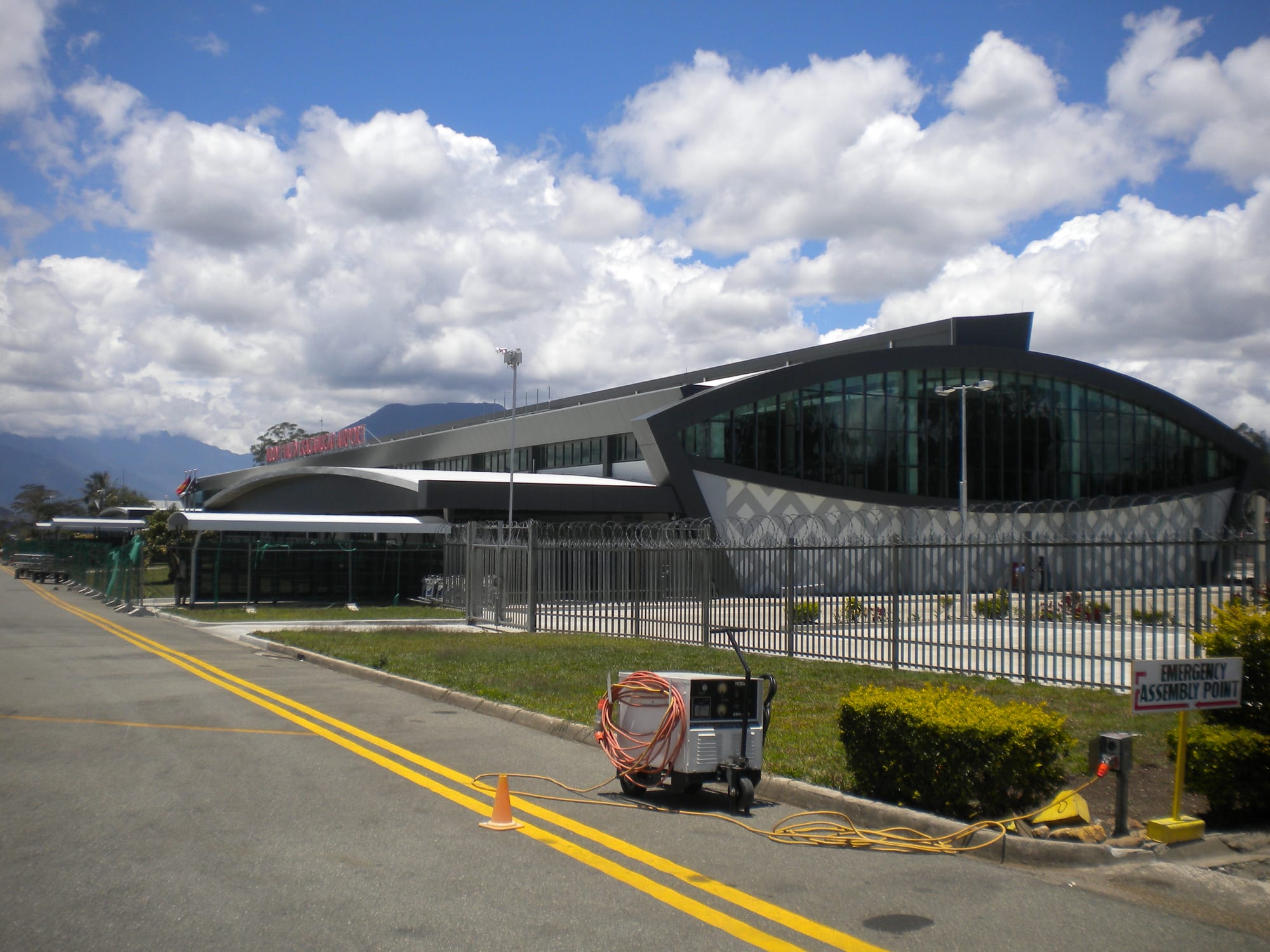
A curved glass and steel airport terminal under tall white clouds, with dark highland ridges rising behind it

The Highlands, Papua New Guinea

Mount Hagen

The terminal at Kagamuga Airport outside Mount Hagen, the main gateway to the Highlands. (Samidelux4 / Wikimedia Commons · CC BY-SA 4.0)

The commercial centre of the Papua New Guinean Highlands, set at about 1,700 metres in the Wahgi Valley and named after the old volcano 24 kilometres to the north-west. A patrol post and airstrip in the 1930s, it grew on coffee, tea and trade into the country's third-largest city, and is best known abroad for the cultural show that gathers clan groups in feathers and paint each August.

Neighbourhoods

  • The town centre
    • First-time visitors
    • Banks and shops
    • Close to the market

    A compact grid of shops, trade stores, banks, offices and hotels around the main street. It is busy and crowded by day, empties quickly in the late afternoon, and holds most of the places a visitor needs.

    Open in Maps
  • Around the main market
    • Markets
    • Local life

    The produce market beside the centre is the reason many people come to town, with vegetables, coffee, bilum bags and betel nut changing hands from early morning. The surrounding streets are the busiest and most closely watched in the town.

    Open in Maps
  • Kagamuga and the airport road
    • Arrivals and departures
    • Hotels

    The road north-east towards Kagamuga Airport passes warehouses, coffee factories, guarded compounds and several of the town's hotels. Most visitors see this stretch first and use a hotel vehicle on it.

    Open in Maps
  • The Wahgi valley edge
    • Quiet and residential
    • Gardens and coffee

    Beyond the built-up town, homesteads, gardens, coffee blocks and church stations spread along the valley floor and up the ridges. Lodges in the surrounding hills use the height for cooler air, views and birdwatching.

    Open in Maps

Things to do

The valley and its history

  • Kuk Early Agricultural Siteattraction

    A World Heritage Site since 2008, in the Wahgi Valley, where drainage ditches and garden mounds show cultivation from about 9,000 years ago — taro first, then bananas and sugar cane — evidence of agriculture developed independently in New Guinea.

    Open in Maps
  • Mount Hagen Airporttransit hub

    The Kagamuga airfield north-east of town, built in 1934 and now the second-biggest airport in the country, with daily flights to Port Moresby.

    Open in Maps
  • Mount Hagenviewpoint

    The old, heavily eroded stratovolcano that gave the town its name, about 24 kilometres north-west on the Western Highlands–Enga border, and the second-highest volcano in the country after Mount Giluwe.

    Open in Maps

Markets and crafts

  • Mount Hagen marketmarket

    The main produce market, where growers bring sweet potato, greens, corn, sugar cane, peanuts and seasonal karuka nuts, and women sell woven bilum bags.

    Open in Maps
  • Highlands coffee countryattraction

    Smallholder blocks and old plantations around the town grow the arabica that leaves the Highlands by road and air; several estates and factories can be visited with a guide.

    Open in Maps

Short trips from the town

  • Mount Giluweviewpoint

    An eroded shield volcano south-west of the valley, in the Southern Highlands, and at 4,367 metres the second-highest mountain in the country as well as the highest volcano in Oceania, with vast alpine grasslands above its moss forest.

    Open in Maps
  • Highlands Highwayattraction

    The road that carries almost everything the Highlands buys and sells, climbing from the port of Lae through the Markham Valley, Kainantu, Goroka and Kundiawa into the Wahgi Valley; a two-lane road for most of its length, often hindered by potholes and landslips.

    Open in Maps
  • Mount Wilhelmviewpoint

    The highest mountain in Papua New Guinea, at 4,509 metres, climbed from the Chimbu side past twin glacial lakes and reckoned the most accessible of the country's big peaks; several hours east of the valley by road.

    Open in Maps
  • Kundiawaattraction

    The capital of Chimbu Province in a deep valley east along the Highlands Highway, a stop on the way towards Mount Wilhelm.

    Open in Maps

Seasonal events

  • Mount Hagen Cultural ShowAugust

    The town's sing-sing, one of the largest cultural events in the country, when clan groups from across the Highlands and beyond perform in feather headdresses, shell ornaments and body paint at the showground.

  • Independence Day16 September

    The anniversary of independence in 1975, marked with parades, dancing, sport and church services across the town.

  • Coffee harvestthe harvest months

    Not a festival but the busiest season, when cherries are picked, sold to the roadside buyers who handle much of the smallholder crop, and trucked or flown out, and money moves through the town.

Eat and drink

Long-standing places and food districts in Mount Hagen. Hours, ratings and directions come from your maps app, always current.

Markets

  • Mount Hagen marketmarket

    The town's big fresh market: kaukau and taro, cabbages, carrots, beans and broccoli grown in the cool valley, bananas and betel nut brought up from the coast, and karuka nuts in season.

    Open in Maps
  • Roadside buying and food stallsneighborhood

    Along the highway and market edges, stalls sell roasted kaukau and corn, scones, fried flour balls, cooked greens and sweet tea to travellers and market-goers.

    Open in Maps

Places to eat

  • Hotel dining roomsneighborhood

    The town's hotels and the lodges in the hills run most of its sit-down eating, serving mumu-style pork and vegetables, grilled meat, rice dishes and local arabica coffee.

    Open in Maps
  • Trade-store takeawaysneighborhood

    Counters attached to the main-street stores sell fried chicken, lamb flaps, rice and instant noodles, the standard town meal across Papua New Guinea.

    Open in Maps

Experience Mount Hagen

History

The Wahgi Valley has been farmed for a very long time. At Kuk, on the valley floor near the modern town, archaeologists have traced drainage ditches and garden mounds showing that taro, bananas and sugar cane were being cultivated thousands of years ago, making New Guinea one of the places where agriculture began independently. The arrival of the sweet potato, within the last few centuries, allowed far denser populations and much larger pig herds, and the valley became one of the most heavily settled parts of the island.

Outsiders knew nothing of it until the 1930s. In 1933 the Australian gold prospector Mick Leahy, his brother Dan and the government officer Jim Taylor flew over the valley and then walked in with a patrol, the first Westerners to meet the peoples living there, and found a landscape of gardens and a dense population. The first patrol built an airstrip at Kelua, a short distance from the modern town, which takes its name from the volcano to the north-west that the Germans had named after Curt von Hagen, a colonial officer, and mission stations, trade stores and a coffee industry followed. Aircraft, not roads, tied the new town to the coast for years.

After the Second World War the post grew into the commercial hub of the Highlands: coffee and tea plantations spread through the valley, the Highlands Highway eventually connected it to the port of Lae, and the town became the capital of Western Highlands Province. Since independence in 1975 Mount Hagen has grown quickly and struggled with the results — unemployment, squatter areas, crime and the spread of guns into clan fighting. In May 2012 three neighbouring districts of the eastern valley were separated to form Jiwaka Province.

Culture & Customs

This is the country of the Melpa-speaking people, whose social world is built on exchange. The moka, a system of competitive gift-giving in which pigs, shells and later money were handed over in ever larger quantities, once linked whole districts and made the reputations of big men, leaders whose authority rested on generosity and persuasion rather than inheritance. Its logic still runs through bride-price, compensation payments and church fundraising.

Decoration is the region's great art. Headdresses of bird-of-paradise plumes, cassowary feathers, shells, clay and charcoal paint are assembled with care and worn with pride, and the Mount Hagen Cultural Show turned that tradition into an annual gathering of clan groups from across the Highlands and beyond. It began as a way of bringing rival groups together peacefully and is now one of the largest cultural events in the country, watched as closely by Papua New Guineans as by the few foreign visitors present.

Churches are central: Lutheran, Catholic, Seventh-day Adventist and Pentecostal congregations all have a strong presence, and Sunday is quiet. Belief in sorcery persists alongside Christianity, and accusations have led to violent attacks, mostly against women, that churches, women's groups and the state are trying to stop. Rugby league is followed intensely, bilum string bags are made and worn everywhere, and Tok Pisin is the common language of the market and the street.

Daily Life

Some 46,000 people live in the third-largest city in the country, and many more in the villages and gardens around it, giving the market its scale. Coffee is the backbone of the economy: smallholders grow most of it on blocks of a few hundred trees, sell cherries to roadside buyers in the harvest season, and depend on the highway and the airport to move it. Tea, fresh vegetables for the coastal cities, transport, wholesaling, government offices, schools and churches provide the rest of the paid work.

Most residents live in the valley rather than the centre, in homesteads among their gardens, while the fast-growing settlements on the edge of town house people who have come in from other provinces looking for work. Days begin early and business is done in the morning; by mid-afternoon the market thins and by dusk the streets are empty. Compounds are fenced, shops have grilles and security guards are everywhere.

The town's difficulties are severe and openly discussed: crime, alcohol, unemployment among young men, the cost and unreliability of the highway, land pressure as the population grows, and the spillover of clan fighting from neighbouring provinces, which displaces families and sometimes closes the roads the whole Highlands depends on.

Food

Kaukau, the sweet potato, is eaten at almost every meal, roasted in the ashes or steamed in a mumu, the earth oven in which heated stones cook pork, greens and root vegetables under banana leaves for hours. A pig killing for a wedding, a funeral or a compensation payment is the centre of Highlands hospitality, and the meat is distributed according to obligation rather than appetite.

Gardens in the cool valley grow taro, yam, bananas, sugar cane, corn, beans, peanuts and highland pitpit, a grass eaten as a vegetable, alongside introduced cabbages, carrots, broccoli and potatoes that fill the market and travel down the highway to Lae and Port Moresby. In season the oily nut of the karuka, a highland pandanus, is roasted and eaten in quantity, and marita, the red fruit of another pandanus, is cooked into a sauce in some districts.

The valley's most famous product is coffee: washed highland arabica, which makes up most of the country's crop, hand-picked on smallholder blocks and sold on as Papua New Guinean single origin abroad. It is drunk locally as well, strong and sweet, in hotel dining rooms and at market stalls. Betel nut, trucked up from the coast, is chewed everywhere despite the distance it travels, and beer is a visible and often troublesome part of town life.

Planning tools

Budget

Costs here are driven by three things: the flight from Port Moresby, a hotel or lodge that can be relied on, and a driver and guide, which are treated as necessities rather than luxuries. Show week in August fills rooms months ahead and pushes rates up sharply. Food and market produce are cheap; nothing involving a vehicle is.

Daily Budget Midrange
USD 250–500 (hotel or hill lodge, driver and guide, flights from Port Moresby, a show-week package)
Daily Budget Shoestring
USD 90–150 (mission or village guesthouse, market food, a local guide arranged through a host)

Book show-week beds and flights far in advance, and confirm that the hotel will collect guests from the airport rather than arriving without a plan.

Best Time to Visit

The drier months from May to October are easier for road travel and walking, and August brings the cultural show, the single reason most foreign visitors come. September has Independence Day celebrations and the Goroka Show further east. Rain falls in every month, so the difference between seasons is one of degree, and afternoon cloud and showers are normal all year.

Suggested Number of Days

A day or two is enough for the town, its market and the valley nearby. Three to five allow the wider valley, a lodge stay in the hills and a drive along the highway. Show week needs its own extra days, and road conditions and security can change plans at short notice.

First Visit
1–2 days
With Surroundings
3–5 days

Transportation

Everything beyond the centre is reached by road. PMV minibuses and open trucks run along the Highlands Highway and into the side valleys and are what residents use, but they are not recommended for visitors. Hotels and lodges provide vehicles and drivers, and guided trips are the normal way to see the valley. The highway itself is potholed, subject to landslides, and closed from time to time by disputes or roadblocks.

Travel only in daylight with a trusted driver, ask about the state of the highway on the day, and avoid stopping in crowds or at roadblocks.

Airport & Station Connections

Kagamuga Airport, about 13 kilometres north-east of the centre, is the second-biggest airport in the country and has daily flights from Port Moresby as well as other domestic services. By road, the Highlands Highway climbs from Lae on the north coast through Goroka and Kundiawa to the Wahgi Valley, a long haul on a two-lane road that cargo trucks take days to make. There is no road from Port Moresby.

Arrange to be met at the airport before flying in, and treat the highway as a journey to be made with an operator rather than alone.

Walkability

The centre is small and flat enough to cross in fifteen minutes, and the market is beside it, but walking is not how visitors usually move here. Streets are crowded, bag-snatching and worse are common, and hotels advise guests to use a vehicle even for short distances and not to walk at all after dark. Beyond the built-up area there are no footpaths.

Safety

Mount Hagen has high levels of violent crime, including armed robbery, carjacking, break-ins and bag-snatching, and trouble can build quickly in and around the market and the highway. Tribal fighting between clans in the provinces west and south of the town is fought with automatic weapons and can close roads without warning. Violence linked to sorcery accusations is reported in the region, and police and medical resources are limited.

Do not travel to Enga, Hela or the Southern Highlands. In and around Mount Hagen, move only with a trusted guide and driver in daylight, stay inside secure accommodation at night, keep plans flexible, avoid crowds and any disturbance, and carry insurance with medical evacuation cover. Check current official travel advice before travelling.

Climate

Altitude, not latitude, sets the weather: days are mild rather than hot and nights are cool, with mornings often clear and cloud building over the ranges by early afternoon. Rain falls in every month, and El Niño years can bring drought and damaging frosts to the higher valleys.

Summer
the wetter season, roughly December–March: generally 20–26°C by day with frequent heavy afternoon rain and landslides on the highway
Winter
the drier season, roughly May–October: similar days with clearer, colder nights around 10–13°C, and frost on the highest ground

Local Customs

Highlands life runs on clan, exchange and obligation. Standing comes from what a person can give away, pigs remain a measure of wealth, and compensation payments settle disputes. Visitors are expected to greet people properly, go slowly and be introduced rather than wander in. Land, gardens and villages have owners, so a local host or guide is the right way to visit anywhere outside the town.

Ask before photographing people, houses or gardens, and expect a payment to be appropriate for photographs of dancers in full decoration. Tipping is not customary; paying a guide, driver or landowner is. Dress modestly, and treat drunkenness in town as a reason to leave.

Common Payment Methods

The currency is the kina (PGK). Hotels, the larger stores and the airline office take cards when the connection is working; the market, PMV fares, guides and village guesthouses are cash only. Banks and a few ATMs are in the centre, and drawing cash there is best done with a driver waiting and nothing else in hand.