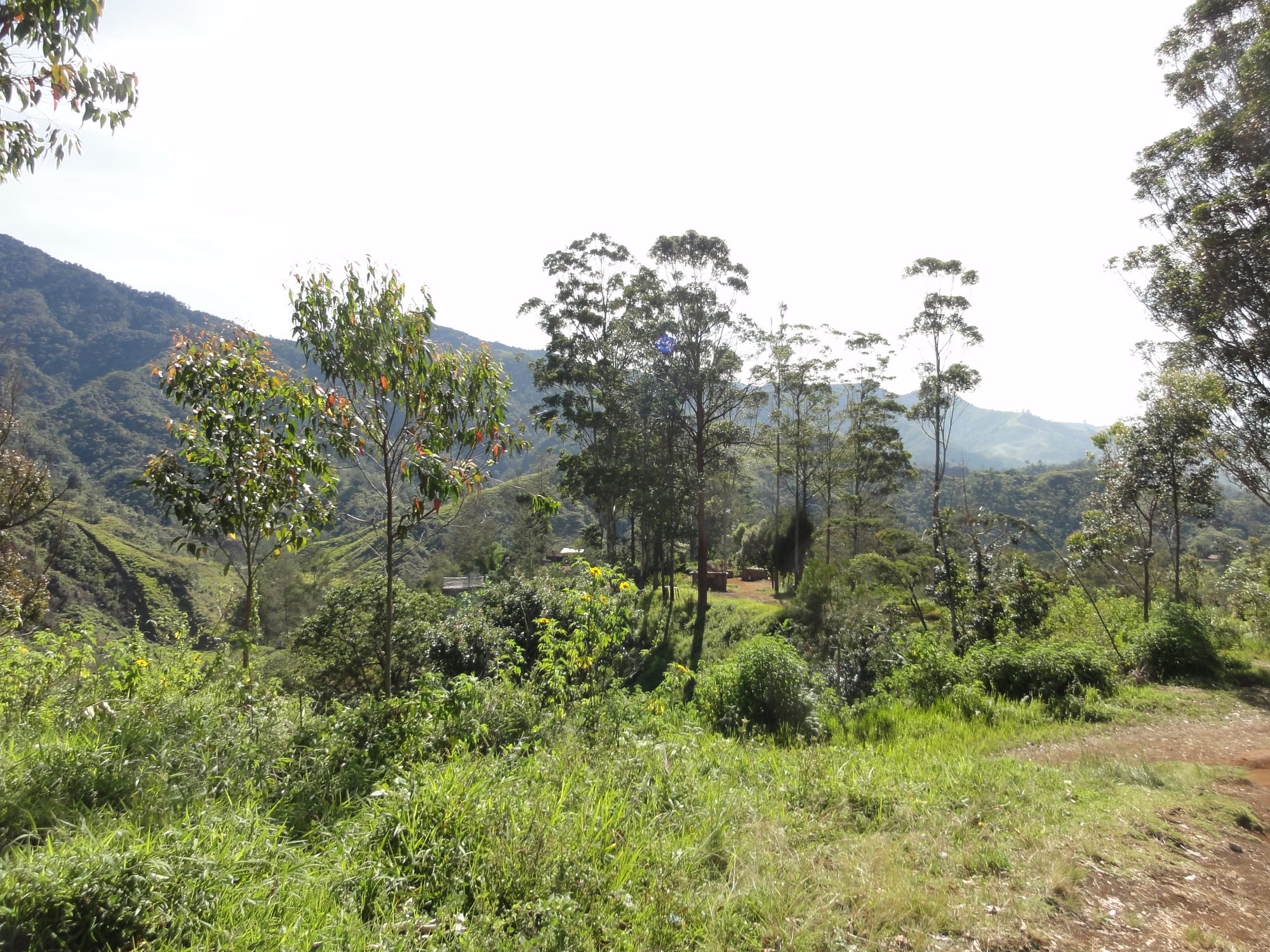
Eucalyptus trees and rough grass on a ridge above a green highland valley, with forested mountains behind

The Highlands, Papua New Guinea

Goroka

Highland ridges and garden country in the Eastern Highlands near Goroka. (eGuide Travel / Wikimedia Commons · CC BY 2.0)

The capital of Eastern Highlands Province, a cool town at about 1,600 metres in a valley of coffee gardens on the Highlands Highway. It grew from a patrol post and airstrip into a centre of coffee buying, medical research and teacher training, and is known across the country for the Goroka Show, the sing-sing that brings clan groups together each September.

Neighbourhoods

  • The town centre
    • First-time visitors
    • Banks and shops
    • Close to the market

    A small grid of stores, banks, offices and hotels a few streets across, with the main market at its edge. Business is done in the morning, and the streets thin out well before dark.

    Open in Maps
  • Around the market and showground
    • Markets
    • Festivals

    The produce market is the busiest place in town, with coffee, vegetables and bilum bags sold from early morning, and the town's show grounds fill once a year for the Goroka Show. The surrounding blocks are crowded and best visited with a local.

    Open in Maps
  • North Goroka and the university
    • Quiet and residential
    • Students

    Housing, church stations, research institutes and the university campus spread north of the centre along the road towards the hills, with gardens and coffee blocks between them.

    Open in Maps
  • The valley and the highway out of town
    • Coffee country
    • Views

    The Highlands Highway leaves town east towards Kainantu and west up over the Daulo Pass, passing coffee factories, roadside markets and homesteads scattered through the Asaro and Bena valleys.

    Open in Maps

Things to do

Museums and institutions

  • University of Gorokaattraction

    A university on a green campus north of the centre, teaching education, humanities, and science and technology, and one of several national institutions based in the town.

    Open in Maps
  • Papua New Guinea Institute of Medical Researchattraction

    The institute's headquarters and laboratories, established in 1968, known for work on kuru, malaria and respiratory disease in Highlands communities.

    Open in Maps

Around the town

  • Goroka Airporttransit hub

    The airfield in the centre of town, with daily flights to Port Moresby and the quickest way in and out of the valley.

    Open in Maps
  • Goroka marketmarket

    The main produce market, where growers sell sweet potato, greens, corn, peanuts, coffee and seasonal fruit, and women sell woven bilum bags.

    Open in Maps
  • Mount Gahavisuka Provincial Parkpark

    A provincial park of mossy montane forest and lookouts on a high ridge above the valley, its forest reaching well above 2,000 metres, a short drive up from the town.

    Open in Maps

Short trips from the town

  • Asaro mud menattraction

    Villages in the Asaro valley near the town where men perform in clay-covered bodies and large moulded mud masks, a tradition revived for the agricultural show in the 1950s and shown to visitors since the 1960s.

    Open in Maps
  • Kainantuattraction

    A smaller Highlands Highway town 90 kilometres east of Goroka, with a cultural centre best known for its pottery, and gold mining in the hills around it.

    Open in Maps
  • Highlands Highwayattraction

    The road the whole region depends on, climbing from the port of Lae over the Kassam Pass to Goroka and on towards Kundiawa and Mount Hagen.

    Open in Maps

Seasonal events

  • Goroka ShowSeptember, around Independence Day

    The country's largest cultural event, held since 1956, when about a hundred clan groups perform in feathers, shells, paint and mud over a weekend.

  • Independence Day16 September

    The anniversary of independence in 1975, marked with parades, sport, church services and dancing, and often run together with show week.

  • PNG Coffee FestivalMay

    A festival for the crop the town lives on, with coffee tastings, barista competitions and cultural performances.

Eat and drink

Long-standing places and food districts in Goroka. Hours, ratings and directions come from your maps app, always current.

Markets

  • Goroka marketmarket

    The town's main market, with kaukau, taro, cabbages, carrots, broccoli, ginger and peanuts grown in the cool valley, and karuka nuts in season.

    Open in Maps
  • Roadside stalls on the highwayneighborhood

    Stands along the road out of town sell roasted sweet potato and corn, scones, fried flour balls, cooked greens and sweet tea to drivers and market-goers.

    Open in Maps

Places to eat and drink

  • Hotel dining roomsneighborhood

    The town's hotels run most of its sit-down meals, cooking pork and vegetables in the mumu style, grilled meat, rice dishes and vegetables bought that morning at the market.

    Open in Maps
  • Coffee houses and factory shopsneighborhood

    Goroka sits at the centre of Eastern Highlands coffee country, and arabica from the surrounding valleys is roasted, sold and drunk in the town where it is traded.

    Open in Maps

Experience Goroka

History

The valleys around Goroka were farmed and densely settled long before any outsider saw them, by peoples speaking several unrelated languages who grew taro, then sweet potato, and raised pigs for the exchanges that ordered social life. First contact came in the 1930s, when Australian prospectors and patrol officers crossed the Highlands and found a populous landscape of gardens; a patrol post was set up in the Goroka valley, and an airstrip followed, which remains in the centre of the town.

After the war the post became the administrative centre of the Eastern Highlands. Coffee proved ideally suited to the valley, and by the 1950s and 1960s smallholders and planters together had made the district one of the centres of the country's coffee industry, with buyers, factories and a road link to the coast. The University of Goroka and the Institute of Medical Research, established in 1968, gave the small town an unusual concentration of institutions. The Institute's work with Highlands communities on kuru, a fatal neurological disease found among the Fore people to the south, contributed to research recognised with the 1976 Nobel Prize in Physiology or Medicine.

The first Goroka Show was held in 1956, on the initiative of Australian patrol officers, as a way of bringing rival clan groups together in peaceful competition, and it grew into the country's best-known cultural gathering. Since independence in 1975 the town has grown steadily rather than explosively, and its problems are those of the region: dependence on one highway, unemployment among young people, crime, and the strain of clan disputes in the wider province.

Culture & Customs

Goroka's reputation rests on the show. Each September the showground fills with clan groups from the Eastern Highlands and beyond, performing in headdresses of bird-of-paradise plumes, cassowary feathers, shells, pig tusks and clay and charcoal paint; the Asaro mud men, with their heavy moulded masks and clay-covered bodies, are the images that travel furthest. Behind the spectacle is a serious purpose, since the show was designed to turn rivalry into performance, and it remains as much an event for Papua New Guineans as for the handful of foreign visitors.

Eastern Highlands society runs on the same principles found across the region: clans, big men whose standing comes from what they can give away, bride-price and compensation payments, and obligations to one's wantok, the people who share a language and place. Bilum string bags, made and worn by everyone, are both craft and identity, and the province is known for its weaving, pottery and carved artefacts.

The town also carries a strong institutional culture, unusual for its size: teachers, students, researchers and coffee traders give it a mixed, relatively literate population, and the Raun Raun Theatre, built in the early 1980s and reopened after renovation in 2019, is one of the national institutions based here. Churches of several denominations are central to social life, and belief in sorcery persists alongside them, with accusations sometimes leading to violence that churches and women's groups work to prevent.

Daily Life

Around 29,000 people live in the town, with many more in the villages and gardens of the surrounding valleys who come in to sell, shop and go to hospital. Coffee sets the economic rhythm: smallholder blocks of a few hundred trees, buying points along the roads during the harvest, factories that hull and grade the beans, and trucks that carry them down the highway to Lae for export. Government offices, schools, the university, the research institutes and the hospital provide most of the salaried work.

Mornings are the working part of the day. The market opens early and is at its fullest by mid-morning, traffic on the highway builds with trucks and PMVs, and by late afternoon the centre quietens. Most families live in houses with gardens rather than flats, and food, firewood and bilum bags are part of household economics as much as cash is.

The town's concerns are practical: keeping the highway open, since everything arrives on it; the price paid for coffee cherries, which sets how much money circulates; land pressure as the population grows; law and order; and the reach of health services into valleys that are hours from a road. Young people leave for Lae and Port Moresby to study and work, and the university brings students in from other provinces.

Food

Kaukau, the sweet potato, is the everyday staple, roasted in the embers or cooked with pork, greens and root vegetables in a mumu, the earth oven of heated stones and banana leaves that marks weddings, funerals and compensation feasts. Pigs remain the centre of celebration food, and meat is shared out according to relationship and obligation.

The cool valley grows an unusual range of produce for the tropics. Alongside taro, yam, bananas, sugar cane, corn, beans, peanuts and highland pitpit, a grass eaten as a vegetable, the market carries cabbages, carrots, potatoes, broccoli, ginger and peanuts, grown in food gardens alongside the coffee. In season the oily nut of the karuka pandanus is roasted and eaten in quantity.

Coffee is the town's signature. Arabica from the surrounding valleys is picked by hand, processed nearby and sold on to roasters abroad, and it is drunk here too, strong and sweet, in hotel dining rooms and at market stalls. Betel nut comes up by truck from the coast and is chewed everywhere; beer is widely drunk and a recognised source of trouble in the evenings; and a trade-store meal of fried chicken, lamb flaps, rice or noodles is the fallback for anyone in a hurry.

Planning tools

Budget

Goroka is a little cheaper and calmer than Mount Hagen, but the same costs dominate: the flight from Port Moresby, a hotel that can be relied on, and a guide with a vehicle for anything outside the town. Show week in September fills rooms months ahead and raises prices. Market food is very cheap, and guesthouses run by missions and villages cost a fraction of hotel rates.

Daily Budget Midrange
USD 250–450 (hotel or lodge, driver and guide, flights from Port Moresby, a show-week package)
Daily Budget Shoestring
USD 90–150 (mission or village guesthouse, market food, a local guide arranged through a host)

Book show-week beds and flights months ahead, and arrange to be met at the airport rather than sorting out transport on arrival.

Best Time to Visit

The drier months from June to September are the easiest for road travel and walking in the valleys, and September brings the Goroka Show and the Independence Day celebrations, the busiest week of the year. Similar shows are held in Mount Hagen and other towns. Rain falls in every month and cloud builds most afternoons, so the seasons differ in degree rather than kind.

Suggested Number of Days

A day or two covers the town, its market and its institutions. Three or four allow the valleys nearby, a forest park and a drive along the highway. Show week is worth extra days of its own, and road conditions or security can change plans at short notice.

First Visit
1–2 days
With Surroundings
3–4 days

Transportation

The town is small enough to cross on foot, and everything beyond it goes by road. PMV minibuses and open trucks run the Highlands Highway and the side valleys and are what residents use, but are not recommended for visitors. Hotels and lodges provide vehicles with drivers, and guided day trips are the usual way to reach the Asaro valley, the pass and the forest park.

Travel in daylight with a trusted driver, ask about the state of the highway before setting out, and do not stop at roadblocks or in crowds.

Airport & Station Connections

Goroka Airport sits in the centre of town, with daily flights from Port Moresby. By road the town is on the Highlands Highway, about 285 kilometres from the port of Lae over the Kassam Pass, 90 kilometres west of Kainantu and east of Mount Hagen beyond the Daulo Pass; the road journeys take most of a day. Travel to and from Port Moresby is by air.

Confirm flights the day before, since Highlands services are often rescheduled by weather, and have a hotel vehicle waiting.

Walkability

The centre is one of the more walkable Highlands towns: the market, shops, airport and several hotels stand within a few hundred metres of each other, and the altitude keeps the air comfortable. Even so, hotels advise guests to walk only in daylight, in the busiest streets, carrying nothing valuable, and to use a vehicle in the evening. There are no footpaths outside the built-up area.

Safety

Goroka is generally calmer than Mount Hagen, and by Highlands standards it is an easy town to be in, but crime is real: bag-snatching, break-ins, theft and alcohol-related trouble, mostly after dark. Clan fighting occurs in parts of the province and can close roads, holdups happen on the Highlands Highway, and violence linked to sorcery accusations is reported in the region. Police and hospital resources are limited.

Do not travel to Enga, Hela or the Southern Highlands. In and around Goroka, move with a trusted guide and driver, travel by road only in daylight, stay in secure accommodation at night, avoid crowds and any disturbance, and carry insurance with medical evacuation cover. Check current official travel advice before travelling.

Climate

Altitude gives the town a mild, spring-like climate: warm days, cool nights and none of the coastal humidity. Mornings are often clear, cloud gathers over the ranges by early afternoon, and rain falls in every month. Drought and frost can hit the higher valleys in El Niño years.

Summer
the wetter season, roughly December–March: warm to very warm afternoons of about 23–27°C, with frequent heavy rain and landslides on the highway
Winter
the drier season, roughly June–September: similar warm afternoons with clearer skies and cool mornings near 15°C, colder on the high passes

Local Customs

Clan, exchange and obligation shape life here as across the Highlands: pigs are wealth, generosity builds standing, and compensation payments settle disputes. Visitors are expected to greet people properly and to be introduced rather than turn up unannounced. Land, gardens and villages all have owners, so visits outside town go through a host or guide. Churches are strong and Sundays are quiet.

Ask before photographing people, houses or gardens, and expect a payment to be appropriate for photographs of performers in full decoration. Tipping is not customary, but paying guides, drivers and landowners is. Dress modestly, and avoid drinking places in the evening.

Common Payment Methods

The currency is the kina (PGK). Hotels and the larger stores accept cards when the connection is up; the market, PMV fares, guides and village guesthouses need cash. Banks and a few ATMs are in the centre, and cash is best drawn inside a bank with a vehicle waiting rather than from a street machine.