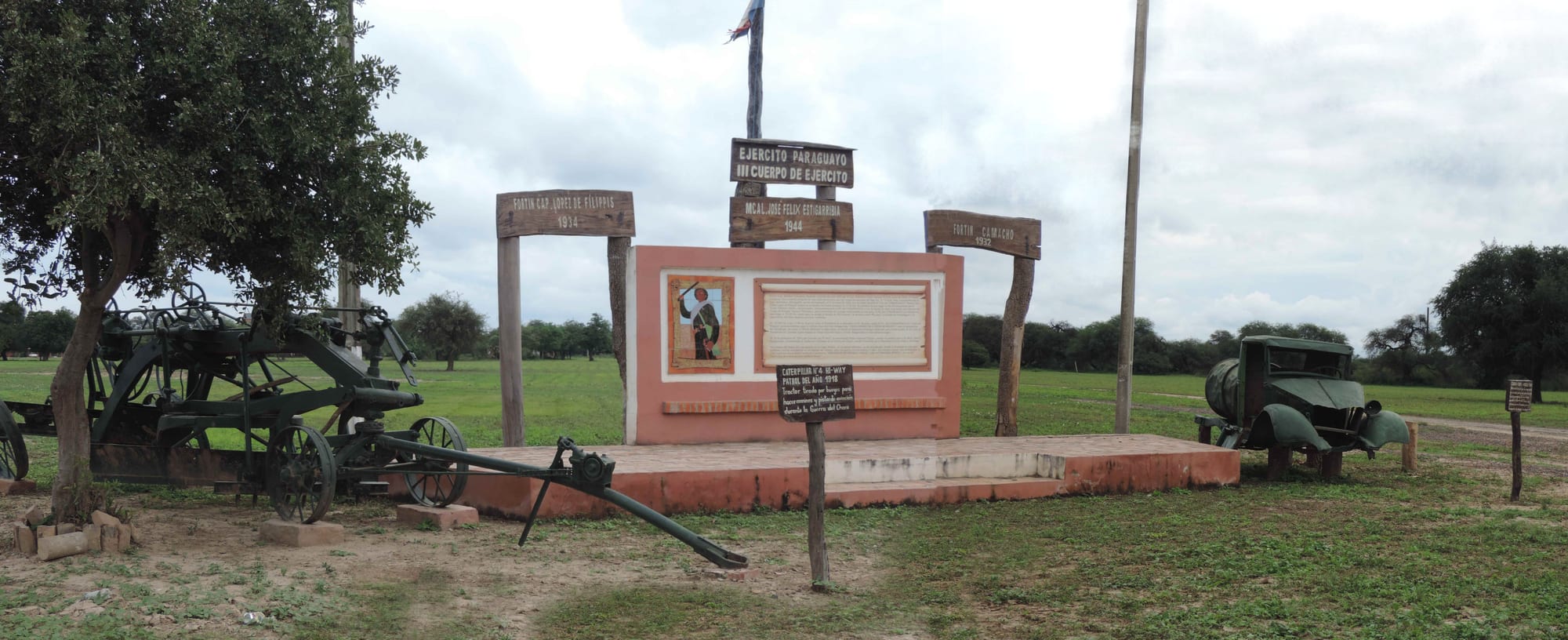
A pink memorial platform with wooden signs for the old fort names, flanked by old field guns and an army truck on grass

The Chaco, Paraguay

Mariscal Estigarribia

A military memorial with old field guns at Mariscal Estigarribia. (Rodney Damián / Wikimedia Commons · CC BY-SA 3.0)

A military town on the Transchaco highway in the heart of the Paraguayan Chaco, about 520 km north-west of Asunción. Founded as a Bolivian fort, captured in the Chaco War and renamed after Paraguay's victorious commander, it grew around a large army base and a giant airport, and is the last stop with services before the remote north-west and the Bolivian border.

Neighbourhoods

  • The town along the Transchaco
    • First-time visitors
    • Shops and services

    The civilian town, a long string of blocks on the east side of the highway, with the bus terminal, the town hall, the new cathedral, supermarkets, petrol stations and the businesses that serve soldiers, truck drivers and travellers.

    Open in Maps
  • The military quarter
    • History
    • Chaco War heritage

    West of the highway lie the army base, the largest in the Chaco, with the old red-brick cathedral, a reservoir that looks like a small lake and the road to the huge airport. Visitors can usually enter by showing identification at the gate.

    Open in Maps
  • Santa Teresita
    • Local life
    • Crafts

    The Indigenous community about 3 km south on the Transchaco, home to Guaraní Occidental, Guaraní Ñandeva, Nivaclé and Manjui people, with a round church and an Indigenous public high school. Crafts such as bags, carpets and palo santo carvings are sold here.

    Open in Maps

Things to do

In and around town

  • Old cathedrallandmark

    A red-brick church inside the military base, holding the tomb of the Belgian priest Pedro Shaw, known as Pa'í Pukú, 'the tall priest', who travelled the Chaco on horseback.

    Open in Maps
  • Dr. Luis María Argaña International Airportlandmark

    A military-run airport built by army engineers between 1977 and 1986, with the longest runway in Paraguay, empty hangars and a control tower out of all proportion to the town.

    Open in Maps
  • New cathedral and museummuseum

    A modern church in the civilian town, with a carved wooden Virgin by a sculptor from Tobatí, and an adjoining museum of Nivaclé craftwork, old household technology and bullets from the Chaco War.

    Open in Maps
  • Santa Teresita churchlandmark

    The circular church of the Indigenous community, with a round altar adapted to local tradition, visited by Pope John Paul II in 1988.

    Open in Maps

Short trips from the town

  • Filadelfianeighborhood

    The capital of the Fernheim Mennonite colony, with museums of the settlers and the Chaco's wildlife, and the region's best services.

    Open in Maps
  • Loma Plataneighborhood

    The centre of the Menno Colony, the first Mennonite colony in the Chaco, founded in 1927 by settlers from Canada, with its dairy industry and colony museum.

    Open in Maps

Seasonal events

  • Areté GuazúCarnival, February or March

    A three-day Guaraní 'big celebration' in Santa Teresita, with masks, long costumes, flutes and drums, and chicha made from algarrobo fruit; visitors are invited to join.

  • Transchaco RallyLate September or early October

    Paraguay's biggest motor rally, started in 1971, which begins and ends in Asunción but holds its main stages around Mariscal Estigarribia and brings large crowds to the town.

Eat and drink

Long-standing places and food districts in Mariscal Estigarribia. Hours, ratings and directions come from your maps app, always current.

Mariscal Estigarribia classics

  • Supermarkets along the Transchacomarket

    Well-stocked supermarkets on the highway where travellers stock up on food and water before heading further into the Chaco.

    Open in Maps
  • Town restaurants and roadside stopsneighborhood

    A few simple restaurants and snack bars in town and convenience stores at the petrol stations, serving the truck drivers, soldiers and travellers on the highway.

    Open in Maps

Experience Mariscal Estigarribia

History

The town began as a Bolivian fort. In June 1931, as Bolivia pushed roads and outposts into the disputed Chaco, its army founded Fortín General Eliodoro Camacho here, and in 1932 expeditions set out from it towards the lagoon of Pitiantuta, part of the clashes that led to the Chaco War. After the encirclement at Campo Vía, Bolivian troops abandoned the fort, and Paraguay took it in January 1934, renaming it Fortín López de Filippis. On 31 July 1934 General José Félix Estigarribia moved his main headquarters here for the last stage of the war, turning the post into a military town.

The 1938 peace treaty confirmed the site as Paraguayan territory. In December 1944 it was renamed Mariscal José Félix Estigarribia, honouring the commander who had been made a national hero and promoted to marshal after his death in a plane crash in 1940. A large army base was kept here to guard against another conflict with Bolivia, and the soldiers' families formed the first town. The army ran it alone until 1973.

Only in the early 1980s was land surveyed for civilian settlers. In the same years military engineers built a giant airport, completed in 1986 as part of a planned free-trade zone, whose real purpose has long been debated. In 2005–06 US troops took part in joint exercises with Paraguay's army, fuelling rumours of a foreign base. In 2006 Filadelfia and Loma Plata split off as districts of their own, yet Mariscal Estigarribia remains the largest municipality in Paraguay.

Culture & Customs

Mariscal Estigarribia is known as "the military city" and "the heart of the Chaco". The army's Third Corps and an infantry division are based here, and the town's memorials, field guns and old fort names keep the Chaco War present in daily life. The town anniversary has only been celebrated since 1998, when the documents creating the municipality were rediscovered.

The Indigenous community of Santa Teresita, on the southern edge of town, gives the place another identity. Its Guaraní Occidental, Guaraní Ñandeva, Nivaclé and Manjui people built a round church with a round altar to suit their own traditions, visited by Pope John Paul II in 1988, and run an Indigenous public high school. At carnival the Guaraní hold the Areté Guazú, a three-day "big celebration" with masks of jaguars, pigs and ancestors, flutes and drums, considered one of the most authentic in the country.

The Catholic Church has deep roots here through the Oblate priest Pedro Shaw, Pa'í Pukú, who travelled the Chaco on horseback and founded a pioneering Indigenous school; he is buried in the old cathedral. Each spring the town is taken over by the Transchaco Rally, Paraguay's biggest motor race.

Daily Life

About 13,200 people lived in the municipality at the 2022 census, spread across a vast area that includes border posts and small settlements; the town itself has only a few thousand residents, and growth is slow because of the harsh climate and limited services.

Unlike the Mennonite towns to the south-east, Mariscal is not an industrial colony. Its economy is that of a frontier town: most people depend on state institutions — the army, the regional hospital, the municipality — and on businesses serving soldiers, truck drivers on the Transchaco and travellers heading to or from Bolivia. In 2025 the government announced plans for a large new general hospital for the Chaco here.

Life follows the heat. The air is often hot, windy, dusty and dry, rain comes in short, violent summer storms, and in November 2023 the town recorded South America's highest-ever minimum temperature. Days start early, the highway is the main street, and supplies, water and fuel are the constant concerns of anyone heading further into the Chaco.

Food

Mariscal Estigarribia eats like the rest of the Chaco, with beef at the centre. Asado, beef grilled over charcoal, is the social meal, and Paraguayan staples — sopa paraguaya, a cornbread with cheese and onion; chipa, cheese bread made with cassava starch; and mandioca, boiled cassava — fill the plates of the snack bars and family kitchens.

Tereré, cold yerba mate shared from one cup through a metal straw, is drunk through the hot days; it has been declared the national drink of Paraguay, with its own day on the last Saturday of February. Asado has been the Paraguayan favourite for Sundays and celebrations since the first cattle arrived in Asunción in 1556. The supermarkets and petrol-station stores on the highway are where travellers buy food and water before driving on, and the Mennonite colonies to the south-east contribute heavily to Paraguay's dairy output.

The Indigenous communities ferment the fruit of the algarrobo, a tree of the Chaco, into chicha, which is drunk at the Areté Guazú at carnival.

Planning tools

Budget

Daily costs in town are low, with simple lodgings, a few snack bars and supermarkets. What costs money is going further: guided trips into the northern Chaco and its national parks, which last one to three days and need a four-wheel-drive vehicle, fuel, a guide and supplies.

Daily Budget Midrange
USD 100–250 (best hotel in town, guided 4x4 trips into the Chaco)
Daily Budget Shoestring
USD 35–60 (simple inn, snack-bar meals and supermarket food, buses)

Bring cash: very few shops take cards, and there is a single ATM in town. During the Transchaco Rally rooms in the area are hard to find without a booking.

Best Time to Visit

May to September, the dry and cooler season, is the time for trips into the Chaco. Summer, from November to March, is extremely hot, and storms can make dirt roads impassable. The Transchaco Rally in late September or early October brings crowds and noise, and the Areté Guazú is held at carnival.

Suggested Number of Days

A night is enough for the town itself, which most travellers use as a supply stop or a border-formalities stop. Allow three to five days for guided trips into the Chaco and the Mennonite colonies; expeditions to the far national parks take longer.

First Visit
1 day
With Surroundings
3–5 days

Transportation

The town is spread out along the highway, and most places are reached on foot or by car. Beyond the paved roads, the Chaco is explored with a four-wheel-drive vehicle and a guide. The Transchaco continues about 231 km to the Bolivian border, and the unpaved Picada 500 runs south-west towards a remote crossing into Argentina, with no public transport.

Fill up with fuel and water at every opportunity, never drive at night, and tell someone the route before leaving the main roads.

Airport & Station Connections

Mariscal Estigarribia lies on the Transchaco highway, about 520 km from Asunción. Daily buses from Asunción run via Loma Plata and Filadelfia, and international buses between Asunción and Santa Cruz, Bolivia, stop here, usually at night. Travellers heading for Bolivia should check in advance where to get the Paraguayan exit stamp.

Walkability

The town stretches in a long line along the Transchaco, so walking from end to end takes time, and the heat and dust are hard going for much of the year. The civilian centre around the town hall is compact, but the airport and Santa Teresita are better reached by car.

Safety

Paraguay is relatively safe and low-profile for visitors. Mariscal Estigarribia is a quiet garrison town; the real risks are extreme heat, dehydration and the great distances without fuel, phone signal or medical care. The road to the Bolivian border is a smuggling route.

Carry plenty of water and a hat, travel off the main roads with a guide or a second vehicle, carry identification for the military base, and take precautions against dengue and Chagas disease. Check current official travel advice before travelling.

Climate

Hot and semi-arid, on the edge of a tropical savanna climate; the town is known as one of the hottest places in South America and holds the continent's record for the highest minimum temperature, 34°C, set in November 2023. Rain falls mostly in summer storms; winters are dry, with little or no rain.

Summer
November–March: very hot, averaging around 29°C, with highs that can pass 43°C and sudden storms
Winter
June–August: mild, with a July average around 19°C, warm afternoons and occasional nights near 0°C

Local Customs

Spanish and Guaraní are the everyday languages, alongside the languages of the Indigenous communities and German in the Mennonite colonies nearby. Much of the town is shaped by the army; respect military rules, and enter the base only with permission at the gate. The Indigenous people of Santa Teresita are generally reserved with outsiders.

Ask before photographing people and never photograph military installations without permission. Dress modestly in the churches, and buy crafts directly from the makers in Santa Teresita.

Common Payment Methods

The currency is the guaraní (PYG). This is a cash town: very few shops accept cards, and there is a single ATM at the roundabout by the military quarters. Bring enough cash for onward travel, as there are few chances to get more further into the Chaco.