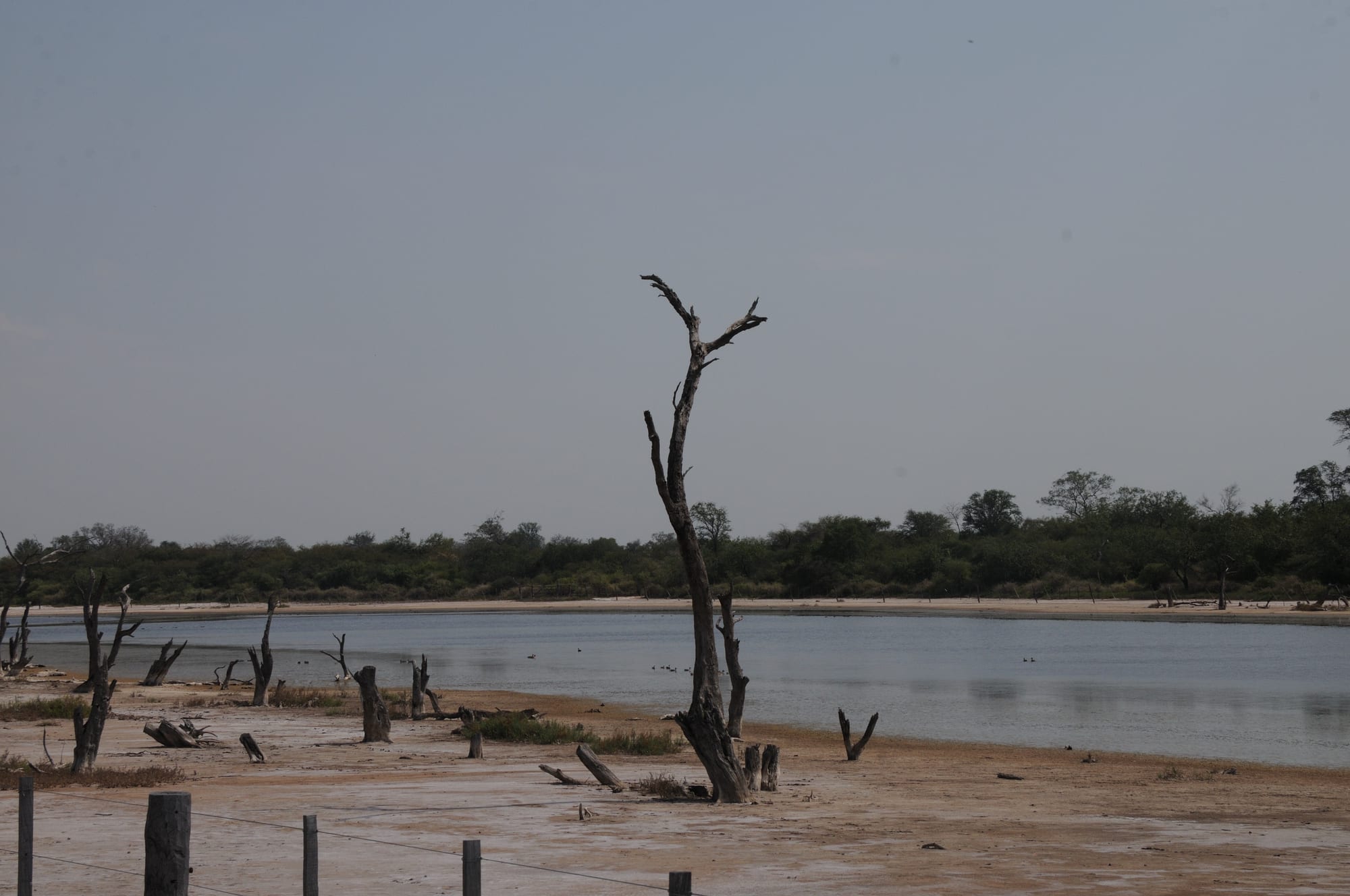
A shallow grey lagoon with a pale salty shore, dead tree trunks in the foreground and low dry scrub forest beyond

Paraguay

The Chaco

Saline lagoons and dry scrub in the Paraguayan Chaco. (Josep M. Gracia / Wikimedia Commons · CC BY-SA 4.0)

Paraguay's western region beyond the Paraguay river, more than half the national territory but home to only a few per cent of its people — a hot, flat land of palm savanna, thorn forest and saline lagoons, the battleground of the Chaco War, now shared by Indigenous peoples, cattle ranchers and the German-speaking Mennonite colonies around Filadelfia.

Explore The Chaco

History

The Chaco was long the domain of hunting, gathering and fishing peoples — ancestors of the Enxet, Nivaclé, Ayoreo, Ishir, Guaraní Ñandeva and others — who resisted outsiders for centuries. Spanish expeditions from Asunción crossed it in search of the silver of Peru, but colonial Paraguay never settled it beyond a few river forts such as Fuerte Olimpo, founded in 1792.

After the War of the Triple Alliance, Argentina claimed part of the region; in 1878 an arbitration by US President Rutherford B. Hayes awarded it to Paraguay, which named Villa Hayes and the department of Presidente Hayes after him. To raise money, the state sold huge tracts, and companies such as Carlos Casado's built tannin factories at Puerto Casado and other river ports to process quebracho wood, with rail lines into the forest.

Mennonites arrived from the 1920s under a 1921 law that granted exemption from military service and freedom to run their own schools in German: the Menno colony, founded in 1927 by settlers from Canada, Fernheim in 1930 by refugees from the Soviet Union, and Neuland in 1947 after the Second World War.

Bolivia also claimed the Chaco, and the Chaco War of 1932 to 1935 was fought over it, partly in the belief that it held oil. Paraguayan forces under José Félix Estigarribia won the siege of Fortín Boquerón in September 1932 and pushed the Bolivians west, but both sides lost tens of thousands of men, many to thirst and disease. The 1938 peace treaty left Paraguay most of the disputed land. Since the 1990s paved roads, beef exports and clearing for cattle pasture have transformed the region.

Culture & Customs

The Chaco has the greatest diversity of Indigenous peoples in Paraguay, from several language families: the Enxet and Enlhet, the Nivaclé along the Pilcomayo, the Ayoreo of the north, the Ishir, or Chamacoco, on the upper Paraguay river, the Guaraní Ñandeva and others. Some Ayoreo-Totobiegosode groups still live in voluntary isolation in the northern forests. Many communities work on ranches and in the colonies while pursuing claims to their ancestral land.

The Mennonite colonies have a culture of their own: Low German, or Plautdietsch, at home, High German in church and school, and Spanish for dealing with the wider country. Life is organised around the church, the cooperative, the school and the family, and the towns are known for their order and early nights. Congregations range from conservative to modern, and relations with neighbouring Indigenous communities, many of whose members work for Mennonite farms, are a long-running subject of debate.

The rest of the population are Paraguayan ranch hands, soldiers and townspeople who bring Guaraní, tereré and polca music to the region, and a growing number of Brazilian and Paraguayan ranchers. The Chaco War is remembered at every fort site, and the Transchaco Rally is the region's big annual event.

Daily Life

The Chaco covers more than half of Paraguay but has only a few per cent of its people. The largest towns are Villa Hayes, near Asunción; Filadelfia, the capital of Boquerón, and Loma Plata, each with some thousands of people; Neu-Halbstadt, the centre of Neuland; Mariscal Estigarribia, a military town; and Fuerte Olimpo and Bahía Negra on the upper Paraguay river.

The economy is cattle and dairy. The Chaco raises a large share of the country's beef, and the Mennonite cooperatives run slaughterhouses, dairies, supermarkets, hospitals and schools, and supply much of the milk sold in Paraguay; peanuts and sorghum are also grown. Beyond the colonies, ranches of tens of thousands of hectares are the norm.

Days begin at dawn to beat the heat, work stops at midday, and tereré is ever-present. The main issues are deforestation, among the fastest in the world as forest is cleared for pasture; Indigenous land rights, including protection for the isolated Ayoreo; water, which is scarce and often salty, making rainwater tanks essential; and new roads that are opening the region to trade with Brazil and Bolivia.

Food

The Chaco eats beef above all. Asado on the ranch and in town is the social event of the week, and cattle country supplies cuts to the whole country. Paraguayan staples — sopa paraguaya, chipa, mandioca, puchero and tereré — are found everywhere.

The Mennonite colonies add a Russian-Mennonite and German kitchen. Vereniki are dumplings filled with cottage cheese and served with a cream sauce; Rollkuchen, strips of fried dough, are eaten with watermelon in summer; Zwieback are double-decker bread rolls; and Borscht is a cabbage soup. Colony dairies produce milk, yoghurt, butter and cheese, and the bakeries and cafés of Filadelfia and Loma Plata sell cakes and cold drinks.

Indigenous communities gather wild foods: honey from wild bees, fruits and pods of the thorn forest, and fish from the rivers.

Attractions & Natural Wonders

The Mennonite colonies are the easiest part of the Chaco to visit. Filadelfia, capital of Fernheim, has a museum of the colony's past and the Chaco's wildlife; nearby Loma Plata has the Menno colony's museum, and Neu-Halbstadt has its own. Around the colonies lie the saline lagoons of the central Chaco, with abundant birdlife. The Chaco peccary, a species known from fossils before it was found alive in Paraguay in the 1970s, lives in the region's thorn forest.

West of Filadelfia, the preserved trenches, museum and cemetery of Fortín Boquerón mark the Chaco War's first great battle, and other forts line the old front towards Bolivia.

The wild scrubland of the Gran Chaco is best seen in the north. Defensores del Chaco National Park, Paraguay's largest, protects dry thorn forest around the isolated hill of Cerro León, with jaguars, pumas, tapirs, giant armadillos and peccaries; it is reached only by a long four-wheel-drive journey. Médanos del Chaco and Teniente Agripino Enciso national parks lie towards the Bolivian border. On the upper Paraguay river, Bahía Negra is the gateway to Pantanal wetlands and the Río Negro National Park, and the old tannin port of Puerto Casado recalls the quebracho era.

Cities in The Chaco

Planning basics

Budget

Day-to-day costs are low, but the Chaco is expensive to explore. Filadelfia and Loma Plata have a handful of clean, mid-priced hotels and good Mennonite restaurants and supermarkets, and long-distance buses from Asunción are cheap. Reaching the national parks, however, means a four-wheel-drive vehicle, fuel, a guide and supplies, often arranged as a private expedition, which is by far the biggest cost.

Daily Budget Midrange
USD 100–250 (better hotel, guided 4x4 excursions to the lagoons or national parks)
Daily Budget Shoestring
USD 35–60 (simple hotel in Filadelfia or Loma Plata, cafeteria meals, buses)

Arrange trips to Defensores del Chaco through experienced operators in Filadelfia or Asunción, and bring enough cash in guaraníes, as card machines are few outside the colonies.

Safety

Crime is low in the Mennonite towns, and the main dangers are the land itself: extreme heat, dehydration, vast distances without fuel, phone signal or medical care, and dirt roads that flood after rain. Livestock and wildlife wander onto the highway at night. The Bolivian border area is a smuggling route, and Chagas disease and dengue occur in rural areas.

Carry plenty of water, travel with a guide or a second vehicle off the main roads, and sleep under a net in rural housing. Check current official travel advice before travelling.

Climate

The hottest and driest part of Paraguay, and one of the hottest places in South America. Summer heat is intense, while winter nights can fall close to freezing. Rain falls mostly between November and April; the Lower Chaco near the Paraguay river is humid, with palm savanna and wetlands, while the far west towards Bolivia is semi-arid thorn forest. Summer downpours turn dirt roads to mud.

Summer
November–March: very hot, with average highs above 30°C, sudden storms and impassable dirt roads after rain
Winter
May–August: dry and pleasant by day, 20–28°C, with cool to cold nights and dusty winds

Transportation

The Transchaco highway, Ruta PY09, runs north-west from Asunción through Villa Hayes, Pozo Colorado, Filadelfia and Mariscal Estigarribia to the Bolivian border. Buses reach Filadelfia and Loma Plata from Asunción in about seven to eight hours, and international buses continue to Santa Cruz in Bolivia. A road from Carmelo Peralta on the upper Paraguay river crosses to the central Chaco. Beyond the main roads, travel needs a four-wheel-drive vehicle, and the river towns of Fuerte Olimpo and Bahía Negra can also be reached up the Paraguay river from Concepción.

Fill up with fuel and water at every opportunity, never drive at night, and let someone know the route before heading off the main roads.

Best Time to Visit

May to September is the time to go: dry roads, bearable heat and wildlife gathering at the remaining water. The Transchaco Rally, an annual motorsport event, is held in the region. Summer heat and rain make travel to the national parks difficult or impossible, and the colonies are quiet over the Christmas and New Year holidays.