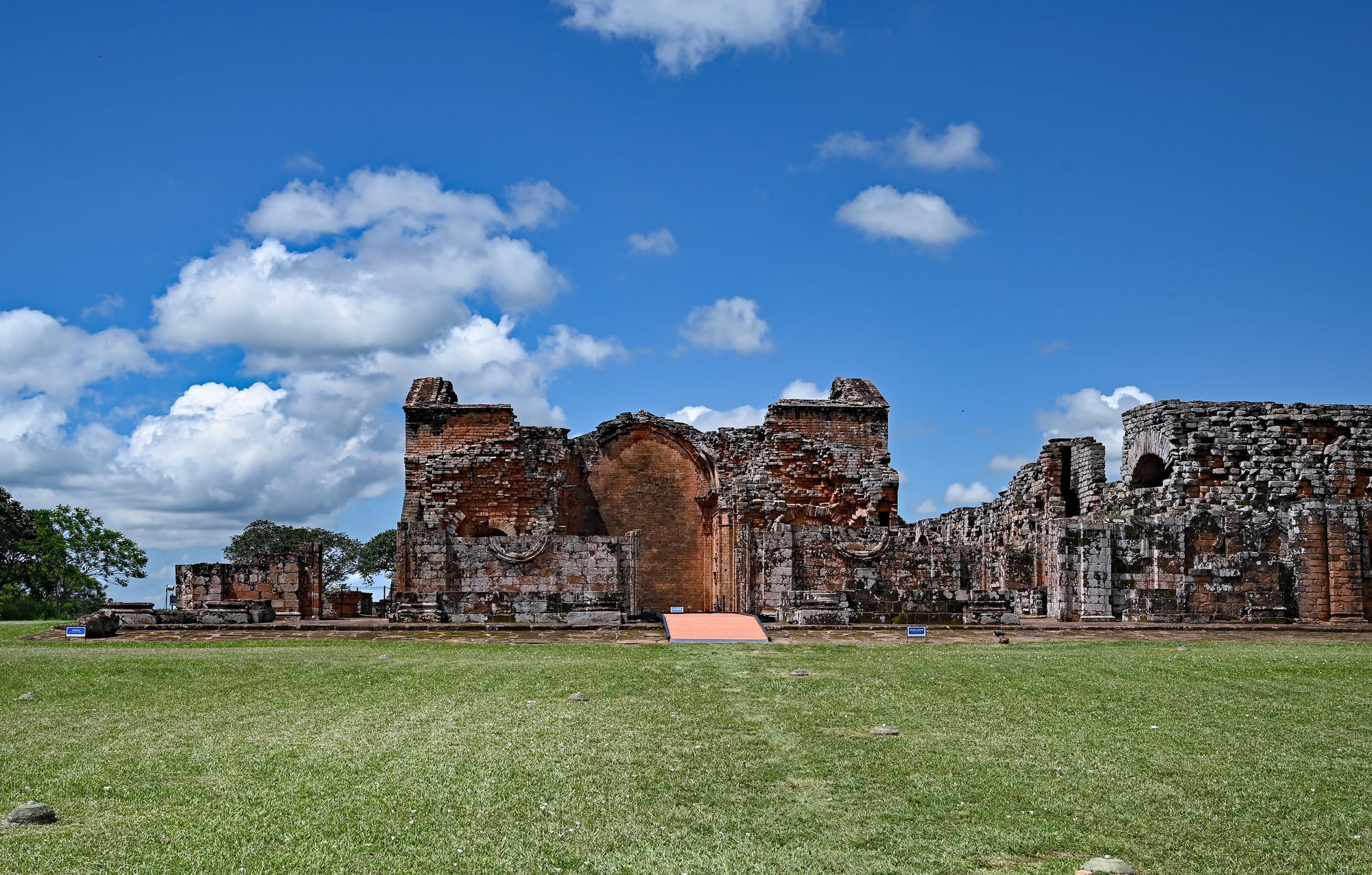
The roofless red-sandstone walls and arches of a large baroque mission church standing on a grassy plain under a blue sky

Paraguay

The Jesuit mission ruins of La Santísima Trinidad del Paraná, a UNESCO World Heritage Site near Encarnación. (P. Hughes / Wikimedia Commons · CC BY 4.0)

A landlocked country at the heart of South America, split by its river into fertile east and the vast semi-arid Chaco — bilingual in Spanish and the Indigenous Guaraní, and shaped by a catastrophic 19th-century war and a long 20th-century dictatorship.

Explore Paraguay

History

The Spanish founded Asunción in 1537, and it became the base from which much of southern South America was colonised. In the seventeenth and eighteenth centuries, Jesuit missionaries and Guaraní people built the "Reductions" — self-governing mission towns of farming, craft, music, and defence — until Spain expelled the Jesuits in 1767; the red-stone ruins of Trinidad and Jesús are now World Heritage sites. Paraguay declared independence in 1811 and was then ruled by a succession of strongmen: Dr Francia, who sealed the country off almost completely, and the López family, who modernised it and then led it into the War of the Triple Alliance of 1864–1870 against Brazil, Argentina, and Uruguay.

That war was the deadliest inter-state war in Latin American history. Paraguay lost perhaps half its population and most of its adult men, along with large territory, and recovery took generations. The Chaco War of 1932–1935 against Bolivia, fought over the Gran Chaco and hoped-for oil, Paraguay largely won, at the cost of tens of thousands of lives on both sides.

From 1954 to 1989 the country was ruled by Alfredo Stroessner, one of the longest dictatorships in the Americas, notorious for corruption, torture, sheltering Nazi fugitives, its role in the region's Operation Condor, and the vast Itaipú hydroelectric dam built with Brazil. A 1989 coup ended Stroessner's rule, and democracy has held since — dominated almost throughout by the Colorado Party — while Paraguay has become one of the world's biggest soybean and beef exporters.

  • Paraguay: The Landlocked Heart — A bilingual country where almost everyone speaks Guaraní — a Jesuit mission province, an isolationist dictatorship, a catastrophic war that cost a large share of its people, and the longest one-party rule in the Americas

Culture & Customs

Paraguayan culture is a genuine Spanish–Guaraní blend, and the survival of Guaraní as the everyday language of most people is its defining feature. Music is central: the light, portable Paraguayan harp and the guitar carry guaranias and polcas, and "Pájaro Campana" is one of the country's most famous folk songs. Ñandutí, a fine sun-shaped lace, and ao po'i embroidery are signature crafts.

Terere — cold yerba mate infused with water and herbs, drunk from a shared guampa through a metal straw — is a national ritual carried out all day, in the street and at work, especially in the heat. Football is the mass passion, and Catholicism runs deep, with the December pilgrimage to the Virgin of Caacupé, the country's largest sanctuary, the high point of the religious year.

The Chaco adds a different layer entirely: German-speaking Mennonite towns with their own institutions, and Indigenous peoples — Nivaclé, Enxet, Ayoreo, and others — some still living in voluntary isolation.

  • Paraguay: A Culture Woven in Two Languages — A deeply Catholic country that speaks Guaraní as readily as Spanish, keeps its promises to the Virgin on foot, shares one drink around the circle, and gave the world a day for friendship

Daily Life

About six million people live in Paraguay, most of them in the fertile eastern region between the Paraguay and Paraná rivers, with Greater Asunción — a low, hot city on the river — holding around a third. The Gran Chaco, more than half the national territory, holds under four per cent of the population: cattle ranches, Mennonite dairy colonies, thorn scrub, and scattered Indigenous communities.

The economy runs on agribusiness — soybeans, beef, maize — and on cheap, abundant hydropower from the Itaipú and Yacyretá dams, much of which is sold to Brazil and Argentina rather than used at home. Paraguay is a low-tax, macroeconomically stable country, but with one of the world's most unequal distributions of land, widespread rural poverty and informal work, and a large cross-border trade economy centred on Ciudad del Este.

Deforestation of the Chaco has been among the fastest in the world.

  • Paraguay: A Country That Shares Its Straw — A household language that mixes Spanish and Guaraní without thinking about it, a long midday pause that still quietens the streets outside the capital, and a cold yerba mate ritual passed from hand to hand through a single metal straw all day long

Food

Paraguayan cooking leans heavily on maize, cassava (mandioca), cheese, and beef. Sopa paraguaya, despite the name, is a moist cornbread with cheese and onion; chipá, a chewy cheese-bread ring made with cassava starch, is eaten everywhere, especially at Easter and from roadside and bus-window vendors; and chipa guasu is a softer corn-and-cheese bake.

Beef is grilled asado-style, and puchero and vori vori — also written bori-bori, a thick soup with corn-flour-and-cheese dumplings — fill out home cooking. Mandioca accompanies almost every meal in place of bread.

Terere is the constant drink, along with sugarcane juice and, on cold days, hot mate. Dulce de mamón (papaya) and a sweet corn pudding are typical desserts.

Attractions & Natural Wonders

Paraguay is one of the least-visited countries in South America, which is part of its appeal. The Jesuit ruins of Trinidad and Jesús near Encarnación — roofless red-sandstone churches, plazas, and carved detail from the mission era — are the country's headline heritage sites.

Asunción has a walkable historic centre: the Panteón de los Héroes, the Cabildo, the riverfront Palacio de los López, faded belle-époque mansions, and the sprawling Mercado 4. Encarnación, remade with a beach promenade on the Paraná, is Paraguay's summer resort, and the Itaipú Dam offers tours of one of the largest power stations on Earth.

For nature, the eastern parks protect the last fragments of the Atlantic Forest — the Mbaracayú reserve and the Saltos del Monday waterfall near Ciudad del Este — while the Chaco holds Defensores del Chaco National Park and remote Pantanal-edge wetlands around Bahía Negra. The Franciscan towns of the "Circuito de Oro" and the lakeside potters' town of Areguá are easy trips from the capital.

  • Paraguay: Seven Attractions and Natural Wonders — The red sandstone ruins of Jesuit mission towns once home to a self-governing Guaraní republic, one of the world's largest hydroelectric dams, and a vast thorn-forest wilderness few travellers ever cross

Planning basics

Budget

Paraguay is among the cheapest countries in South America and sees few tourists. Guesthouses and posadas, market and comedor food, and long-distance buses cost very little; Asunción and Encarnación have mid-range hotels.

Daily Budget Midrange
USD 60–120 (mid-range hotel, restaurants, a hire car or private driver, guided trips)
Daily Budget Shoestring
USD 25–45 (guesthouse, comedor meals, buses)

Carry cash in guaraníes; card acceptance is decent in Asunción but thin elsewhere, and ATMs can be unreliable in the interior.

Visa Requirements

Citizens of the EU, the UK, most of Latin America, Australia, and New Zealand can enter visa-free for 90 days. US and Canadian citizens can also enter visa-free. Check current rules before travel, as they have changed.

Typical Stay
90 days, visa-free, for most Western passports

Safety

Paraguay is relatively safe and low-profile for visitors. Petty theft occurs in Asunción's downtown and market areas and especially in Ciudad del Este and the "triple frontier", a smuggling and organised-crime hub best transited purposefully. Drug-trafficking violence affects the northern border departments of Amambay, Concepción, and San Pedro, where governments advise extra caution and police checks are common.

Health
Recurring dengue outbreaks; yellow-fever vaccination is recommended; the Chaco has Chagas disease and limited medical care

Watch valuables in Asunción and Ciudad del Este, avoid the northern border zone, don't drive at night, and use mosquito precautions.

Climate

Subtropical to tropical. Summers (December–February) are hot and humid, and the Chaco is one of the hottest places in South America. Winters (June–August) are mild with occasional cold snaps from the south. The east has rain year-round; the Chaco is much drier.

Summer
December–February, often above 35°C in Asunción, hotter in the Chaco
Winter
June–August, 10–22°C

Transportation

Asunción's Silvio Pettirossi airport is the main gateway; there are few domestic flights and no working passenger railway. Long-distance buses are the way to travel, with a good network from Asunción to Encarnación, Ciudad del Este, and across the Chaco toward Bolivia. Cargo-passenger boats run up the Paraguay River from Concepción.

Avoid driving at night on rural roads and the long Chaco highway; livestock, motorbikes, and poor lighting make it dangerous.

Best Time to Visit

April to September, the cooler half of the year, is the most comfortable time. The pilgrimage to the Virgin of Caacupé on 8 December is the high point of the religious year, and San Juan bonfire festivals fill June; Encarnación holds the country's liveliest Carnival in January and February.

Events
Caacupé pilgrimage (8 December); San Juan festivals (June); Encarnación Carnival (January–February); Independence (14–15 May)

Currency

The currency is the guaraní (PYG), one of the region's lowest-denomination currencies, so prices run into the tens and hundreds of thousands. It is largely a cash economy outside Asunción; carry small notes.

Symbol
₲
Currency Code
PYG — guaraní

Language

Paraguay is officially bilingual in Spanish and Guaraní, and is one of the few countries in the Americas where an Indigenous language is spoken by most of the population — around three in four Paraguayans understand Guaraní, many as their home language, and everyday speech mixes the two. German is spoken in the Mennonite colonies of the Chaco.

Everyday Speech
A Spanish–Guaraní mix known as jopara
Official Languages
Spanish, Guaraní