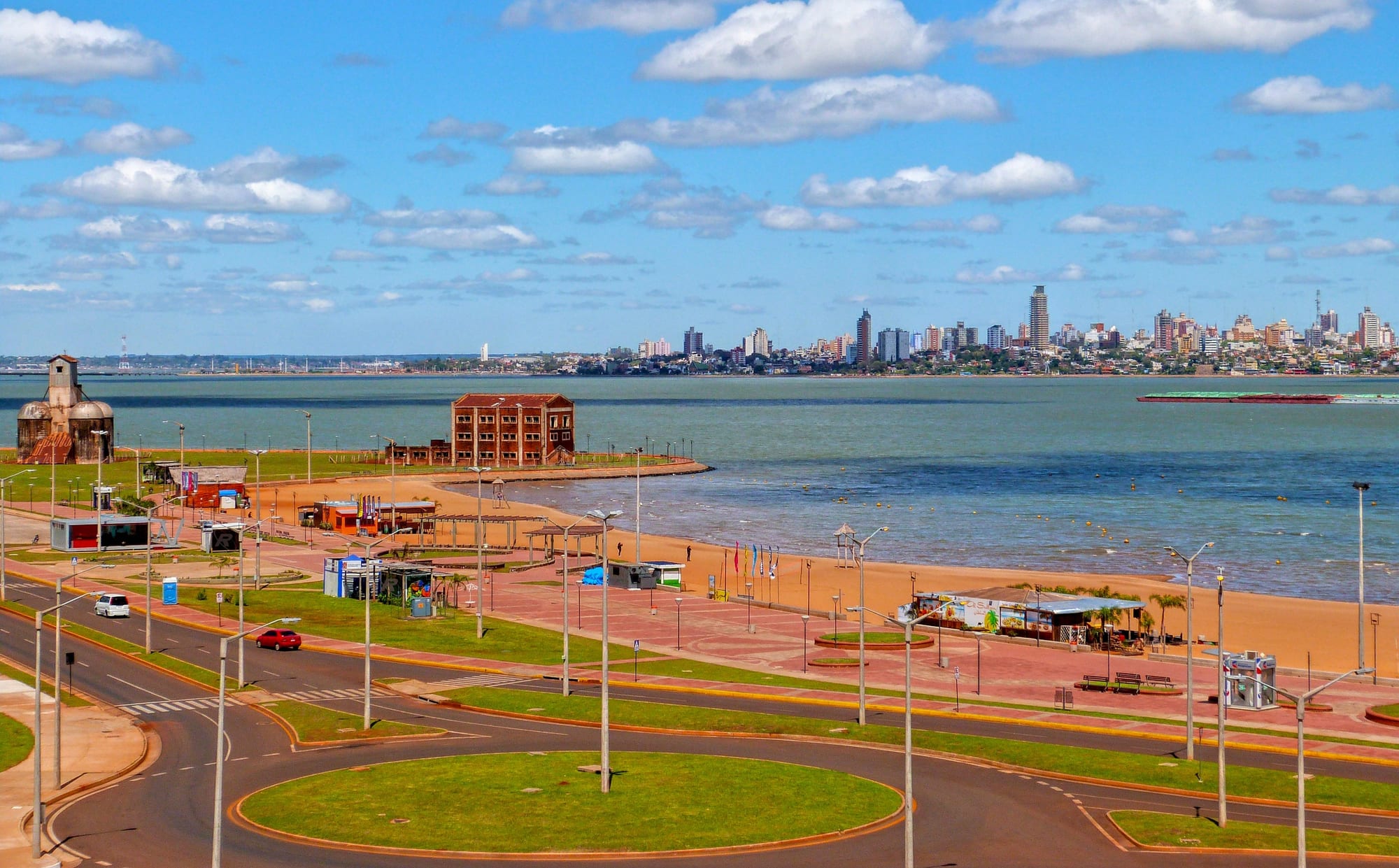
A riverside avenue and sandy beach on the wide Paraná, with an old brick silo and mill and the Posadas skyline across the water

Asunción & the East, Paraguay

Encarnación

The Costanera and San José Beach in Encarnación, with Posadas, Argentina, across the Paraná. (Myparaguay / Wikimedia Commons · CC BY-SA 3.0)

The capital of Itapúa department, on the Paraná River opposite Posadas in Argentina — a Jesuit mission town that grew with the railway, was rebuilt when the Yacyretá dam flooded its old lower town, and has remade itself as Paraguay's summer resort, with river beaches, a long Costanera promenade, a big Carnival and the UNESCO-listed mission ruins of Trinidad and Jesús nearby.

Neighbourhoods

  • The centre and Plaza de Armas
    • First-time visitors
    • Local life
    • Close to public transport

    The easily walkable streets around the Plaza de Armas, a green square with a Japanese garden. Hotels, cafés, ice-cream shops and cash machines are within a few steps, city buses pass the plaza, and taxis wait at stands nearby.

    Open in Maps
  • The Costanera and the beaches
    • Beaches
    • Summer evenings
    • Best for food

    The riverside avenue opened in December 2011 where the old lower town stood before the Yacyretá works, running along the Paraná with San José Beach, Mbói Ka'e and Pacu Cuá. In summer it is the heart of the city, with restaurants by the sand and views across to Posadas.

    Open in Maps
  • The Circuito Comercial
    • Shopping
    • Local life

    The commercial district where many of the city's bus routes end, with shops serving local people and Argentine visitors who cross the bridge from Posadas to buy.

    Open in Maps

Things to do

The riverfront and beaches

  • San José Beachbeach

    The most visited of the three river beaches opened with the Costanera in 2011, a small artificial strand with several restaurants and a view of the Posadas skyline.

    Open in Maps
  • Mbói Ka'e Beachbeach

    Another of the city beaches along the Paraná, opened in 2011.

    Open in Maps
  • The Costaneratrail

    The riverside avenue and promenade that runs along the Paraná to the northern and southern ends of the city, the place for walks, cycling and summer evenings.

    Open in Maps

The city and the border

  • Plaza de Armaspark

    The main square, a green space with a Japanese-style garden and a display of flags.

    Open in Maps
  • Catedral de Encarnaciónlandmark

    The city's cathedral, seat of the Diocese of Encarnación since 1957.

    Open in Maps
  • San Roque González de Santa Cruz Bridgelandmark

    A 2,550-metre cable-stayed road and rail bridge to Posadas, opened in 1990 after a decade of delays; it was first proposed as compensation for land flooded by the Yacyretá dam.

    Open in Maps
  • Posadas–Encarnación International Traintransit hub

    An 8-kilometre cross-border commuter service over the bridge to Posadas, running since 2014.

    Open in Maps

Short trips from the city

  • La Santísima Trinidad de Paranálandmark

    One of the last Jesuit reductions to be built, begun in 1706, with the church, plaza, school and workshops of a planned self-sufficient mission town; the most visited of the mission sites, listed by UNESCO in 1993 with Jesús.

    Open in Maps
  • Jesús de Tavaranguelandmark

    The ruins of a Jesuit reduction whose great church was left unfinished at the expulsion of 1767, part of the World Heritage Site declared in 1993.

    Open in Maps
  • Posadasattraction

    The capital of Argentina's Misiones province directly across the river, reached by bridge, train or bus with a passport.

    Open in Maps
  • Carmen del Paranáattraction

    A small town about 35 kilometres north-west, founded in 1843 and known as the country's 'Capital of Rice', with a river beach popular in summer.

    Open in Maps

Seasonal events

  • Carnival of EncarnaciónJanuary and February

    The city's Carnival, drawing more than 100,000 visitors, with clubs competing in a parade judged on originality, design, charisma, dance, rhythm, beauty and elegance.

Eat and drink

Long-standing places and food districts in Encarnación. Hours, ratings and directions come from your maps app, always current.

Food districts

  • The Costanera beachesneighborhood

    Restaurants and snack bars by San José Beach and along the riverside avenue, busiest on summer evenings.

    Open in Maps
  • Around the Plaza de Armasneighborhood

    Cafés, ice-cream shops and set-lunch restaurants in the streets around the main square, and the city also has Japanese restaurants, a reminder of the Japanese settlers of Itapúa.

    Open in Maps

Experience Encarnación

History

The city began as a Jesuit mission. Roque González de Santa Cruz, a Paraguayan-born Jesuit, founded the reduction of Anunciación de Itapúa on 25 March 1615 on the southern bank of the Paraná, and in 1703 it was moved to the northern bank, where the city now stands, as Encarnación de Itapúa. The nearby missions of Trinidad, begun in 1706, and Jesús grew in the same century, until the Jesuits were expelled in 1767.

Encarnación gained importance when the railway arrived in 1894. In 1926 an F5 tornado devastated it, killing at least 300 people — the deadliest tornado in South American history. On 20 February 1931 a student and worker group led by Obdulio Barthe seized the city and declared a "revolutionary commune" run by popular assemblies. In 1957 the city became the seat of a Catholic diocese. Alfredo Stroessner, who ruled Paraguay from 1954 to 1989, was born here.

The biggest change came with the Yacyretá dam downstream. The plan to complete its reservoir flooded the Zona Baja, the old lower town by the river, and a new city of wide avenues and bridges took its place. The San Roque González de Santa Cruz Bridge to Posadas, proposed as compensation for the flooding, opened in 1990. In December 2011 the Costanera opened with three public beaches, and since then the city has become the centre of summer tourism for Paraguayans and visitors from the region.

Culture & Customs

Encarnación is often called "The Pearl of the South", and summer is its season. The Carnival, held each January and February, is the city's great event: clubs compete in a parade judged on originality, design, charisma, dance, rhythm and beauty, and it draws more than 100,000 visitors. On summer evenings the Costanera and the beaches fill with visitors.

The city is unusually mixed for Paraguay. Most people are of Spanish and Guaraní descent, but German, Ukrainian and Polish minorities live here, and Encarnación has the country's largest Ukrainian settlement, with Orthodox as well as Catholic churches. The surrounding department of Itapúa was settled by German, Ukrainian, Japanese and other immigrants, and the Plaza de Armas has a Japanese garden. Guaraní and Spanish mix in everyday speech, and terere is shared through the day, as across the country.

Life is closely tied to Argentina. Posadas lies directly across the river, many Argentines come to shop and holiday, and the bridge and the cross-border train make the two cities feel like neighbours. The city was a host city of the 2003 Futsal World Cup.

Daily Life

About 107,000 people lived in the city at the 2022 census, and Greater Encarnación has around 200,000, making it the third-largest city in Paraguay. It is the capital of Itapúa department and an important financial centre, with a close commercial relationship with Posadas, and trade with Argentine visitors and summer tourism bring much of its income.

Since the rebuilding that followed the Yacyretá works, the city has a modern look: wide avenues, the riverside Costanera and new districts in place of the old lower town. Tourism has grown steadily, and in peak summers rooms have run out across the city, with visitors lodged in towns up to 50 kilometres away. Bars, restaurants, discos and casinos are a notable source of work in the city.

The year has two speeds: crowded beaches, Carnival and full hotels in summer, and a quieter city in the cooler months, when Encarnación is the coldest city in Paraguay.

Food

Encarnación eats like the rest of Paraguay, on maize, cassava, cheese and beef. Chipa, a baked bun of cassava starch, cheese and milk, is sold everywhere, including from vendors who board the long-distance buses; sopa paraguaya is a cornbread made with corn flour, cheese and milk; and mandioca, boiled cassava, comes with most meals in place of bread. Beef is grilled asado-style, and vori vori, a thick soup with dumplings of corn flour and cheese, is home cooking.

The immigrant communities of Itapúa add their own tables. The city has Japanese restaurants, a reminder of the Japanese settlers in the surrounding department.

Most eating out happens around the Plaza de Armas and along the Costanera, where restaurants and snack bars sit by San José Beach, and set-menu lunches in local restaurants are the cheapest good meals. Terere is the constant drink, cold and shared, with fruit juices and hot mate.

Planning tools

Budget

Cheap by any standard, though Encarnación's beach hotels cost more in the summer season and at Carnival, when rooms can run out entirely. Set-menu lunches in local restaurants are the best-value meals, and buses to the missions cost little.

Daily Budget Midrange
USD 75–150 (mid-range hotel, restaurant dinners, taxis or app rides, a guided mission visit)
Daily Budget Shoestring
USD 25–45 (hostel or guesthouse, set lunches, local buses)

Stay in Encarnación rather than at the ruins to combine Trinidad, Jesús and the beaches, and book well ahead for Carnival weekends.

Best Time to Visit

Summer, from December to February, is the beach and Carnival season, hot and humid and very busy. April to October is cooler and calmer, and better for walking around the mission ruins in comfort.

Suggested Number of Days

Two days cover the riverfront and the nearby mission ruins. Three or four allow a slower pace and a crossing of the border. Summer crowds and Carnival make everything slower.

First Visit
2 days
With Surroundings
3–4 days

Transportation

City buses connect the districts with the centre, though there are no passes and routes are best checked with the driver. Taxis wait near the plaza and the bus terminal. Local buses run to Trinidad, and a train and buses cross the bridge to Posadas.

The international bus to Posadas stops briefly at passport control and may leave before everyone is back on board; the same ticket is valid on the next one.

Airport & Station Connections

Encarnación is about 370 km from Asunción on Route 1, around five to six hours by bus on a direct service, and about 280 km from Ciudad del Este. Teniente Amin Ayub Gonzalez Airport is about 14 km north of the centre, in Capitán Miranda. Posadas, across the river, has its own airport with flights to Buenos Aires.

Walkability

The centre and the Costanera are easy to walk, and the riverside promenade is pleasant for long walks and cycling. The missions and the airport need a bus or taxi.

Safety

Paraguay is relatively safe and low-profile for visitors. Encarnación is on the calm main tourist circuit; the usual care with phones and belongings is enough, especially in the summer crowds and at Carnival. Dengue outbreaks are frequent.

Keep phones out of sight in crowds, use registered taxis at night and take mosquito precautions. Check current official travel advice before travelling.

Climate

Humid subtropical, with hot, humid summers and cool, temperate winters. Being in the far south of the country, Encarnación is Paraguay's coldest city, and in 1975 it recorded the first snowfall in the country's history. The annual mean temperature is about 21°C.

Summer
December–February: hot and humid, with thunderstorms; the city's annual mean is about 21°C
Winter
June–August: cool and temperate, around 10–22°C as across Paraguay, with cold snaps from the south

Local Customs

Most people are of mixed Spanish and Guaraní descent, with German, Ukrainian and Polish minorities, and the city has Paraguay's largest Ukrainian community; Catholic and Orthodox churches both serve the city. Terere is shared throughout the day, and many Argentines cross to shop and holiday.

Beachwear belongs on the beach; dress neatly for churches and the mission ruins; ask before photographing people.

Common Payment Methods

The currency is the guaraní (PYG). Cards are taken in hotels, larger restaurants and shops, but buses, small eateries and beach stalls want cash. Argentine pesos are often seen because of the border trade, but guaraníes are the safer choice.