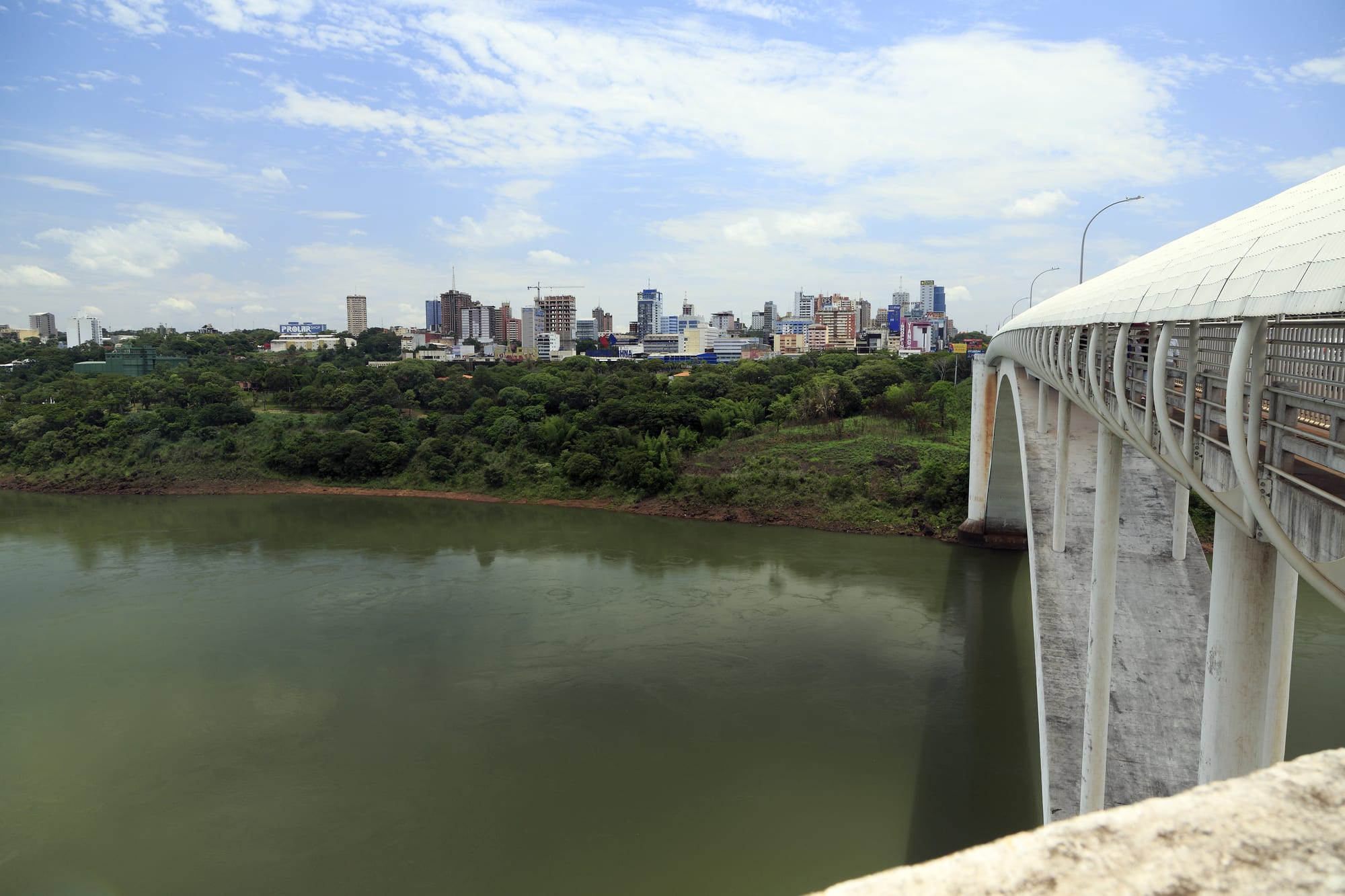
The high-rise centre of Ciudad del Este above green riverbank forest, seen across the Paraná beside the arch of a long bridge

Asunción & the East, Paraguay

Ciudad del Este

Ciudad del Este seen across the Paraná River from the Brazilian side, by the Friendship Bridge. (Falk2 / Wikimedia Commons · CC BY-SA 4.0)

Paraguay's second-largest city and capital of Alto Paraná, on the Paraná River facing Foz do Iguaçu in Brazil. Founded in 1957 as Puerto Flor de Lis, it grew with the Friendship Bridge and the Itaipu dam into one of the world's largest free-trade shopping zones, a crowded, multilingual border city at the heart of the Triple Frontier.

Neighbourhoods

  • Downtown by the bridge
    • Shopping
    • First-time visitors

    The dense commercial centre at the Paraguayan end of the Friendship Bridge, a maze of malls, arcades and department stores selling electronics, clothing and imported goods, with Arabic, Chinese and Portuguese heard alongside Spanish and Guaraní. Crowded by day, it empties once the shops close.

    Open in Maps
  • Around the Lago de la República
    • Quiet and residential
    • Parks

    The area around the city's lake near the centre, fed by the Amambay stream and the main place for recreation in the city, with an open-air amphitheatre.

    Open in Maps
  • Monday
    • Parks
    • Local life

    One of the city's 30 neighbourhoods, home to the Yrendy Lake, about 1 km from Route 7, which a municipal resolution designated an ecological sanctuary.

    Open in Maps

Things to do

Landmarks and the border

  • Friendship Bridgelandmark

    The concrete arch bridge to Foz do Iguaçu, built under a 1956 treaty; when it was constructed in the 1960s its 290-metre span was a world record for a reinforced-concrete fixed arch. More than 40,000 vehicles cross it each day.

    Open in Maps
  • Lago de la Repúblicapark

    The city's lake, described as its recreational site par excellence, ringed by vegetation and with an open-air amphitheatre.

    Open in Maps
  • Antonio Aranda Stadiumattraction

    Home of Club Atlético 3 de Febrero, used for the 1999 Copa América and one of the biggest football stadiums in Paraguay.

    Open in Maps
  • Mosque of the Eastlandmark

    The Al-Khulafa Al-Rashidin Mosque, the largest in the region, inaugurated in 2015 for the city's sizeable Muslim community.

    Open in Maps

Itaipu and the falls

  • Itaipu Damattraction

    The binational dam on the Paraná, completed in 1984 about 15 km north of the Friendship Bridge, among the largest hydroelectric plants in the world, with a visitor centre on the Paraguayan side offering tours.

    Open in Maps
  • Hernandariasattraction

    A separate town about 21 km from the city centre, part of Greater Ciudad del Este and across the highway from the Itaipu dam; known as the 'Latin American Capital of Electric Power', it has the Museum of the Guaraní Land.

    Open in Maps
  • Saltos del Mondaypark

    A waterfall about 45 metres high and 120 metres wide on the Monday River, in a municipal park in Presidente Franco about 8 km south of the city.

    Open in Maps

Short trips from the city

  • Moisés Bertoni Scientific Monumentpark

    A protected area of forest, museum and historic site about 26 km from the city, preserving the house and research station of the Swiss-born naturalist Moisés Bertoni, who died in 1929.

    Open in Maps
  • Iguazu Fallspark

    The largest waterfall system in the world, on the Iguazu River between Argentina and Brazil, reached through Foz do Iguaçu or Puerto Iguazú.

    Open in Maps
  • Foz do Iguaçuattraction

    The Brazilian city across the Friendship Bridge, the main base for the Brazilian side of the falls and a multicultural city of some 80 nationalities.

    Open in Maps
  • The Triple Frontierviewpoint

    The meeting point of Paraguay, Brazil and Argentina at the mouth of the Iguazú in the Paraná, with an obelisk on the Paraguayan side and a viewpoint looking up the Iguazú gorge.

    Open in Maps

Eat and drink

Long-standing places and food districts in Ciudad del Este. Hours, ratings and directions come from your maps app, always current.

Food districts

  • Shopping-centre food courtsneighborhood

    Because street-front space downtown is so valuable, most of the city's eating places are inside its multi-storey shopping malls rather than on the main streets.

    Open in Maps
  • Arab foodneighborhood

    Arab food, typically shawarma and kebab to go, found off the main streets and in many shopping centres.

    Open in Maps
  • Brazilian restaurantsrestaurant

    With so many Brazilian shoppers crossing every day, restaurants serving typical Brazilian food are among the easiest to find.

    Open in Maps
  • Chinese and Korean kitchensneighborhood

    Chinese and Korean restaurants, including a few vegetarian Chinese places outside the centre.

    Open in Maps

Experience Ciudad del Este

History

The city was born of Alfredo Stroessner's "March to the East", a drive to give Paraguay an outlet to the Atlantic through Brazil instead of the costly route down the Río de la Plata. A joint Paraguayan–Brazilian commission was set up in 1955, army units built a 200-kilometre road from Coronel Oviedo to the Paraná, and on 3 February 1957 a decree founded the town as Puerto Flor de Lis, near a place called Tacuru Pucu, "tall termite hill" in Guaraní. It was soon renamed Puerto Presidente Stroessner.

Dense forest held back settlement at first, but the city expanded quickly once the Friendship Bridge to Brazil and the Acaray and Itaipu dams were built in the 1960s and 1970s. Thousands of engineers and construction workers arrived for Itaipu, and traders, many from the Middle East and China, pressed for almost all goods to be imported tax-free, creating a large price gap with Brazil. Downtown became a shopping destination for Brazilians, and the city took its place at the centre of the Triple Frontier with Foz do Iguaçu and Puerto Iguazú.

After the 1989 coup that ended Stroessner's rule, a referendum chose the new name Ciudad del Este, "City of the East". It is now the second most populous and developed city in Paraguay, and the headquarters of the company that runs Itaipu.

Culture & Customs

Ciudad del Este is a multicultural and diverse city. Alongside Paraguayans, it has sizeable Chinese, Taiwanese, Arab, Indian and Korean communities. Sunni Arabs began arriving in the 1970s, followed in the 1980s by Shia Lebanese from the south of Lebanon, and the Al-Khulafa Al-Rashidin Mosque, the largest in the region, opened in 2015; pagodas and Catholic churches complete the skyline. The city is the seat of a Catholic diocese.

Language reflects the mix. As across Paraguay most people speak Spanish and Guaraní, and the mixture of the two called jopara, but Portuguese is used by thousands in trade and farming, and downtown signs and conversations are often in Arabic, Chinese or Korean.

Football is followed as everywhere in Paraguay. Club Atlético 3 de Febrero plays at the Antonio Aranda Stadium, which hosted matches at the 1999 Copa América. The rhythm of the city is set by commerce: it is a place of business more than leisure, and the Lago de la República is its main place to relax.

Daily Life

About 302,000 people lived in the city according to official projections for 2019, and together with Hernandarias, Minga Guazú and Presidente Franco it forms Greater Ciudad del Este. The city produces around 8 per cent of Paraguay's GDP.

Its economy rests on the border. Every day Brazilians cross the Friendship Bridge to buy cheaper electronics, clothing and household goods, and the sacoleiros — named from the Portuguese for "bag" — buy in bulk to resell in Brazil. Much of this trade is considered smuggling by the Brazilian government, and the city has repeatedly appeared on the United States list of notorious markets for counterfeit goods. The economy has diversified into auto parts, textiles and agribusiness, and the farming towns around it are served from here.

The working day follows the shops: buyers cross while they are open, the border markets close in the late afternoon, and the centre empties as shoppers head home. Because Paraguay sells most of its share of Itaipu's power to Brazil and so much trade crosses the bridge, the mood of the Brazilian economy is felt directly in the city's streets.

Food

Ciudad del Este eats Paraguayan food first: chipa, a baked bun of cassava starch, cheese and milk; sopa paraguaya, a cornbread made with corn flour, cheese and milk; grilled beef asado; and mandioca, boiled cassava, with most meals. Terere is drunk through the day, which in this heat makes sense.

The border and its communities shape everything else. With so many Brazilians in town every day, restaurants serving typical Brazilian food are among the easiest to find. Arab food, typically shawarma and kebab to go, is sold in the shopping centres and off the main streets, and Chinese and Korean restaurants can also be found, with a few vegetarian Chinese places outside the centre.

Because street-front space downtown is so valuable, most eating happens inside the multi-storey malls rather than on the main street. The city also has a large food market with more than 800 shops selling fruit, vegetables and clothing.

Planning tools

Budget

Cheap for food and transport, and cheap for goods, which is why the city exists as it does. Hotels cater to shoppers and business visitors, and the main extra costs are taxis and tours to Itaipu or the falls across the border.

Daily Budget Midrange
USD 75–150 (mid-range hotel, restaurant dinners, taxis or app rides, a dam visit)
Daily Budget Shoestring
USD 25–45 (budget hotel or guesthouse, food-court and street meals, city buses)

Compare prices and check guarantees before buying electronics; Brazil limits what its residents may take home tax-free, and foreign visitors should check their own customs rules.

Best Time to Visit

April to October is the most comfortable time, with temperate, changeable winters. Summer is hot and very humid.

Suggested Number of Days

One or two days are enough for the city itself. Three or four allow for the sights of the surrounding area and the neighbouring Brazilian and Argentine sides of the border, where separate immigration procedures add time.

First Visit
1–2 days
With Surroundings
3–4 days

Transportation

City buses link the centre with Hernandarias, Presidente Franco and the other towns of the metropolitan area. Taxis are common, and motorcycle taxis are a quick way through the heavy traffic near the bridge. Many shoppers cross the Friendship Bridge on foot.

Immigration stamps are needed when entering Paraguay or Brazil even on a short crossing; buses and taxis often skip the immigration posts, so stop and get the stamps.

Airport & Station Connections

Ciudad del Este is 327 km east of Asunción, and frequent buses make the trip in about five hours or more; buses also run from Encarnación. The bus terminal is south of the centre. Guaraní International Airport, the country's second airport, is in the neighbouring municipality of Minga Guazú. Many visitors arrive over the Friendship Bridge from Foz do Iguaçu.

Walkability

The downtown shopping district by the bridge is compact and walkable, though very crowded and hot. Everything else — the lake, the bus terminal, Itaipu and the falls — needs a bus or taxi.

Safety

Paraguay is relatively safe and low-profile for visitors. Ciudad del Este's crowded market streets and the triple frontier have more theft, smuggling and organised crime than the rest of the main tourist circuit, and the empty streets and dark alleys downtown after the shops close call for care.

Stay alert in the market district, keep valuables out of sight, avoid dark streets at night and use taxis after dark. Check current official travel advice before travelling.

Climate

Humid subtropical, with about 1,700 mm of rain a year. Summers are hot and humid, often oppressively so; winters are temperate and irregular, with recorded temperatures from 0°C to 30°C. Snow fell in 1982, the first time in the city.

Summer
December–February: hot and humid, with a January average of about 26°C
Winter
June–August: temperate and changeable, with a July average of about 16°C

Local Customs

The city is multicultural: Spanish, Guaraní and jopara are spoken alongside Portuguese, which is common in commerce and farming, and Arabic, Chinese and Korean are heard and seen downtown. Catholic churches stand beside mosques and pagodas.

Dress modestly when visiting the mosque; ask before photographing traders or their stalls.

Common Payment Methods

The currency is the guaraní (PYG), but downtown many businesses also take Brazilian reais, US dollars and Argentine pesos and give change in the same currency. Cards are accepted in malls and larger stores; small vendors and buses want cash. Exchange rates in the city are often better than on the Brazilian side.