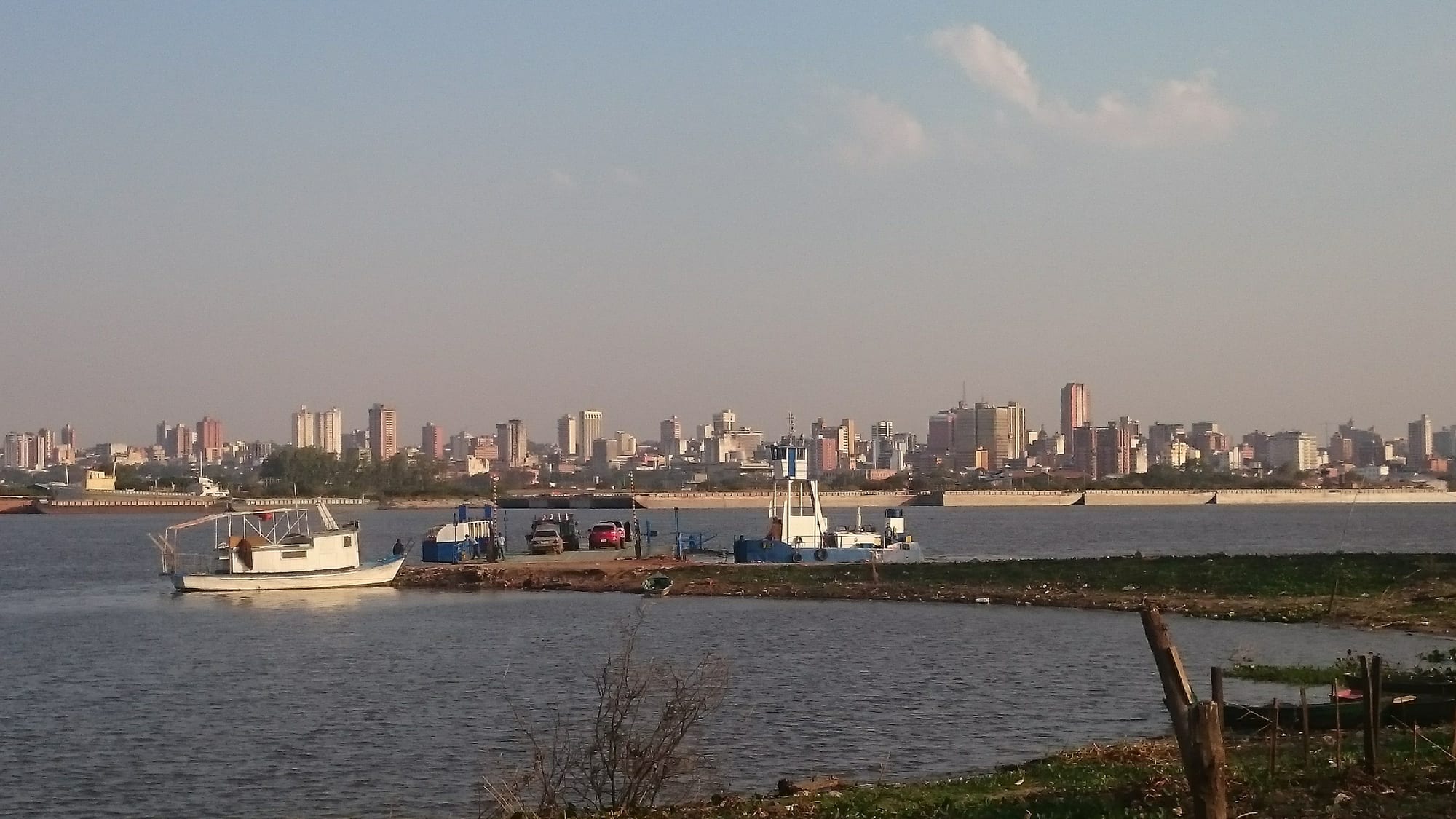
Asunción's high-rise skyline across the wide Paraguay River, with a small ferry landing and boats in the foreground

Asunción & the East, Paraguay

Asunción

Asunción seen across the Paraguay River from Chaco'i. (P. S. F. Freitas / Wikimedia Commons · CC BY-SA 4.0)

Paraguay's capital and largest city, on the east bank of the Paraguay River — founded as a Spanish fort in 1537 and known as the 'Mother of Cities' for the expeditions that left it to found others. A low, green city of colonial and nineteenth-century landmarks, a new riverside promenade and busy suburbs that hold a large share of the country's people and wealth.

Neighbourhoods

  • Historic centre (Catedral and the microcentro)
    • First-time visitors
    • Historic district
    • Museums

    The old core by the bay, between Colón and Antequera streets: the cathedral, the Cabildo, the Plaza de la Independencia, the Pantheon of the Heroes and the government palace, with the riverside Costanera a few steps away. Busy on weekdays, it empties from Saturday afternoon and can feel deserted on Sundays.

    Open in Maps
  • Villa Morra
    • Best for food
    • Nightlife
    • Shopping

    An upscale commercial and residential neighbourhood east of the centre, along Avenida Mariscal López, with high-end shops, restaurants, bars, nightclubs and many of the newer hotels. It is where much of the city's social life has moved.

    Open in Maps
  • Carmelitas and the business district
    • Shopping
    • Nightlife
    • Modern city

    The newer district of office towers and large shopping centres such as Shopping del Sol, with North American-style bars and restaurants. Lively in the evenings and at weekends, when the old centre is quiet.

    Open in Maps
  • Loma San Jerónimo
    • Historic district
    • Local life

    One of the named hills (lomas) of Asunción, called after a hermitage dedicated to Saint Jerome that once stood on it.

    Open in Maps

Things to do

Famous landmarks

  • National Pantheon of the Heroeslandmark

    The state mausoleum, begun in 1863 as a chapel and completed only in 1936, after the Chaco War; it holds the remains of Carlos Antonio López, Francisco Solano López and the child soldiers of Acosta Ñu.

    Open in Maps
  • Palacio de los Lópezlandmark

    The white neoclassical government palace overlooking the bay, begun in 1857 by order of Carlos Antonio López, who intended it for his son Francisco Solano López; it was looted when Brazilian and Argentine forces sacked the city in January 1869, and now the president's workplace.

    Open in Maps
  • Asunción Cathedrallandmark

    The Metropolitan Cathedral of Our Lady of the Assumption on the Plaza de la Independencia, inaugurated in its present form in 1845, with a high altar coated in silver.

    Open in Maps
  • The Cabildomuseum

    The old town-council building on the Plaza de la Independencia, now the Cultural Center of the Republic, with exhibitions on national history and art.

    Open in Maps
  • Municipal Theatre Ignacio A. Panelandmark

    The city theatre in the historic centre, inaugurated in 1889 and since restored.

    Open in Maps
  • Recoleta Cemeterylandmark

    A national cemetery of about 14 hectares on Avenida Mariscal López, with the graves of presidents and other leading figures of the country's history.

    Open in Maps

Museums

  • Casa de la Independencia Museummuseum

    The colonial house from which the conspirators emerged on the night of 14 May 1811 to declare independence, opened as a museum in 1965.

    Open in Maps
  • Museo del Barromuseum

    A museum on the outskirts of the city in three parts: pottery, Indigenous art and a contemporary art collection.

    Open in Maps
  • National Museum of Fine Artsmuseum

    Founded in 1909 by the collector Silvano Godoi, with over 650 paintings, sculptures, ceramics and prints by Paraguayan and international artists, sharing its building with the National Archives.

    Open in Maps

Parks and the riverfront

  • Costanerapark

    The riverside avenues and promenades along the Bay of Asunción, opened in sections since 2012; on Sundays and public holidays the bayside lanes are closed to traffic and given over to pedestrians.

    Open in Maps
  • Botanical Garden and Zoo of Asunciónpark

    One of the city's main open spaces, set in 110 hectares of natural forest in the north of the city, with native plants and nearly seventy species of mostly South American animals.

    Open in Maps

Markets and crafts

  • Mercado 4market

    The sprawling municipal market in the Pettirossi district, selling fruit, vegetables, groceries and clothes, with food stalls serving Paraguayan and international dishes; it has spread into the surrounding streets.

    Open in Maps
  • Craft stalls on Plaza de los Héroesmarket

    Covered stalls on Plaza Libertad, one of the four squares that make up Plaza de los Héroes, selling traditional crafts in wood, cotton and leather.

    Open in Maps

Sport

  • Estadio Defensores del Chacoattraction

    The national football stadium in the Sajonia neighbourhood, owned by the Paraguayan Football Association and named after the soldiers of the Chaco War.

    Open in Maps

Short trips from the city

  • Areguáattraction

    A town by Ypacaraí Lake known for its pottery, strawberry products, colonial architecture and cobblestone streets.

    Open in Maps
  • San Bernardinoattraction

    A holiday resort on the shore of Ypacaraí Lake, popular with people from Greater Asunción.

    Open in Maps
  • Ypacaraí Lakepark

    A large lake about 50 kilometres east of the capital, ringed by towns; pollution and algae have turned it green, and swimming is not advised.

    Open in Maps

Seasonal events

  • Independence Day14–15 May

    Celebrates the night of 14–15 May 1811, when rebels in Asunción forced the Spanish governor to surrender.

  • San Juan festivalsJune

    The feast of San Juan brings bonfires, walking on embers and the burning of a straw effigy.

  • Pilgrimage to CaacupéDecember

    Held outside the city: pilgrims walk from across the country to the basilica of the Virgin of Caacupé, in the town of Caacupé east of Asunción, the largest sanctuary in Paraguay, for her feast on 8 December.

Eat and drink

Long-standing places and food districts in Asunción. Hours, ratings and directions come from your maps app, always current.

Asunción classics

  • Lido Barrestaurant

    A cafe-bar opposite the Pantheon of the Heroes, established in 1954 and little changed since, serving Paraguayan food and known for its fish soup.

    Open in Maps
  • Street lomito standsneighborhood

    Lomito sandwiches of sliced beef sold from street stands across the city, many also offering lomito árabe, the local shawarma, and chorizo.

    Open in Maps

Food districts and markets

  • Mercado 4market

    The city's great market, with cheap cookshops among the produce stalls serving Paraguayan staples.

    Open in Maps
  • Villa Morra and Carmelitasneighborhood

    The districts where most of the city's newer restaurants, cafés and bars are found, and where the shopping centres are useful places to eat on Sunday evenings, when much of the centre is closed.

    Open in Maps

Experience Asunción

History

Juan de Salazar de Espinosa founded a fort on the east bank of the Paraguay River on 15 August 1537, the feast of the Assumption, which gave it its name. In 1541 a cabildo, a town council, turned the fort into a civilian town, and an alliance with local Guaraní chiefs, sealed by marriage, created the mestizo society that still speaks their language. For decades it was the base for Spanish expansion across the south: expeditions left it to found Villarrica, Corrientes, Santa Fe and Santa Cruz de la Sierra, and in 1580 to refound Buenos Aires, which earned it the name "Mother of Cities".

On the night of 14 to 15 May 1811 rebels in the city forced the Spanish governor to surrender, and Paraguay became independent. Under Dr Francia roads were built and the streets named; Carlos Antonio López and his son Francisco Solano López added the cathedral, the palace and the beginnings of the Pantheon. The War of the Triple Alliance ended that era: the city fell to Brazilian forces on 1 January 1869 and was occupied until 1876.

A horse-drawn tramway opened in 1871, electric trams followed in 1913, and the city grew through the twentieth century as people moved in from the countryside. The Stroessner dictatorship ended with a coup in 1989, and in 1991 the Treaty of Asunción was signed here by the presidents of Argentina, Brazil, Uruguay and Paraguay. In August 2004 a fire at the Ycuá Bolaños supermarket killed more than 400 people. The city hosted the 2025 Junior Pan American Games and is due to host the 2031 Pan American Games.

Culture & Customs

Asunción is where Paraguay's two languages meet. By one count most residents speak Spanish as their main language, a smaller share Guaraní, and over a quarter jopara, the everyday mixture of the two, which fills streets and radio. Around nine in ten people are Catholic, and the cathedral and the Pantheon of the Heroes — in the full name an oratory of the Virgin of the Assumption, the city's patroness — sit at the heart of civic life.

Music is a point of pride. Guaranias and polcas, carried by the Paraguayan harp and the guitar, are the country's own music, and Maneco Galeano's guarania "Soy de la Chacarita" made a poor riverside neighbourhood of the capital famous. The Cabildo's Hall of Music keeps the guitar of Agustín Pío Barrios, known as Mangoré, the virtuoso guitarist and composer. Crafts from across the country — ñandutí lace, tooled leather, carved wood and pottery — are sold in the centre.

Football divides families: Olimpia and Cerro Porteño are the giants, with Libertad, Nacional, Guaraní and Sol de América among the other city clubs, and Cerro Porteño's stadium has been enlarged to hold 45,000 people. CONMEBOL, South American football's governing body, has its headquarters in neighbouring Luque. Terere, cold yerba mate shared from a guampa through a bombilla straw, is drunk all day, at work and in the street.

Daily Life

The 2022 census counted about 462,000 people in the city itself, while Greater Asunción, spreading into San Lorenzo, Luque, Lambaré, Fernando de la Mora, Capiatá and other towns of the Central Department, has more than 2.3 million. The city's own population has hardly grown since the late 1990s, as cheaper land and lower taxes have drawn new residents to the suburbs.

The capital is the seat of government, banking, the unions and the main cultural institutions, and about eight in ten working people are in commerce and services. The Universidad Nacional de Asunción, founded in 1889, and the Catholic University are the largest universities. Wealth is concentrated in Villa Morra, Carmelitas and the business district, with their towers and shopping centres, while La Chacarita, a shanty town of about 20,000 people beside the government palace, is one of the poorest places in the country. Low-lying districts by the river are exposed when the Paraguay floods.

The centre is busy on weekdays and empties from Saturday afternoon, when life moves to the shopping centres of the newer districts and to the Costanera. The city relies on buses, and residents widely report that crime has risen, with theft the everyday concern.

Food

Asunción eats like the rest of Paraguay, on maize, cassava, cheese and beef. Chipa, a baked bun of cassava starch, cheese and milk, is sold everywhere, from street corners to the vendors who board long-distance buses. Sopa paraguaya, despite the name, is a cornbread made with corn flour, cheese and milk, and chipa guasu is a cake of corn grains often served at an asado, the grilled-meat gathering. Mandioca, boiled cassava, accompanies almost every meal in place of bread, and vori vori is a thick soup with dumplings of corn flour and cheese.

Street food is part of daily life. Lomito stands sell sandwiches of sliced beef, and many also sell lomito árabe, the local version of shawarma. The Paraguayan empanada is a staple snack, and old-fashioned cafe-bars in the centre, such as the Lido opposite the Pantheon, serve home cooking and a well-known fish soup.

Mercado 4 is the place to see what the city buys, with fruit, vegetables and groceries and cookshops serving Paraguayan dishes among the stalls. Terere is the constant drink, with mosto, a non-alcoholic sugarcane drink, and hot mate. The newer restaurants and bars of Villa Morra and Carmelitas cover everything from grills to international food.

Planning tools

Budget

Paraguay is among the cheapest countries in South America, and Asunción has the widest choice of hotels in the country. Street food, market cookshops and city buses cost very little; the newer restaurants and hotels of Villa Morra and the business district are the main expense.

Daily Budget Midrange
USD 75–150 (mid-range hotel, restaurant dinners, taxis or app rides, a guided day trip)
Daily Budget Shoestring
USD 25–45 (guesthouse or hostel, market and street food, city buses)

Carry cash in guaraníes for buses, markets and street food; cards are widely accepted in hotels, malls and restaurants.

Best Time to Visit

April to October is the most comfortable time, with milder days. Summer, from December to February, is very hot and humid, with heavy thunderstorms that can cause flooding in low-lying parts of the city.

Suggested Number of Days

Two or three days cover the historic centre, the museums and the modern districts. Four or five allow for the lake towns east of the city. The centre is quiet on Sundays, which is worth bearing in mind when planning a short stay.

First Visit
2–3 days
With Surroundings
4–5 days

Transportation

Buses are everywhere and cheap, but there are few official stops, timetables or maps; riders flag them down and check routes in apps. Taxis are reasonably inexpensive, and app rides are widely used. There is no metro or tram — the old tramway closed in the 1990s, and plans for a metrobus were interrupted.

Buses sometimes slow down rather than stop for passengers getting off, so take care stepping down.

Airport & Station Connections

Silvio Pettirossi International Airport, the country's main gateway, is in Luque, a suburb north-east of the capital; a taxi to the centre takes about 30–45 minutes. The main bus terminal, south-east of the centre, has services to Encarnación, Ciudad del Este, the Chaco and neighbouring countries. The Argentine city of Clorinda lies just across the river.

Walkability

The historic centre is compact and walkable, and the Costanera is good for walking and cycling. Distances to Villa Morra, Carmelitas and the Botanical Garden are too long for most people on foot in the heat, so a bus, taxi or app ride is needed.

Safety

Paraguay is relatively safe and low-profile for visitors. In Asunción, pickpockets work the centre and the Mercado 4 area, and phone snatches by motorbike thieves, known as motochorros, are common. Some neighbourhoods, such as Ita Pyta Punta, are best avoided at night.

Keep phones out of sight on the street, use app taxis at night, and watch belongings in Mercado 4. Check current official travel advice before travelling.

Climate

Subtropical: hot and humid for much of the year, with rain in every season and summer thunderstorms. Winters are mild with occasional cold snaps from the south.

Summer
December–February: hot and humid, often 33–40°C, with heavy thunderstorms
Winter
June–August: mild, about 10–22°C, with occasional cold snaps

Local Customs

Asunción is largely Catholic, and many people speak Spanish, Guaraní or a mix of the two known as jopara. Terere, cold yerba mate, is drunk from a shared guampa throughout the day, and being offered a turn is a friendly gesture. Football loyalties, above all Olimpia against Cerro Porteño, run deep.

Greet people before asking for anything; dress neatly when visiting churches and the Pantheon; ask before photographing people, especially in markets.

Common Payment Methods

The currency is the guaraní (PYG), and prices run into the tens and hundreds of thousands. Card acceptance is decent in Asunción's hotels, restaurants and shopping centres, but buses, markets and street stalls take cash, so carry small notes.