💰 Budget
Daily costs on the island are modest and fixed: a set home-stay tariff that normally includes meals and laundry, and little to spend money on beyond carvings, honey and stamps. The real expense is the journey — flights to Tahiti, the connection to Mangareva and a berth on the ship, which together dwarf everything else.
- Daily Budget Midrange
- USD 110–190 (home-stay with meals, quad-bike or boat outings, carvings, honey and stamps)
- Daily Budget Shoestring
- USD 60–110 (home-stay tariff with meals, walking and island tracks)
Everything is arranged in advance with the island administration, and the whole cost of a visit is dominated by the voyage rather than by anything spent on the island.
📅 Best Time to Visit
April to October is a little drier and easier for walking the steep tracks; November to March is more humid, with the heaviest rain around December. In practice the sailing schedule of the passenger ship from Mangareva decides when a visit is possible at all, and the swell at Bounty Bay decides whether landing happens on the day.
⏳ Suggested Number of Days
The ship's timetable sets the length of a stay rather than preference: stays are commonly a few days, or closer to a fortnight when the ship turns round later. Longer stays suit anyone wanting the walks and the island's rhythm.
- First Visit
- 3–4 days
- With Surroundings
- 10–14 days
🚆 Transportation
One paved road of about 6.4 km climbs from Bounty Bay through Adamstown, and beyond it are dirt tracks; there is no public transport. Islanders use quad bikes, and visitors walk or are given lifts by their hosts. Distances are tiny — the island is about 3.2 km long — but the gradients are severe, and tracks turn slippery after rain. Boats handle everything on the water.
Sturdy shoes with grip matter more than anything else packed, and a torch is useful after dark, as the village has little lighting.
🛬 Airport & Station Connections
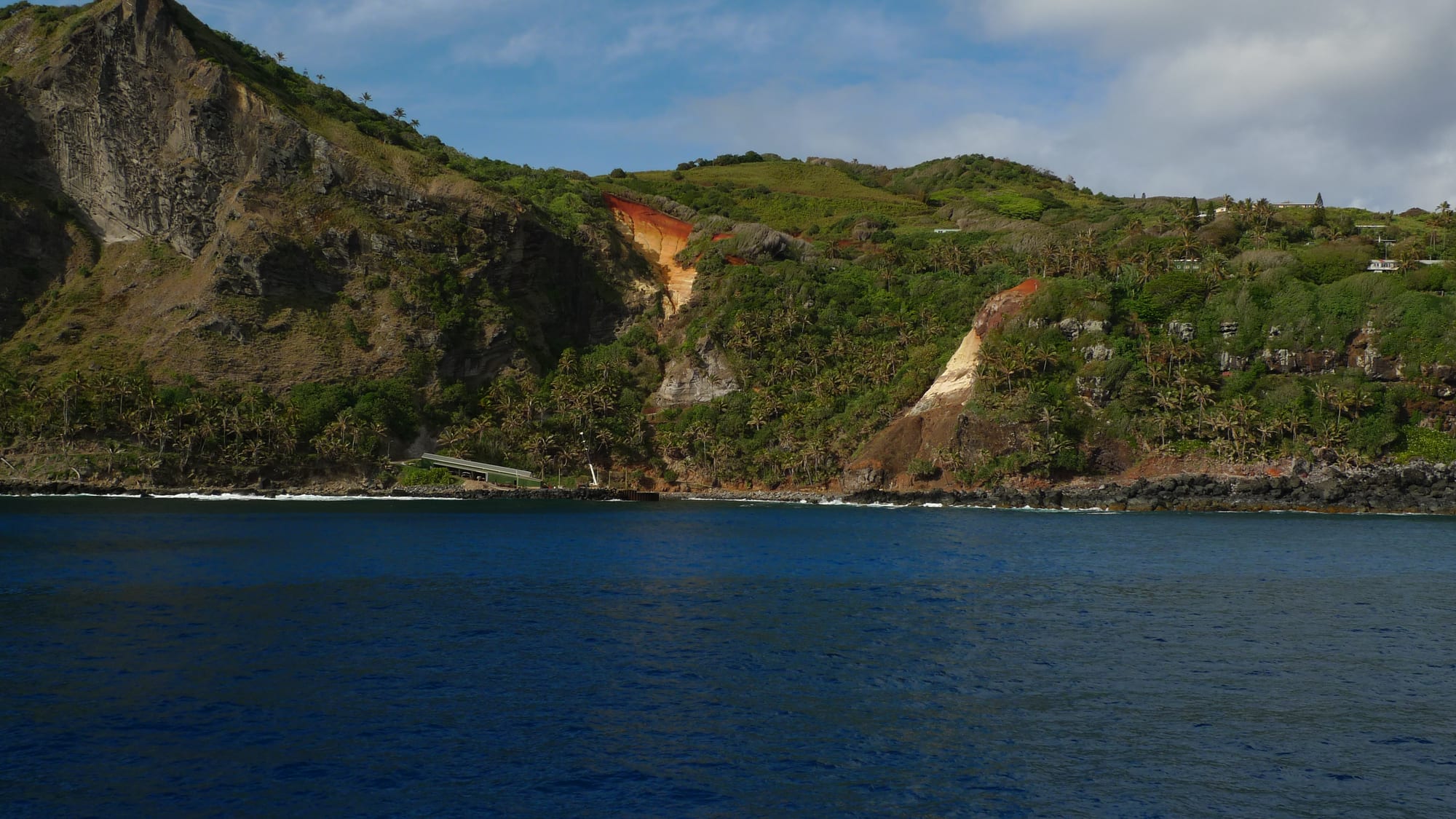
There is no airport, airstrip or seaport. The route runs by air to Tahiti, then to Mangareva in the Gambier Islands, then about 690 km by the territory's passenger and cargo ship, the MV Silver Supporter, which sails to a limited schedule. The ship anchors offshore and passengers transfer by longboat through the surf at Bounty Bay. Stays of up to 14 days need no visa, longer stays need clearance in advance, and accommodation is arranged before travel.
🚶 Walkability
Adamstown is walked, not driven — the square, the church, the museum and most houses lie within a few hundred metres of each other. The catch is the gradient: almost every route climbs or drops steeply, the surface is dirt or concrete strip, and the climb from Bounty Bay to the village is hard work in the heat. Walks to Down Rope and the high ground are steep and rough.
🛡️ Safety
Crime is not a concern in a community of a few dozen people. The hazards are the sea and the terrain: the longboat transfer at Bounty Bay is exposed and can be rough or cancelled, cliff edges and the descent to Down Rope are dangerous, and tracks are slippery when wet. There is a small health clinic and no rapid evacuation — advanced care is days away.
Comprehensive medical and evacuation insurance matters more here than almost anywhere, islanders' instructions on the boat transfer and the cliff paths should be followed exactly, and travellers should accept that swell can delay or prevent both landing and departure. Check current official travel advice before travelling.
🌦️ Climate
Warm and even, with average temperatures in a narrow band of roughly 19–24°C and little variation through the year. Rain falls in every month: Adamstown averages about 1,540 mm a year and December is the wettest month. Tropical cyclones are possible between November and May, and heavy Pacific swells are what govern the landing.
- Summer
- warm, humid and wetter — December to February, around 24°C, with frequent showers and heavy swell at times
- Winter
- slightly cooler and a little drier — June to August, nearer 19°C, with fresher winds and the most comfortable walking weather
🤝 Local Customs
The community is Seventh-day Adventist, and Saturday is the sabbath, when work stops and the church holds its services; visitors are welcome at them. Old dietary and alcohol rules have relaxed, and there is now a licensed café. Pitkern, a creole of eighteenth-century English and Tahitian, is spoken alongside English, and a handful of surnames covers almost everyone. Hospitality is generous and privacy is limited, since guests live in island homes.
Households should be asked before photographs are taken, the 2004 abuse trials are a painful subject best left alone, quiet is expected on the sabbath, and visitors are expected to lend a hand when the ship is being worked.
💳 Common Payment Methods
The currency is the New Zealand dollar and the island is a cash economy: there is no bank, no ATM and no dependable card payment, so New Zealand dollars are brought in for the home-stay tariff, the landing fee, carvings and honey. Some payments can be settled by bank transfer afterwards through the island administration.