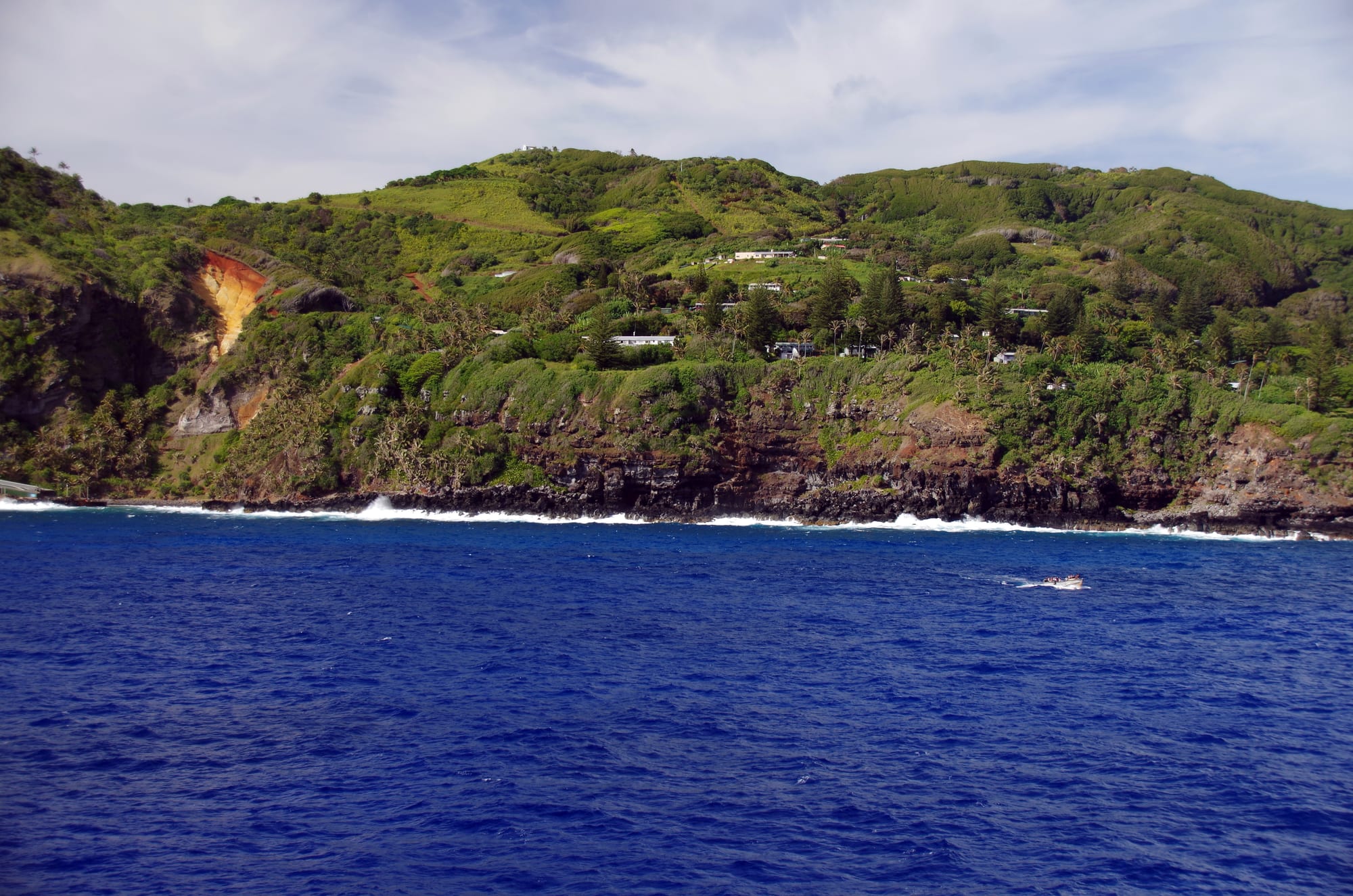
A scatter of houses and gardens on a steep green hillside above a rugged coastline and open ocean, under a bright sky

Pitcairn Islands

Adamstown, Pitcairn's only settlement, on the slopes above Bounty Bay — home to a few dozen people. (Balou46 / Wikimedia Commons · CC BY-SA 4.0)

A single inhabited volcanic speck in the remote South Pacific, the only British Overseas Territory in the Pacific — home to around 35 to 40 people, most descended from the HMS Bounty mutineers and the Tahitians who settled with them in 1790, and reachable only by a multi-day voyage from French Polynesia.

Explore Pitcairn Islands

History

Polynesians lived on Pitcairn centuries ago but had gone by the time Europeans arrived. A British ship sighted it in 1767 and named it for the midshipman who spotted it; it was mischarted by three degrees, which later helped hide those who settled there. In 1789 the crew of HMS Bounty mutinied against Lieutenant William Bligh in Tahitian waters. Nine mutineers, with about twenty Polynesians, fourteen of them women, settled Pitcairn in 1790 and burned the Bounty in the bay.

The colony descended into violence and disease, and within a decade only one mutineer, John Adams, was left, with the women and children. The community turned devoutly Christian and has been Seventh-day Adventist since an 1886 conversion. The outside world "rediscovered" Pitcairn in 1808. The population was briefly resettled to Norfolk Island in 1856, though some families returned. Pitcairn became a British territory, administered through the British high commissioner to New Zealand, with the island's administration based in Auckland.

The population peaked at around 230 in the 1930s and has declined ever since. A series of sexual-abuse trials in 2004 convicted several men, including the mayor, and left deep scars on the tiny community. Today the island offers land and support to would-be migrants to try to arrest the decline, with limited success.

  • Pitcairn Islands: The Mutineers' Refuge — The last British territory in the Pacific — a hidden island settled by the mutineers of HMS Bounty and the Tahitians they brought with them, and now the least populous jurisdiction on Earth

Culture & Customs

Around 35 to 40 people live on Pitcairn; the territory's other three islands — Henderson, Ducie, and Oeno — are uninhabited. English and Pitkern, a creole of eighteenth-century English and Tahitian, are both spoken. Seventh-day Adventism shapes life, with a Saturday sabbath and once-strict moral and dietary codes that have relaxed over time — the alcohol licence has been dropped and there is a licensed café and bar. A handful of surnames — Christian, Warren, Young, Brown — cover most of the island, and everyone holds one public role or several.

"Bounty Day" on 23 January marks the mutineers' arrival aboard the Bounty in 1790. Pitcairn honey, from unusually docile bees, is prized and exported, and carvings in miro wood and woven baskets are made for visitors and for mail order.

  • Pitcairn Islands: The Longboat and the Sabbath — A community of a few dozen people descended from the Bounty mutineers and their Tahitian companions, bound together by an Adventist faith, a creole of their own, a boat crew everyone trusts and a burning ship every January

Daily Life

The population lives at Adamstown, the only settlement, on the slopes above Bounty Bay, the island's one sheltered landing. There is no airstrip and no safe harbour; longboats are launched from a ramp in the shallow harbour and meet ships offshore. The economy is UK budget support plus the sale of honey, stamps, coins, and ".pn" internet domains, and fees from the few visitors.

Power comes from diesel generators, with home solar systems now covering most household use. There is a school, often with a single-figure roll, basic medical care, a shop open a few hours a week, a church, and a museum. Starlink satellite internet arrived in 2024, and quad bikes are the main way to get around the steep tracks.

  • Pitcairn Islands: Everyone on the Payroll — A permanent population of around forty people, a government store open a few hours a week, and a community small enough that nearly every working adult is, one way or another, employed by the government itself

Food

Home gardens and orchards provide breadfruit, bananas, taro, sugarcane, citrus, and mango; fish and lobster come from the surrounding sea, and chickens are kept. A resupply of frozen and packaged goods arrives with the ship from Mangareva. Pitkern staples include pilhi, a baked pudding of grated banana, pumpkin, or taro; mudda, green-banana dumplings; and fish in every form. Pitcairn honey is the island's signature product.

Attractions & Natural Wonders

The Bounty story is the draw: the museum in Adamstown, which has kept the Bounty Bible under glass since it opened in 2006, John Adams's grave, and the wreck of the Bounty, still visible underwater in the bay. "Down Rope", the island's only beach — small, at the foot of a steep cliff descent — has Polynesian petroglyphs on the rock face. Walking tracks lead to the island's high point and around the cliffs, and the birdlife is abundant.

Sea conditions permitting, a boat trip runs to uninhabited Henderson Island, a raised-coral UNESCO World Heritage Site with four endemic bird species — and, despite its extreme isolation, beaches found in 2017 to carry the highest density of plastic rubbish recorded anywhere in the world.

Planning basics

Budget

There is no hotel. Visitors stay in islanders' homes on a home-stay arranged in advance. The overwhelming cost is the voyage — flights to Tahiti, a flight to Mangareva, and the passenger ship.

Daily Budget Note
Modest home-stay costs; the cost is almost entirely getting there and back

Book early; the ship and the home-stay must both be confirmed before you go.

Visa Requirements

Visits of up to 14 days, arriving and leaving on the same vessel, need no advance application: a short-term visitor visa is granted on arrival to those who meet the character, health, travel and medical insurance and financial requirements. Longer stays need a long-term visitor visa, applied for before you travel. Stays are built around the ship's schedule.

Typical Stay
Up to 14 days on a short-term visa, set by the ship's sailing schedule

There is no way to visit on spec — the ship and the home-stay are both arranged well ahead.

Safety

Crime against visitors is not a concern, though the island's recent history includes the 2004 sexual-abuse convictions, which visitors are sometimes aware of. The real hazards are the sea and the landing — Bounty Bay is exposed and the longboat transfer can be rough or cancelled — along with the steep, slippery tracks (the climb from the bay is called the "Hill of Difficulty") and the isolation, with only basic medical care and no quick evacuation.

Health
No tropical disease risk; the concern is that advanced care is days away by sea

Carry comprehensive medical and evacuation insurance, follow islanders' guidance on the boat transfer and the tracks, and accept that the swell can delay or prevent landing.

Climate

Subtropical and humid, moderated by the ocean: summer days run at about 20–30°C, and in winter, from May to October, temperatures can drop to around 17°C. Rain falls through the year, with December usually the wettest month, and the island takes heavy Pacific swells.

Cool Dry
May–October
Warm Wet
November–March

Transportation

There is no airport. Access is via Tahiti, then a flight to Mangareva in the Gambier Islands of French Polynesia, then the 688 km crossing on the territory's passenger and cargo ship, the MV Silver Supporter, which sails only on set dates. There is no seaport: the ship anchors offshore and passengers transfer to the island by longboat through the surf at Bounty Bay. Expedition cruise ships land passengers for the day about ten times a year. On the island, quad bikes and walking cover the steep dirt tracks.

Plan the whole trip around one ship sailing; a missed connection can mean a long wait for the next.

Best Time to Visit

May to October is a little cooler. In practice the passenger-vessel schedule from Mangareva, and the sea state at Bounty Bay, decide when a visit is even possible.

Events
Bounty Day (23 January), marking the mutineers' arrival in 1790; the arrival of each supply voyage, which is an island event in itself

Currency

The New Zealand dollar, though local souvenirs are often priced in US dollars too. Bring cash: the Government Treasury Office in the town square changes money and can advance cash on a credit card.

Symbol
$
Currency Code
NZD — New Zealand dollar

Language

English is the official language. Pitkern, a creole of eighteenth-century English and Tahitian, is spoken alongside it within the community.

Also Spoken
Pitkern (English–Tahitian creole)
Official Language
English