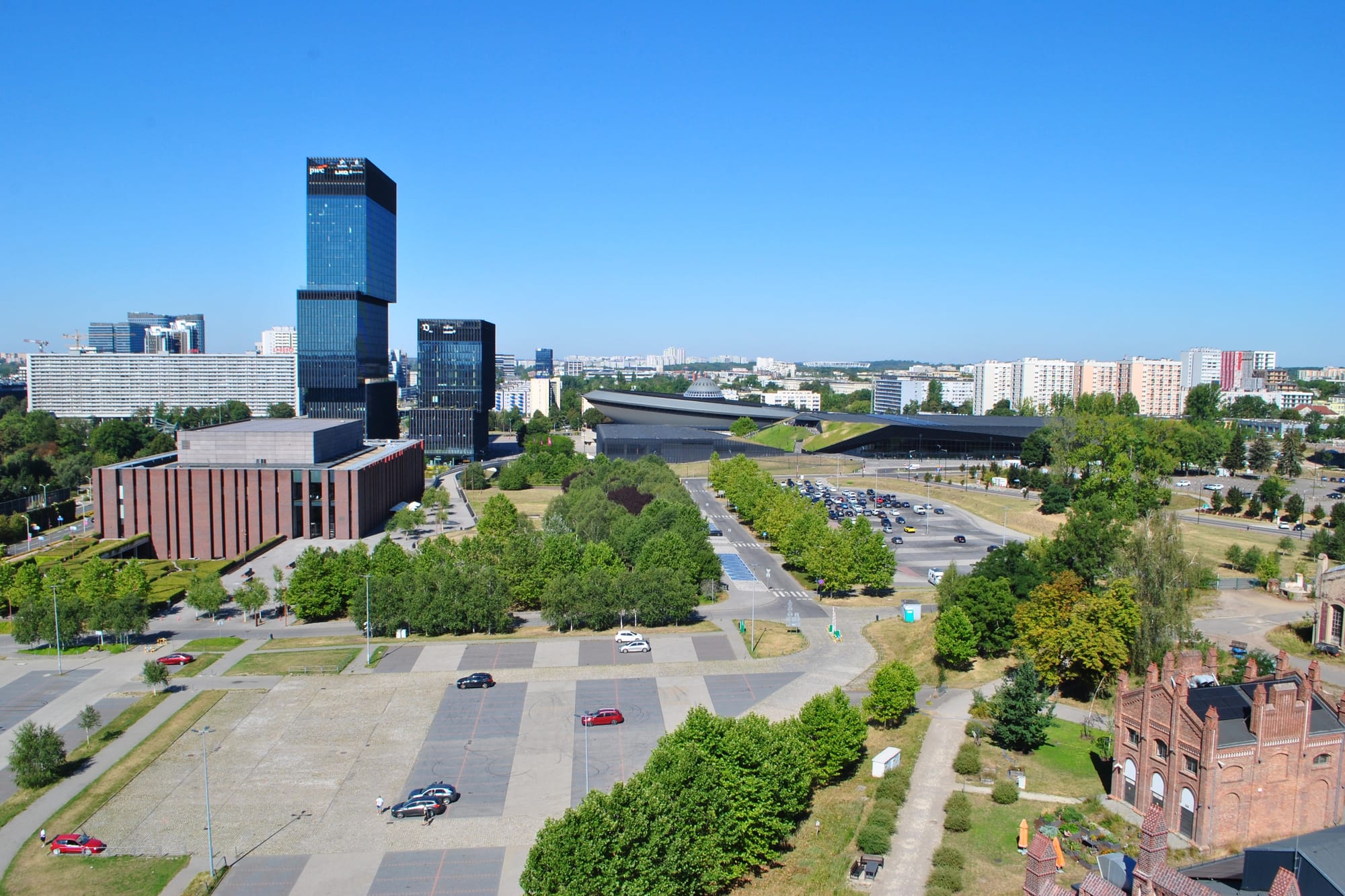
A brick concert hall, two glass office towers and a low saucer-shaped arena among trees and open plazas under a clear blue sky

Silesia: Wrocław & Katowice, Poland

Katowice

The Zone of Culture in Katowice, with the NOSPR concert hall, the .KTW towers and the Spodek, seen from the Silesian Museum's viewing tower. (Marek Mróz / Wikimedia Commons · CC BY 4.0)

The capital of Poland's Silesian Voivodeship and centre of the country's largest urban area, Katowice grew from a 16th-century village into a coal, zinc and steel city in the 19th century. As the mines closed it rebuilt itself around music and conferences, with a concert hall, an underground museum and a congress centre on the site of a former coal mine.

Neighbourhoods

  • Śródmieście
    • First-time visitors
    • Close to public transport
    • Architecture

    The city centre around the main railway station and the Rynek, the market square crossed by trams. Streets of late 19th-century revival buildings sit beside interwar modernism and post-war blocks, and the Spodek, the concert hall and the Silesian Museum are a short walk away.

    Open in Maps
  • Koszutka
    • Architecture
    • Quiet and residential

    A district just north of the centre, built up as a housing estate from the 1950s, its oldest buildings in the socialist realist style. Its broad streets and solid apartment blocks show the city as the post-war planners imagined it.

    Open in Maps
  • Osiedle Tysiąclecia
    • Modernist housing
    • Parks

    A large housing estate begun in 1961 and completed in 1982. Its tallest blocks, the 24-storey Kukurydze or 'Corn on the Cob' towers, are among the tallest apartment buildings in Poland, and the estate borders the Silesian Park.

    Open in Maps
  • Nikiszowiec
    • Historic district
    • Galleries and cafés

    A red-brick estate begun in 1908 for the miners of the Giesche coal mine, with arched gateways, inner courtyards and a neo-Baroque church. Galleries and a branch of the city history museum are here, and the estate is one of Poland's official national Historic Monuments.

    Open in Maps
  • Giszowiec
    • Historic district
    • Quiet and residential

    A miners' settlement of 1907–1910 laid out as a self-contained garden city of small houses. Later blocks of flats broke up the original design, but some of the early streets survive.

    Open in Maps
  • Ligota and the southern suburbs
    • Quiet and residential
    • Woods and parks

    The greener, more suburban south and west of the city, where many of the middle-class neighbourhoods are. The Franciscan monastery and basilica at Panewniki and stretches of woodland are here.

    Open in Maps

Things to do

Famous landmarks

  • Spodeklandmark

    The saucer-shaped arena opened in 1971, widely seen as the symbol of the city and one of the first buildings in the world with a tensegrity roof; it hosts concerts, ice hockey and festivals.

    Open in Maps
  • Silesian Insurgents Memoriallandmark

    A monument of 1967 beside the Spodek whose three wings stand for the Silesian uprisings of 1919, 1920 and 1921, with the names of battle sites cut into its sides.

    Open in Maps
  • Cathedral of Christ the Kinglandmark

    The largest cathedral in Poland, built between 1927 and 1955 in brick faced with stone, with a plain interior known for its acoustics.

    Open in Maps
  • Drapacz Chmurlandmark

    A functionalist 'skyscraper' of 1934, 60 metres tall and built on a steel frame, one of the first tall buildings of interwar Poland.

    Open in Maps
  • Wujek Coal Minelandmark

    The mine where nine striking miners were killed after the declaration of martial law in December 1981, with a memorial unveiled ten years later.

    Open in Maps

Museums and the Zone of Culture

  • Silesian Museummuseum

    The region's main museum, reopened in 2015 in a largely underground building on the site of a former coal mine, with Polish painting, a gallery of non-professional art and displays on Silesian history.

    Open in Maps
  • NOSPR concert hallattraction

    The home of the Polish National Radio Symphony Orchestra, based in Katowice since 1945, whose hall of 2014 has a main auditorium of about 1,800 seats.

    Open in Maps
  • International Congress Centrelandmark

    The congress centre opened in 2015 beside the Spodek, cut through by a grassy canyon so as not to block the view of the arena; it hosted the 2018 UN climate summit.

    Open in Maps
  • Nikiszowiecneighborhood

    The miners' estate of red-brick blocks and courtyards in the east of the city, with galleries and a branch of the Museum of the History of Katowice.

    Open in Maps

Parks and green spaces

  • Kościuszko Parkpark

    A 72-hectare landscaped park dating from 1888, with a pre-war parachute tower, rose alleys and a wooden church moved here from the countryside.

    Open in Maps
  • Valley of Three Pondspark

    A large park and woodland in the south of the city around three ponds, the site of the OFF Festival each summer.

    Open in Maps
  • Silesian Parkpark

    A 620-hectare recreation park in neighbouring Chorzów, created from 1950s onwards on industrially devastated land between the cities of the conurbation.

    Open in Maps

Music, sport and nights out

  • Silesian Stadiumattraction

    For decades Poland's national stadium, in the Silesian Park in Chorzów, with about 54,000 covered seats and an annual Diamond League athletics meeting.

    Open in Maps
  • Teatr Śląskiattraction

    The city's oldest working theatre, opened in 1907 on the main square, and the first to stage plays in Silesian.

    Open in Maps

Short trips from the city

  • Guido Minemuseum

    In Zabrze, a historic deep coal mine turned museum, where visitors go underground on the European Route of Industrial Heritage.

    Open in Maps
  • Historic Silver Mine in Tarnowskie Górymuseum

    A UNESCO World Heritage Site since 2017, with old silver-mine workings and the neighbouring Black Trout Adit.

    Open in Maps

Seasonal events

  • Tauron Nowa MuzykaJune

    A dance and techno festival held in the city's former industrial spaces.

  • OFF Festivalearly August

    An alternative music festival founded by Artur Rojek, held in the Valley of Three Ponds since 2010.

  • Rawa Blues FestivalOctober

    Described as the world's largest indoor blues festival, first held in 1981 and named after the Rawa river, with its main concerts in the Spodek.

  • Maydayearly November

    An electronic music event in the Spodek, a sister to the festival of the same name in Dortmund.

  • Barbórka4 December

    St Barbara's Day, the miners' holiday, celebrated by miners in their dress uniforms.

Eat and drink

Long-standing places and food districts in Katowice. Hours, ratings and directions come from your maps app, always current.

Katowice classics

  • Silesian Sunday dinnerrestaurant

    Several restaurants in the centre serve the Silesian classics — beef roulade with red cabbage and kluski śląskie, the round potato dumplings served with gravy.

    Open in Maps
  • Milk bars and canteensrestaurant

    Cheap self-service places serving filling, home-style Silesian and Polish food.

    Open in Maps

Food districts

  • Nikiszowiecneighborhood

    The old miners' estate has cafés and restaurants among its galleries, in the arcades of the red-brick blocks.

    Open in Maps
  • Around the Rynekneighborhood

    The streets around the market square and the station hold most of the city's restaurants, bars and music clubs, from Silesian kitchens to Vietnamese, Indian and Georgian food.

    Open in Maps

Experience Katowice

History

The land around Katowice was farmed and worked by small hammer mills for centuries before the town existed. Dąb, now a district, is mentioned in 1299, and Katowice itself first appears in 1598 as one of several villages. Under Bohemian, Habsburg and, from 1742, Prussian rule, the discovery of rich coal deposits changed everything: mines opened from 1740 onwards, zinc works and steelworks followed, and in 1846–47 the railway from Breslau arrived. The industrialist Franz von Winckler made the village the seat of his estate, and in 1865 Kattowitz received town rights. In 1884 it hosted the first public Zionist meeting.

After the First World War the city voted to stay German in the 1921 plebiscite, but the surrounding district voted for Poland, and after the Silesian uprisings Katowice joined Poland in 1922 as the capital of an autonomous voivodeship with its own parliament. The new authorities built a modern quarter in the south of the centre, with the Silesian Parliament building, the cathedral and the steel-framed Drapacz Chmur. German troops entered in September 1939 and burned the Great Synagogue; Polish and Jewish residents were expelled or deported, and the Red Army took the city in January 1945.

Post-war Katowice became the most industrialised city in Poland. Between 1953 and 1956 it was renamed Stalinogród, a name residents never accepted. The University of Silesia was founded in 1968 and the Spodek opened in 1971. On 16 December 1981, after martial law was declared, nine striking miners were killed at the Wujek mine. Since 1989 the mines have closed one after another, the population has fallen, and the city has rebuilt its centre around culture and conferences, hosting the 2018 UN climate summit and the 2022 World Urban Forum.

Culture & Customs

Music is the city's calling card. Katowice joined UNESCO's Creative Cities Network as a City of Music in 2015, on the strength of the Karol Szymanowski Academy of Music, whose teachers and graduates formed the Silesian school of composers, and of the Polish National Radio Symphony Orchestra, which has been based here since 1945 and moved into its new hall in 2014. The Silesian Philharmonic is also here, and festivals range from the Rawa Blues Festival, held since 1981, to the OFF Festival of alternative music and electronic events in the Spodek. The finals of the Intel Extreme Masters esports tournament are held in the city.

The theatre scene is old by local standards: Teatr Śląski opened in 1907 and was the first theatre to stage plays in Silesian. Architecture is a point of interest in itself, from interwar modernism to the Spodek and the post-2004 buildings of the Zone of Culture, some of them nominated or shortlisted for the Mies van der Rohe award.

Silesian identity is strong. Mining traditions shape the calendar, and the Catholic Church is the main religion, though the share of residents declaring themselves Catholic fell sharply between the 2011 and 2021 censuses. The city also has a small Lutheran community with a cathedral dating from 1858, the oldest church originally built in Katowice.

Daily Life

Katowice had an official population of about 287,000 in the 2021 census, and the city estimates its resident population at around 315,000. It lies at the centre of Poland's largest conurbation, a chain of some forty towns with about 2.5 million people. The city is also home to tens of thousands of Ukrainian workers and refugees, and to more than 100,000 students at over twenty universities and colleges.

The economy has moved from coal and steel to professional services, finance, IT, retail and administration. In 2024 the city was Poland's seventh-largest job market and unemployment was around 1 per cent; salaries are among the highest in the country after Warsaw and Kraków. Only one coal mine still works within the city limits, and the headquarters of Polska Grupa Górnicza, Europe's largest coal-mining company, are here.

The centre is dense, with offices and flats around the station and the Zone of Culture. The northern and eastern districts grew up as workers' estates around mines and steelworks, each with its own shopping street, while the south and west are greener and more suburban. Trams carry many commuters across city boundaries that are invisible on the ground. The population has been shrinking since its peak of almost 369,000 in 1988, and with more deaths than births the decline continues.

Food

Silesian cooking is the city's own. The Sunday dinner is a beef roulade, rolada, stuffed with pickled vegetables and ham, served with modra kapusta, red cabbage, and kluski śląskie, round dumplings made of mashed and grated potato and served with gravy. Everyday dishes include krupniok, a sausage of blood and kasha, and wodzionka, a soup of garlic and cubes of dried rye bread. The żymła is the local bread roll, topped with poppy seeds, and kołocz śląski is a yeast cake under a sweet crumb.

Christmas Eve brings the region's special dishes: makówki, a dessert of finely ground poppy seeds with raisins, almonds, honey and candied peel, and moczka, a dark sweet of gingerbread, nuts and dried fruit. Kopalnioki, black hard sweets flavoured with anise and herbs and coloured with charcoal dye, are another regional speciality.

Milk bars and canteens serve filling home-style food cheaply in the centre, and the streets around the Rynek have a broad range of restaurants, from Silesian kitchens to Vietnamese, Indian and Georgian. Beer is the usual drink: Tyskie is brewed in nearby Tychy.

Planning tools

Budget

Katowice is one of the cheaper large cities in Poland for visitors. Its business hotels are aimed at weekday conference trade, so rooms are often cheaper on Friday and Saturday nights, but they fill and rise in price during big congresses, esports finals and festivals. Food, public transport and most museums are inexpensive.

Daily Budget Midrange
USD 110–210 (central hotel, restaurant dinners, museum and concert tickets, regional trains)
Daily Budget Shoestring
USD 45–75 (hostel bed, milk bars and canteens, trams and buses)

One ticket system covers trams and buses across the forty-odd towns of the conurbation, so a day ticket is the simple choice for trips to Chorzów, Zabrze or Nikiszowiec.

Best Time to Visit

May to September is the warmest time, when the parks and the OFF Festival are at their best. The concert season, the Rawa Blues festival in October and the miners' Barbórka celebrations in early December make autumn and winter good for music and for seeing the city's own traditions, though the weather is cold and grey.

Suggested Number of Days

One or two days are enough for the city itself. Three or four allow time for the mining museums and other towns of the conurbation, which are reached by tram, bus or train. A concert or festival date is often the reason to stay longer.

First Visit
1–2 days
With Surroundings
3–4 days

Transportation

Katowice sits at the centre of a large tram network shared with neighbouring cities, operated together with the buses by the metropolitan transport authority under one ticket system. Trams run through the Rynek and out to Chorzów and other towns, and suburban trains link the outer districts. A city bike scheme covers Katowice and many nearby towns.

Paper tickets must be validated immediately on boarding and inspectors check them; machines at the main stops and kiosks sell them.

Airport & Station Connections

Katowice Airport is at Pyrzowice, about 30 km north of the city, with many budget and holiday flights; an airport express bus reaches the centre in a little under an hour. Kraków's airport is the alternative for more international routes. Trains from Kraków take about an hour and from Warsaw just under three hours, arriving at the central station beside the Rynek; the intercity coach station is nearby.

Walkability

The centre is easy to walk: the Rynek, the station, the cathedral and the Zone of Culture are all within a kilometre or two, and pavements are broad and level. Wide roads and the railway split the centre in places. Nikiszowiec, the parks and the outer districts need a tram or bus.

Safety

Poland is a safe country with low violent crime. Central Katowice is busy and well used by day and at night, and crime against visitors is rare; some of the conurbation's post-industrial districts can be rough at night. The usual city precautions apply in crowds at concerts and festivals.

Use a taxi app or agree the fare before a street taxi sets off, and watch bags at big events. Check current official travel advice before travelling.

Climate

A temperate climate between oceanic and continental. Katowice has the highest elevation of Poland's large cities, and the average temperature over the year is about 8°C. Summers are mild to warm with showers; winters are cold and grey.

Summer
mild to warm — July averages about 18°C
Winter
cold — January averages about −2°C

Local Customs

Many people in and around Katowice see themselves as Silesian as well as, or rather than, Polish, and in the 2021 census about 18 per cent of the city's residents declared a Silesian nationality. Mining traditions are respected, and the miners' holiday on 4 December is a public occasion.

Dress modestly and keep quiet in churches during services, and ask before photographing people in the residential courtyards of Nikiszowiec.

Common Payment Methods

The currency is the Polish złoty (PLN). Cards and contactless payment are accepted almost everywhere, including at ticket machines; bus drivers sell a single type of ticket and may not give change, so a little cash is useful. ATMs are easy to find in the centre.