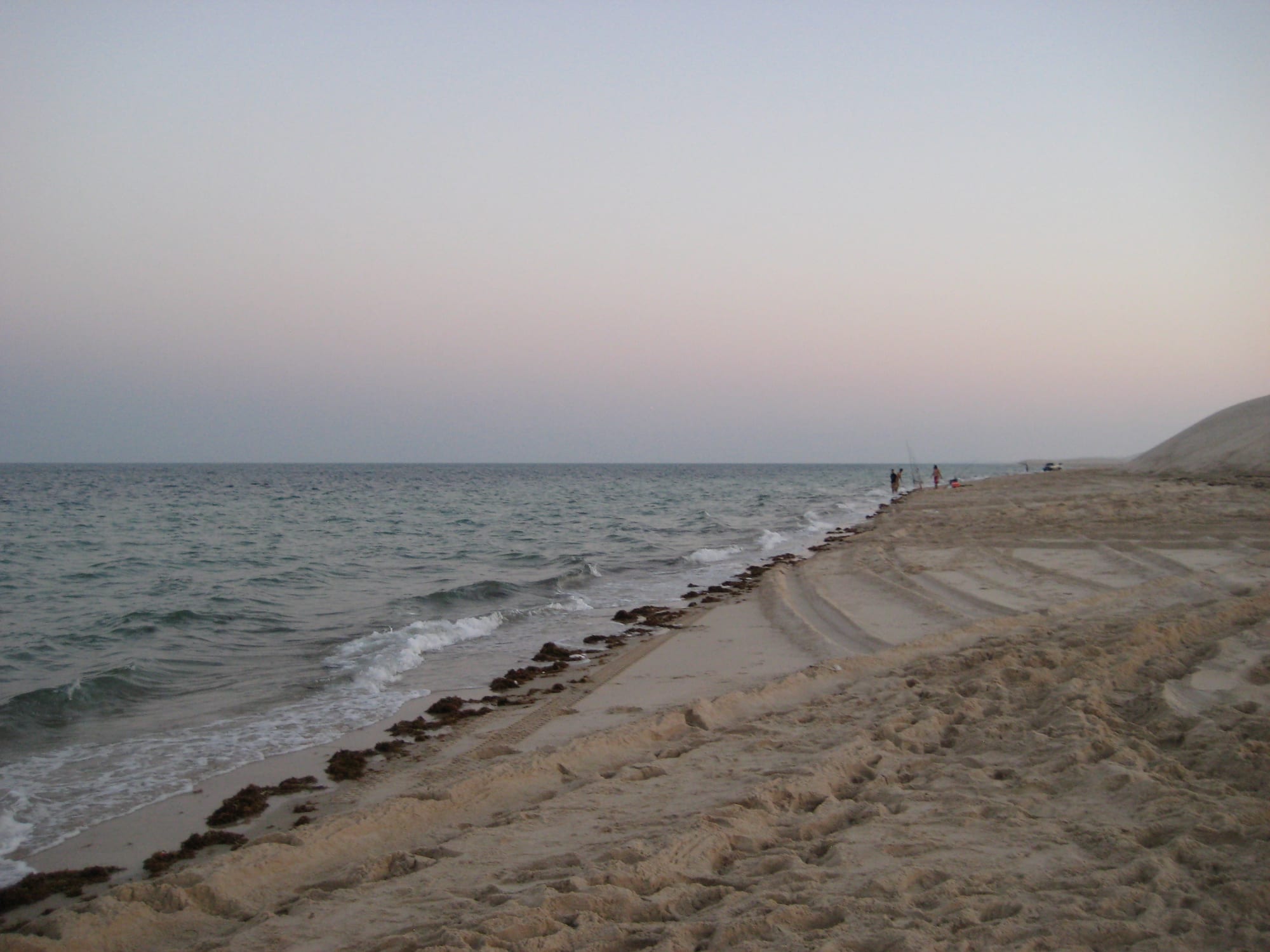
A long pale sand beach curving beside calm green-blue Gulf water at dusk, with a low sand ridge rising on the right

Qatar

Mesaieed

The beach at Sealine, on the coast beside Mesaieed. (Paul Trafford / Wikimedia Commons · CC BY 2.0)

A planned industrial town and port on Qatar's south-eastern coast, about 36 kilometres from Doha, built from the 1950s around oil exports and later petrochemicals and steel. Beyond its gated company housing the coast turns to high dunes at Sealine, the usual starting point for desert camps and drives towards the Khor Al Adaid inland sea.

Neighbourhoods

  • Mesaieed town
    • Local life
    • Quiet and residential

    The residential grid north of the plants, built as company housing and now a small town with schools, clinics, mosques, sports clubs, supermarkets and a handful of restaurants. It is quiet, low-rise and largely occupied by the workforce and their families.

    Open in Maps
  • The industrial area and port
    • Industry
    • Port

    A very large fenced zone of refineries, petrochemical and fertiliser plants, a steelworks and a deepwater port, laid out south of the town. It is closed to visitors, and photography of the installations is not permitted.

    Open in Maps
  • Sealine and the coast
    • Beaches
    • Desert camps
    • Weekends

    The dune coast east and south of the town, where sand meets the Gulf. Beach resorts, camps and quad-bike hire operate here in the cooler months, and Qatari families drive out at weekends.

    Open in Maps
  • The southern desert
    • Dunes
    • Four-wheel driving

    The open sand sea running towards the Saudi border, crossed only by four-wheel drive. Camps are set up here through the winter season, and the track to the inland sea starts from this side.

    Open in Maps

Things to do

Beaches and the desert

  • Sealine beach and dunesbeach

    The stretch of coast where dunes run down to the Gulf, used for swimming, camping, quad bikes and dune drives in the cooler months.

    Open in Maps

Short trips from the town

  • Khor Al Adaidattraction

    The inland sea in the far south-east, a tidal arm of the Gulf reaching in among high dunes near the Saudi border, about 45 kilometres away by desert track and reachable only by four-wheel drive.

    Open in Maps
  • Al Wakrahattraction

    An old pearling and fishing town about 25 kilometres north, with a restored souq of coral-stone buildings, a harbour full of dhows and a public beach.

    Open in Maps
  • Al Janoub Stadiumattraction

    Zaha Hadid's stadium at Al Wakrah, opened in 2019 with a roof shaped after the sails of traditional pearling dhows, and used in the 2022 World Cup.

    Open in Maps
  • Doha Cornichetrail

    The capital's waterfront promenade, about 35 kilometres north, the obvious outing for anyone staying in the town.

    Open in Maps
  • Museum of Islamic Artmuseum

    I. M. Pei's museum on the Doha waterfront, holding one of the world's major collections of Islamic art.

    Open in Maps

Seasonal events

  • Desert camping seasonOctober to April

    Camps are set up in the dunes along the coast and inland, and Qatari families spend weekends and holidays in them through the cooler months.

  • Qatar National Day18 December

    Marked nationally with parades and fireworks, and locally with gatherings, flags and displays in the town.

  • Ramadan and Eidthe month of Ramadan, moving earlier each year

    Daytime eating and drinking in public stop, working hours shorten, and life shifts to the hours after sunset.

Eat and drink

Long-standing places and food districts in Mesaieed. Hours, ratings and directions come from your maps app, always current.

Eating in the town

  • Mesaieed town restaurantsneighborhood

    A small choice of Indian, Pakistani, Filipino, Lebanese and fast-food places serving the workforce, along with supermarkets and bakeries.

    Open in Maps
  • Karak tea standscafe

    Counters selling strong tea boiled with evaporated milk, sugar and cardamom, the standard stop on the drive out to the dunes.

    Open in Maps

The coast

  • Sealine beach restaurantsneighborhood

    Resort and camp kitchens along the dune coast serving grills, rice dishes and mezze, busiest at weekends in the cooler months.

    Open in Maps
  • Al Wakrah souqmarket

    The restored waterfront market in the town to the north, with seafood restaurants, cafés and shisha terraces beside the harbour.

    Open in Maps

Experience Mesaieed

History

Mesaieed exists because of oil. After Qatar's first commercial field was developed at Dukhan on the west coast, a pipeline was laid across the peninsula to this sheltered south-eastern shore, where deep water allowed tankers to load, and exports began from the new terminal in 1949. The older name Umm Said stuck to the place for decades and is still heard; the town grew around the terminal as a company settlement of housing, canteens and workshops for the workforce that ran it.

From the 1960s the state broadened the site from an oil port into Qatar's main heavy-industrial zone. A refinery was built to supply the domestic market, then a fertiliser complex using natural gas as feedstock, a steel plant founded in the 1970s that used imported ore and local gas, and petrochemical works making ethylene and plastics. Port and storage facilities and a large shipping infrastructure followed, and the area became one of the two poles of Qatari industry alongside Ras Laffan in the north.

The town itself remained small and controlled, its residential quarter separated from the plants by distance and fencing, with a school system, clubs and shops provided for employees. From the 1990s the coast east of the town developed a second life as a leisure area: beach resorts, camps and quad-bike operators along the Sealine dunes, drawing weekend crowds from the capital. The industrial area was among the places struck during the regional war that began in February 2026.

Culture & Customs

Mesaieed's culture is that of a Gulf company town. Its population is overwhelmingly foreign and male — engineers, technicians, drivers and labourers from India, Pakistan, Nepal, Bangladesh, the Philippines and the Arab world — with a smaller number of families in the residential quarter, and Qatari nationals mostly in management or living in Doha and commuting. Social life runs through company clubs, sports grounds, cricket and football pitches, mosques and the canteens.

The surrounding desert supplies the other tradition. The dunes and the inland sea are where Qatari families keep the camping culture that is central to national identity: tented camps with carpets and majlis seating are pitched from autumn, and weekends through the winter are spent out on the sand with extended family. Falconry, camel racing and dune driving belong to the same season, and the coast's popularity with day visitors from Doha grew out of it.

Behaviour follows Qatari norms strictly. Dress is modest in public, alcohol is absent, and during Ramadan public eating and drinking in daylight stop altogether. Photography is a live issue here in a way it is not elsewhere: refineries, the port and security installations must not be photographed, and people, especially women and families camping, should be asked first. Greetings are unhurried, and English serves everywhere in the town.

Daily Life

Mesaieed is a small town, and the great majority of the people in and around it work in the industrial zone; some live in the town's housing, while a large labour force is accommodated in camps on its edges or bused in from Doha and Al Wakrah. Qatari citizens are a small minority of the local population.

The economy is a single industry in several forms: refining, fertiliser, petrochemicals, steel and the port that moves the output. Shift work sets the rhythm, buses move crews at fixed hours, and the town's shops, clinics and canteens follow those hours rather than the leisure calendar. Conditions and accommodation for migrant workers in Qatar's industrial sector have drawn sustained international attention, and labour rules were revised in recent years, including a minimum wage and the end of exit permits.

Daily life is shaped by heat and by distance. Errands are made by car, the supermarket and the mall serve as social space, and outdoor activity happens early or after dark for half the year. At weekends the direction of travel reverses: residents drive north to Doha for shopping and family, while Doha drives south to the beaches and the dunes. Water comes from desalination, electricity from gas, and the air carries the industry with it when the wind is from the south.

Food

Eating in Mesaieed is workforce eating, which in Qatar means South Asian food above all. Biryani and chicken or mutton curry with rice, dosa and idli at the South Indian canteens, Pakistani karahi and naan from a tandoor, Filipino grilled fish and rice, and Bangladeshi and Nepali kitchens serving their own communities all sit along the town's few commercial streets, alongside Lebanese shawarma counters and international fast food.

Qatari and Gulf cooking appears at the resorts and at the souq restaurants in Al Wakrah to the north: machboos, rice cooked with meat or fish, dried lime, saffron and baharat; madrouba, a soft rice and chicken dish; harees of wheat and meat beaten smooth; and grilled hamour, safi and prawns from the Gulf. Dates and Arabic coffee scented with cardamom open any hospitality, and luqaimat — fried dough balls in date syrup and sesame — close the meal.

Karak tea is the local fixture, sold from small counters and drunk in cars, often with regag, a thin crisp bread cooked on a hot plate and rolled with cheese or egg. Desert camps cook over fire — whole lamb, kebabs, rice — and bring their supplies with them, since there is nothing to buy beyond the tarmac. Alcohol is not sold or served in the town, and none may be taken into the desert.

Planning tools

Budget

Costs are Qatari, which is to say high, though Mesaieed itself is cheaper than Doha: the restaurants are workforce canteens rather than hotel dining rooms. The expensive parts are accommodation, which is limited to a few beach resorts, and organised desert activity — dune drives, quad bikes and overnight camps.

Daily Budget Midrange
USD 150–330 (beach resort room, restaurant meals, a desert tour or dune drive)
Daily Budget Shoestring
USD 55–95 (simple hotel room or a night in Doha, local restaurants, taxis)

A hire car or a driver is close to essential here, since distances between the town, the beaches and the desert are long and there is little public transport.

Best Time to Visit

November to March, when the coast and the dunes are comfortable and the camping season is under way, with December and January the best of it. April and October are hot but usable early and late in the day. From May to September the combination of heat and coastal humidity makes outdoor time impractical.

Suggested Number of Days

Most people come for a day from the capital, or for a night at the coast. Two or three days suit anyone spending time in the desert or using the beaches. The heat decides how much of the day is usable, and in summer that is very little.

First Visit
1 day
With Surroundings
2–3 days

Transportation

The metro does not reach the town and public transport amounts to a bus link with Doha, so nearly everyone arrives by car — a hire car, a Karwa taxi or a ride-hailing app from Doha. The town itself is spread out and designed for driving, and the beaches and desert tracks beyond it need a four-wheel drive, which is usually taken with a guide rather than alone.

Soft sand traps ordinary cars easily; dune driving is for experienced drivers in convoy with recovery gear, and tyre pressures must be lowered.

Airport & Station Connections

Mesaieed lies about 36 kilometres south of central Doha, well under an hour by road on a dual carriageway. Hamad International Airport is about 35 kilometres north, and taxis and ride-hailing cars make the run directly. Aviation in the region has been disrupted since the war that began in February 2026, so flights should be checked before planning.

Walkability

Barely walkable. The residential town has pavements and a few local shops within reach of each other, but distances between the town, the industrial zone and the coast are measured in kilometres of open road with no shade. Walking on the beach and the dunes is the pleasant exception, and only in the cooler months.

Safety

Since February 2026 Qatar has been drawn into the war between the United States, Israel and Iran. Iranian missiles and drones have struck the country, including the Mesaieed and Ras Laffan industrial areas and the US air base at Al Udeid, and the Strait of Hormuz has been blocked since late March, disrupting shipping, aviation and tourism across the Gulf. Away from the war, crime is extremely low. The real hazards here are practical: extreme summer heat, fast driving on the Doha road, getting stuck or lost in soft sand, and the industrial zone, where access and photography are restricted. Conservative norms apply in public, including modest dress.

Cover shoulders and knees in public and more so at mosques and during Ramadan, ask before photographing anyone, and carry insurance as private medical care is costly. Check current official travel advice before travelling.

Climate

Hot desert climate on a humid coast, with almost no rain; what falls comes between December and March. Sandstorms and the hot shamal wind blow in spring and summer, and the sea breeze gives the coast a little relief.

Summer
extreme — daytime highs of 40–45°C from June to September, with high humidity and warm nights
Winter
mild — daytime highs around 22–25°C from December to February, cool at night in the desert

Local Customs

The conservative norms of Qatar apply, and this is a more traditional setting than central Doha. Shoulders and knees are covered in public, and swimwear belongs on resort beaches rather than on public sand, where Qatari families gather. There is no alcohol outside licensed venues, and none in the desert. During Ramadan eating, drinking and smoking in public during daylight are offences.

Photographing industrial plants, the port or security installations is prohibited, campsites and family groups on the beach should be given a wide berth, and litter must be carried out of the desert.

Common Payment Methods

The currency is the Qatari riyal, pegged to the US dollar at about 3.64. Cards work in supermarkets, fuel stations, restaurants and resorts; a little cash is useful for small purchases, karak stands and informal hires. ATMs are in the town centre and at the shopping areas.