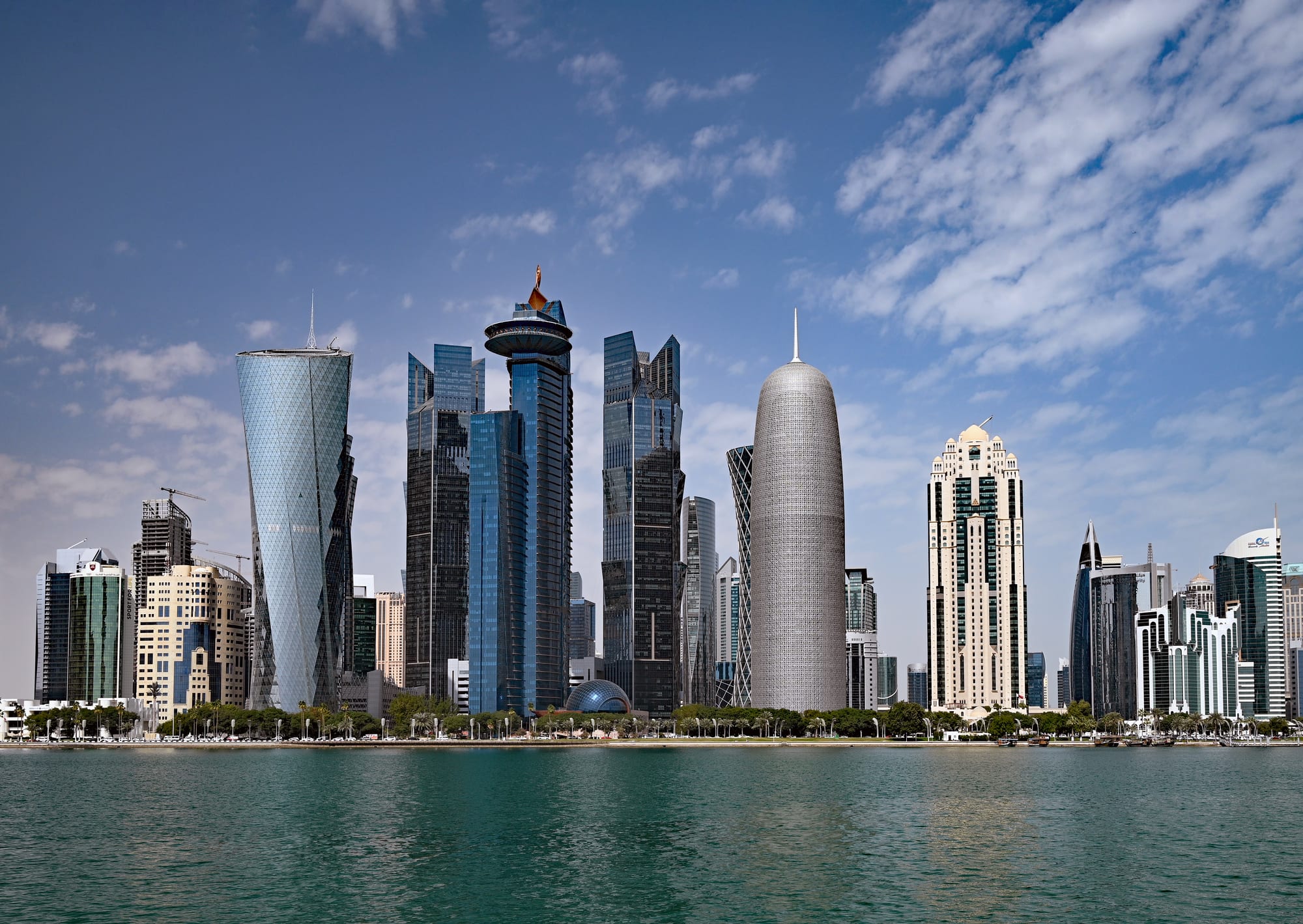
A row of tall glass and stone towers of unusual shapes along the Doha waterfront, seen across green-blue water under a blue sky

Qatar

Doha

The West Bay towers seen across the bay from the Doha Corniche. (P. Hughes / Wikimedia Commons · CC BY 4.0)

Qatar's capital, on the east coast of the peninsula, where most of the country's population now lives. A pearling and fishing settlement until gas revenue transformed it from the 1990s, it pairs the restored Souq Waqif and a long Corniche with the glass towers of West Bay, a group of major museums and a driverless metro.

Neighbourhoods

  • Souq Waqif and the old centre
    • First-time visitors
    • Best for food
    • Markets

    The rebuilt market quarter of mud-rendered lanes near the bay, with spice, textile and falcon traders, shisha cafés and restaurants from across the Arab world. It is the liveliest part of the city after dark and within walking distance of the Corniche.

    Open in Maps
  • West Bay
    • Business travellers
    • Architecture
    • Close to public transport

    The skyline district across the bay, a dense group of towers holding ministries, company offices, embassies, hotels and a large shopping centre. It is designed around cars and air conditioning rather than walking, but the metro reaches it.

    Open in Maps
  • Msheireb
    • Architecture
    • Museums
    • Close to public transport

    A redevelopment of the old commercial centre into low-rise blocks of pale stone with shaded streets and the city's main metro interchange, built to a design meant to revive traditional Qatari forms.

    Open in Maps
  • Katara and the northern coast
    • Arts and culture
    • Beaches
    • Restaurants

    The stretch north of West Bay around the Katara cultural village, with an amphitheatre, galleries, mosques, a beach and a long line of restaurants, running on towards the artificial islands.

    Open in Maps
  • The Pearl and Lusail
    • Waterfront
    • Restaurants
    • Shopping

    Reclaimed land north of the centre developed as marinas, apartment towers and a Mediterranean-styled promenade, continuing into the new city of Lusail with its stadium, towers and tram.

    Open in Maps
  • Al Sadd and Bin Mahmoud
    • Local life
    • Best for food
    • Quiet and residential

    Inland residential districts of apartment blocks, clinics, sports clubs and everyday shops, where much of the city's expatriate population lives and eats, with South Asian, Levantine and Iranian restaurants along the main streets.

    Open in Maps

Things to do

Museums

  • Museum of Islamic Artmuseum

    I. M. Pei's stone building of 2008 on its own island off the Corniche, holding one of the world's major collections of Islamic art across fourteen centuries.

    Open in Maps
  • National Museum of Qatarmuseum

    Jean Nouvel's building of interlocking discs, opened in 2019 around the restored palace of Sheikh Abdullah bin Jassim Al Thani, telling the country's story from geology to the present.

    Open in Maps
  • Mathafmuseum

    The Arab Museum of Modern Art in Education City, with a large collection of modern and contemporary work from across the Arab world.

    Open in Maps
  • Msheireb Museumsmuseum

    Four restored heritage houses in the old centre covering the history of slavery in the Gulf, the oil industry, and Qatari family life and folk traditions.

    Open in Maps
  • Qatar National Libraryattraction

    A single vast room designed by Rem Koolhaas in Education City, with a sunken heritage collection of maps, manuscripts and early printing.

    Open in Maps

Markets and landmarks

  • Souq Waqifmarket

    The old standing market, rebuilt in traditional style in the 2000s, selling spices, textiles, perfume and household goods, with a falcon souq and hospital alongside.

    Open in Maps
  • Doha Cornichetrail

    A seven-kilometre waterfront promenade curving around the bay, with dhows moored along it and the West Bay towers in view.

    Open in Maps
  • Katara Cultural Villageattraction

    A purpose-built cultural district with an open-air amphitheatre, galleries, a pigeon tower, two elaborately tiled mosques and a public beach.

    Open in Maps
  • Aspire Towerlandmark

    The 300-metre torch-shaped tower built for the 2006 Asian Games, standing over the sports complex in the west of the city.

    Open in Maps
  • The Pearl Islandneighborhood

    An artificial island of marinas, towers and waterfront shopping built on former pearl-diving beds off the northern coast.

    Open in Maps

Parks and the waterfront

  • Museum of Islamic Art Parkpark

    The park wrapped around the Museum of Islamic Art, with lawns, a dhow harbour and the clearest view back to the skyline.

    Open in Maps
  • Aspire Parkpark

    One of the largest parks in the city, laid out around a lake beside the sports complex, busy on winter evenings.

    Open in Maps
  • Al Bidda Parkpark

    A long park between the Corniche and the government district, with walking tracks, gardens and views of the bay.

    Open in Maps

Sport and stadiums

  • Khalifa International Stadiumattraction

    The national stadium, first opened in 1976 and rebuilt for the 2022 World Cup, next to the Aspire complex and the sport museum.

    Open in Maps
  • Lusail Stadiumattraction

    The largest of the 2022 World Cup grounds, in Lusail north of the city, where the final was played.

    Open in Maps
  • Lusail International Circuitattraction

    A motor-racing circuit north of the city that hosts Formula One and motorcycle grand prix rounds.

    Open in Maps

Short trips from the city

  • Al Wakrahattraction

    A coastal town about 15 kilometres south with a rebuilt souq of coral-stone buildings, a fishing harbour, a public beach and the Al Janoub Stadium, built for the 2022 World Cup.

    Open in Maps
  • Khor Al Adaidattraction

    The inland sea in the far south-east, where the Gulf reaches into high dunes near the Saudi border, reached only by four-wheel drive on a trip of about 80 kilometres.

    Open in Maps
  • Barzan Towerslandmark

    Two fortified watchtowers of the late nineteenth century at Umm Salal Mohammed, north of the city.

    Open in Maps
  • Al Zubarahlandmark

    The excavated remains of an eighteenth- and nineteenth-century pearling and trading town on the north-west coast, inscribed by UNESCO in 2013, about 90 kilometres away.

    Open in Maps

Seasonal events

  • Qatar National Day18 December

    Parades, a fly-past, fireworks and displays along the Corniche marking the unification of the country under Sheikh Jassim bin Mohammed Al Thani.

  • Motorcycle and Formula One grands prixwinter and spring

    International motor-racing rounds held at the Lusail circuit north of the city, often run at night under floodlights.

  • Qatar ExxonMobil OpenJanuary

    An ATP men's tennis tournament played at the Khalifa International Tennis and Squash Complex.

  • Ramadan and Eidthe month of Ramadan, moving earlier each year

    Daytime eating and drinking in public stop, working hours shorten, and the souq and restaurants stay busy through the night, with Eid celebrations and family gatherings at the end.

  • Qatar International Food Festivalthe cooler months

    An outdoor food festival held in the cooler months, with stalls from the city's restaurants and visiting cooks.

Eat and drink

Long-standing places and food districts in Doha. Hours, ratings and directions come from your maps app, always current.

Doha classics

  • Souq Waqif restaurantsneighborhood

    The densest choice in the city — Qatari, Yemeni, Lebanese, Iranian, Syrian and Turkish kitchens with tables in the lanes, plus shisha cafés and stalls of karak tea.

    Open in Maps
  • The fish market and seafood restaurantsmarket

    Gulf fish — hamour, safi, king fish and prawns — sold at the wholesale market and cooked in the surrounding restaurants, grilled or in machboos.

    Open in Maps
  • Katara restaurantsneighborhood

    A waterfront row of restaurants and cafés beside the cultural village, mixing Qatari and Levantine food with international chains.

    Open in Maps

Everyday food districts

  • Al Sadd and Bin Mahmoudneighborhood

    Where much of the city eats — Indian, Pakistani, Sri Lankan, Filipino, Egyptian and Iranian kitchens along the main roads, cheap and open late.

    Open in Maps
  • Karak tea standscafe

    Drive-up counters selling strong tea boiled with evaporated milk, sugar and cardamom, a fixture of Qatari evenings, often with regag bread alongside.

    Open in Maps

Experience Doha

History

The bay held small settlements of fishermen and pearl divers for centuries, the larger being Al Bidda, west of the present centre. Doha itself is generally dated to the 1820s; Al Bidda was bombarded by an East India Company vessel in 1821, and Doha and Al Wakrah were largely destroyed in 1867 in an assault mounted from Bahrain, during the struggles that ran along the Gulf coast. In 1868 a British- brokered agreement recognised Mohammed bin Thani as the leading figure of the peninsula, establishing the dynasty that still rules; an Ottoman garrison was stationed in Doha from 1871 until the First World War, and Qatar became a British protectorate in 1916, with Doha as its capital.

Pearling was the economy, and its collapse in the 1920s and 1930s — Japanese cultured pearls, then the Depression — left the town destitute, with people leaving for Bahrain and Saudi Arabia. Oil, found at Dukhan in 1939 and exported from 1949, reversed that slowly: the first school, hospital, power station and paved roads followed in the 1950s. Qatar became independent in 1971, and the discovery and development of the offshore North Field, the Qatari share of the largest natural-gas field in the world, changed everything from the 1990s.

Sheikh Hamad bin Khalifa Al Thani, who took power in 1995, turned gas revenue into a state-building project centred on Doha: Al Jazeera, Education City, Hamad International Airport, the museums, the metro, and a successful bid for the 2022 FIFA World Cup, whose stadiums and infrastructure remade the city and drew international scrutiny of conditions for migrant workers. A blockade by neighbouring states from 2017 to 2021 pushed Qatar towards self-sufficiency. The city has been affected by the regional war that began in February 2026, which has disrupted aviation and shipping across the Gulf.

Culture & Customs

Doha is two cities at once: a Qatari capital of a few hundred thousand citizens, and a vastly larger population of migrants from South Asia, the Philippines, the Arab world, Africa and the West. Qatari identity is expressed in dress — the white thobe and gutra for men, the black abaya and shayla for women — in the majlis, the reception room where men gather to talk, and in falconry, camel racing and the sadu weaving of desert wool, all of which the state supports as heritage.

The country's wealth has been spent deliberately on culture. Museums of international standing, an Islamic-art collection assembled from the 1980s, an orchestra, film and book festivals, public sculpture by well-known artists along the Corniche and at the airport, and Education City's branch campuses of American and European universities all belong to that policy, along with sport: the World Cup, motor racing, tennis, athletics and the Aspire academy.

Manners are formal and hospitable. Greetings are drawn out, coffee and dates are offered at the start of any visit, and the right hand is used for eating and giving. Religion is visible — the call to prayer, Friday closure at midday, and a dry public realm — and the norms are enforced by law as well as custom: modest dress, no public drinking, no displays of affection, and restraint in criticising the state or religion. Outside those limits the city is relaxed with visitors, and English is spoken almost everywhere.

Daily Life

About a million people live in Doha, and the great majority of Qatar's population of about 3 million lives in the wider metropolitan area running from Al Wakrah in the south to Lusail in the north. Qatari nationals are a small minority, perhaps a tenth of the total; the rest are foreign residents, from labourers and domestic workers to engineers, teachers and bankers, on employment-linked residence.

The economy rests on liquefied natural gas and the sovereign wealth it funds, with construction, aviation, finance, logistics, health, education and government employment layered on top. Wages and conditions for migrant workers drew heavy international criticism in the years before the World Cup, and labour rules were changed, including the ending of exit permits and the introduction of a minimum wage; enforcement remains debated. Qatari citizens receive extensive state benefits and are concentrated in public-sector employment.

Life follows the heat and the calendar. The working week runs Sunday to Thursday, Friday morning is for prayer and family, and from May to September activity moves indoors or into the night, with parks, beaches and the Corniche coming alive after dark. Malls function as public space, the metro has changed how many people move, and traffic remains heavy. In the cooler months families drive out to the dunes and the coast at weekends, camping in the desert through the winter season.

Food

Qatari home cooking is Gulf cooking, built on rice, lamb, chicken and fish with Indian and Persian spicing. Machboos — rice cooked with meat or fish, dried lime, saffron and baharat — is the national dish; madrouba is a soft, porridge-like rice and chicken dish; harees, wheat and meat beaten to a paste, is eaten especially in Ramadan; and thareed is meat and broth soaked into crumbled flatbread. Breakfast can be balaleet, sweet vermicelli under an omelette, or chebab pancakes with date syrup and cream.

Fish is central on this coast: hamour, safi, king fish and prawns, grilled whole or cooked into rice. Dates are served with everything, and Arabic coffee, pale green with cardamom, is poured from a long-spouted dallah into small cups, with three cups the customary limit. Luqaimat, fried dough balls soaked in date syrup and sesame, are the standard sweet, and karak — strong black tea boiled with evaporated milk, sugar and cardamom, an import from South Asia — is drunk at stands across the city at all hours.

The everyday food of Doha is the food of its migrant population: South Indian dosa and biryani, Pakistani karahi, Filipino canteens, Egyptian koshari, Iranian kebabs, Levantine mezze and shawarma, and Yemeni mandi and haneeth, roasted lamb and rice served on a shared tray. Souq Waqif holds the greatest concentration of restaurants, while alcohol is confined to licensed hotel bars and restaurants.

Planning tools

Budget

Doha is expensive, in line with the wealthier Gulf cities. Hotels and licensed alcohol cost the most, and alcohol is heavily taxed and served only in licensed hotel venues. The metro, Karwa taxis, the souq's street food and the city's free attractions — the Corniche, the parks, Katara, the souq itself — keep a day out much cheaper than the hotel rate suggests.

Daily Budget Midrange
USD 150–330 (four-star hotel, restaurant meals, a desert tour, museum and Katara visits)
Daily Budget Shoestring
USD 55–95 (budget hotel, South Asian and casual eateries, metro and taxis)

The metro is cheap and air-conditioned, museum entry is often free or low, and the main costs are the hotel and anything involving alcohol.

Best Time to Visit

November to March, when days are warm and evenings cool enough to sit outside, with December to February the peak and the main season for sport and festivals. April and October are hot but tolerable. From May to September the heat and humidity make outdoor life impractical, and the city moves indoors. Ramadan restricts daytime eating and drinking in public.

Suggested Number of Days

Two or three days cover the museums, the old market quarter and the waterfront at an easy pace. Four or five allow the desert and the coast beyond the city. Summer heat slows everything and pushes visits into the evening, which stretches the time needed.

First Visit
2–3 days
With Surroundings
4–5 days

Transportation

The Doha Metro, opened in 2019, has three driverless lines linking the airport, the centre, West Bay, Education City and Lusail, with feeder buses and the Lusail tram. Karwa taxis and ride-hailing apps are inexpensive and are how most visitors move between districts. Distances are long, roads are wide and fast, and a four-wheel drive with a guide is needed for the dunes.

Driving is fast and assertive and there is zero tolerance for drink-driving; the metro plus a taxi for the last stretch covers most journeys.

Airport & Station Connections

Hamad International Airport, about 8 kilometres south-east of the centre and the hub of Qatar Airways, handles almost all arrivals; the metro reaches it directly, and a taxi takes about the same time. Aviation across the region has been disrupted since the war that began in February 2026, so flights should be checked before planning. The only land border is with Saudi Arabia at Abu Samra, south-west of the city.

Walkability

Walkable in patches rather than as a whole. The Corniche, Souq Waqif, Msheireb, Katara and the Pearl are pleasant on foot in winter, and the metro links them, but the districts between are built for cars, with wide roads, long blocks and little shade. From May to September walking outside is uncomfortable to dangerous in the middle of the day.

Safety

Since February 2026 Qatar has been drawn into the war between the United States, Israel and Iran. Iranian missiles and drones have struck the country, including the Ras Laffan and Mesaieed industrial areas and the US air base at Al Udeid, and the Strait of Hormuz has been blocked since late March, disrupting shipping, aviation and tourism across the Gulf. Away from the war, Doha is one of the safest cities in the world for visitors, with extremely low crime. The other risks are practical and legal: extreme summer heat, fast driving, and the desert beyond the city. Conservative norms apply — modest dress in public, no public drunkenness or displays of affection, and great care with photography of people and of government, military and industrial sites.

Cover shoulders and knees in public and more so at mosques and during Ramadan, ask before photographing anyone, and carry insurance as private medical care is costly. Check current official travel advice before travelling.

Climate

Hot desert climate on a humid coast, and among the hottest inhabited cities anywhere. Rain is rare and falls mostly between December and March; sandstorms and the hot shamal wind occur in spring and summer.

Summer
extreme — daytime highs of 40–45°C from June to September, with high humidity on the coast and warm nights
Winter
mild and pleasant — daytime highs around 22–25°C from December to February, with cool evenings and occasional rain

Local Customs

Qatar is a conservative Muslim country and Doha follows suit in public: shoulders and knees covered, no public displays of affection, no drinking outside licensed hotel venues, and particular care during Ramadan, when eating, drinking and smoking in public during daylight are offences. Alcohol may not be brought into the country. Greetings between men are warm and unhurried; many Qatari women do not shake hands with men, so the lead is best followed rather than offered. Tipping is not obligatory, and a service charge is often added.

Ask before photographing anyone, never photograph government, military, industrial or airport facilities, dress modestly at mosques and Katara, and remember that Friday midday is prayer time when much of the city closes.

Common Payment Methods

The currency is the Qatari riyal, pegged to the US dollar at about 3.64. Cards and contactless payment work almost everywhere, including taxis and the metro. A little cash is useful in the souq, at karak stands and for small purchases. ATMs and exchange houses are common, and exchange rates at the souq's money changers are usually better than at hotels.