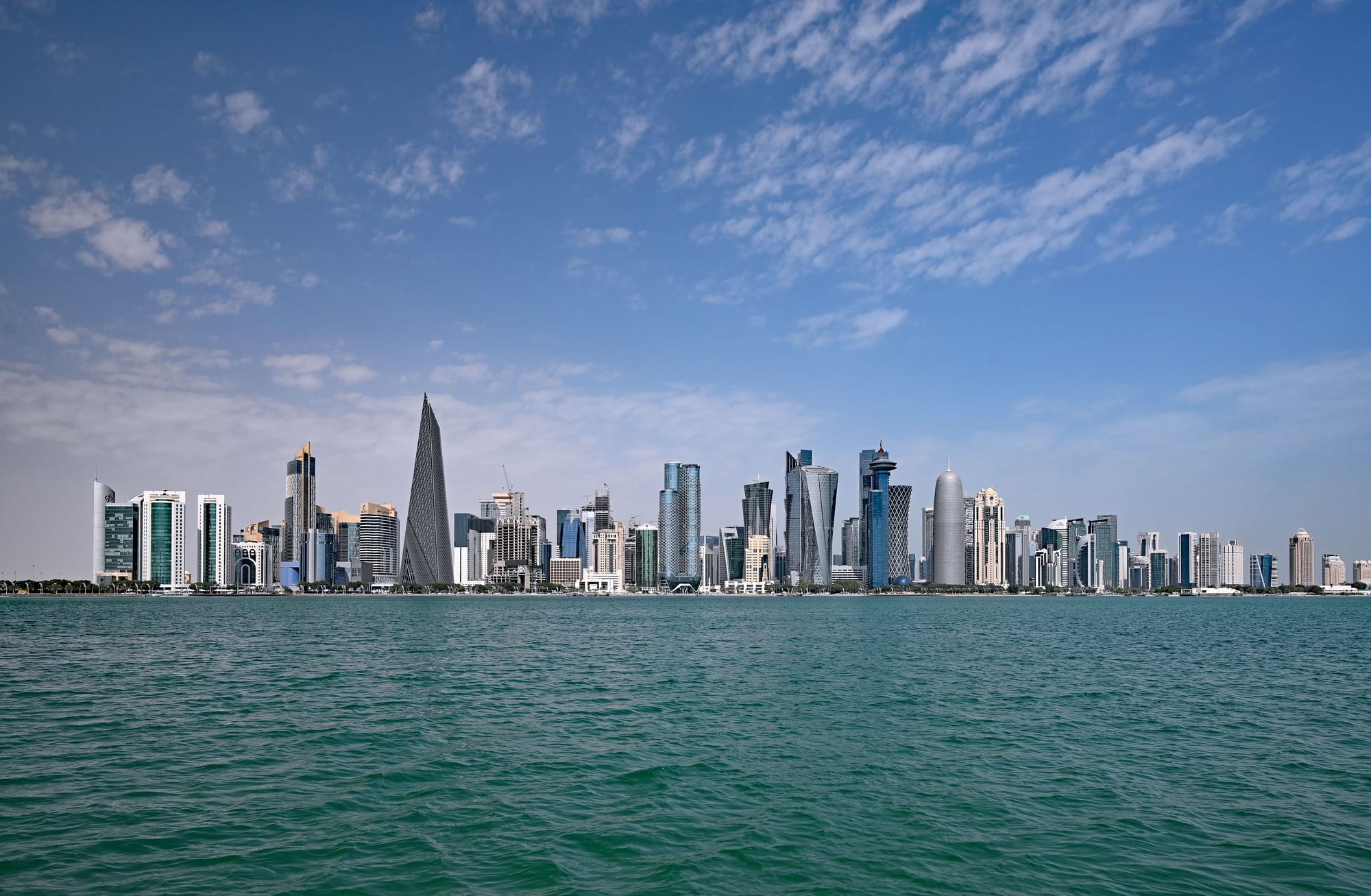
A cluster of tall glass skyscrapers of varied shapes rising along a curved bay, with calm blue water and a clear sky

Qatar

The West Bay skyline of Doha, built in a generation on the wealth of Qatar's vast natural-gas reserves. (P. Hughes / Wikimedia Commons · CC BY 4.0)

A small, flat peninsula in the Persian Gulf, ruled by the Al Thani family — a former pearling backwater turned, on the wealth of one of the world's largest gas fields, into one of the richest countries per head, an activist mediator, and the 2022 World Cup host. Qatar has been struck during the war that began in February 2026 between the United States, Israel and Iran, and has acted as one of its mediators.

Explore Qatar

History

Qatar was a poor stretch of pearling and fishing villages, nominally under Ottoman and then British influence, with the Al Thani family emerging as its leading dynasty in the nineteenth century and a 1916 treaty making it a British protectorate. Oil, found in 1939 and exported from 1949, brought the first wealth; independence came in 1971, when Qatar chose to stay separate from the new UAE federation.

The real transformation was natural gas: Qatar sits on part of the world's largest gas field and, from the 1990s, built a massive liquefied-natural-gas industry that made it, per head, one of the richest countries on Earth. Under Sheikh Hamad, who ruled from 1995 to 2013, that wealth funded an outsized global profile — founding the broadcaster Al Jazeera, buying trophy assets worldwide through a sovereign wealth fund, hosting the forward base of the US military in the region, and pursuing an activist foreign policy that made Doha a venue for talks between adversaries and a refuge for exiled political figures.

Sheikh Hamad handed power in an orderly transition to his son Sheikh Tamim in 2013. From 2017 to 2021, Saudi Arabia, the UAE, Bahrain, and Egypt imposed a land, sea, and air blockade on Qatar, which it weathered by deepening ties with Turkey and Iran before the rift was healed. In 2022 Qatar hosted the FIFA World Cup, the first in the Arab world, after a vast building programme that also brought intense scrutiny of the treatment of the migrant workers who built it, and it has since been central to Gaza ceasefire and hostage negotiations.

Since 28 February 2026 Qatar has been caught up in the war between the United States, Israel and Iran. Iranian missiles and drones struck the country from the first days of the war, hitting the American air base at Al Udeid and the Ras Laffan and Mesaieed industrial areas, which forced an unprecedented halt to Qatar's liquefied-natural-gas production and pushed world fuel prices higher; a further attack in mid-March targeted Qatari gas production. Qatari air defences shot down two Iranian aircraft, and Iran attempted to strike Doha's airport. Doha has gone on playing mediator, helping to broker a ceasefire in Lebanon in June 2026 and pressing for the reopening of the Strait of Hormuz, which Iran blocked in the first days of the war and claimed sovereignty over in late March, and where a Qatari gas tanker was set ablaze in July.

  • Qatar: The Peninsula That Bought Influence — A desert thumb of land with the world's third-largest gas reserves — a pearling and Bedouin society, a British protectorate, and, since a palace coup in 1995, a tiny state that has spent its wealth on outsized global reach

Culture & Customs

Qatari society is small, wealthy, and built on tribe, family, and a conservative Sunni Islam. National dress is worn with pride — the white thobe and headcloth for men, the black abaya for women — and majlis gatherings, cardamom coffee with dates, falconry, camel and Arabian-horse racing, and pearl-diving heritage remain touchstones even as daily life is thoroughly modern.

The state has invested heavily in culture and knowledge as a national project: I.M. Pei's Museum of Islamic Art and Jean Nouvel's desert-rose National Museum, the branch campuses of Education City, a busy calendar of art and sport, and, in Al Jazeera, a media voice out of all proportion to the country's size.

Ramadan reshapes the rhythm of the year, and the small citizen population — a minority in their own country — lives alongside a vast, stratified expatriate workforce that does most of the actual work.

  • Qatar: Sword Dance, Sadu and the Falcon — A small Muslim nation where the majlis is the heart of social life, coffee is poured with the right hand and elders served first, weddings are celebrated twice, and Bedouin crafts and falconry are guarded as living heritage

Daily Life

Almost the entire population lives in or around Doha, a fast-built city of glass towers on the bay, ringed by planned districts, malls, and a new metro. Qatari citizens — a small minority of residents — enjoy free health care and schooling, subsidised housing and energy, and largely government employment, alongside a "Qatarisation" push to bring more nationals into skilled private-sector roles.

Everyone else is an expatriate on a work visa, from South Asian construction and service workers at one end to Western and Arab professionals at the other, in a sharply layered society. Labour reforms passed before the World Cup — a minimum wage and an easing of the rules tying workers to one employer — were called significant but are unevenly enforced.

Life runs on the calendar of the heat: an early start, indoor air-conditioned days through the summer, and social life outdoors on the Corniche and in the desert in the cool half of the year.

  • Qatar: A Country Its Citizens Share — A Friday-Saturday weekend, a working day that empties the streets at midday in summer, and a nation where citizens make up little more than one in ten of the people who actually live there

Food

Qatari cooking is Gulf Arab, with strong Persian, Indian, and Levantine influence. The national dish is machboos — spiced rice cooked with meat or fish, dried lime, and a baharat spice blend, close to a biryani. Harees (wheat and meat pounded to a porridge), thereed (a stew over torn flatbread), grilled Gulf fish such as hammour, and ghuzi (a whole roast lamb over nut-studded rice) fill out the traditional table.

Sweets include luqaimat, fried dough balls in date syrup, and balaleet, sweet vermicelli with egg. Dates and light, cardamom-scented coffee are offered to any guest.

Beyond the Qatari kitchen, Doha's restaurant scene reflects its population — outstanding South Asian, Iranian, Lebanese, Turkish, and Filipino food alongside the full international range — with karak, strong sweet spiced tea, sold from roadside stalls as the everyday drink. Alcohol is served only in licensed hotels.

  • Qatar: Food and the National Dish — Spiced rice and meat shared across the Gulf, in a country whose modern wealth has brought a genuinely international dining scene alongside it

Attractions & Natural Wonders

Doha's waterfront Corniche runs from the West Bay skyline past the dhow harbour to the Museum of Islamic Art, set on its own island with one of the world's finest collections of Islamic art. Nearby, the restored Souq Waqif is a warren of lanes selling spices, textiles, falcons, and food, liveliest in the evening, and the Msheireb district pairs modern architecture with museums of Qatari history.

The National Museum of Qatar, built as an interlocking cluster of discs like a desert rose, traces the country's story, while Katara Cultural Village stages concerts and exhibitions by the beach and The Pearl and Lusail are showpiece planned marina districts.

Out of the city, the desert leads to Khor Al Adaid, the "Inland Sea", where dunes meet a tidal lagoon on the Saudi border, reached by 4x4 with a guide. The north holds the ruined fort and pearling town of Al Zubarah, a UNESCO World Heritage Site, the mangroves of Al Thakira, and the rock carvings at Al Jassasiya.

  • Qatar: Six Attractions and Natural Wonders — A museum built like a modern desert fortress, a trading souq more than a century old rebuilt in its traditional style, and an inlet of the Gulf ringed by high sand dunes

Planning basics

Budget

Qatar is an expensive destination, in line with the wealthier Gulf states. Hotels, dining, and licensed alcohol cost most; the metro, Karwa taxis, Souq Waqif street food, and the free museums and Corniche keep a day out cheaper than expected.

Daily Budget Midrange
QAR 550–1,200 / USD 150–330 (four-star hotel, restaurants, a desert 4x4 tour, museum and Katara visits)
Daily Budget Shoestring
QAR 200–350 / USD 55–95 (budget hotel, casual and South Asian eateries, metro and taxis)

Use the cheap, air-conditioned Doha Metro and Karwa or ride-hailing apps; alcohol is only in licensed hotels and is heavily taxed.

Visa Requirements

Citizens of many countries — including the EU, the UK, the US, Canada, Australia, and New Zealand — get a free visa waiver on arrival, typically for 30 or 90 days; US citizens may stay up to 90 days. Everyone else can apply online for the Hayya e-visa, which is open to all nationalities. A passport valid for six months is required.

Typical Stay
30–90 days on a visa waiver, depending on nationality

Safety

Since February 2026 Qatar has been drawn into the war between the United States, Israel and Iran. Iranian missiles and drones have struck the country, including the Ras Laffan and Mesaieed industrial areas and the US air base at Al Udeid, and shipping through the Strait of Hormuz has been largely blocked since early March, disrupting shipping, aviation and tourism across the Gulf. Check current official travel advice before making plans. Away from the war, Qatar is one of the safest countries in the world for visitors, with extremely low crime. The other risks are practical and legal: extreme summer heat, fast and aggressive driving, and the desert. Respect conservative norms — dress modestly in public, no public drunkenness or displays of affection, and take great care with photography of people, and of government, military, and industrial sites.

Laws
Alcohol is served only in licensed hotels; homosexuality is illegal; drug penalties are severe; criticism of the state, the emir, or Islam can bring charges

Cover shoulders and knees in public and more so at mosques and during Ramadan, ask before photographing anyone, and carry insurance as private medical care is costly.

Climate

Hot desert, and one of the hottest inhabited countries. Summers, roughly May to September, are extreme — 40–48°C and very humid on the coast, with outdoor life largely suspended. Winters, November to March, are pleasant, in the high teens to mid-twenties, with occasional rain and sandstorms. Annual rainfall is tiny.

Summer
May–September, 40–48°C, humid
Winter
November–March, 15–25°C by day

Transportation

Hamad International Airport in Doha is a major global hub and home to Qatar Airways, though aviation across the region has been disrupted since the 2026 Iran war began, and an Iranian attempt to strike Doha's airport was reported in March 2026, so check what is actually flying. The Doha Metro — three clean, cheap, air-conditioned lines — reaches the airport, the Corniche area, Education City, and Lusail, with feeder buses and a tram. Karwa taxis and ride-hailing apps are inexpensive. A 4x4 with a guide is needed for the desert dunes.

Doha's roads are excellent but local driving is fast; the metro and taxis are the easy way around, and drink-driving carries zero tolerance.

Best Time to Visit

November to March, when days are warm and evenings cool, is the season for the desert, the Corniche, festivals, and sport, with December to February the peak. Summer is best avoided or planned around indoor and night-time activity. Ramadan restricts daytime eating and drinking in public.

Events
Qatar National Day (18 December); the MotoGP night race at Lusail (moved from April to November in 2026 because of the war); the Qatar ExxonMobil Open tennis and other winter sport. The war has disrupted events across the region, so check before you plan around one.

Currency

The currency is the Qatari riyal (QAR), pegged to the US dollar at about 3.64. Cards and contactless payment are accepted almost everywhere; carry a little cash for the souq, street karak, and small taxis.

Symbol
ر.ق / QR
Currency Code
QAR — Qatari riyal

Language

Arabic is the official language, in a Gulf dialect. English is extremely widely spoken — the de facto language of business, education, and daily life across the multinational population — and signage is bilingual, so visitors have no language barrier. Hindi, Urdu, Malayalam, Nepali, Tagalog, and other South and Southeast Asian languages are heard everywhere.

English
Near-universal in business and daily life
Official Language
Arabic