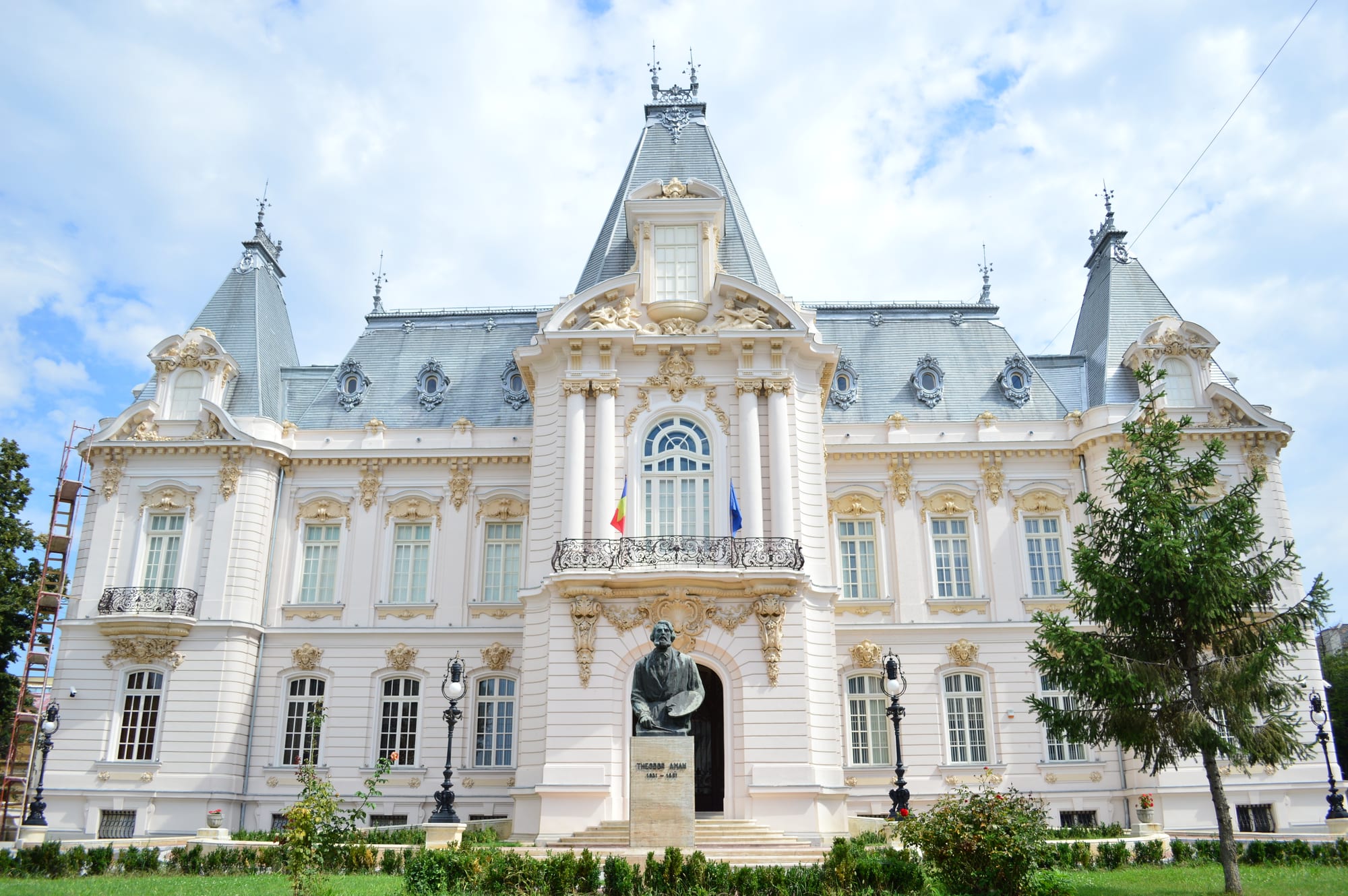
The white French-style façade of a palace with grey slate roofs and turrets, a bronze bust and lawns in front

Oltenia, Romania

Craiova

The Jean Mihail Palace in Craiova, home of the Craiova Art Museum. (Transcedentalia / Wikimedia Commons · CC BY-SA 3.0 ro)

The largest city of south-western Romania and the capital of Dolj County, near the Jiu river in central Oltenia. For centuries the seat of the bans who governed Oltenia, it grew into a trading and industrial city; today it has a car plant, two universities, a palace art museum with early Brâncuși sculptures and the landscaped Nicolae Romanescu Park.

Neighbourhoods

  • City centre and Mihai Viteazul Square
    • First-time visitors
    • Museums
    • Cafés and restaurants

    The central square, with its statue of Michael the Brave, fountains and gardens, sits among the main civic buildings, the Art Museum in the Jean Mihail Palace and the National Theatre. Pedestrian streets lead to cafés, shops and the old churches.

    Open in Maps
  • The old quarter around the Bănie
    • Historic district
    • Churches

    The oldest part of the city around the Băniei House, rebuilt in 1699 on the site of the bans' residence, the Metropolitan Cathedral of St Demetrius on Matei Basarab Street and the Madona Dudu church, with the Museum of Oltenia's buildings nearby.

    Open in Maps
  • Romanescu Park
    • Parks
    • Families

    The great landscaped park of 1897–1903 on the former Bibescu estate, with its lake, suspension bridge and mock castle, is the city's largest and best-known park.

    Open in Maps
  • Housing estates
    • Local life
    • Quiet and residential

    Apartment districts built under communism — Brazda lui Novac, Siloz, Craiovița Nouă, Rovine and others — where much of the population lives, linked to the centre by trams and buses.

    Open in Maps

Things to do

Museums

  • Craiova Art Museummuseum

    In the Jean Mihail Palace of 1898–1907, designed by Paul Gottereau, with Carrara marble stairs and Murano chandeliers — and a gallery of six early Brâncuși sculptures, including a version of The Kiss.

    Open in Maps
  • Museum of Olteniamuseum

    The regional museum, whose archaeology section dates from 1915, in three buildings: history and archaeology, natural history with a traditional pottery shop, and ethnography.

    Open in Maps
  • Băniei Housemuseum

    The oldest non-religious building in Craiova, rebuilt by Constantin Brâncoveanu in 1699 on the site of the bans' residence, now home to the Museum of Oltenia's ethnography exhibition.

    Open in Maps

Landmarks and churches

  • Cathedral of Saint Demetriuslandmark

    The seat of the Metropolis of Oltenia, on the site of a church renovated in 1651; the present building was begun in 1889 and consecrated in 1933.

    Open in Maps
  • Madona Dudu Churchlandmark

    A church of 1750–1756, renovated by 1844 after the earthquake of 1831, with oil murals in Western style completed in 1844.

    Open in Maps
  • Coșuna Monastery churchlandmark

    Dating from 1483, the oldest building preserved in Craiova.

    Open in Maps
  • Mihai Viteazul Squarelandmark

    The central square, with the statue of Michael the Brave, a musical fountain and a formal garden.

    Open in Maps

Parks and gardens

  • Nicolae Romanescu Parkpark

    A romantic landscaped park by the French architect Édouard Redont, whose plans won a gold medal at the 1900 Paris Exposition, with a lake, a suspension bridge of 1901–02 and the 'Enchanted Castle' built to hide a water tower.

    Open in Maps
  • Craiova Botanical Gardenpark

    The university's botanical garden in the city centre, laid out by the botanist Alexandru Buia and opened in 1952, with plants from across Romania.

    Open in Maps

Theatre and sport

  • National Theatre Marin Sorescuattraction

    The theatre of Oltenia, with roots in a company of 1850, internationally known for its avant-garde productions since the 1990s and host of a Shakespeare festival since 1994.

    Open in Maps
  • Ion Oblemenco Stadiumattraction

    The 30,983-seat football stadium opened in 2017, named after the Universitatea Craiova legend Ion Oblemenco.

    Open in Maps

Short trips from the city

  • Târgu Jiuattraction

    The Gorj county town where Brâncuși laid out his ensemble of the Table of Silence, the Gate of the Kiss and the Endless Column as a war memorial in the late 1930s.

    Open in Maps

Seasonal events

  • International Shakespeare Festivalevery two years

    The National Theatre's festival, held since 1994, brings theatre companies from around the world to the city's stages.

Eat and drink

Long-standing places and food districts in Craiova. Hours, ratings and directions come from your maps app, always current.

Food districts and markets

  • Piața Centralămarket

    The central market, a stop on many of the city's bus routes.

    Open in Maps
  • Restaurants in the centreneighborhood

    The pedestrian streets around Mihai Viteazul Square and the old quarter hold the city's restaurants, terraces and cafés.

    Open in Maps

Experience Craiova

History

Craiova stands on the site of the Dacian and Roman settlement of Pelendava, and the first known record of the town itself is a charter of 1475. In 1395 Mircea the Elder probably defeated the Ottoman sultan Bayezid I nearby at Rovine. For centuries the city was the seat of the Great Ban, who represented the prince in Oltenia; the first bans came from the Craiovești family, and several princes, Neagoe Basarab and Matei Basarab among them, came from the family. The bans could mint coins with their own effigies — the origin of the Romanian word ban for a coin.

The Habsburg occupation of 1718–1739 hurt the city, the bans moved to Bucharest in 1761, and an earthquake in 1790, plague in 1795 and the rebel pasha Osman Pazvantoğlu's burning of the town in 1800 followed. Yet Craiova prospered as a regional trading centre; Wallachia's last two princes, Gheorghe Bibescu and Barbu Știrbei, came from a Craiova boyar family. In 1896 it became the first Romanian city lit by electricity from internal-combustion engines, and the Treaty of Craiova of 1940 returned Southern Dobruja to Bulgaria.

From the 1960s the communist state made Craiova an industrial centre for machinery, aircraft, chemicals and vehicles, and built its large housing estates. After 1989 many industries were privatised, but industry still makes up about 70 per cent of the city's economy; in 2015 the city gave its name to the Craiova Group of Romania, Bulgaria, Serbia and later Greece.

Culture & Customs

Craiova is a cultural centre for Oltenia. The National Theatre Marin Sorescu, with roots in a company of 1850, gave the first complete Romanian performance of Hamlet in 1925 and became internationally famous in the 1990s for the avant-garde productions of Silviu Purcărete; it has hosted its own Shakespeare festival since 1994. The Art Museum's six early sculptures by Brâncuși, including variants of his best-known works, are among the city's proudest possessions.

Education has deep roots: the school founded by Constantin Obedeanu in 1759 became, in 1826, the second Romanian high school after Saint Sava in Bucharest, and the University of Craiova, founded in 1947, is the largest in Oltenia. The city's interwar printing houses, Ramuri and Scrisul Românesc, were known across Romania and abroad.

Football has a long history in the city. Universitatea Craiova became the first Romanian club to reach the semi-finals of a European competition, in the 1982–83 UEFA Cup, and the city now has rival clubs carrying the name, CS Universitatea Craiova and FC U Craiova 1948. Basketball, handball and volleyball teams play in the Polyvalent Hall. Local speech is known for its frequent use of the simple past tense.

Daily Life

The 2021 census counted about 234,000 people within the city limits, making Craiova the seventh-largest city in Romania, down from the figure recorded in 2011. The city also administers eight villages, among them Făcăi, Mofleni and Rovine, and large apartment estates built under communism house much of the population.

Industry still dominates the economy. The Ford car plant, in the former Oltcit factory, has built the EcoSport and, since 2019, the Puma; it passed to Ford Otosan in 2022. Avioane Craiova, which built the IAR-93 and IAR-99 military jets, is based at Ghercești, near the city, and the two universities, the hospitals and the county administration are major employers.

Public transport runs on 35 trams, on an 18.4 km double-track line opened in 1987, and 190 buses, and the pedestrian centre fills in the evenings. Romanescu Park is the city's great weekend walk, and match days at the Ion Oblemenco Stadium bring crowds onto the streets.

Food

Oltenian cooking shares the Wallachian basics — ciorbă sour soups, sarmale and mămăligă. Before Christmas, on Ignat's Day, 20 December, rural families traditionally slaughter a pig, which becomes sausages, caltaboș — minced pork organs, liver and rice stuffed in a casing — and jumări crackling. Mici, grilled sausages of mixed beef, lamb and pork, are served with mustard everywhere.

The Dolj plain around the city is market-garden and farming country, and the sandy soils at Dăbuleni produce watermelons famous throughout Romania. Papanași, fresh-cheese doughnuts with sour cream and fruit preserve, are a favourite dessert, cozonac, a sweet bread with nuts or poppy seeds, sweetens the Christmas meal, and plum țuică is offered before a meal.

Wine is a local pride. Segarcea, in Dolj, has a vineyard belonging to the Romanian Crown Estate and is known for its white wines, while the Drăgășani wine region is known for the native white Crâmpoșie. Craiova once had macaroni and bread factories and three breweries.

Planning tools

Budget

Craiova is inexpensive by Romanian standards, with moderate hotel prices, restaurants at decent prices and cheap public transport. The Art Museum and other museums charge little, and the parks are free.

Daily Budget Midrange
USD 75–140 (comfortable hotel, restaurant meals, museum entries, taxis)
Daily Budget Shoestring
USD 35–55 (guesthouse, local restaurants and fast food, trams and buses)

Taxis are plentiful and cheap; trams and buses use tickets bought from kiosks.

Best Time to Visit

May to June and September to October. Summers on the plain are long and hot, and winters cold but too mild for a lasting snow cover; fog is common in the cold season.

Suggested Number of Days

One or two days cover the museums, churches and the big park at an easy pace. Three or four allow time for excursions into the Oltenian foothills or towards the Danube. Theatre or football fixtures can add an evening.

First Visit
1–2 days
With Surroundings
3–4 days

Transportation

The city has three tram lines on a double-track route opened in 1987 and 17 bus lines, run by RAT Craiova; tickets are bought from kiosks and used on both. Taxis are plentiful. The centre and the old quarter can be covered on foot, and Romanescu Park is a short ride away.

Buses 8 and 9 link the city with the airport; buy tickets before boarding.

Airport & Station Connections

Craiova International Airport is 7 km east of the city, with flights to several European cities. The city is a major railway centre: trains to Bucharest take about three hours and to Timișoara about seven, and maxi-taxis to Bucharest and other towns leave from the Nord bus station next to the railway station.

Walkability

The centre is compact and largely pedestrianised around Mihai Viteazul Square, and the main museums, churches and theatre are within a short walk of each other. Romanescu Park is a short ride or longer walk away; the housing estates and the industrial east need a tram, bus or taxi.

Safety

Romania is a safe country with low violent crime. Craiova is a large provincial city where ordinary precautions are enough; stray dogs are occasionally met and can be aggressive.

Keep clear of stray dogs, use metered or app taxis, and keep valuables secure in crowds. Check current official travel advice before travelling.

Climate

A humid continental climate bordering on humid subtropical, with an average annual temperature of about 11°C. Summers are long and hot; winters bring occasional cold spells but are usually too mild for a permanent snow cover. Craiova has about 64 days of fog a year, mostly in winter, and rainfall is lower than in most of the country.

Summer
long and hot — in Caracal, on the plain east of Craiova, July averages 22.9°C and the record is 40.5°C
Winter
usually too mild for a permanent snow cover, with frequent fog — in Caracal, on the plain east of Craiova, January averages −3°C

Local Customs

Local speech is known for its frequent use of the simple past tense, which the rest of the country uses far less. The city has two football clubs carrying the Universitatea name, and match days at the Ion Oblemenco Stadium draw crowds.

Churches are working places of worship; keep quiet during services and ask before photographing worshippers.

Common Payment Methods

The currency is the Romanian leu (RON). Cards are accepted in shops, malls and most restaurants, and ATMs are common; cash is useful at markets, kiosks and for tram and bus tickets.