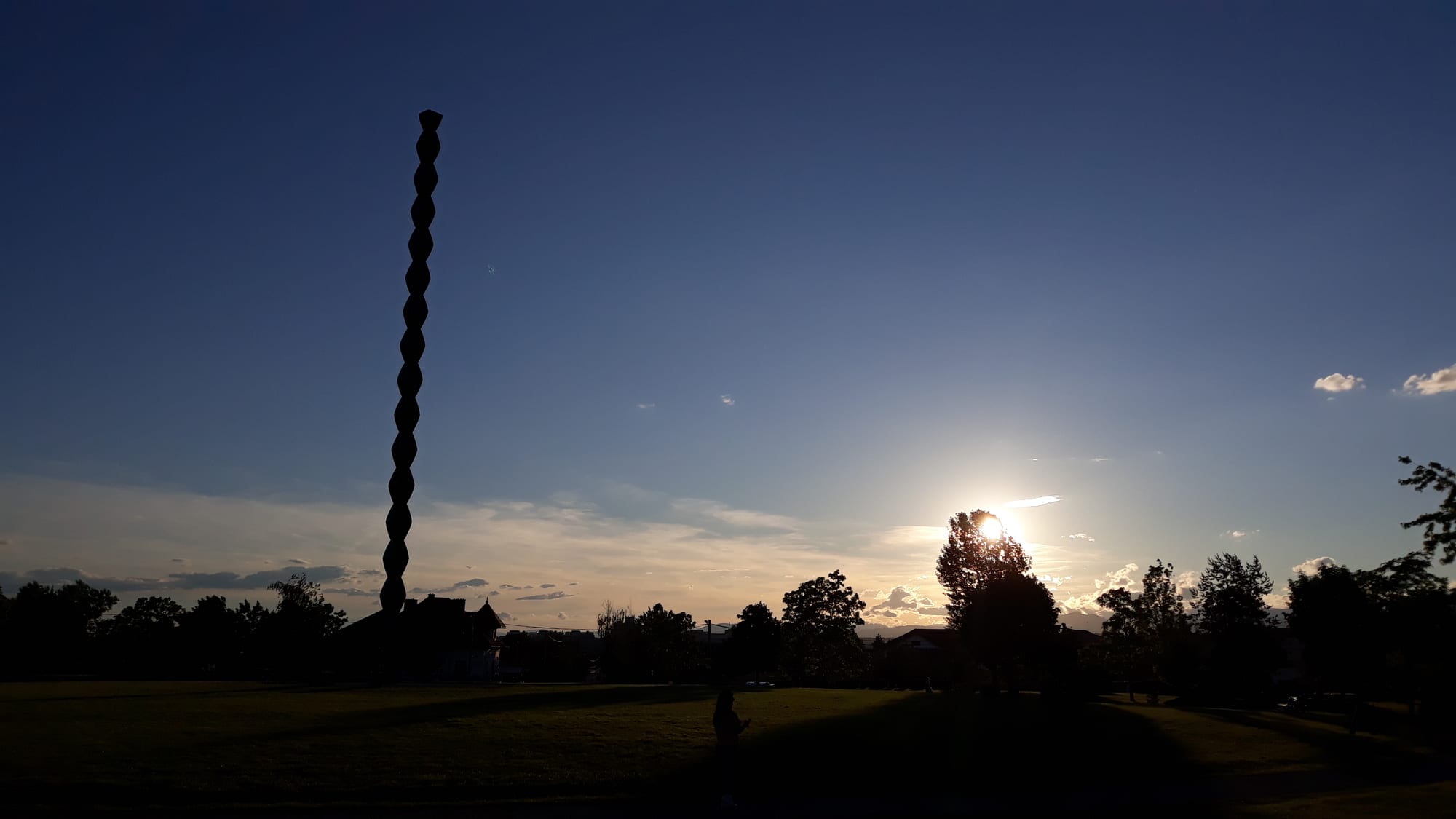
The Endless Column silhouetted against a deep blue evening sky, with the sun setting behind trees across a lawn

Oltenia, Romania

Târgu Jiu

Brâncuși's Endless Column at sunset in its park at the eastern end of Calea Eroilor, Târgu Jiu. (Vlad Tamnos / Wikimedia Commons · CC BY-SA 4.0)

The capital of Gorj County, on the river Jiu in the Sub-Carpathian hills of northern Oltenia — a market town first recorded in 1406 that grew with lignite mining under communism. It is known above all for Constantin Brâncuși's First World War memorial, the Table of Silence, Gate of the Kiss and Endless Column, a UNESCO World Heritage Site since 2024.

Neighbourhoods

  • Town centre and the Central Park
    • First-time visitors
    • Close to public transport
    • Best for food

    The centre, largely rebuilt in the communist era, runs from the main street, Calea Victoriei, to the park on the bank of the Jiu. The park holds the western end of Brâncuși's ensemble — the Table of Silence, the Gate of the Kiss and the alley of stone seats — and has places to eat around its edges.

    Open in Maps
  • Calea Eroilor
    • Historic district
    • Art and sculpture

    Heroes' Street, the 1.3-kilometre axis that Brâncuși used to tie his memorial together, running east from the park through ordinary streets of houses and flats to the Endless Column. Walking it end to end takes in the whole ensemble.

    Open in Maps
  • Vădeni
    • Quiet and residential
    • Local life

    A former village that is now a district of the city, the birthplace of the First World War heroine Ecaterina Teodoroiu, whose memorial house is one of the town's listed sights.

    Open in Maps

Things to do

Brâncuși's ensemble

  • The Table of Silencelandmark

    A round stone table surrounded by twelve hourglass-shaped seats that stand for time, at the western end of the ensemble near the river; it has been read both as the moment before battle and as the Last Supper.

    Open in Maps
  • The Gate of the Kisslandmark

    A travertine gate about 6.5 metres wide and 5 metres high, carved with Brâncuși's kiss motif on its pillars and understood as the passage to another life.

    Open in Maps
  • The Endless Columnlandmark

    A column of stacked rhomboidal cast-iron modules 29.3 metres high, completed in October 1938; the communist authorities planned to scrap it in the 1950s, and it was restored between 1998 and 2000.

    Open in Maps
  • Stool Alleylandmark

    The alley of thirty square stone seats in the Central Park, laid out in October 1937 on Brâncuși's instructions as part of the ensemble.

    Open in Maps

Museums

  • Gorj County Museummuseum

    The county museum, named after the historian Alexandru Ștefulescu, covering the history and archaeology of Gorj, including Roman-era archaeology and coins.

    Open in Maps
  • Ecaterina Teodoroiu Memorial Housemuseum

    The family home in Vădeni of the young woman who fought and died as a second lieutenant at Mărășești in 1917 and became a national heroine.

    Open in Maps

Short trips from the town

  • Museum of Popular Architecture of Gorjmuseum

    An open-air museum at Curtișoara, north of the town, with farmhouses and buildings showing the folk architecture and crafts of Gorj, itself listed as a historical monument.

    Open in Maps
  • Hobițaattraction

    The village in Peștișani commune where Constantin Brâncuși was born in 1876.

    Open in Maps
  • Lainici Monasterylandmark

    An Orthodox monastery in the Jiu gorge, first mentioned in the 14th century and rebuilt from 1812, which German troops burned during the First World War.

    Open in Maps
  • Defileul Jiului National Parkpark

    A national park of about 11,000 hectares along the gorge the Jiu cuts between the Vâlcan and Parâng mountains, declared in 2005.

    Open in Maps
  • Tismanaattraction

    A small town whose monastery was founded in the 14th century by Nicodemus of Tismana, a centre of hesychast monasticism, set on a rock above a waterfall.

    Open in Maps
  • Polovragiattraction

    A village at the foot of the Carpathians with a monastery built in 1505 and, in the gorge of the Olteț above it, a cave where about 300 horseshoe bats roost.

    Open in Maps

Eat and drink

Long-standing places and food districts in Târgu Jiu. Hours, ratings and directions come from your maps app, always current.

Târgu Jiu classics

  • Restaurants around the Central Parkneighborhood

    The streets around the park, at the Table of Silence end of the ensemble, hold most of the town's restaurants and cafés.

    Open in Maps
  • Romanian home cookingrestaurant

    Traditional restaurants serve sour ciorbă soups, sarmale cabbage rolls with mămăligă, and tochitură, a pork and sausage stew.

    Open in Maps

Experience Târgu Jiu

History

The town takes its name from the river Jiu, which runs through it. A Dacian village stood among forests here in antiquity, and after the Roman conquest of Oltenia in 101–102 soldiers guarded the roads that met at this point on the route from the Danube into Transylvania. Mosaics, coins, ceramics and Roman bricks found when the railway to Rovinari was dug suggest that it was a small commercial settlement, a vicus, under Roman rule. In the 13th century the area belonged to the domain of the voivode Litovoi, who was killed fighting the Hungarians around 1277.

The town itself is first recorded in an order of Mircea the Elder dated 23 November 1406, addressed to Tismana Monastery, and it has been the seat of Gorj County since 1497. In 1916 its defenders held off the Central Powers on the Jiu for a time, and the National League of Gorj Women later commissioned Constantin Brâncuși, born in nearby Hobița, to make a memorial. He accepted in 1935, refused payment, and the ensemble along Calea Eroilor was inaugurated on 27 October 1938.

During the Second World War the town's prison became an internment camp where political prisoners were held, among them the future communist leaders Gheorghe Gheorghiu-Dej and Nicolae Ceaușescu. Under communism the authorities planned to demolish Brâncuși's "bourgeois" art, but did not; from the 1960s opencast coal mining around the town made it grow rapidly. A university named after Brâncuși opened in 1992, the ensemble was restored in 1998–2000, and in 2024 it was inscribed as a UNESCO World Heritage Site.

Culture & Customs

Târgu Jiu's identity is bound up with Brâncuși. The Endless Column stands at the centre of the city's coat of arms, flanked by the golden lions of Oltenia, and the ensemble is regarded as one of the great works of 20th-century outdoor sculpture. It is not set apart in a museum: the Table of Silence and Gate of the Kiss stand in the town park, the column in a lawn at the end of an ordinary street, and residents pass them every day. The architect Mihai Radu has praised how the sculptures shape the town's plan, giving a jumbled communist-era centre an axis in the manner of the Great Axis of Paris.

The town also honours Ecaterina Teodoroiu, born in Vădeni, now one of its districts, who fought as a soldier in the First World War and died at Mărășești in 1917; a leading school and a boulevard carry her name, and her family house is a memorial museum.

Sport is followed closely. Pandurii, the city's best-known football club, spent twelve seasons in Romania's top league, finished second in 2012–13 and reached the group stage of the Europa League the following season; CSM Târgu Jiu fields teams in basketball and women's handball.

Daily Life

At the 2021 census about 73,500 people lived in the municipality, down from the previous census in 2011, and almost all are Romanians, with a small Roma community. Eight surrounding villages are administered by the city. Most people live in the blocks of flats and houses of districts such as 9 Mai, Grivița, Victoriei and Ecaterina Teodoroiu, and the centre around Calea Victoriei, the main street, and the park is where the town comes together.

The town grew with opencast lignite mining from the 1960s, and its industries have included wood, machine building, textiles, glassware and building materials such as cement, bricks and tiles. With the decline of mining, Gorj County has one of the highest unemployment levels in Romania.

Daily life follows the pace of a county town. Trolleybuses and buses link the districts, shopping happens at supermarkets and shopping centres, and evenings and weekends bring families to the park along the Jiu. The population fell by about 5,000 between the 2011 and 2021 censuses.

Food

Târgu Jiu eats in the Oltenian and wider Romanian tradition. Ciorbă, the sour soup that begins many meals, is made in many versions — tripe with sour cream and garlic, meatballs, beans with smoked meat — and soured with borș, vinegar or sauerkraut juice. Sarmale, cabbage leaves rolled round minced meat, rice, onions and herbs, are often called the national dish and are served with mămăligă, the cornmeal mush that accompanies much of the cooking.

Pork is the main meat. Tochitură is a stew of pork and smoked and fresh sausage served with mămăligă, and jumări are crisp pieces of pork left after rendering fat. Mititei, or mici, grilled rolls of spiced minced meat with garlic and thyme, are most associated with outdoor grilling, and telemea, a white brined cheese a little like feta, appears on most tables.

Desserts include papanași, cheese dumplings boiled or fried and served with jam and sour cream, and cozonac, the sweet bread of Christmas and Easter. Meals are often opened with țuică, a spirit made only from plums.

Planning tools

Budget

Oltenia is one of the cheapest parts of Romania, and Târgu Jiu is a working county town rather than a resort, so rooms and meals cost less than in Transylvania's tourist cities. The Brâncuși ensemble is in public parks and streets. A hire car is the main extra cost for the monasteries and gorges of the surrounding hills.

Daily Budget Midrange
USD 70–140 (comfortable hotel, restaurant meals, a hire car for the hills)
Daily Budget Shoestring
USD 30–55 (guesthouse, local restaurants, buses and trains)

Carry some cash for village guesthouses and monastery donations outside the town.

Best Time to Visit

May–June and September–October are the most comfortable months for walking the ensemble and visiting the foothill monasteries. July and August are hot on the Oltenian plain but pleasant in the Gorj hills. The Transalpina road to the north is usually open only from mid-May to mid-October.

Suggested Number of Days

The ensemble and the centre fit into a single day. With a car, three or four days allow time for the monasteries, caves and gorges of the foothills; without one, the hill country is slow to reach.

First Visit
1 day
With Surroundings
3–4 days

Transportation

The town has two trolleybus lines and eight bus lines. The centre and the ensemble are walkable. The monasteries and caves of the hills are far easier with a car; the European route E79 and the DN67 road run through the town.

Use a taxi app rather than a street taxi, and allow extra time on the winding roads into the mountains.

Airport & Station Connections

Several trains a day run from Bucharest to the main station on Republicii Boulevard. By road, the E79 and the DN67 run through the town, the DN67 linking it with Drobeta-Turnu Severin to the west and Râmnicu Vâlcea to the east.

Walkability

Good in the centre. The whole of Brâncuși's axis, from the Table of Silence by the river to the Endless Column, is about 1.3 km and an easy walk along Calea Eroilor; the centre is compact.

Safety

Romania is a safe country with low violent crime. Târgu Jiu is quiet, and the main risks are on the roads: narrow, unlit routes in the hills and heavy traffic on the main highways. Bears live in the Gorj mountains to the north.

Drive the mountain roads in daylight, keep away from bears and never feed them, and book taxis by app. Check current official travel advice before travelling.

Climate

A temperate-continental climate in a sheltered basin at the foot of the Carpathians, with an annual mean temperature of about 10.6°C. Summers are warm, winters cold, and the mountains to the north are much cooler and snowy.

Summer
warm in the town and the Gorj hills, long and hot on the plain around Craiova; temperatures in Târgu Jiu vary by about 22°C over the year
Winter
cold, with snow in the mountains, where the annual mean falls to about 3°C at middle heights and 0°C or below on the high peaks

Local Customs

Romanian is the language of daily life; younger people often speak English. The Brâncuși ensemble is a war memorial as well as a work of art, and the Table of Silence and the Endless Column are treated with respect. Orthodox churches and monasteries expect modest dress.

Cover shoulders and knees in churches and monasteries, and ask before photographing services or monks.

Common Payment Methods

Romania uses the leu (RON), not the euro. Cards and contactless payment are widely accepted in the town; carry cash for markets, small restaurants, village guesthouses and monastery donations.