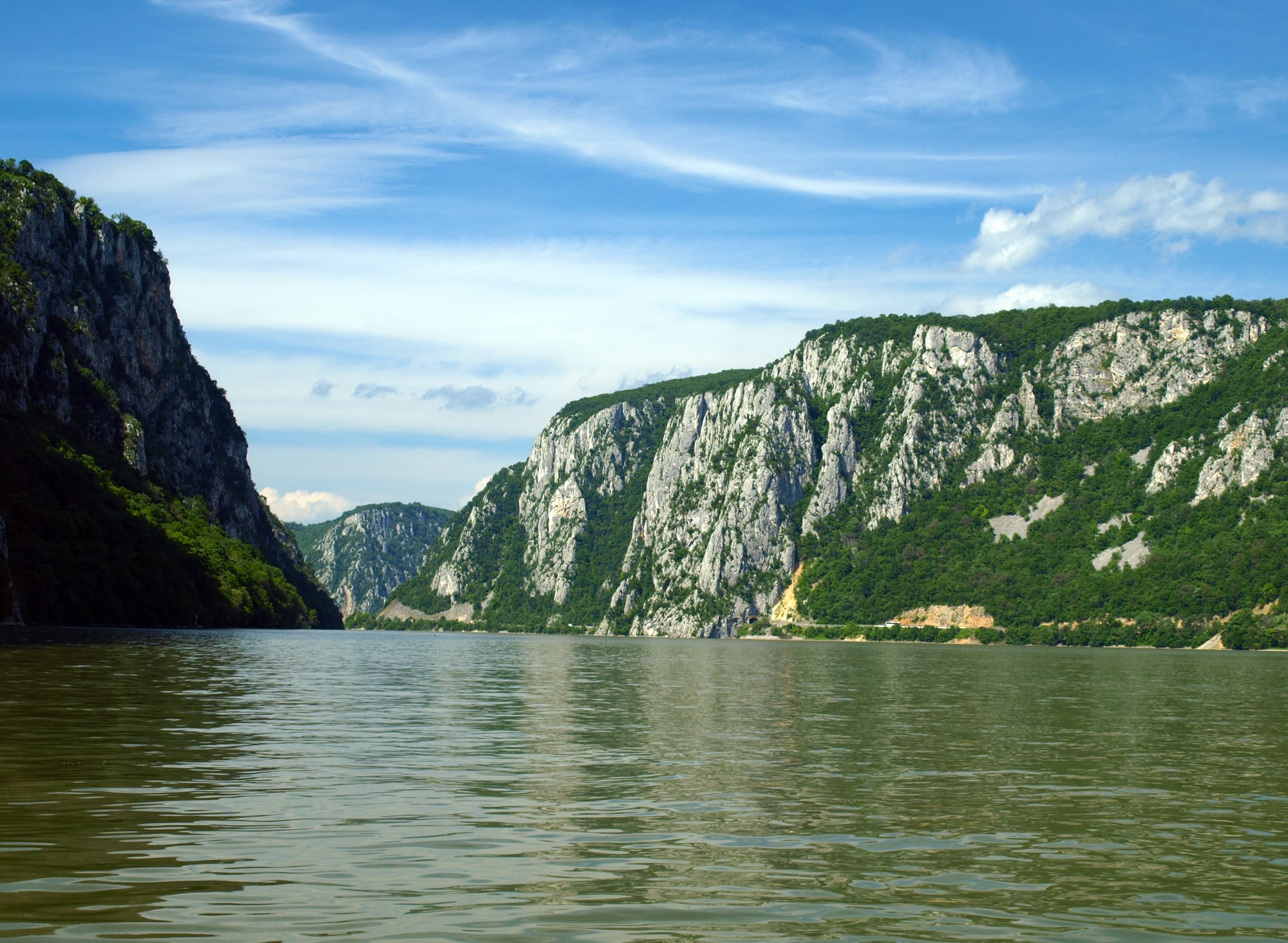
The wide green Danube flowing between steep, forested limestone cliffs under a blue sky with streaks of cloud

Romania

Oltenia

The Danube in the Cazane gorge, the narrowest stretch of the Iron Gates on the border between Romania and Serbia. (FlaC / Wikimedia Commons · CC BY-SA 4.0)

The western part of historic Wallachia, between the Olt river, the southern Carpathians and the Danube — a region of Roman Drobeta, the monasteries of Cozia and Horezu, Brâncuși's home ground around Târgu Jiu, the Iron Gates gorge and the university and industrial city of Craiova.

Explore Oltenia

History

Oltenia was one of the first parts of Romania settled by Rome. Trajan's legions crossed the Danube at Drobeta, where Apollodorus of Damascus built a great bridge in 105 for the second Dacian war; the stumps of its piers still stand beside the city, and Drobeta became a Roman town. After the empire withdrew from Dacia in the 270s the region passed through centuries of migrations, and in the Middle Ages a Hungarian frontier province, the Banate of Severin, was fought over by Hungary and the rising principality of Wallachia.

Within Wallachia Oltenia kept a special status under a ban based in Craiova, in the late 15th and early 16th centuries often drawn from the powerful Craiovești boyar family. Michael the Brave was ban of Craiova before becoming prince in 1593. Mircea the Elder founded Cozia, and in the 1690s Constantin Brâncoveanu built Horezu. After the Treaty of Passarowitz in 1718 Oltenia was ruled by the Habsburgs for two decades before returning to Wallachia in 1739.

In 1821 Tudor Vladimirescu, a local freeholder and militia officer, raised a revolt from Gorj against the Phanariot regime and marched on Bucharest; it failed, but it helped restore native princes. In 1916 the Romanian army fought German forces on the Jiu near Târgu Jiu, the battle that Brâncuși's ensemble commemorates. Communism built coal mines, power stations and heavy industry around Craiova, Târgu Jiu and Râmnicu Vâlcea, and in 1972 the Iron Gates dam, shared with Yugoslavia, flooded the Danube gorge and the island town of Ada Kaleh.

Culture & Customs

Oltenians have a reputation elsewhere in Romania for being proud, quick-tongued and fond of argument, and they enjoy the jokes about themselves. Their speech is easy to recognise: they still use the simple past tense that the rest of the country has largely abandoned in conversation. Oltenia keeps the tradition of the Călușari, the ritual dance of men with sticks and bells performed at Whitsun and recognised by UNESCO as intangible heritage.

Craft traditions are strong. Horezu's potters make red-clay plates and jugs painted with cockerels, fish and spirals in brown, red, green, blue and the cream known as Horezu ivory; the craft is on UNESCO's intangible heritage list, and a ceramics fair held in the town since 1971 draws buyers from across the country. Oltenian woven carpets and embroidered costumes are known for their bold colour.

The region is Orthodox and monastic, with a chain of old foundations along the foothills — Cozia, Horezu, Bistrița, Arnota, Tismana, Polovragi — that remain active and draw pilgrims on their feast days. Constantin Brâncuși, born in the Gorj village of Hobița in 1876, is the region's most celebrated son, and football, above all Universitatea Craiova, is a matter of regional pride.

Daily Life

Craiova, with about 235,000 people, is the region's capital and one of Romania's larger cities, with a university, a car plant owned by Ford Otosan and a renovated centre. Râmnicu Vâlcea, Drobeta-Turnu Severin, Târgu Jiu and Slatina are the other main towns, each well under 120,000, and much of the population still lives in villages on the plain and in the foothills.

The economy has been hard hit since 1990. Gorj's lignite mines and the coal power stations at Rovinari and Turceni are shrinking, Slatina lives from its aluminium smelter, and Râmnicu Vâlcea from chemicals and services. The Danube plain grows wheat, maize and vegetables, and the sandy soils around Dăbuleni are known for watermelons. Emigration, especially to Italy and Spain, has emptied many villages.

Life in the smaller towns is slow, built around the market, the church and the café terrace. In summer the Olt valley spas fill with Romanian pensioners taking cures, and families head for the Danube gorge at weekends.

Food

Oltenian cooking shares the Wallachian basics — ciorbă, sarmale, mămăligă — with a taste for vegetables from the plain and plenty of garlic. Summer brings stuffed peppers, aubergine salad and bean dishes, and on the Danube at Calafat and Drobeta fish is grilled, fried or cooked into sour ciorbă de pește. Pork dominates in winter, when the pig is killed before Christmas and turned into sausages, caltaboș offal sausage and fried jumări crackling.

The Vâlcea hills are orchard country, and their plums become țuică, the plum brandy served before meals. Dăbuleni's watermelons are famous throughout Romania.

Drăgășani, on the Olt, is one of Romania's best-known wine regions: its wineries grow the native white Crâmpoșie and the reds Novac and Negru de Drăgășani alongside international grapes. Further south, Segarcea in Dolj, whose vineyard belongs to the Romanian Crown Estate, is known for its white wines.

Attractions & Natural Wonders

Craiova's sights sit around its pedestrian centre: the Casa Băniei, the old seat of the bans, the Art Museum in the Jean Mihail Palace, designed by a French architect, which holds early works by Brâncuși, and Nicolae Romanescu Park, a large landscaped park with a boating lake and bridges. In Târgu Jiu, Brâncuși's ensemble runs along an axis through the town, from the Table of Silence and the Gate of the Kiss by the Jiu to the Endless Column, almost 30 metres of stacked cast-iron modules.

North of Târgu Jiu, the foothills hold Tismana Monastery above its waterfall, Polovragi Monastery and cave, and the Women's Cave at Baia de Fier, while the Transalpina climbs from Novaci into the Parâng mountains. In Vâlcea, Horezu Monastery, a UNESCO World Heritage Site, is a masterpiece of the Brâncovenesc style, and the potters' workshops line the road into the town. Cozia Monastery stands on the bank of the Olt in the gorge, near the spa towns of Călimănești-Căciulata and Băile Olănești.

In the southwest, the Danube cuts through the Carpathians at the Iron Gates. Below the Iron Gates Natural Park's cliffs, the river narrows at the Great and Small Cazane; boats run from Dubova to the Mraconia monastery, the rock sculpture of Decebalus and the Ponicova cave. Drobeta-Turnu Severin has the ruins of Trajan's Bridge and the Iron Gates Museum.

Cities in Oltenia

Planning basics

Budget

Oltenia is one of the cheapest parts of Romania, with few foreign visitors and low prices for guesthouses, meals and transport. Craiova has a choice of modern hotels at moderate rates; the Olt valley spas of Călimănești and Băile Olănești and the Danube guesthouses around Dubova and Eșelnița are busier and a little dearer in summer and at weekends.

Daily Budget Midrange
USD 75–150 (comfortable hotel or Danube guesthouse, restaurant meals, a boat trip on the Cazane, a hire car)
Daily Budget Shoestring
USD 30–55 (guesthouse, local restaurants, trains and minibuses)

Book a small-boat trip through the Cazane from the Dubova or Eșelnița guesthouses rather than from the larger tour companies.

Safety

Oltenia is quiet and safe for visitors. The main risks are on the roads: the heavy lorry traffic of the Olt valley highway, which is prone to jams and accidents, and the narrow, unlit Danube and mountain roads. Bears are present on the Transalpina and in the Vâlcea and Gorj mountains.

Drive the Olt valley in daylight, keep away from bears on the Transalpina, and take cash for village guesthouses. Check current official travel advice before travelling.

Climate

The Danube plain around Craiova and Calafat is one of the warmest parts of the country, with long, hot summers; the Iron Gates gorge has an unusually mild pocket climate with sub-Mediterranean vegetation. The northern hills and the Parâng and Căpățânii mountains are cooler and snowy, and the Transalpina pass is closed for much of the year.

Summer
hot on the plain, 30–38°C around Craiova; pleasant in the Vâlcea and Gorj hills; cool on the Transalpina
Winter
cold and grey on the plain, around −4 to 5°C; mild by Romanian standards in the Danube gorge; snowy in the mountains

Transportation

Craiova has an airport and lies on the main railway from Bucharest to Timișoara, which also serves Drobeta-Turnu Severin and the Danube towns. The Olt valley line and road link Râmnicu Vâlcea with Sibiu through the Cozia gorge. Horezu, Târgu Jiu's hinterland, the Danube road through the gorge and the Transalpina are far easier with a car.

Allow a full day for the Danube road through the Iron Gates; it is winding, and the viewpoints and boat trips take time.

Best Time to Visit

May–June and September–October for the monasteries, Horezu and Craiova. July and August suit the Danube gorge, the Olt valley and the Transalpina, which is usually open from mid-May to mid-October. Autumn is grape harvest time around Drăgășani, and Horezu holds a yearly pottery fair.