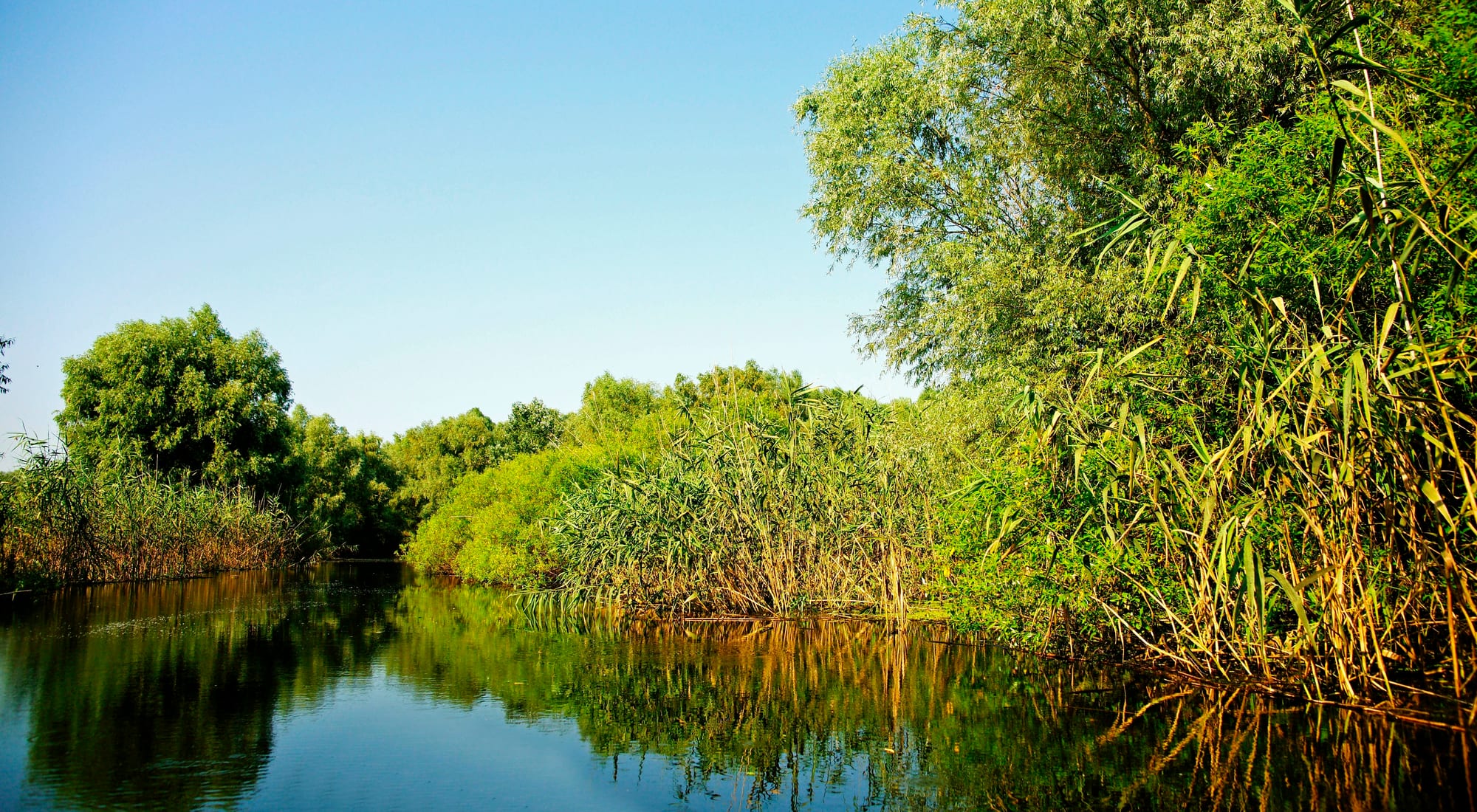
A calm channel of dark water reflecting willows and tall reeds under a clear blue sky

Romania

Dobruja & the Black Sea Coast

A reed-lined channel in the Danube Delta near Murighiol, Tulcea County. (Ioan Cepaliga / Wikimedia Commons · CC BY 3.0)

The strip of land between the lower Danube and the Black Sea in Romania's south-east — a dry plateau of Greek and Roman ruins, Turkish and Tatar villages and vineyards, with Romania's only sea coast, its largest port at Constanța, and the wetlands of the Danube Delta around Tulcea.

Explore Dobruja & the Black Sea Coast

History

Greek settlers from Miletus founded Histria in the 7th century BC, and later colonies grew at Tomis, now Constanța, and Callatis, now Mangalia, trading grain, fish and slaves with the Getae of the interior. Rome took the coast in the 1st century BC; the poet Ovid was exiled to Tomis by Augustus in AD 8 and died there, and Trajan raised the Tropaeum Traiani at Adamclisi after his wars against the Dacians. The province of Scythia Minor stayed under Rome and Byzantium until the Slav and Bulgar invasions.

In the Middle Ages the land passed between Byzantium, Bulgaria, Genoese traders and local lords, and Mircea the Elder of Wallachia held it briefly before the Ottomans took Dobruja in the early 15th century. Four and a half centuries of Ottoman rule brought Turkish and Tatar settlers, and later Russian Old Believers, known as Lipovans, and Ukrainian Cossacks found refuge in the delta. In 1878, after the Russo-Turkish war, northern Dobruja was given to Romania, and Carol I made Constanța the country's great port, linked to Bucharest by Anghel Saligny's bridge over the Danube at Cernavodă in 1895.

Southern Dobruja, taken from Bulgaria in 1913, was returned in 1940. Under communism, political prisoners were forced to dig the first Danube–Black Sea Canal in the early 1950s, in conditions that killed many; it was finally opened in 1984. The regime built the resorts of the southern coast, and Cernavodă became the site of Romania's nuclear power station. Since 2022 the region has been on NATO's front line, with a growing air base near Constanța.

Culture & Customs

Dobruja is Romania's most ethnically varied region for its size. Alongside the Romanian majority, which includes Aromanians who moved here from Southern Dobruja in 1940, there are Turkish and Tatar communities around Constanța, the centre of Romanian Islam, and Medgidia; the Lipovans, Russian-speaking Old Believers, in fishing villages such as Jurilovca, Sarichioi and Mila 23; Ukrainians in the delta; and small Greek, Armenian and Bulgarian groups. Mosques, Old Believer churches and Orthodox churches can stand within a few streets of each other.

The Lipovans keep their own calendar, beards, icons and a style of blue-painted wooden house, and are famous as fishermen and boatmen. The Tatars and Turks keep the Muslim festivals, including Kurban Bayram.

Summer culture is dominated by the seaside. Mamaia and Constanța attract young Romanians for beaches and clubs, while Vama Veche, near the Bulgarian border, has kept a reputation since communist times as a free-spirited, bohemian refuge, known for camping and rock music.

Daily Life

Constanța, with about 265,000 people, is one of Romania's largest cities and its main port, handling much of the country's trade and, since 2022, an outlet for Ukrainian grain. Tulcea, the gateway to the delta, has about 65,000 people, and Mangalia, Medgidia and Cernavodă are smaller towns.

The economy combines the port, shipbuilding at Constanța and Mangalia, the Cernavodă nuclear plant, oil refining, grain farming on the plateau and summer tourism. In the delta, fishing, reed-cutting and guesthouses support a small, ageing population, and many villages have no road.

Life is strongly seasonal. From June to August the coast is packed and Constanța fills with visitors; from October the resorts close and the region quietens. Delta villages depend on boats for shopping, school and doctors. Coastal erosion, the pressure of building in Mamaia, and the war across the Danube are the regional concerns.

Food

Fish rules the table. From the delta come carp, pike, catfish and zander, served as saramură, grilled fish in garlic brine, as plachie, fish baked with onions and tomatoes, or in borș pescăresc, a fisherman's soup of several kinds of fish soured with fermented bran, often eaten with mămăligă. The Black Sea adds turbot, anchovies, mussels and the invasive rapa whelk, now eaten in coastal restaurants.

The Turkish and Tatar communities contribute șuberek, fried half-moon pastries filled with meat, baclava and kataif soaked in syrup, and grilled meats, and the region's own plăcintă dobrogeană is a pastry protected as an EU geographical indication.

The hills around Murfatlar produce Dobruja's best-known wines, both dry and sweet, and the Sarica-Niculițel vineyards near Tulcea form another wine region.

Attractions & Natural Wonders

The Danube Delta, a UNESCO World Heritage Site and biosphere reserve, is the region's great natural sight. Its three branches — Chilia, Sulina and Sfântu Gheorghe — split below Tulcea and fan out into channels, lakes and reed beds with colonies of white and Dalmatian pelicans, herons and cormorants. Tulcea has a natural-history museum of the Danube Delta and a riverside promenade, and boat trips run to Crișan, Mila 23, the Letea forest of oaks and sand dunes, and Sulina with its old lighthouse and beach. Enisala's medieval fortress looks out over Lake Razim, and the Măcin Mountains, a national park, rise near the Danube.

Histria lies on the shore of Lake Sinoe, with walls, temples, baths and a museum spread across the site. Constanța's old town has the Casino on the seafront, the statue of Ovid, the History and Archaeology Museum and the Roman mosaic building, and the Carol I mosque. Mamaia's beaches stretch north of the city, with a gondola lift along the seafront.

South of Constanța are Eforie Nord and the mud-bath lake of Techirghiol, the communist-era resorts from Olimp to Saturn, Mangalia with the remains of Callatis, and Vama Veche. Inland stand the Tropaeum Traiani at Adamclisi and the vineyards of Murfatlar.

Cities in Dobruja & the Black Sea Coast

Planning basics

Budget

Prices on the coast swing with the season: Mamaia and the southern resorts are expensive in July and August, especially at weekends, and much quieter and cheaper in June and September. Constanța itself is moderately priced. In the Danube Delta, guesthouses with meals are good value, but boat trips and transfers add up.

Daily Budget Midrange
USD 100–220 (seaside or delta hotel, restaurant meals, private boat excursions, sunbeds)
Daily Budget Shoestring
USD 35–65 (guesthouse or hostel, fish and street food, buses and public boats)

Visit the coast in June or September for lower prices, and book delta guesthouses with full board, as villages have few restaurants.

Safety

The region is generally safe, but the sea is the main danger: rip currents and sudden waves cause drownings every summer, mostly outside guarded beaches. In the delta, heat, sunburn and mosquitoes are the usual hazards. Northern Tulcea borders Ukraine across the Danube, and debris from Russian drones attacking Ukrainian ports has repeatedly fallen on Romanian territory there.

Swim only on guarded beaches and obey the flags, use insect repellent in the delta, and follow local instructions near the Ukrainian border. Check current official travel advice before travelling.

Climate

Dobruja has little rain, with hot summers tempered on the coast by sea breezes and winters that are milder by the sea than inland, though east winds can bring cold snaps and blizzards. The sea is warm enough for swimming from late June to early September, and the delta is hot, humid and full of mosquitoes in midsummer.

Summer
hot and sunny, 27–32°C on the coast; hotter and more humid in the delta
Winter
around −2 to 6°C, mild by Romanian standards on the coast; icy winds and occasional snow

Transportation

A motorway and a railway link Bucharest with Constanța in around two to three hours, and the airport at Mihail Kogălniceanu has summer flights. Buses and minibuses run along the coast and to Tulcea. The delta is mostly roadless: public ferries and fast boats run from Tulcea to Sulina, Crișan and Sfântu Gheorghe, and local boatmen take visitors into the channels from the villages.

Plan delta travel around the boat schedules from Tulcea and allow an extra day in case of weather; Sulina has no road link.

Best Time to Visit

Late May and June for birds and flowers in the Danube Delta, when the pelicans are nesting and the mosquitoes are fewer; July and August for the beaches, at their busiest; September for quieter seaside days and warm water. Many resort hotels and delta guesthouses close from October to April.