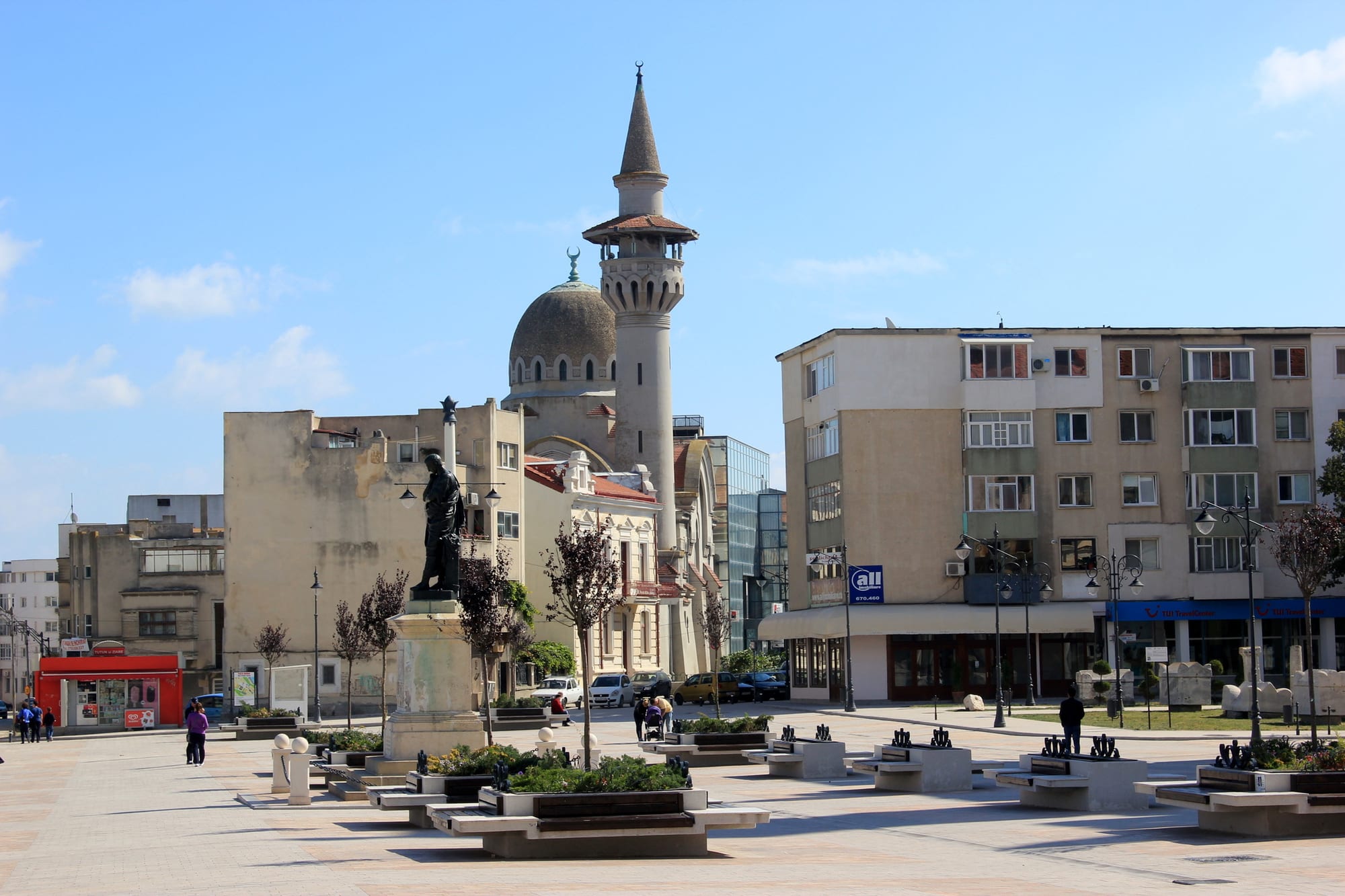
Ovid's statue on a paved square with benches, the dome and tall minaret of the Grand Mosque rising behind older buildings

Dobruja & the Black Sea Coast, Romania

Constanța

Ovid Square in Constanța's old town, with the statue of the poet and the minaret of the Grand Mosque. (Julian Nyča / Wikimedia Commons · CC BY-SA 4.0)

Romania's main seaport and fourth-largest city, on the Black Sea coast of Northern Dobruja. Founded by Greeks as Tomis around 600 BC, it is the oldest continuously inhabited city in the country, where Ovid died in exile. Roman ruins, mosques and an Art Nouveau casino fill the old peninsula, and the beach resort of Mamaia stretches north of the centre.

Neighbourhoods

  • The Peninsula (old town)
    • First-time visitors
    • Historic district
    • Sea views

    The rocky headland where Greek Tomis stood, now the old town around Ovid Square. The history museum, the Roman mosaic, the Grand Mosque, the Orthodox cathedral, the Genoese Lighthouse and the Casino are all within a few minutes' walk, with a seafront promenade and the Tomis marina on its edges.

    Open in Maps
  • City centre and Tomis Boulevard
    • Shopping
    • Close to public transport

    The modern centre inland of the peninsula, along Tomis Boulevard and Ștefan cel Mare street, with the Hünkar Mosque, shopping centres, the archaeological park and Tăbăcărie Park.

    Open in Maps
  • Mamaia
    • Beaches
    • Nightlife
    • Summer resort

    Romania's most popular resort, a district of the city on an 8 km strip of sand only 300 m wide between the Black Sea and Lake Siutghiol. It is packed with hotels, beach clubs and bars in summer and has almost no full-time residents.

    Open in Maps
  • Plaja Modern
    • Beaches
    • Local life

    The large town beach in the middle of the city near the marina, favoured by locals, where the water stays shallow far from the shore — a short walk from the old town.

    Open in Maps

Things to do

The old town

  • Constanța Casinolandmark

    Daniel Renard and Petre Antonescu's Art Nouveau casino on the seafront, commissioned by Carol I in 1910, a symbol of the city; it reopened to visitors in May 2025 after five years of restoration.

    Open in Maps
  • Ovid Square and the statue of Ovidlandmark

    The old-town square named after Ettore Ferrari's statue of 1887 of the Roman poet, who was exiled to Tomis by Augustus in AD 8 and died there.

    Open in Maps
  • Roman Mosaic Edificelandmark

    The remains of a great 4th-century port building on terraces between the town and the ancient harbour, found in 1959, with about 850 square metres of its mosaic floor surviving.

    Open in Maps
  • Genoese Lighthouselandmark

    A small stone lighthouse, square at the base and octagonal above, built in 1858–1860 on the waterfront, behind a group of statues around a bust of Mihai Eminescu.

    Open in Maps
  • Grand Mosque of Constanțalandmark

    Built in 1910 by King Carol I for the city's Muslims in Neo-Egyptian and Neo-Byzantine styles, with a reinforced-concrete dome and a tall minaret over the old town.

    Open in Maps
  • Cathedral of Saints Peter and Paullandmark

    The Orthodox cathedral of 1883–1885 on the peninsula, with interior designs by Ion Mincu, seat of the Archbishop of Tomis.

    Open in Maps
  • Hünkar Mosquelandmark

    A simple Ottoman mosque of 1869 on Tomis Boulevard, built of stone from the old Ottoman fortress, with a 24-metre minaret.

    Open in Maps

Museums

  • Constanța History and Archaeology Museummuseum

    Greek and Roman finds from Tomis in the former city hall on Ovid Square, a Romanian National Style building completed in 1921; its centrepiece is a 2nd-century statue of the snake-god Glycon.

    Open in Maps
  • Constanța Aquariummuseum

    The aquarium beside the Casino, opened in 1958 in a building that was once the Casino's restaurant, with marine, freshwater and exotic sections and over 100 species.

    Open in Maps
  • Romanian Navy Museummuseum

    A museum of Romania's maritime history on Traian Street, with anchors, amphorae and dozens of ship models.

    Open in Maps

Beaches and the waterfront

  • Mamaia beachbeach

    Several kilometres of sandy beach north of the centre, at its best from mid-June to early September, with a gondola lift running 2 km along the resort since 2004.

    Open in Maps
  • Lake Siutghiolpark

    A lagoon 7.5 km long on the landward side of Mamaia, with small Ovidiu Island near its western shore.

    Open in Maps
  • Port of Constanțaattraction

    The largest port on the Black Sea, about 30 km long, and the transit point for much of Romania's foreign trade.

    Open in Maps

Short trips from the city

  • Histrialandmark

    The ruins of a Greek colony founded by settlers from Miletus in the 7th century BC, on the shore of Lake Sinoe north of the city.

    Open in Maps
  • Techirghiolattraction

    A town beside a salt lake whose mud has been famous for its healing properties since a local legend of a blind man cured on its shore.

    Open in Maps
  • Murfatlarattraction

    A small town inland, with the Murfatlar vineyards and the Basarabi cave complex nearby.

    Open in Maps
  • Mangaliaattraction

    A town further south along the coast, on the site of the ancient Greek city of Callatis, which also administers the summer resorts of Neptun and Olimp.

    Open in Maps

Eat and drink

Long-standing places and food districts in Constanța. Hours, ratings and directions come from your maps app, always current.

Constanța classics

  • Restaurant Turcesc Norrestaurant

    A bar serving drinks and Turkish food on Tomis Boulevard, reflecting the city's long Turkish and Tatar presence.

    Open in Maps
  • Șaormă and kebab standsneighborhood

    Șaormă, grilled chicken with salad, chips and sauces wrapped in thin flatbread, is sold at fast-food places all over the city.

    Open in Maps

Food districts and nights out

  • Mamaia's bars and beach clubsneighborhood

    In summer the resort strip is lined with restaurants, terraces, bars and clubs, and some city-centre bars close for the season when Mamaia opens.

    Open in Maps
  • Tomis marinaneighborhood

    The yacht harbour north of the commercial port, beside the old town, where sea trips leave and terraces look over the water.

    Open in Maps

Experience Constanța

History

Greek colonists founded Tomis in the 6th century BC on a rocky peninsula with a fine harbour, close to the sister colonies of Histria and Callatis. The Romans took the coast in 29 BC, and in AD 8 the Emperor Augustus exiled the poet Ovid here; he spent his last years lamenting the place in the Tristia and the Epistulae ex Ponto. Tomis later became the capital of the province of Scythia Minor, lay at the seaward end of the Great Wall of Trajan, and was renamed Constantiana, possibly after a half-sister or son of Constantine the Great.

Avars besieged the city in 597–598, Bulgarians took it in 680, and it changed hands between Byzantium and Bulgaria for centuries; by the 14th century Italian sea charts called it Constanza. It fell to the Ottomans around 1411 and declined into a small Turkish fishing town. A railway to Cernavodă was laid in 1860, and in 1878, after the Romanian War of Independence, Northern Dobruja passed to Romania. The town then had just over 5,000 people.

Carol I made Constanța the country's great port, joined to Bucharest in 1895 by the railway over the Danube at Cernavodă. The Casino rose on the shore, and by the 1930s more than half of Romania's exports left through the harbour. Central Powers troops occupied the city from 1916 to 1918, and Allied bombing in the Second World War badly damaged the port. Under communism a first attempt at the Danube–Black Sea Canal, in 1949–1953, used forced labour; the canal to the city was finally built in 1976–1984. Since 2022 the port has been an outlet for Ukrainian grain, and in 2026 a stray naval drone exploded there, forcing the evacuation of more than 1,300 people.

Culture & Customs

Constanța's identity is maritime and mixed. Tatar and Greek communities, large in earlier centuries, remain alongside Turkish and Roma residents and the Romanian majority, which formed only in the early 20th century. The city is the centre of Romanian Islam: the Grand Mosque, given by Carol I in 1910, and the older Hünkar Mosque of 1869 stand a few streets from the Orthodox cathedral, and the local Muslim community is known for being largely secular.

The classical past is part of everyday life. Ovid's statue presides over the main square of the old town, the university bears his name, and Roman walls, columns and the great mosaic sit among the old town's streets; the archaeological park lies in the modern centre. The Casino, closed for years, reopened in 2025 and is again the symbol of the seafront.

Culture follows the seasons. The National Theatre, the Oleg Danovski Opera and Ballet Theatre and the Elpis theatre are the main stages, while summer belongs to the beaches, Mamaia's clubs and the crowds of visitors. Sport is followed closely: Farul Constanța plays football in the top division, with a rugby team of the same name and the handball club HCD Constanța. The city is also home to the Mircea cel Bătrân Naval Academy, and the navy's Black Sea squadron is based here.

Daily Life

Constanța had about 264,000 people at the 2021 census, fewer than in 2011, and the metropolitan area of 14 localities within 30 km had about 426,000 in 2011. In high summer at least 120,000 more people a day — tourists and seasonal workers — pass through.

The port drives the economy. Covering about 39 square kilometres along 30 km of coast, it is the largest on the Black Sea and one of the largest in Europe, linked to the Danube by the canal, and the city has a large shipyard. Trade, logistics and tourism employ much of the workforce, and Ovidius University and the Naval Academy bring students. Industry has had a cost: the growth of the port and shipyards has damaged the city beaches.

Shopping has moved to malls such as Tomis Mall on Ștefan cel Mare street, City Park Mall by Tăbăcărie Park and VIVO! on the edge of the city. The rhythm of the year is strongly seasonal: crowded and noisy from June to early September, quiet and windy in winter. The war in neighbouring Ukraine is watched closely, and the 2026 drone explosion in the port brought the conflict close to home.

Food

Constanța eats from the sea and from the Danube Delta. Fish dishes from Romanian cuisine include saramură de crap, carp in brine; plachie, a ragout of river fish with vegetables; and ciorbă de pește "ca-n Deltă", a fish soup in the Delta style. Scrumbie de Dunăre afumată, smoked Danube shad, carries a protected geographical indication, as does a traditional carp-roe salad, salată de icre.

Turkish and Tatar communities have left a strong mark. Plăcintă dobrogeană, a Dobruja pastry, is also an EU-protected regional speciality, and grilled meats, from mici, grilled minced-meat sausages, to frigărui skewers, are everywhere in summer. Șaormă, chicken with salad, chips and sauces wrapped in flatbread, is sold at fast-food places across the city, and Nor on Tomis Boulevard serves Turkish food.

Wine comes from the Murfatlar vineyards just inland, one of Romania's wine regions. In summer the restaurants, terraces and bars of Mamaia take over much of the city's eating and drinking.

Planning tools

Budget

Constanța itself is moderately priced, but the coast swings with the season: Mamaia is busiest in high summer, and some of its hotels open in winter offer good off-season deals. Street food is cheap, and many of the old town's sights cost little or nothing to see from outside.

Daily Budget Midrange
USD 100–220 (seaside hotel, restaurant meals, sunbeds, museum tickets and taxis)
Daily Budget Shoestring
USD 35–65 (hostel or guesthouse, șaormă and simple restaurants, city buses)

Use banks rather than exchange offices in Mamaia, which can carry hidden commissions.

Best Time to Visit

June to September for the beaches, with July and August the hottest and busiest months. Spring is cool on the coast, and many resort businesses in Mamaia close outside the summer. Winters are mild by Romanian standards but windy, with storms at sea.

Suggested Number of Days

Two days cover the old town and its museums with time on the beach. Four or five allow for the ancient sites along the coast, the southern resorts and more time by the sea, and Constanța is also a starting point for the Danube Delta.

First Visit
2 days
With Surroundings
4–5 days

Transportation

CT Bus runs about 19 year-round bus lines, including electric buses, and in summer an open-top double-decker sightseeing line and buses to Mamaia; maxi-taxi minibuses also run to Mamaia and the southern resorts. The old trams and trolleybuses have been withdrawn. Taxis are cheap if metered, and there are bicycle lanes on Tomis Boulevard and in Mamaia.

Avoid the taxis waiting at the railway station with high tariffs; walk a short way and hail a yellow licensed cab, and insist on the meter.

Airport & Station Connections

Mihail Kogălniceanu International Airport is about half an hour away by road along the E60, with a small number of international flights. Trains from Bucharest take two to two and a half hours over the Danube bridges to the station close to the centre, and the A2 motorway links the two cities. Coaches use the bus station by the railway station.

Walkability

The old town on the peninsula is compact and best explored on foot, with a seafront promenade past the Casino. The whole city can be crossed on foot in a few hours, but Mamaia and the outer districts are easier by bus or taxi.

Safety

Romania is a safe country with low violent crime. Constanța is generally safe, and the sea is the main danger, so swimming is safest on guarded beaches. Taxi overcharging at the station, exchange offices with hidden commissions and stray dogs are the common nuisances.

Swim only on guarded beaches and obey the flags, insist on the meter in taxis, and back away calmly from barking dogs rather than running. Check current official travel advice before travelling.

Climate

A humid subtropical climate, milder than inland Romania. Summer runs from early June to mid-September and is hot and sunny. Winters are mild but often very windy, with storms at sea between December and March. In April and May the coast is one of the coolest places in lowland Romania.

Summer
hot and sunny; July and August average around 23°C
Winter
mild but windy; January averages about 1°C, December days often reach 8–12°C, and snow is not abundant

Local Customs

Constanța has long mixed Romanians, Tatars, Turks, Greeks and others, and residents are used to foreigners and generally helpful. Mosques and Orthodox churches expect modest dress. Waiters usually know some English, and menus are often translated.

Wear clothing that covers the legs and shoulders for mosques and churches — women in short skirts may be refused entry — and avoid commenting on religious matters.

Common Payment Methods

Romania uses the leu (RON), not the euro. Cards and contactless payment are widely accepted in shops, malls, hotels and restaurants, but taxis take cash only. Banks and ATMs are found throughout the city; banks give fairer exchange rates than the exchange offices in Mamaia.