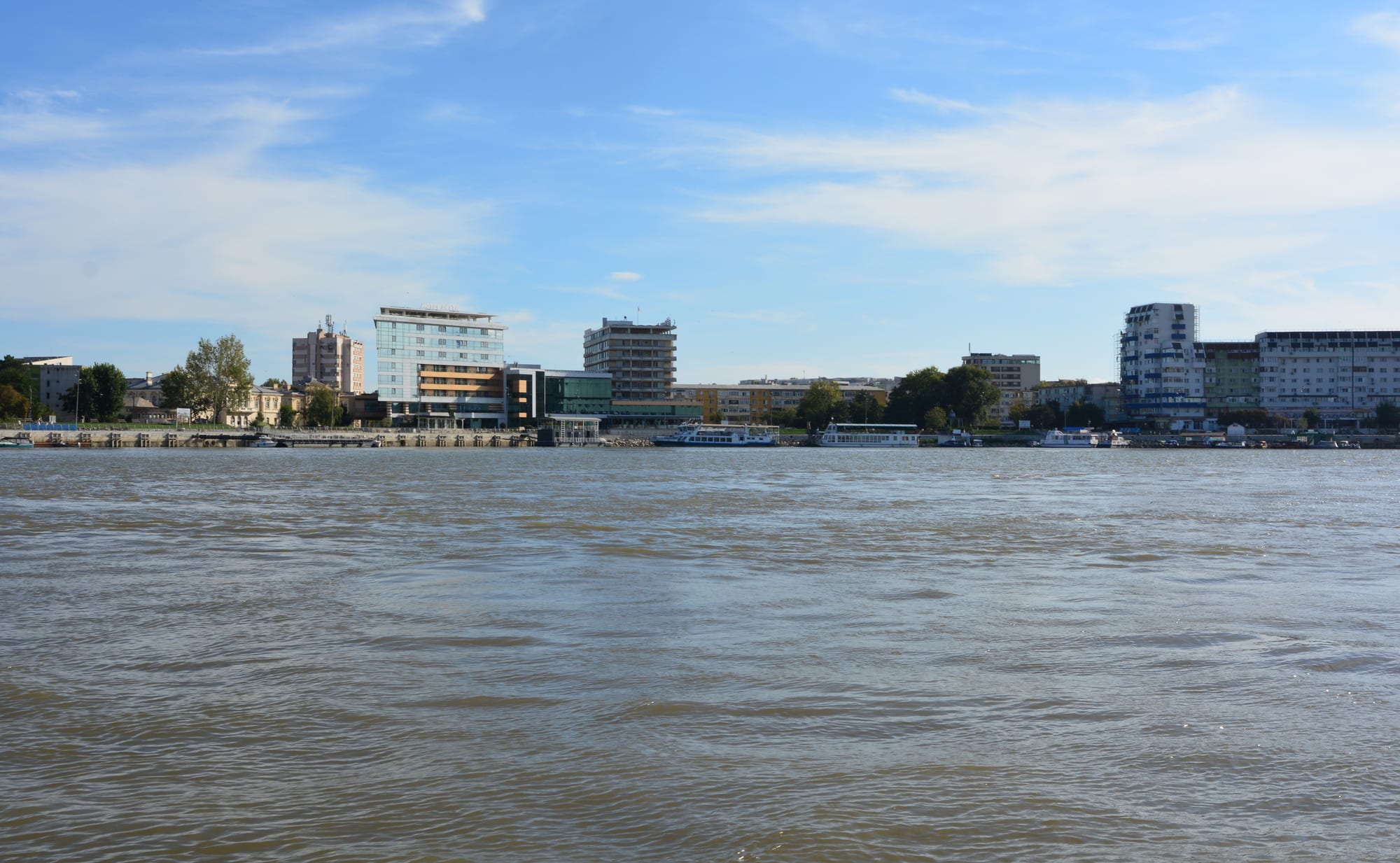
The broad brown Danube in front of Tulcea's waterfront, with tour boats moored along the quay below modern blocks and trees

Dobruja & the Black Sea Coast, Romania

Tulcea

Tulcea's waterfront on the Danube, with delta tour boats moored at the quay. (Joe Mabel / Wikimedia Commons · CC BY-SA 4.0)

A Danube river port on hills at the western entrance to the Danube Delta, the seat of Tulcea County in Northern Dobruja. Founded as Aegyssus in antiquity and an Ottoman provincial capital until 1878, it is now an industrial and shipbuilding town and the main departure point for boats into the delta's channels, lakes and fishing villages.

Neighbourhoods

  • The Danube waterfront
    • First-time visitors
    • Boat trips
    • River views

    The riverside promenade, modernised in 2023, where delta tour boats and passenger ferries tie up beside the town park. A Danube Delta information centre with English-speaking staff stands on the promenade, and the art museum and the city's restaurants are a short walk inland.

    Open in Maps
  • City centre
    • Historic district
    • Museums
    • Close to public transport

    The streets just inland from the river, where St Nicholas Cathedral, the Azizyie Mosque and the art museum in the former Ottoman pasha's palace stand within a few minutes of each other, with the railway terminus close by.

    Open in Maps
  • Monument Hill
    • Views
    • History

    The hill above the river crowned by the Independence Monument, with the ruins of ancient Aegyssus and the history and archaeology museum beside it, and a panoramic view over the town and the Danube.

    Open in Maps

Things to do

Landmarks and places of worship

  • Independence Monument and Aegyssusviewpoint

    An obelisk with an eagle and a soldier, begun in 1879 in the presence of Prince Carol I to mark the war that made Dobruja Romanian, on the hill with the ruins of ancient Aegyssus and a panoramic view over the city and the river.

    Open in Maps
  • Azizyie Mosquelandmark

    A mosque of 1863 named after Sultan Abdülaziz, one of the largest built by the Ottomans in Dobruja, with walls of cut stone 85 cm thick and 32 windows.

    Open in Maps
  • St Nicholas Cathedrallandmark

    The large Byzantine Revival Orthodox cathedral begun in 1862, closed by the Ottoman authorities in 1872 and reopened in 1877, with bells cast at Memmingen in 1882.

    Open in Maps
  • Danube waterfront promenadetrail

    The riverside walk, modernised in 2023, lined with moored boats, with views across the Danube.

    Open in Maps

Museums

  • Danube Delta museum complex and aquariummuseum

    The city's Danube Delta complex, whose aquarium, opened in February 2009, is the largest in Romania.

    Open in Maps
  • Tulcea Art Museummuseum

    Modern Romanian painting and sculpture, icons and oriental art in the former palace of the Ottoman pasha of the Tulcea sanjak, built in 1863–1865; the museum opened in 1982.

    Open in Maps
  • History and Archaeology Museummuseum

    The city's museum of history and archaeology, dating from 1975, on the same hill as the ruins of Aegyssus and the Independence Monument.

    Open in Maps
  • Museum of Ethnography and Folk Artmuseum

    A museum of the ethnography and folk art of Northern Dobruja.

    Open in Maps

Short trips into the delta and Dobruja

  • Danube Deltapark

    A UNESCO World Heritage Site and biosphere reserve of channels, lakes, reed beds and fishing villages, home to colonies of white and Dalmatian pelicans; boat trips leave from Tulcea's waterfront.

    Open in Maps
  • Crișan and Mila 23attraction

    Fishing villages on the channels of the delta, reached by boat from Tulcea.

    Open in Maps
  • Sulinaattraction

    A town and free port at the mouth of the Sulina branch, the easternmost point of Romania, reached only by water, with an old lighthouse and a beach.

    Open in Maps
  • Letea Forestpark

    Romania's oldest nature reserve, protected since 1938, an oak and poplar forest among sand dunes up to 12 metres high, with climbing plants and half-wild horses.

    Open in Maps
  • Halmyrislandmark

    The excavated ruins of a Roman and Byzantine fort and naval port at the eastern end of the Danube frontier, near the village of Murighiol.

    Open in Maps
  • Cocoș Monasterylandmark

    A monastery founded in 1833 in a forest clearing south of Niculițel, which keeps the relics of four 3rd-century martyrs found nearby in 1971.

    Open in Maps
  • Niculițelattraction

    A village in the hills south-west of Tulcea where an early Christian basilica of the 4th to 6th centuries was discovered.

    Open in Maps

Eat and drink

Long-standing places and food districts in Tulcea. Hours, ratings and directions come from your maps app, always current.

Food districts

  • Restaurants on the waterfrontneighborhood

    The terraces along and just behind the promenade are the place for Danube fish — carp, pike, catfish and zander — as saramură, fish soup or fried fillets.

    Open in Maps
  • City centre restaurantsneighborhood

    The streets between the waterfront and the art museum hold most of the town's other restaurants and cafés.

    Open in Maps

Experience Tulcea

History

People have lived on Tulcea's hills since the time of the Gumelnița culture. The ancient town, Aegyssus, was founded in the 7th century BC on a high hill overlooking the Danube; Ovid recorded a local tradition naming its founder as Aegisos the Caspian. Amphorae show it was a busy trading centre around the turn of the eras. The Romans took it after Getic raids in AD 12–15, and after Trajan's Dacian Wars it became a fort and port of the Danube fleet on the frontier. A cohort raised in Britain was stationed here in the 3rd century. Huns destroyed it in the 5th century, Justinian rebuilt it, and it was abandoned in the 7th century after Avar and Slav attacks.

Byzantium built a new fort in the late 10th century, destroyed by the Uzes in 1064. Ottoman rule began around 1420 and lasted four centuries; the name Tulcea first appears in Ottoman customs records of 1506, describing an important transit-trade centre. In 1853 The Times called it the last fortified place held by the Turks on the Danube. It became the capital of an Ottoman sanjak in 1860, and in the following years the Azizyie Mosque and the pasha's palace, now the art museum, were built, partly paid for with money from the raids of Circassians settled in the region in 1864.

In 1878, after the Russo-Turkish War, Tulcea passed to Romania with the rest of Northern Dobruja, and Carol I attended the start of work on the Independence Monument the next year. The Central Powers occupied the city from 1916 to 1918, and Bulgarian troops took down the statue of Mircea the Elder. In the 20th century Tulcea grew into an industrial town and the gateway to the Danube Delta, which became a biosphere reserve in the 1990s.

Culture & Customs

Tulcea's culture is shaped by the river and by the many peoples of Northern Dobruja. Lipovans, Russian-speaking Old Believers who found refuge in the delta, keep religious traditions older than Patriarch Nikon's reforms of the Russian Church, while the Azizyie Mosque recalls four centuries of Ottoman rule and the Turkish community that remains. Ukrainians, Greeks and Bulgarians have also lived here, and the city has a Museum of Ethnography and Folk Art.

The town has a strong musical tradition for its size. The George Georgescu Contest, a music competition created by teachers at the Tulcea Arts High School and held every year since 1992, is named after the conductor born in Tulcea County and now admits international students. The Jean Bart Theatre opened in 2008, the art museum shows painting, sculpture, icons and decorative arts, and the Avramide House holds further art collections.

The Danube Delta is central to local identity. Fishermen, boatmen and reed-cutters work its channels, and the sportsman Ivan Patzaichin was among the county's notable people. The city sits on seven hills, and the Independence Monument above the river is one of its main attractions.

Daily Life

Tulcea had about 65,600 people at the 2021 census, down from about 73,700 in 2011. Most are Romanians, with Lipovan, Roma, Turkish, Ukrainian and Greek minorities; the city also administers the village of Tudor Vladimirescu.

It is one of six Romanian county seats on the Danube and an important industrial centre. The VARD shipyard builds ships, the ALUM plant is the country's only producer of calcined alumina, and the port handles both passenger boats and freight, mostly raw materials. Tourism to the delta supports hotels, boat operators and guides, and a Danube Delta information centre on the promenade serves visitors.

Life follows the seasons. From late spring to early autumn the waterfront is busy with tour boats, and ferries run to Sulina and to villages that have no road; delta communities depend on boats. In winter the town quietens. The war across the Danube in Ukraine is close at hand, and drone debris falling in Tulcea County has been a recurring concern.

Food

Tulcea's table is set by the Danube. From the delta come carp, pike, catfish and zander, cooked as saramură, fish grilled and then soaked or sprinkled with brine; as plachie, a ragout of river fish with vegetables; or in ciorbă de pește, also called borș de pește, a freshwater-fish soup normally soured with borș, made from fermented wheat bran. Storceag is a fish soup enriched with sour cream and egg and soured with vinegar or lemon juice.

Other river dishes include saramură de crap, carp in brine; crap pane, breaded carp fillet; and salată de icre, a roe salad of carp or pike, one version of which is protected by the European Union. Smoked Danube shad, scrumbie de Dunăre afumată, also carries an EU protected geographical indication.

Șuberek, half-moon pastries filled with minced meat and fried, come from Crimean Tatar cooking and are a Dobruja speciality; baclava is among Romanian desserts, and plăcintă dobrogeană is the region's protected pastry. The Sarica-Niculițel vineyards in the hills south-west of Tulcea form one of Dobruja's wine regions.

Planning tools

Budget

Tulcea itself is inexpensive. The real cost of a visit is the delta: public ferries are cheap but slow, while private boat excursions and fast boats add up quickly. Guesthouses in the delta villages with full board are good value, as the villages have few restaurants.

Daily Budget Midrange
USD 100–220 (riverside or delta hotel, restaurant meals, private boat excursions)
Daily Budget Shoestring
USD 35–65 (guesthouse or budget hotel, simple restaurants, public ferries)

Plan delta trips around the boat schedules from Tulcea and allow a spare day in case of bad weather; book delta guesthouses with full board.

Best Time to Visit

Late spring and early summer suit birdwatching in the delta, home to great white and Dalmatian pelicans. July and August are hot and bring mosquitoes in the delta, and September is quieter.

Suggested Number of Days

The town itself needs a day or two. Most people come for the delta, and four or five days allow for boat trips into the channels and a stay in a delta village; travel by water is slow, so more time means seeing more.

First Visit
1–2 days
With Surroundings
4–5 days

Transportation

The city bus company runs local lines and services to nearby villages and the airport. The centre and the waterfront are walkable. The delta is mostly roadless: public ferries and fast boats run from Tulcea to Sulina and Sfântu Gheorghe, and local boatmen take visitors into the smaller channels from the villages.

Sulina and many delta villages have no road link, so check the ferry times at the waterfront before planning a trip.

Airport & Station Connections

Minibuses take about two hours from Constanța and about four from Bucharest. Trains are slow, running about three hours from Medgidia, where Intercity trains from Bucharest and Constanța connect, to the terminus near the centre. Tulcea's Danube Delta Airport, 16 km south, has no scheduled flights; the nearest scheduled flights use Mihail Kogălniceanu airport near Constanța.

Walkability

The centre is compact and pleasant on foot, with the waterfront promenade at its heart and the museums, mosque and cathedral within walking distance. The town is built on hills, so the climb to the Independence Monument is steep but short.

Safety

Romania is a safe country with low violent crime. In and around Tulcea the usual hazards are heat, sunburn and mosquitoes in the delta in summer, and the water itself on boat trips. The north of Tulcea County borders Ukraine across the Danube, and debris from Russian drones attacking Ukrainian ports has repeatedly fallen on Romanian territory there.

Use insect repellent and sun protection in the delta, wear a life jacket on small boats, and follow local instructions near the Ukrainian border. Check current official travel advice before travelling.

Climate

A climate between continental and temperate, with cold winters and hot summers. Tulcea's average annual temperature, about 10.8°C, is among the highest in Romania. Night frosts occur on roughly 80 days a year between October and April, and snow lies for about four weeks a year on average.

Summer
hot; Tulcea's record high is 40.3°C, and the delta has mosquitoes in midsummer
Winter
cold; nights fall below 0°C on about 80 days a year between October and April, about 17 days stay below 0°C all day, and snow lies on about 28 days

Local Customs

Tulcea has a mixed heritage: Romanians live alongside Lipovans, Russian- speaking Old Believers who were traditionally fishermen, as well as Turks, Ukrainians and Greeks, and the mosque and Orthodox churches stand a few streets apart. Modest dress is expected in churches and the mosque, and delta villages are small, close-knit communities.

Cover shoulders and knees in places of worship, ask before photographing people in the delta villages, and respect the reserve's rules on fishing and camping.

Common Payment Methods

Romania uses the leu (RON), not the euro. Cards are accepted in hotels, larger shops and many restaurants in Tulcea, but carry cash for boatmen, ferries, village guesthouses and small shops in the delta. Tulcea has banks and ATMs in the centre.