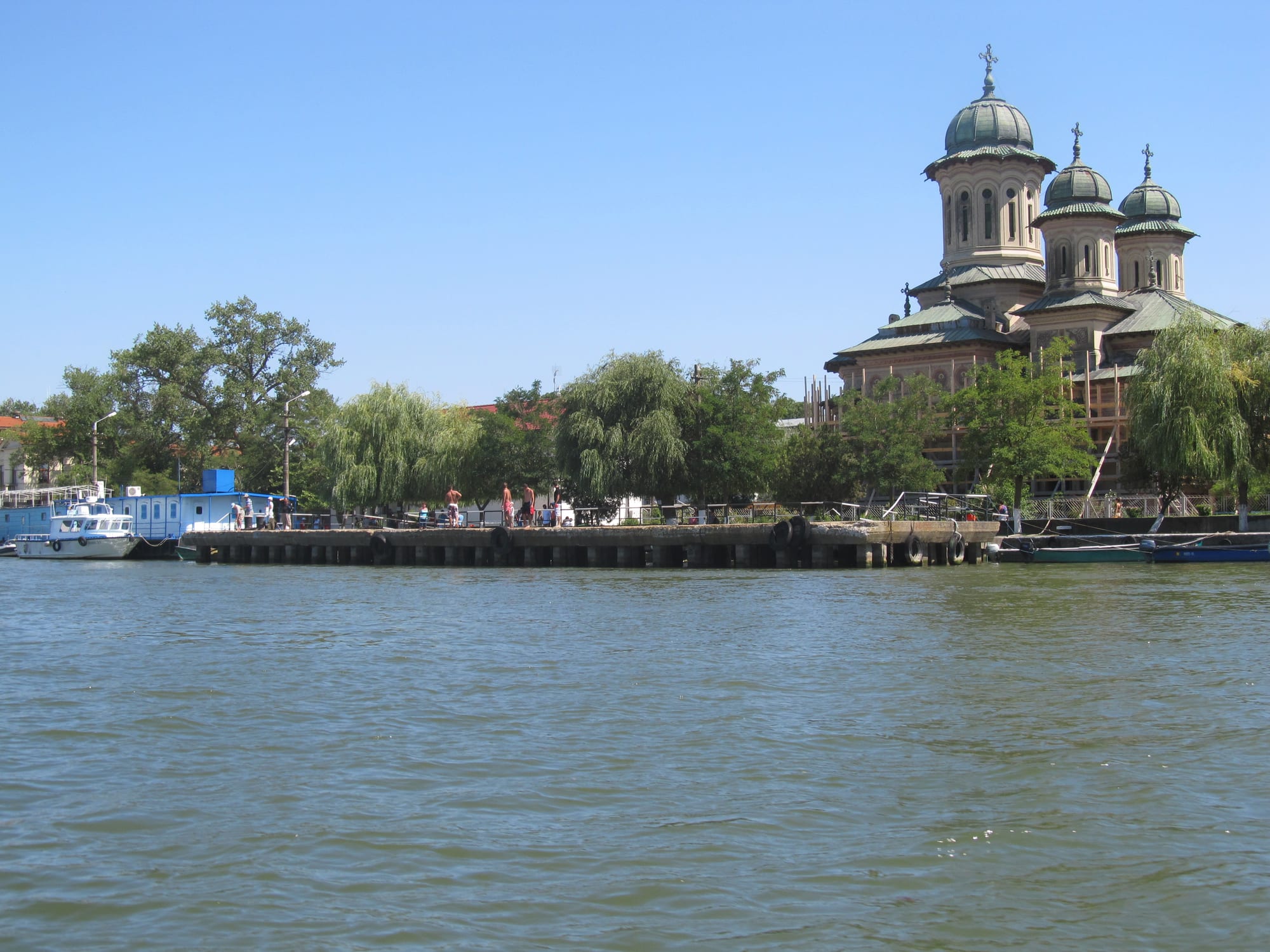
A green-domed Orthodox cathedral and weeping willows behind a concrete quay, seen across the wide Danube

Dobruja & the Black Sea Coast, Romania

Sulina

The Cathedral of St Alexander and St Nicholas above the Danube quay in Sulina. (Nenea hartia / Wikimedia Commons · CC BY-SA 4.0)

Romania's easternmost town, a small free port where the Sulina branch of the Danube meets the Black Sea, reached only by water. It grew in the 19th century as the base of the European Commission of the Danube, a cosmopolitan port of Greeks, Turks, Romanians, Old Believers and others; today it is a quiet fishing town and summer resort with an old lighthouse, a multinational cemetery and a long, wild beach.

Neighbourhoods

  • The riverfront and town centre
    • First-time visitors
    • Historic district
    • Close to the boats

    Most of Sulina stretches along the right bank of the Danube, and its life is lived on the riverside promenade, where the boats from Tulcea tie up. The cathedral stands near the ferry terminal, and the main supermarket and a few small shops line the promenade.

    Open in Maps
  • The beach road and the sea
    • Beaches
    • Wildlife
    • Summer nights

    East of the town centre the road runs towards the Black Sea, where kilometres of sand begin. One stretch has loungers and a beach bar busy on summer nights; beyond it the beach is wild, with birds and horses roaming.

    Open in Maps
  • Prospect island and the left bank
    • Quiet and residential
    • Fishing life

    Across the river, reached by a small passenger boat, the left bank on Prospect island holds the fish market and the smaller part of the town. It is the quieter, more rural side of town.

    Open in Maps

Things to do

Landmarks of the Danube Commission

  • Sulina Lighthouse Museummuseum

    The old lighthouse, taken over by the European Commission of the Danube in 1879, about 17 metres tall and now some 1.5 km from the shore, today a museum holding the study of the writer Jean Bart and a room on the history of the Commission.

    Open in Maps
  • Palace of the European Commission of the Danubelandmark

    The former seat of the international commission whose works made the river mouth navigable, built between 1860 and 1868 and one of the town's important monuments.

    Open in Maps
  • Sulina cemeterylandmark

    A maritime cemetery divided into Christian, Muslim and Jewish sectors, where people of 21 nationalities lie, among them Danube Commission officials and engineers, and some of the funeral monuments are works of art.

    Open in Maps
  • Cathedral of St Alexander and St Nicholaslandmark

    The Orthodox cathedral near the ferry terminal, its green domes a landmark for boats arriving along the river.

    Open in Maps

The beach

  • Sulina Beachbeach

    Kilometres of Black Sea sand, among the widest on the coast, largely undeveloped, with one stretch of loungers and a beach bar and long wild sections beyond.

    Open in Maps

Short trips into the delta

  • Letea Forestpark

    Romania's oldest nature reserve, declared in 1938, a forest of oaks, poplars and ash hung with climbing plants among high sand dunes, home to half-wild horses, between the Sulina and Chilia branches.

    Open in Maps
  • Sfântu Gheorgheattraction

    A fishing village at the mouth of the delta's southern branch, near the Black Sea.

    Open in Maps
  • Crișan, Caraorman and Mila 23attraction

    The villages of a commune in the middle of the delta, crossed by the Sulina branch, with Romanian, Lipovan and Ukrainian communities.

    Open in Maps

Eat and drink

Long-standing places and food districts in Sulina. Hours, ratings and directions come from your maps app, always current.

Sulina classics

  • Home-cooked fish mealsrestaurant

    Some local homestays cook full meals for visitors on request — fish soup, grilled fish and traditional Romanian side dishes.

    Open in Maps
  • Restaurants in townneighborhood

    The town has quite a few restaurants besides the homestay kitchens.

    Open in Maps

Markets

  • Sulina fish marketmarket

    The town's fish market stands on the left bank, just over a small bridge from the boat crossing, and is at its best early in the morning.

    Open in Maps

Experience Sulina

History

A Byzantine emperor, Constantine Porphyrogenitus, is the first to name Sulina, and by the 14th century it was a small Genoese port of sailors, pirates and fishermen, marked on Italian sea charts. In the 18th century the Ottomans built a lighthouse here, when the Sulina branch had become the most easily navigable route between Constantinople and the Danubian principalities, the capital's main breadbaskets. The Treaty of Adrianople of 1829 opened the Danube grain trade, and Sulina, then under Russian control, became an important port: big sailing ships could not reach Brăila and Galați fully loaded through the shallow river, so cargoes were moved here into small riverboats, nearly all owned and crewed by Greeks.

The Treaty of Paris of 1856, which ended the Crimean War, created the European Commission of the Danube, which deepened the river mouth so that large ships could enter. The Commission turned a fishing village into a town and built its palace between 1860 and 1868, and in 1870 the Ottoman authorities declared Sulina a free port. After the Russo-Turkish war of 1877–78 the town passed to Romania with the rest of Dobruja; an estimate of 1878 counted about 800 people, Greeks, Turks, Romanians, Old Believers and others. The writer Eugeniu Botez, who wrote as Jean Bart, served as captain of the port and set his novel Europolis there.

In the First World War the Romanian cruiser Elisabeta was based here and kept the delta in Romanian hands. In the Second World War, according to the town's lighthouse museum, more than 80 per cent of the town was destroyed by Soviet bombing. Sulina later became a small fishing town and seaside resort, still reached only by boat.

Culture & Customs

Sulina's identity is its cosmopolitan past. In 1930 fewer than half its people were Romanians, beside Greeks, Lipovans, Serbs, Turks, Jews and Germans, and the town's cemetery, with Christian, Muslim and Jewish sections and graves of 21 nationalities, is the clearest record of that town. Jean Bart's Europolis gave it a literary name, and his study is kept in the old lighthouse.

Today most people are Romanian and Orthodox, with a community of Lipovans, the Russian-speaking Old Believers whose ancestors settled in Dobruja in the 17th and 18th centuries, and smaller numbers of Ukrainians and Greeks. The cathedral of St Alexander and St Nicholas stands on the riverfront, and there is also a Roman Catholic church of St Nicholas.

Life follows the river and the seasons. Boats arrive and leave from the promenade, and in summer the beach bar and a nearby club draw crowds at night, while the far stretches of sand stay empty enough for birds, wild horses and nude bathers. The town is Romania's easternmost and lowest-lying, at about 4 metres above sea level.

Daily Life

About 3,100 people lived in Sulina at the 2021 census, down from about 3,700 in 2011. Roughly four in five are Romanians, with Lipovans the largest minority. The town is run by a mayor and a council of 13; Maria Bălan of the Social Democratic Party has been mayor since November 2024.

It is a small fishing town and summer resort. Most homes stand on the right bank in a long strip along the river, with a smaller settlement on the left bank. The land around is sandy, salty and crossed by canals, with reeds in the marshy parts and almost no large trees outside the town.

Everything arrives by water. Shopping is done at one large supermarket on the promenade and a few small shops, the banks close at weekends, and the boats to Tulcea are the link with the rest of the country. Summer brings visitors and full guesthouses; out of season the town is quiet.

Food

Fish is the base of the table, from the river and the delta's lakes — carp, pike, zander and wels catfish among them. Saramură, a traditional dish made especially with fish in Dobruja, is fish grilled, sometimes on a bed of salt, then soaked or sprinkled with brine or a brine-based sauce; the Lipovans call it rassol, and saramură de crap, carp in brine, is a classic. It is usually served with vegetables or mămăligă, the yellow maize-flour porridge eaten across Romania.

Fish soup is the other staple. Romanian borș is a sour liquid made from fermented wheat or barley bran, and soups made with it can be cooked with fish, flavoured with lovage. A home-cooked meal in Sulina usually brings fish soup, grilled fish and traditional Romanian side dishes.

The fish market on the left bank sells the morning's catch to locals and to visitors who cross early on the little boat. In town, a number of restaurants serve meals, while the supermarket and a butcher's shop supply everything else.

Planning tools

Budget

Sulina is modestly priced once there: guesthouses and home-cooked meals are good value, and there is little to spend money on in town. The boat fares to and from Tulcea and any delta boat tours are the main costs, and rooms fill and cost more in July and August.

Daily Budget Midrange
USD 90–180 (comfortable guesthouse with meals, restaurant dinners, speedboat transfers and a guided delta boat trip)
Daily Budget Shoestring
USD 35–60 (guesthouse room or hostel bed, homestay fish meals or supermarket food, the public ferry)

Book delta boat tours through the guesthouse rather than on the promenade, as many boatmen speak little English, and carry enough cash for the weekend, when the banks are closed.

Best Time to Visit

Late spring to early autumn. Late May and June bring nesting birds and fewer mosquitoes to the delta; July and August are the beach season, the busiest and hottest time; September is quieter, and out of season the town is very quiet.

Suggested Number of Days

Two days cover the town and the beach, allowing for the long boat journey each way. Three or four days leave time for boat trips deeper into the delta. The boat timetable from Tulcea, and the weather, decide the number more than anything else.

First Visit
2 days
With Surroundings
3–4 days

Transportation

There are no roads to Sulina from the rest of Romania and nowhere to use a car in town, so drivers leave their cars in Tulcea. The town is small and walkable; taxis run out to the beach, a small boat crosses to the left bank, and boat tours lasting from two hours to a whole day leave from the promenade. Canoes and kayaks can be hired for exploring the channels.

Leave the car in a guarded car park at Tulcea harbour and plan the trip around the boat times.

Airport & Station Connections

Sulina is reached only by water. From Tulcea a slow state ferry takes about four hours, and small speedboats take about an hour and a half. Tulcea is linked by train and bus with Bucharest and Constanța. Tulcea Danube Delta Airport, 16 km south of Tulcea, has no regular passenger flights; Mihail Kogălniceanu International Airport, which serves Constanța, is the main airport of the region.

Walkability

The town is a long, narrow strip along the river, and the promenade and the streets behind it are easily walked. The beach lies at the eastern end, a longer walk that many people cover by taxi.

Safety

Romania is a safe country with low violent crime. Sulina is a small, quiet town; the main hazards are the sea, where rip currents and sudden waves cause drownings on unguarded beaches, and heat, sun and mosquitoes in the delta. Northern Tulcea County borders Ukraine across the Danube, and debris from Russian drones attacking Ukrainian ports has repeatedly fallen on Romanian territory there.

Swim only where lifeguards are on duty, use insect repellent, and follow local instructions near the Ukrainian border. Check current official travel advice before travelling.

Climate

Sulina has a cold semi-arid climate. In nearby Sfântu Gheorghe, at the mouth of the delta's southern branch, summers are warm and humid, warm nights are not uncommon and winters are very mild for Romania.

Summer
warm and humid, with warm nights; the record high in nearby Sfântu Gheorghe is 35.8°C
Winter
mild for Romania, though cold snaps come; the record low in nearby Sfântu Gheorghe is −18.6°C

Local Customs

Sulina is a mostly Romanian Orthodox town with a Lipovan community of Russian-speaking Old Believers, whose churches and customs are conservative: modest dress and quiet behaviour are expected in church. English is not widely spoken, especially among boatmen. Parts of the wild beach far from town are used for nude bathing.

Dress modestly in churches and ask before photographing people.

Common Payment Methods

The currency is the Romanian leu (RON). Shops on the promenade take cash in lei or cards, mostly Visa and Mastercard and less often American Express. The town has a few ATMs in the centre and two banks that also change money but close at weekends and on public holidays, with poorer rates than in Constanța or Bucharest.