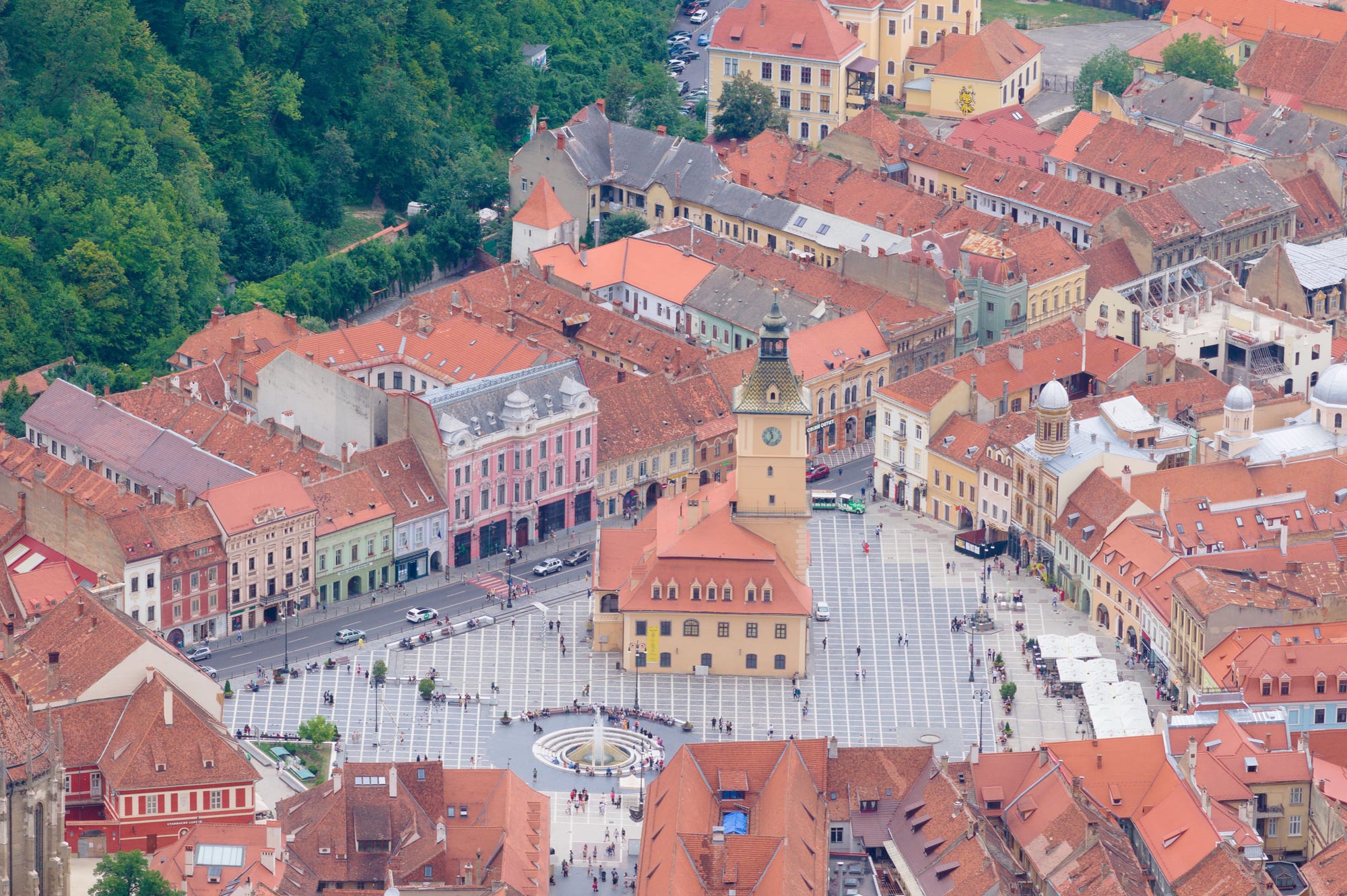
Red-roofed houses around Brașov's Council Square with its clock-towered old town hall, seen from the wooded slope above

Romania

Transylvania

Brașov's Council Square and old town seen from Mount Tâmpa. (Andrei Stroe / Wikimedia Commons · CC BY-SA 4.0)

The high basin enclosed by the arc of the Carpathians and the Apuseni Mountains in the centre of Romania — a region long ruled from Hungary and Vienna, where Romanians, Hungarians, Székelys and the remaining Saxons share walled towns, fortified churches and castles from Brașov and Sibiu to Cluj-Napoca and Sighișoara.

Explore Transylvania

History

Transylvania was the heart of ancient Dacia. The kingdom's capital, Sarmizegetusa Regia, stood in the Orăștie Mountains, and after Trajan's conquest in 106 the Romans built their provincial capital, Ulpia Traiana Sarmizegetusa, nearby, with legionary bases and towns at Apulum (Alba Iulia), Potaissa (Turda) and Napoca (Cluj). From the 10th century the Hungarian kingdom pushed into the basin, settling the Székelys as frontier guards in the east and, from the 12th century, inviting German colonists — the Saxons — who built Sibiu, Brașov, Sighișoara, Bistrița and hundreds of walled villages.

Political power belonged to three privileged "nations", the Hungarian nobles, the Saxons and the Székelys, while the Romanian majority, mostly Orthodox serfs, was excluded. After the Ottoman victory at Mohács in 1526 Transylvania broke away and, from 1570, was a principality under Ottoman overlordship, ruled from Alba Iulia; the Diet at Turda proclaimed religious freedom in 1568. In 1600 Michael the Brave briefly held Transylvania together with Wallachia and Moldavia.

The Habsburgs took over in the 1690s, and part of the Romanian clergy entered union with Rome, creating the Greek Catholic Church whose schools at Blaj nurtured a national revival. After 1867 Transylvania was ruled directly from Budapest. On 1 December 1918 a Romanian assembly at Alba Iulia voted for union with Romania, now the national day. Northern Transylvania was returned to Hungary from 1940 to 1944, when its Jews were deported to Auschwitz. Most Saxons left for Germany before and after 1989, though Sibiu's former Saxon-minority mayor, Klaus Iohannis, went on to be president of Romania.

Culture & Customs

Transylvania is Romania's most mixed region. Romanians are the majority, but Hungarian is spoken in Cluj, Târgu Mureș and much of the countryside, and Harghita and Covasna, the core of the Székely Land, are majority Hungarian, with bilingual signs and their own blue-and-gold flag. German survives in Saxon church services, schools and place names — Hermannstadt, Kronstadt, Schäßburg. Religion is correspondingly varied: Orthodox and Greek Catholic Romanians, Roman Catholic, Calvinist and Unitarian Hungarians, and Lutheran Saxons, with the Unitarian church founded in Cluj in the 16th century.

Transylvanian Romanians are teased elsewhere for their slow, measured speech and their calm, and they take pride in a reputation for order and reliability. Folk culture remains strong in the shepherd villages of Mărginimea Sibiului, around the Apuseni, and in Székely villages with their carved wooden gates.

The calendar is full. Brașov's Junii, horsemen in costume, parade on the Sunday after Easter; the Catholic Pentecost pilgrimage to Șumuleu Ciuc draws huge crowds of Hungarians; Sibiu hosts a large international theatre festival every year; and Cluj holds the TIFF film festival and the Untold music festival.

Daily Life

Cluj-Napoca, with about 290,000 people, is Transylvania's largest city and a magnet for young Romanians: its Babeș-Bolyai University is the country's largest, and much of Romania's software industry is based there. Brașov has about 240,000 residents, Sibiu about 135,000, Târgu Mureș about 115,000, and Alba Iulia, Deva, Bistrița, Sfântu Gheorghe and Miercurea Ciuc are smaller county towns.

The economy is among the strongest in the country: car parts and engineering around Sibiu and Brașov, IT in Cluj, and tourism in the medieval towns and mountains. Hunedoara and the Jiu Valley, by contrast, have struggled since their steelworks and coal mines closed or shrank, and many Saxon villages lost their populations when their German inhabitants left.

The towns keep a Central European rhythm: coffee houses, pedestrian squares, Sunday walks, and markets selling mountain cheese. Housing costs in Cluj and Brașov, traffic, and pressure from tourism on small places like Viscri are the local talking points.

Food

Transylvanian cooking blends Romanian, Hungarian and Saxon traditions. Varză à la Cluj is a baked layered dish of sauerkraut, minced pork and rice under sour cream; Hungarian gulyás soup and paprika stews are common; and the Saxons contribute smoked bacon, pork dishes and hencleș, a flat Saxon cake. Shepherds' food from the mountains includes balmoș, cornmeal cooked in whey with fresh sheep's cheese, and bulz, baked polenta with sheep's cheese.

Kürtőskalács, the Székely chimney cake of dough wound round a spit, baked over coals and rolled in sugar or walnuts, is sold in every town. Two products hold EU protected status: Salam de Sibiu, a dry-cured salami, and Telemea de Ibănești, a brined cheese from the Gurghiu valley in Mureș.

The Târnave valleys are white-wine country, with Jidvei, Blaj and Cetatea de Baltă among the main wine centres. Pălincă, strong fruit brandy, is poured as a welcome, and Székely Land springs such as Borsec are known for their mineral water.

Attractions & Natural Wonders

Brașov's Council Square is overlooked by the Black Church, a Gothic church blackened by the fire of 1689, with the narrow Rope Street, the Schei quarter and the cable car up Mount Tâmpa close by. Bran Castle, the Saxon border fortress sold abroad as "Dracula's castle" and later Queen Marie's home, is about 25 kilometres south-west, with Râșnov citadel on its hill and the ski resort of Poiana Brașov above the city. Sighișoara's citadel, Sibiu's Large and Small Squares, the Bridge of Lies and the Brukenthal Museum, and the ASTRA open-air museum of village buildings in the Dumbrava forest complete the Saxon towns; the fortified churches of Biertan, Viscri, Saschiz and Prejmer lie in the countryside between them.

Cluj-Napoca's Union Square centres on St Michael's Church and the statue of Matthias Corvinus, who was born in the city, and the Turda Salt Mine and Turda Gorge lie south of it. Alba Iulia's star-shaped Alba Carolina citadel holds the Romanesque St Michael's Catholic cathedral and the Orthodox Coronation Cathedral. Further west, Corvin Castle stands at Hunedoara, the Dacian fortresses of the Orăștie Mountains, a UNESCO World Heritage Site, lie in the forest, and the Retezat National Park has glacial lakes and high peaks.

In the mountains, the Transfăgărășan climbs from the Sibiu side to the glacial Bâlea Lake, the Apuseni hold the Scărișoara ice cave, and in the Székely Land the volcanic crater lake of Sfânta Ana lies in the forest near Tușnad.

Cities in Transylvania

Planning basics

Budget

Brașov, Sibiu and Cluj-Napoca are among Romania's pricier cities, with rising hotel and restaurant costs and heavy demand at festival and ski times; Sighișoara's citadel hotels and the Bran area charge tourist prices in summer. Saxon-village guesthouses, the Székely Land and the Apuseni villages are cheaper, and a car is the main extra cost.

Daily Budget Midrange
USD 100–200 (boutique or mid-range hotel, restaurant meals, castle and museum tickets, a hire car)
Daily Budget Shoestring
USD 35–65 (hostel or village guesthouse, canteens and bakeries, trains and buses)

Book Cluj during the Untold and TIFF festivals, and Sighișoara during its July medieval festival, well ahead, as rooms sell out and prices jump.

Safety

Transylvania is generally safe. The main hazards are brown bears, which are numerous in the mountain forests and sometimes wander into towns; fast-changing weather on the high ridges; and busy two-lane roads with lorries and horse carts.

Keep food sealed when camping, make noise on forest trails, never feed bears, and leave the high Făgăraș ridge before afternoon storms. Check current official travel advice before travelling.

Climate

Cooler and wetter than the plains of the south and east. The basin has warm summers and cold, often foggy winters, and the towns under the mountains — Brașov, the Székely basins around Miercurea Ciuc — have long, cold winters. The Făgăraș, Retezat and Bucegi ranges hold snow for half the year.

Summer
warm, 24–30°C in the towns, with thunderstorms; cool in the mountains
Winter
cold, around −8 to 2°C, with snow; colder in the mountain basins; ski season at Poiana Brașov

Transportation

Cluj-Napoca, Sibiu, Târgu Mureș and Brașov have airports, and Cluj is the busiest after Bucharest. The main railway runs Brașov–Sighișoara–Cluj, with lines to Sibiu, Alba Iulia and Deva; trains are slow but scenic. Motorway sections now link Sibiu with Deva and Cluj with Turda, but many routes are still two-lane roads. The Saxon villages, the Apuseni and Székely Land are best explored by car.

Visit Bran early in the morning or on a weekday; at summer weekends the road from Brașov jams and the castle's rooms are crowded.

Best Time to Visit

May to October. Late spring and early autumn are best for the towns, the Saxon villages and walking; July and August bring the Sighișoara Medieval Festival, the Transfăgărășan open (usually from late June) and Cluj's festivals. December is the season of Sibiu's Christmas market, and January–March of skiing.