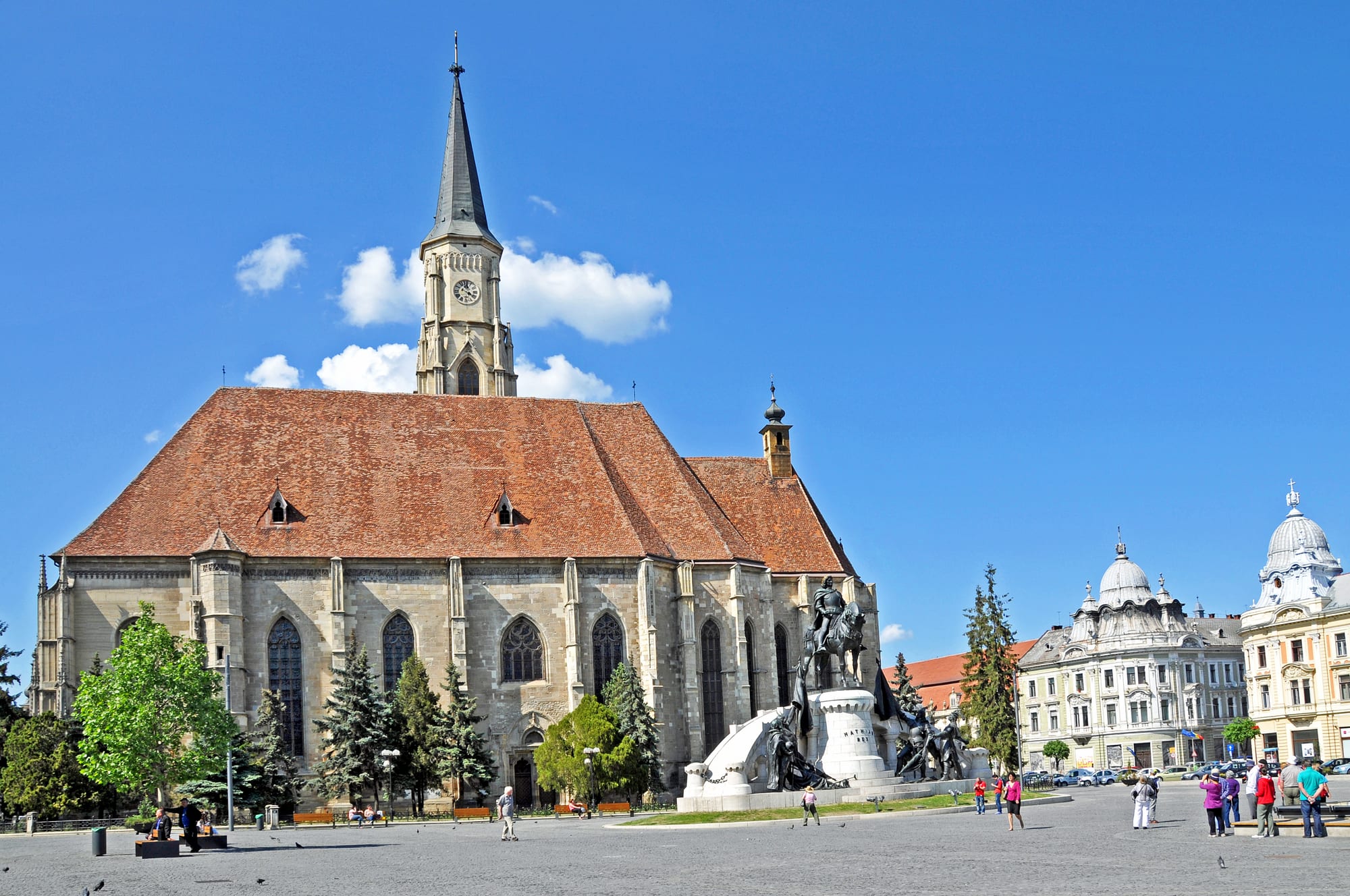
The Gothic St Michael's Church with its tall spire and the equestrian statue of Matthias Corvinus on a wide square under a blue sky

Transylvania, Romania

Cluj-Napoca

St Michael's Church and the Matthias Corvinus monument on Union Square, Cluj-Napoca. (Dennis G. Jarvis / Wikimedia Commons · CC BY-SA 2.0)

Romania's second-largest city, with about 287,000 people in the Someșul Mic valley of north-western Transylvania — the Roman Napoca, the medieval Saxon and Hungarian Kolozsvár and the unofficial capital of Transylvania. Today it is a university and technology city of Gothic churches, Baroque palaces and big summer music festivals, with a large Hungarian community.

Neighbourhoods

  • The centre
    • First-time visitors
    • Historic district
    • Best for food

    The old town spreads out from Union Square, one of the largest squares in Romania, with St Michael's Church and the Bánffy Palace, to the smaller Museum Square, the site of Roman Napoca, and the ensemble of palaces, theatre and cathedral on Avram Iancu Square. Cafés, bars and most of the sights are here.

    Open in Maps
  • Hașdeu and the student quarter
    • Nightlife
    • Students

    The student housing district around Hașdeu Park, whose slanting Strada Piezișă is a central strip of bars and terraces.

    Open in Maps
  • Andrei Mureșanu
    • Quiet and residential

    A residential district in the south-east of the city, named after the poet and revolutionary Andrei Mureșanu.

    Open in Maps
  • Gheorgheni
    • Quiet and residential
    • Local life

    A district of flats in the south-east of the city, named after the nearby village of Gheorghieni.

    Open in Maps
  • Mănăștur
    • Local life

    A district west of the centre, part of the city since 1895, on the site of the medieval Cluj-Mănăștur fortress and abbey; it had about 126,600 residents in 2007.

    Open in Maps
  • Grigorescu
    • Quiet and residential
    • Parks

    A district in the west of the city, known until the 1960s as Donath and named after the First World War general Eremia Grigorescu.

    Open in Maps

Things to do

Famous landmarks

  • St Michael's Churchlandmark

    The Gothic Roman Catholic church on Union Square, begun in the late 14th century and completed in the 1440s, the second-largest church in Transylvania, with a 19th-century Gothic Revival tower that is the tallest church tower in Romania.

    Open in Maps
  • Union Square and the Matthias Corvinus monumentlandmark

    The great square of the city, 220 by 160 metres, with the equestrian statue of King Matthias Corvinus, who was born in the city, in front of St Michael's and palaces on every side.

    Open in Maps
  • Matthias Corvinus Houselandmark

    One of the oldest buildings in the city, a 15th-century Gothic house where the future King Matthias of Hungary was born, owned by the University of Art and Design since 1950.

    Open in Maps
  • Dormition of the Theotokos Cathedrallandmark

    The Orthodox cathedral on Avram Iancu Square, completed in 1933 in the Romanian Brâncovenesc style and the seat of the Metropolitan of Cluj.

    Open in Maps
  • Lucian Blaga National Theatrelandmark

    A neo-Baroque theatre built in the early 20th century by the Viennese firm of Fellner and Helmer, home since 1919 to the National Theatre and the Romanian National Opera.

    Open in Maps
  • Tailors' Bastionlandmark

    The 15th-century tower at the south-east corner of the old city walls, rebuilt in 1627–29 and kept by the tailors' guild, now restored as a centre for urban culture.

    Open in Maps

Museums

  • National Museum of Artmuseum

    In the Bánffy Palace of 1774–75, considered the most representative Baroque building in Transylvania, with collections of Romanian art including Nicolae Grigorescu and Ștefan Luchian.

    Open in Maps
  • National Museum of Transylvanian Historymuseum

    The region's history and archaeology museum, whose collections began in 1859, covering prehistory, the Dacians, Roman Napoca, the Middle Ages and the modern era.

    Open in Maps
  • Ethnographic Museum of Transylvaniamuseum

    Objects and clothing of Transylvanian rural life in the Reduta Palace in the city centre, with a second section in the Romulus Vuia open-air park in the Hoia forest, the first open-air museum in Romania.

    Open in Maps
  • Pharmacy Museummuseum

    The historic pharmacy collection in the Hintz House, the city's first pharmacy, dating from the 16th century.

    Open in Maps

Parks, hills and walks

  • Cluj-Napoca Botanical Gardenpark

    A garden of more than 14 hectares founded in 1872 and run by Babeș-Bolyai University, with over 10,000 plants and a Japanese garden.

    Open in Maps
  • Central Parkpark

    A large park laid out in the 19th century on the south bank of the Someșul Mic, with a lake and island and the restored Chios casino.

    Open in Maps
  • Fortress Hillviewpoint

    Cetățuia, the hill near the centre topped by the earth walls and moat of an old fortress, climbed for its view over the city.

    Open in Maps
  • Hajongard Cemeteryattraction

    One of the oldest cemeteries in the city, founded in the 16th century and covering about 14 hectares, where many of Cluj's notable figures are buried.

    Open in Maps
  • Hoia-Baciu Forestpark

    A forest on the western edge of the city used for walks and biking, the subject of many local stories of strange events.

    Open in Maps

Music, sport and nights out

  • Hungarian Theatre of Clujattraction

    The State Hungarian Theatre, in a building of 1909–10 that it shares with the Hungarian Opera, with translation into Romanian or English usually available.

    Open in Maps
  • Cluj Arenaattraction

    A 30,000-seat stadium beside the Central Park, opened in 2011, home to Universitatea Cluj and the main stage of the Untold festival.

    Open in Maps

Short trips from the city

  • Turda Gorgetrail

    A limestone gorge of the Hășdate river and nature reserve about 24 km south-east of the city, crossed by a footpath between its cliffs.

    Open in Maps
  • Salina Turdaattraction

    A former salt mine in Turda opened to visitors in 1992, whose vast underground chambers drew about 618,000 visitors in 2017.

    Open in Maps
  • Bonțida Bánffy Castlelandmark

    The castle of the Bánffy family in the village of Bonțida, once called the Versailles of Transylvania, about 32 km from the city and the setting of the Electric Castle festival.

    Open in Maps

Seasonal events

  • Fête de la Musique21 June

    A day of free music in the city on the summer solstice, organised with the French Cultural Centre.

  • Electric CastleJuly

    A festival of rock, indie, hip hop, electronic music and art installations in the grounds of the Bánffy Castle at Bonțida.

  • Hungarian Cultural Days of Clujsummer

    A festival of Hungarian culture held each summer since 2010.

  • Untoldearly August

    Romania's largest electronic music festival, held at Cluj Arena and the Central Park with performances that run until morning.

Eat and drink

Long-standing places and food districts in Cluj-Napoca. Hours, ratings and directions come from your maps app, always current.

Food districts

  • Museum Squareneighborhood

    The small square on the site of Roman Napoca, whose bars and cafés set out tables round the obelisk.

    Open in Maps
  • Strada Piezișăneighborhood

    The slanting street of the Hașdeu student quarter, lined with bars and terraces.

    Open in Maps

Cluj classics

  • Varză à la Clujrestaurant

    The city's own dish, layers of cabbage or sauerkraut, minced pork and rice, often topped with sour cream and served with mămăligă.

    Open in Maps

Experience Cluj-Napoca

History

A pre-Roman settlement called Napoca stood here, and after Trajan's conquest of Dacia in 106 the Romans built a town of the same name, made a municipium by Hadrian and later a colonia and the capital of the province of Dacia Porolissensis. The Romans left in 274, and the site had no town for most of a millennium. In the Middle Ages the Hungarian kings made it the seat of the county of Kolozs; a settlement of Transylvanian Saxons grew up, the name Castrum Clus is recorded in 1213, and on 19 August 1316 King Charles I made it a city. Matthias Corvinus, later one of Hungary's most famous kings, was born here in 1443.

After 1541 the city entered a period of economic and cultural prosperity, and in the late 16th century it earned the name "treasure city". Ferenc Dávid, born in the city, founded the Unitarian Church of Transylvania, and from 1790 to 1848 it was the seat of the Transylvanian government and diets. From 1830 it was the centre of the Hungarian national movement in Transylvania; in 1894 the authors of the Transylvanian Memorandum, which demanded rights for Romanians, were tried here as some 20,000 people demonstrated in the streets.

The city became part of Romania after 1918, returned to Hungary from 1940 to 1944, when 16,148 Jews were deported to Auschwitz, and was restored to Romania in 1947. Hungarians remained the majority until the 1960s, when industrialisation brought many Romanians. In 1974 the communist government added "Napoca" to the name. Twenty-six people were killed here in the revolution of 1989. Twelve years of nationalist rule under mayor Gheorghe Funar ended in 2004, and the city has grown rapidly since.

Culture & Customs

Cluj is the unofficial capital of Transylvania and a major cultural centre. The neo-Baroque National Theatre houses both the Lucian Blaga National Theatre and the Romanian National Opera; the State Hungarian Theatre and Hungarian Opera, the Transylvania Philharmonic and the Puck puppet theatre add to a busy season. Babeș-Bolyai University, the largest in Romania, teaches in Romanian, Hungarian and German, and its students set much of the city's pace.

The city is home to the second-largest urban Hungarian community in Romania, almost 50,000 people, and the seat of the Reformed and Unitarian dioceses of Transylvania, while the Orthodox and Greek Catholic churches have cathedrals here. The Hungarian Cultural Days are held each summer.

Summer is festival season. The Transilvania International Film Festival, founded in 2002, was the first international feature film festival in Romania; Untold, the country's largest electronic music festival, fills Cluj Arena and the Central Park every August; and Electric Castle takes over the Bánffy Castle at Bonțida. The city's own bands range from the rock group Compact to Luna Amară, and its nightlife spreads from Union Square to the bars of Strada Piezișă. Football divides the city between CFR Cluj and Universitatea, which played their first derby in the Central Park in 1920.

Daily Life

At the 2021 census Cluj-Napoca had 286,598 inhabitants, the second-largest city in Romania, and its metropolitan area, which includes seventeen surrounding communes, has more than 400,000 people. Students and other non-residents add to the population, and since 2005 new districts such as Borhanci, Becaș and Sopor have been laid out on the edges of the city.

Much of Romania's software and IT industry is based in Cluj, and the city also holds regional offices of international firms, factories such as De'Longhi and Bosch in the industrial parks outside the city, eleven hospitals and many universities. Emil Boc, a former prime minister, has been mayor since 2012.

Most residents live in the large districts of flats built under communism, such as Mănăștur, Gheorgheni and Grigorescu, and travel by bus, trolleybus and tram. Weekends take families to the forests of Făget and Hoia and the gorge at Turda, and summer evenings to the terraces of the centre.

Food

Cluj's cooking is Transylvanian, a mixture of Romanian and Hungarian traditions. The city's own dish is varză à la Cluj, layers of cabbage or sauerkraut, minced pork and rice, first printed in a cookbook in 1695 and often topped with sour cream. Ciorbă, the sour soup made with meat or vegetables and soured with borș, vinegar or sauerkraut juice, opens many meals, and sarmale, stuffed cabbage rolls and Romania's national dish, are popular across Transylvania.

Hungarian dishes such as goulash and chicken paprikash are part of the cooking, and kürtőskalács, the Székely chimney cake of sweet dough wound round a spit and rolled in sugar, is popular in both Hungary and Romania. Mămăligă, the cornmeal mush, comes with stews and with telemea cheese and sour cream, and papanași, a fresh-cheese dough dessert topped with sour cream and fruit preserve, are a traditional sweet.

Pălincă, the strong double-distilled fruit brandy of Transylvania, and țuică, made from plums, are the local spirits. The cafés of Museum Square, the bars of Strada Piezișă and the many restaurants of the centre, from Romanian and Hungarian cooking to international menus, reflect a young, international city.

Planning tools

Budget

Cluj is one of Romania's pricier cities, though still much cheaper than Western Europe, and rooms are in heavy demand during the big summer festivals. Student cafés and canteens, the city's buses and trams and free parks and squares help keep costs down.

Daily Budget Midrange
USD 100–200 (mid-range hotel, restaurant meals, museum tickets, a day trip to Turda)
Daily Budget Shoestring
USD 35–65 (hostel bed, canteens and bakeries, city buses and trams)

Book rooms well ahead for the Untold and TIFF festivals.

Best Time to Visit

Late spring to early autumn, when the squares fill with terraces and the festivals take place, from the film festival and Electric Castle to Untold in August. September and October are quieter. Winters are cold but the city's theatres, opera and concerts run through the season.

Suggested Number of Days

Two days suit the centre and its museums. Three or four allow time for the gorges, salt mine and castles around the city; festival visits often stretch longer.

First Visit
2 days
With Surroundings
3–4 days

Transportation

The centre is walkable. The city company CTP runs 51 bus routes, 12 trolleybus lines and 5 tram lines, with tickets from machines, booths, a transport card or contactless bank card. Private buses serve the towns and villages around the city.

Buy a ticket or travel card before boarding where possible, and use a taxi app or a marked taxi from a reputable firm.

Airport & Station Connections

Avram Iancu International Airport, the second busiest in Romania, lies about 9 km east of the centre; an airport express bus and city buses link it with the centre. The railway station has direct trains to the major Romanian cities, including Bucharest and Oradea, and to Budapest, and long-distance buses also serve the city.

Walkability

Very good in the centre, where Union Square, Museum Square and Avram Iancu Square are a few minutes apart and many streets are pedestrian. The botanical garden and Hașdeu are a short uphill walk south; the outer districts and the airport need a bus.

Safety

Romania is a safe country with low violent crime. Cluj's overall crime rate is low, but petty crime such as pickpocketing can be a nuisance, especially in crowds and on public transport, and festival nights bring heavy crowds around the arena and park.

Keep valuables secure in crowds and on buses, agree on meeting points at festivals, and book taxis by app. Check current official travel advice before travelling.

Climate

A warm-summer continental climate shaped by the nearby Apuseni Mountains. Spring and autumn range from about 0°C to 22°C with frequent mild rain.

Summer
mild to warm, averaging about 20°C, with occasional days of up to 35°C in the city centre
Winter
cold, often below 0°C but rarely below −10°C, with snow

Local Customs

Romanian is the main language and Hungarian is widely spoken by the city's large Hungarian community, which has its own theatre, opera and university programmes. The many students mean English is common among younger people. St Michael's, the Orthodox cathedral and the city's Reformed and Unitarian churches are working places of worship.

Dress modestly in churches, and be aware that Romanian–Hungarian history is a sensitive subject for some residents.

Common Payment Methods

Romania uses the leu (RON), not the euro. Cards and contactless payment are widely accepted, including on city buses and trams; carry some cash for markets, small cafés and villages outside the city.