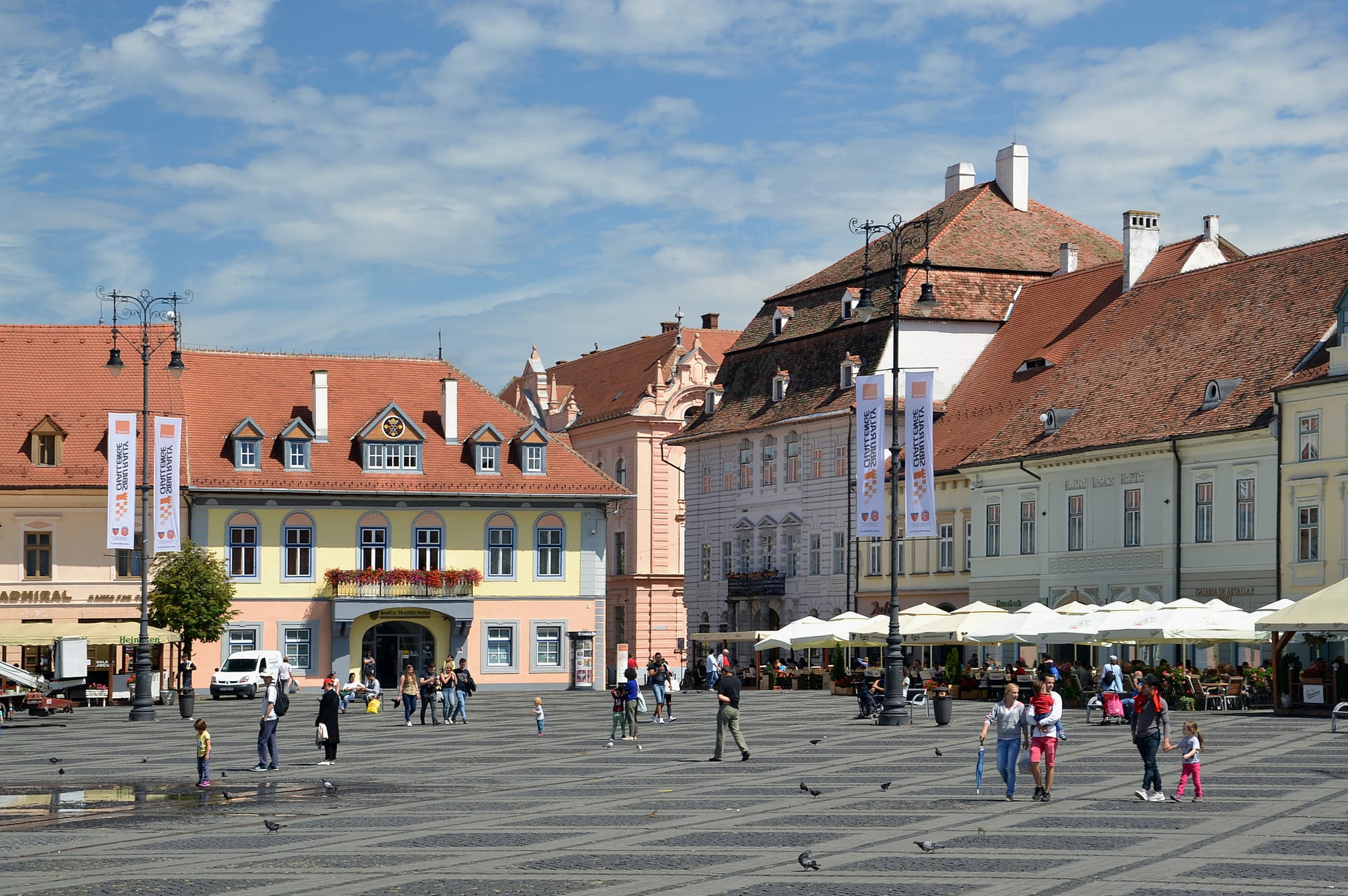
Pastel town houses with steep tiled roofs and small dormer windows around Sibiu's paved Great Square, with café umbrellas and people walking

Transylvania, Romania

Sibiu

Piața Mare, the Great Square of Sibiu's upper town. (Pudelek / Wikimedia Commons · CC BY-SA 4.0)

A city of about 134,000 people on the Cibin river below the Făgăraș and Cibin mountains, founded by Saxon settlers in the 12th century, later named Hermannstadt, and for centuries the chief town of the Transylvanian Saxons. Its walled upper town of linked squares and roofs with eye-shaped windows is among the best-preserved historic sites in Romania, and in 2007 the city was a European Capital of Culture.

Neighbourhoods

  • The upper town
    • First-time visitors
    • Historic district
    • Best for food

    The heart of the old city, ranged around three squares: the Great Square with the Brukenthal Palace and the Catholic church, the Little Square with most of the bars and cafés, and Huet Square around the Lutheran cathedral. The Council Tower stands over the passage between the first two.

    Open in Maps
  • The lower town
    • Historic district
    • Quiet and residential

    The lower part of the old town, reached by stairways such as Pasajul Scărilor or down Ocnei street under the Bridge of Lies, with cobbled squares and old houses.

    Open in Maps
  • Sub Arini and the park districts
    • Parks
    • Sport
    • Quiet and residential

    The leafy residential area around Sub Arini Park, laid out in 1857–59 and one of the largest parks in Romania, home to the rebuilt municipal football stadium.

    Open in Maps
  • Around the station
    • Close to public transport

    The area north-east of the old town by the main railway station and the bus station, about 500 metres from the centre, with the Steam Locomotives Museum nearby.

    Open in Maps

Things to do

Squares and landmarks

  • Piața Marelandmark

    The Great Square, the city's main square since at least 1366, completely renovated in 2005, with the Brukenthal Palace and the Council Tower among its buildings.

    Open in Maps
  • Council Towerviewpoint

    The tower over the passage between the Great and Little Squares, first built in the 12th century and rebuilt many times, used over the centuries as a grain store and fire lookout; it is the symbol of the city.

    Open in Maps
  • Bridge of Lieslandmark

    The first cast-iron bridge built in present-day Romania, carrying the Little Square over Ocnei street to Huet Square, and the subject of many legends about its name.

    Open in Maps
  • Lutheran Cathedral of Saint Marylandmark

    The city's best-known Gothic church on Huet Square, whose 73-metre steeple with four corner turrets is a landmark across the city.

    Open in Maps
  • Holy Trinity Cathedrallandmark

    The Orthodox cathedral of the Metropolitan of Transylvania, built in 1902–04 in the style of a Byzantine basilica inspired by Hagia Sophia.

    Open in Maps

Museums

  • Brukenthal National Museummuseum

    Founded in the palace of Samuel von Brukenthal, governor of Transylvania, whose collections date from about 1790; it is now a complex of six museums, with the art gallery and old library in the palace on the Great Square.

    Open in Maps
  • ASTRA Museummuseum

    The ASTRA National Museum Complex, whose open-air museum of traditional folk civilisation spreads over 96 hectares of the Dumbrava forest south of the city, with over 300 houses and other buildings, among them windmills, water-mills and a wooden church, set around two artificial lakes.

    Open in Maps
  • Steam Locomotives Museummuseum

    Around 40 steam locomotives, two of them in working order, displayed near the main railway station.

    Open in Maps

Parks and walks

  • Sub Arini Parkpark

    A park laid out in 1857–59 to plans by the military engineer Michael Seyfried, one of the biggest in Romania.

    Open in Maps
  • Citadel Parkpark

    Parcul Cetății, a green strip along the old city walls that grew out of the town's first promenade of 1791.

    Open in Maps
  • Dumbrava Sibiuluipark

    A natural park of 960 hectares about 4 km south-west of the centre, holding the ASTRA open-air museum and the city zoo.

    Open in Maps

Short trips from the city

  • Cisnădie and Cisnădioaraattraction

    A small Saxon town about 10 km south at the foot of the Cindrel Mountains, known for its Saxon heritage, with the village of Cisnădioara as part of it.

    Open in Maps
  • Rășinariattraction

    A large village beyond the Dumbrava forest, linked to Sibiu by tram until 2011.

    Open in Maps
  • Păltinișattraction

    Romania's highest resort, at 1,440 metres in the conifer forest of the Cindrel Mountains 35 km south-west, founded in 1894 and administered by the city, with skiing in winter and walks in summer.

    Open in Maps

Seasonal events

  • Sibiu International Theatre FestivalJune

    A ten-day festival of theatre and performing arts that fills the city's stages and streets, ranked among the biggest in the world.

  • Medieval FestivalAugust

    A yearly festival reviving the medieval life of the Saxon city in its squares.

  • Christmas marketDecember

    Romania's first Christmas market, inspired by Vienna's and held since 2007, now with about 70 stalls, a stage for carols and an ice rink on the Great Square.

Eat and drink

Long-standing places and food districts in Sibiu. Hours, ratings and directions come from your maps app, always current.

Food districts

  • Piața Micăneighborhood

    The Little Square, where most of the upper town's bars and cafés are.

    Open in Maps
  • Butoiul de Aurrestaurant

    The Golden Barrel, a restaurant at the foot of the Pasajul Scărilor stairway between the upper and lower towns.

    Open in Maps

Sibiu classics

  • Transylvanian cookingrestaurant

    Restaurants in the old town serve hearty Transylvanian food — ciorbă sour soups, sarmale, stews and grills, often with mămăligă.

    Open in Maps

Experience Sibiu

History

A Roman fort may have stood on the site, but the city was founded by German settlers brought in by King Géza II of Hungary around 1147, from lands now in Germany, France and the Benelux. In 1191 the pope confirmed a free provostry of the Saxons with its seat here, the town was called Villa Hermanni by 1223, and the German name Hermannstadt is recorded from 1366. By the 14th century it was an important trading centre whose craftsmen were organised in 19 guilds, and it became the leading town of the Transylvanian Saxons and the seat of their self-governing Saxon University.

After the Ottomans withdrew, Sibiu became the capital of the Principality of Transylvania in 1699, and it was again the seat of the Transylvanian Diet between 1848 and 1867. In the same centuries it grew into a centre of Romanian life in Transylvania: the first Romanian-owned bank, Albina, and the cultural association ASTRA were founded here, and from the 1860s it became the seat of the Orthodox Metropolitan of Transylvania.

Sibiu joined Romania after the First World War with a German majority that lasted until 1941. From the 1950s to 1990 most of its Germans emigrated to West Germany and Austria, yet in 2000 the city elected Klaus Iohannis, a Transylvanian Saxon, as mayor; he held the post until 2014, when he became president of Romania. In 2007 Sibiu was European Capital of Culture with Luxembourg City, and the city and its surroundings are now among the most visited areas in the country.

Culture & Customs

Sibiu is known as the town with eyes, after the narrow eyebrow dormers that look out from its steep roofs. Its cultural life is large for its size. The Radu Stanca National Theatre, with roots in 1787, has Romanian and German sections and works with directors such as Silviu Purcărete; the Gong Theatre specialises in puppetry and mime; and the State Philharmonic plays in Thalia Hall, a concert hall of 1787 on the old fortifications. The Sibiu International Theatre Festival, one of the largest performing-arts festivals in the world, fills the city every June.

The year is crowded with other events: a medieval festival in August, the rock festival Artmania each summer, the oldest jazz festival in Romania, the Astra Film documentary festival and the Christmas market on the Great Square, the first in the country. In 2019 the region was a European Region of Gastronomy, and the same year the city hosted a summit of the European Union.

Three churches mark the city's faiths: the Lutheran cathedral of the Saxons, the Roman Catholic church on the Great Square and the Orthodox cathedral of the Metropolitan of Transylvania, which makes Sibiu one of the most important centres of the Romanian Orthodox Church. The city's best-known figures include two Transylvanian Saxon pioneers of rocketry, Conrad Haas and Hermann Oberth. Football follows FC Hermannstadt, which plays in the rebuilt municipal stadium in Sub Arini Park.

Daily Life

At the 2021 census Sibiu had 134,309 inhabitants, the 15th-largest city in Romania, and a proposed metropolitan area of about 267,000. Most residents are Romanian Orthodox; Protestants and Roman Catholics make up about 5 per cent. The city also administers the mountain resort of Păltiniș, 35 km away.

The city is an important economic hub with a high rate of foreign investment. Car-component factories run by companies such as ThyssenKrupp Bilstein, Continental and Marquardt fill industrial zones on the eastern and western edges of the city, alongside textiles, food processing and electrical equipment. Lucian Blaga University and other colleges bring more than 23,000 students, the city is a regional medical centre, and tourism has grown steadily since 2007.

Daily life moves between the flats and houses of the outer districts and the old centre, where people meet in the squares and parks. A motorway bypass opened in 2010 has taken heavy traffic out of the city, buses replaced the old trolleybuses, and cycling has revived on more than 40 km of lanes. Shopping has spread to a commercial zone with a mall in neighbouring Șelimbăr.

Food

Sibiu's food is Transylvanian: ciorbă, the sour soups made with meat or vegetables, sarmale, stuffed cabbage leaves cooked in Transylvania with smoked pork between the rolls, stews and grills, often served with mămăligă, the cornmeal mush. Mici, grilled rolls of spiced minced meat, are most associated with outdoor grilling.

Two local products carry European protection. Salam de Sibiu, a salami, was registered in the European Union as a protected geographical indication in 2016, and Telemea de Sibiu, a white brined cheese a little like feta, gained the same status in 2019. The villages of Mărginimea Sibiului have long lived from shepherding, and bulz, mămăligă baked with cheese, is often eaten with sour cream.

Sweets include papanași, cheese doughnuts served with jam and sour cream, and kürtőskalács, the spit-baked chimney cake rolled in sugar. Țuică, plum brandy, and pălincă, a strong double-distilled fruit brandy of Transylvania, are poured as aperitifs. The cafés of the Little Square and the restaurants of the upper town are where most visitors eat.

Planning tools

Budget

Sibiu is one of Romania's pricier cities, and rooms in the upper town fill and rise in price during the theatre festival in June and the Christmas market season. Rooms outside the walls, local buses and the many free squares and parks keep costs down; a hire car for the Saxon villages and the mountains is the main extra.

Daily Budget Midrange
USD 100–190 (old-town hotel, restaurant meals, museum tickets, a day with a hire car)
Daily Budget Shoestring
USD 35–65 (hostel or guesthouse, bakeries and canteens, city buses and trains)

Book well ahead for the theatre festival and the Christmas market weeks.

Best Time to Visit

May to October for the old town, the open-air museum and walks in the mountains; June brings the theatre festival and August the Medieval Festival. December is the season of the Christmas market, and winter also brings skiing at Păltiniș.

Suggested Number of Days

Two days cover the old town and the main museums. Four or five allow time for the shepherd villages, the Saxon countryside and the mountains around the city; festival weeks justify more.

First Visit
2 days
With Surroundings
4–5 days

Transportation

The upper and lower towns are compact and best on foot. Tursib runs the city buses, which accept card payment; bus 13 goes to the ASTRA open-air museum. The city has about 43 km of cycle lanes and bike hire. A car is the easiest way to reach the Saxon villages and the mountains.

Use a taxi app rather than a street taxi, and do not cycle on the busy main roads out of town.

Airport & Station Connections

Sibiu International Airport is about 3 km west of the city, with flights to Germany, Austria, the UK, Ireland and Spain and city buses into the centre. The main railway station is about 500 metres north-east of the centre, beside the bus station, with trains to Brașov, Cluj-Napoca, Timișoara, Craiova and Bucharest and frequent coaches across Romania.

Walkability

Excellent in the old town, where the three upper squares lie a few minutes apart and stairways and cobbled ramps lead down to the lower town; some of the stairs are steep. The station is within walking distance, and the open-air museum is a bus ride away.

Safety

Romania is a safe country with low violent crime. Sibiu's centre is busy and pleasant at all hours. In the mountains to the south, brown bears are numerous and the weather on the high ridges changes fast.

Keep food sealed on mountain walks and never feed bears, and leave the high ridges before afternoon storms. Check current official travel advice before travelling.

Climate

A humid continental climate with an average annual temperature of about 9°C. Summers are warm with thunderstorms, and winters are cold, with about 120 days of hard frost a year and frequent fog in the basin.

Summer
warm, with thunderstorms; the record high is 37.4°C
Winter
cold and often foggy, with snow; the record low is −31°C

Local Customs

Romanian is the main language, and German is still heard: the Radu Stanca National Theatre has a German-language section, and the city elected a Saxon mayor, Klaus Iohannis, from 2000 to 2014. Younger people often speak English. Churches of several faiths stand in the old town and are working places of worship.

Dress modestly in churches and keep quiet during services and concerts.

Common Payment Methods

Romania uses the leu (RON), not the euro. Cards and contactless payment are widely accepted, including on the city's buses; carry some cash for markets and village guesthouses.