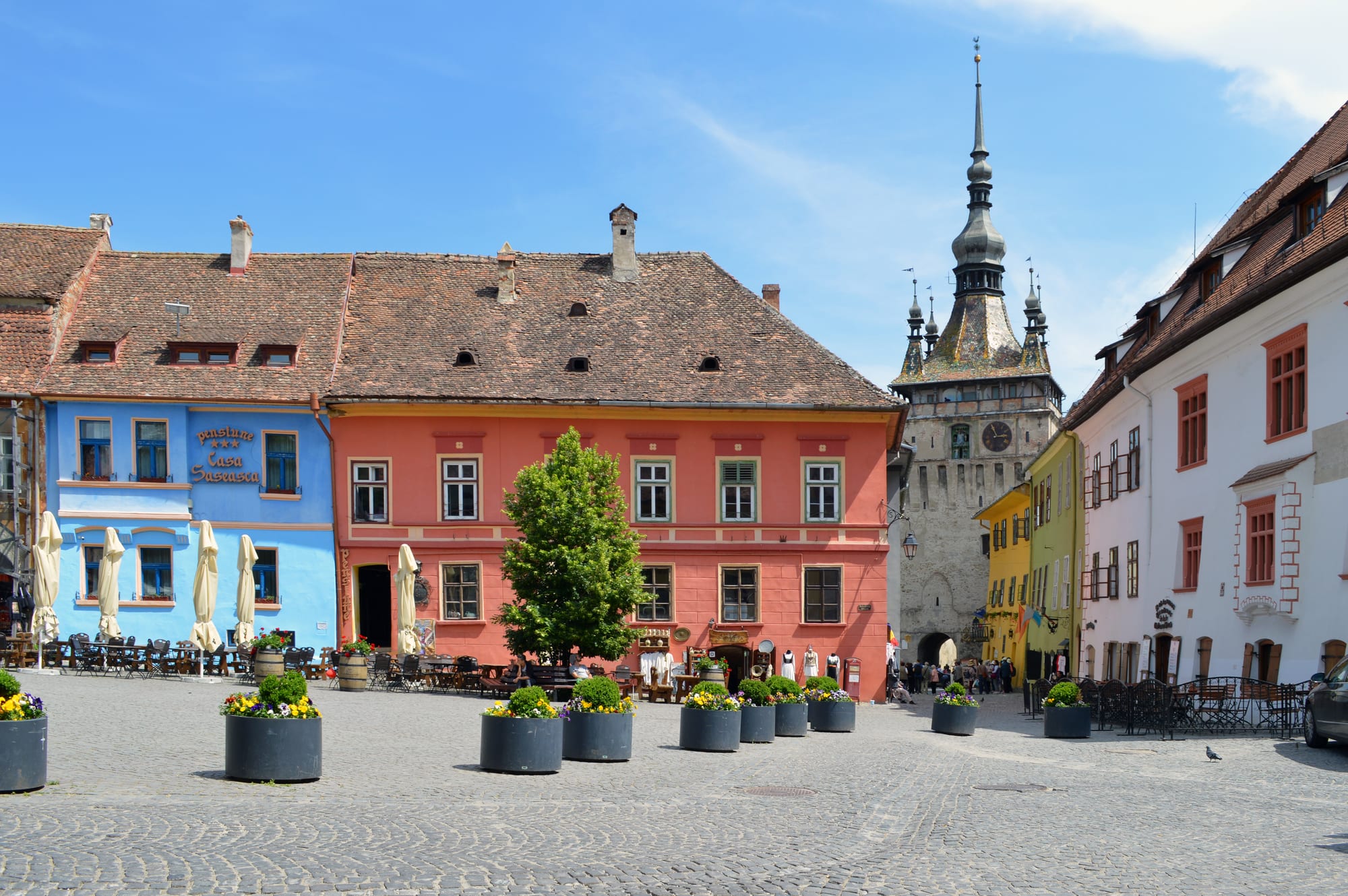
Blue, red and yellow houses with steep tiled roofs around a cobbled square, with the tall spired Clock Tower behind on a sunny day

Transylvania, Romania

Sighișoara

Piața Cetății, the main square of Sighișoara's citadel, with the Clock Tower behind. (DimiTalen / Wikimedia Commons · CC0)

A small town of about 24,000 people on the Târnava Mare river in Mureș County, whose hilltop citadel, built by Transylvanian Saxon craftsmen and guarded by guild towers, is one of the few fortified towns in Eastern Europe still lived in. The old town has been a UNESCO World Heritage Site since 1999, and the Clock Tower rises over the lower town in the valley.

Neighbourhoods

  • The citadel
    • First-time visitors
    • Historic district
    • Best for food

    The walled upper town on its hill, entered beneath the Clock Tower, with the square of Piața Cetății, narrow streets of craftsmen's houses, nine surviving guild towers and the Church on the Hill at the top. Many of its houses are at least 300 years old, and people still live in them.

    Open in Maps
  • The lower town
    • Local life
    • Close to public transport

    The town in the valley of the Târnava Mare below the citadel, with the shops and everyday life of the town; the railway and bus stations are about 1 km north of the old centre, across the river.

    Open in Maps

Things to do

The citadel

  • Clock Towerlandmark

    The 64-metre tower built to defend the main gate of the upper town, begun at the end of the 13th century and the landmark of the city; since 1898 it has held the history museum, and its balcony was the town's main lookout.

    Open in Maps
  • Church on the Hilllandmark

    The Lutheran Bergkirche on top of School Hill, built in stages between 1345 and 1525, the most important monument of religious architecture in Sighișoara and one of the great churches of Transylvania, beside the old cemetery.

    Open in Maps
  • Scholars' Stairslandmark

    A covered wooden stairway built in 1642 so that pupils and churchgoers could reach the school and church on the hill in winter; 174 of its original 300 steps remain.

    Open in Maps
  • Monastery Churchlandmark

    The Gothic church of a Dominican monastery founded in 1289 and demolished in 1888, standing next to the Clock Tower; it is said to have no bell because the Saxons thought the one on the hill was enough.

    Open in Maps
  • Venetian Houselandmark

    A 16th-century house named after the Venetian-style stone frames of its windows, the subject of a local love story about a mayor and a woman from Venice.

    Open in Maps
  • Vlad Dracul's Houselandmark

    The house in the citadel where Vlad Dracul, prince of Wallachia, lived in exile from 1431 to 1435, and where, according to the historian Radu Florescu, his son Vlad the Impaler was born.

    Open in Maps
  • Guild towerslandmark

    Nine towers survive on the walls, each once kept by a guild — among them the Tailors', Shoemakers', Tinsmiths', Butchers' and Ropemakers' towers.

    Open in Maps

Walks and short trips

  • Breite Oak Tree Reservepark

    A 74-hectare wood-pasture reserve on a plateau above the town, with more than 500 oaks aged between 200 and 800 years.

    Open in Maps
  • Albeștiattraction

    The village on the plain where the Battle of Segesvár was fought in 1849, with a monument to the Hungarian poet Sándor Petőfi, believed to have died in the battle; the Via Transilvanica trail passes through the commune.

    Open in Maps
  • Saschiz fortified churchlandmark

    A Lutheran fortified church built by the Saxon community in the village of Saschiz, one of the Transylvanian fortified churches on the UNESCO World Heritage list.

    Open in Maps
  • Biertan fortified churchlandmark

    The Lutheran fortified church of Biertan in Sibiu County, built by the Saxons inside rings of walls on a hill above the village and listed by UNESCO.

    Open in Maps
  • Viscri fortified churchlandmark

    The fortified Lutheran church of the village of Viscri in Brașov County, one of the Saxon churches on the UNESCO World Heritage list.

    Open in Maps

Seasonal events

  • Sighișoara Medieval Festivallast weekend of July

    Three days of theatre, music, crafts and costume in the citadel that draw around 30,000 visitors, doubling the town's population.

Eat and drink

Long-standing places and food districts in Sighișoara. Hours, ratings and directions come from your maps app, always current.

Food districts

  • Piața Cetățiineighborhood

    The citadel's main square and the streets around it, where restaurants and cafés set out terraces among the old merchants' houses.

    Open in Maps
  • The lower townneighborhood

    Restaurants and bakeries below the citadel, in the everyday part of the town.

    Open in Maps

Experience Sighișoara

History

From the mid-12th century the kings of Hungary invited German craftsmen and merchants, the Transylvanian Saxons, to settle and defend this frontier, and a Saxon settlement existed here by 1191. A document of 1280 calls the town Castrum Sex, the six-sided camp, after the shape of an earlier fort, and German and Hungarian forms of the name, Schäßburg and Segesvár, follow soon after. By 1337 it was a royal centre, and in 1367 it received urban status. The Romanian name, first recorded in 1435, comes from the Hungarian.

Guilds made the town rich: in the 16th and 17th centuries it had as many as 15 guilds and 20 crafts, and they built and kept the walls and towers of the citadel. Vlad Dracul, the exiled prince of Wallachia and father of Vlad the Impaler, lived here from 1431 to 1435 and minted coins in the town, and his son, according to the historian Radu Florescu, was born here. In 1631 George I Rákóczi was elected Prince of Transylvania in the town, but the 17th and 18th centuries brought occupation, fires and plague.

On 31 July 1849 the Hungarian revolutionary army of Józef Bem was defeated by Russian forces on the nearby plain of Albești, where the poet Sándor Petőfi is believed to have been killed. After the First World War the town passed with Transylvania to Romania. The citadel survived almost intact, and in 1999 it was listed by UNESCO. Between 2001 and 2003 a plan to build a Dracula theme park near the town was dropped after strong opposition from local groups, the media and politicians.

Culture & Customs

The town's identity is bound up with its citadel, one of the few fortified towns in Eastern and South-Eastern Europe that is still inhabited. Its towers carry the names of the guilds that defended them — tailors, shoemakers, tinsmiths, butchers, ropemakers, tanners, furriers, ironsmiths — and most of its 164 houses that are at least 300 years old are historic monuments. The Saxon heritage is visible in the Church on the Hill, the cemetery beside it and the Joseph Haltrich school.

Vlad the Impaler, the Wallachian prince who inspired the fictional Count Dracula, may have been born here, and his link with Sighișoara draws many visitors; the house where his father lived is marked in the citadel.

The year's high point is the Medieval Festival on the last weekend of July, when theatre, concerts, crafts and costumed parades fill the citadel and around 30,000 visitors come — about as many as the town's own population. The town also holds a blues festival and an interethnic festival of music and dance by Romania's minorities, and the Via Transilvanica long-distance trail passes through it. Sighișoara has long been mixed: Romanians, Hungarians, Roma and the remaining Saxons live side by side.

Daily Life

At the 2021 census Sighișoara had 23,927 inhabitants, down from about 28,100 in 2011. About two-thirds are Romanians, about an eighth Hungarians, with a smaller Roma community and a few Saxons. The town administers seven surrounding villages.

The citadel is both a monument and a neighbourhood: families still live in its houses, and its school, church and cemetery are in daily use, while many of its buildings also hold guesthouses, cafés and shops for visitors. Most residents live in the lower town and in the districts of flats and houses along the valley, where the shops, markets and schools are.

Tourism is an important part of the economy. Life follows the seasons: summer brings coach tours and the festival, while in winter the citadel's streets are almost empty. The population fell between the 2011 and 2021 censuses. Trains and buses from the stations north of the centre connect residents with Bucharest, Sibiu and Cluj-Napoca, and Târgu Mureș, the county seat, is about an hour away by bus.

Food

Sighișoara eats in the Transylvanian way, mixing Romanian, Hungarian and Saxon traditions. Ciorbă, the sour soup soured with lemon, vinegar, sauerkraut juice or borș, starts many meals, and sarmale, cabbage leaves rolled round minced meat and rice, are cooked in Transylvania with smoked pig's trotters or pork skin tucked between the rolls. Mămăligă, cornmeal mush, comes with stews and with telemea cheese and sour cream.

Pork dishes dominate the winter table: tochitură, pan-fried pork with sausages, cheese and fried egg served with mămăligă, and jumări, crisp pork cracklings. Kürtőskalács, the chimney cake of dough wound round a spit and rolled in sugar, is a Székely Hungarian speciality, and papanași are cheese doughnuts served with jam and sour cream.

Fruit brandy is poured as a welcome — țuică from plums and the stronger, double-distilled pălincă of Transylvania — and Transylvania's Târnave wine region is known for its white wines. Restaurants with terraces fill the citadel's square in summer, and simpler places in the lower town serve residents.

Planning tools

Budget

Sighișoara is small and cheaper than Brașov or Sibiu in general, but the citadel's guesthouses and restaurants charge tourist prices in summer, and rooms sell out and rise sharply around the Medieval Festival in July. The lower town and nearby village guesthouses cost less; a car for the Saxon villages is the main extra.

Daily Budget Midrange
USD 90–180 (citadel guesthouse, restaurant meals, museum tickets, a day with a hire car)
Daily Budget Shoestring
USD 35–60 (hostel or guesthouse, bakeries and simple restaurants, trains and buses)

Book well ahead for the Medieval Festival weekend at the end of July, when rooms sell out and prices jump.

Best Time to Visit

May to October, when the citadel and the surrounding villages are at their best; late spring and early autumn are quieter than high summer. The last weekend of July brings the Medieval Festival and the biggest crowds. Winter is cold and very quiet.

Suggested Number of Days

The citadel can be seen in a day, but a night or two lets visitors see it after the day-trippers leave. Three or four days allow time for the Saxon villages and their fortified churches with a car.

First Visit
1–2 days
With Surroundings
3–4 days

Transportation

The town is small enough to walk. Trains link Sighișoara with Bucharest, Sibiu and Târgu Mureș, and buses run to Târgu Mureș, Sibiu, Cluj-Napoca and Bucharest. The Saxon villages are best reached by car or on a tour, as public transport to them is sparse.

Train and bus times can be erratic; check them on the day, and use a taxi app or a booked taxi rather than a street taxi.

Airport & Station Connections

The nearest airport is Târgu Mureș, about 48 km away; Sibiu is about 90 km and Cluj-Napoca about 145 km. Trains run directly from Bucharest in about six hours, and the railway and bus stations stand side by side about 1 km north of the old centre.

Walkability

Excellent but steep: the citadel is compact, cobbled and closed to most traffic, with stairs and slopes between the lower and upper towns and up to the Church on the Hill. The stations are a short walk from the centre.

Safety

Romania is a safe country with low violent crime. Sighișoara is quiet; the main hazards are uneven cobbles and steep stairs, crowds during the festival, and busy two-lane roads with lorries and horse carts in the surrounding countryside.

Wear sturdy shoes on the citadel's cobbles, take care driving the village roads after dark, and never feed bears in the forests. Check current official travel advice before travelling.

Climate

A continental climate with warm summers and cold winters. In nearby Târgu Mureș the average annual temperature is about 8.6°C, summers are warm and fairly dry, and winter temperatures are often below freezing.

Summer
warm; in nearby Târgu Mureș June–August average 18–19°C, with peaks of up to 36°C
Winter
cold, often below 0°C in nearby Târgu Mureș

Local Customs

Romanian is the main language, and a sizeable Hungarian minority lives in the town; a small Saxon community remains. Younger people and tourist businesses often speak English. The churches in the citadel are places of worship as well as monuments.

Dress modestly in churches, and remember that the citadel is a lived-in neighbourhood: keep noise down at night and ask before photographing residents.

Common Payment Methods

Romania uses the leu (RON), not the euro. Cards and contactless payment are accepted in most restaurants and guesthouses; carry cash for small cafés, markets and village guesthouses.