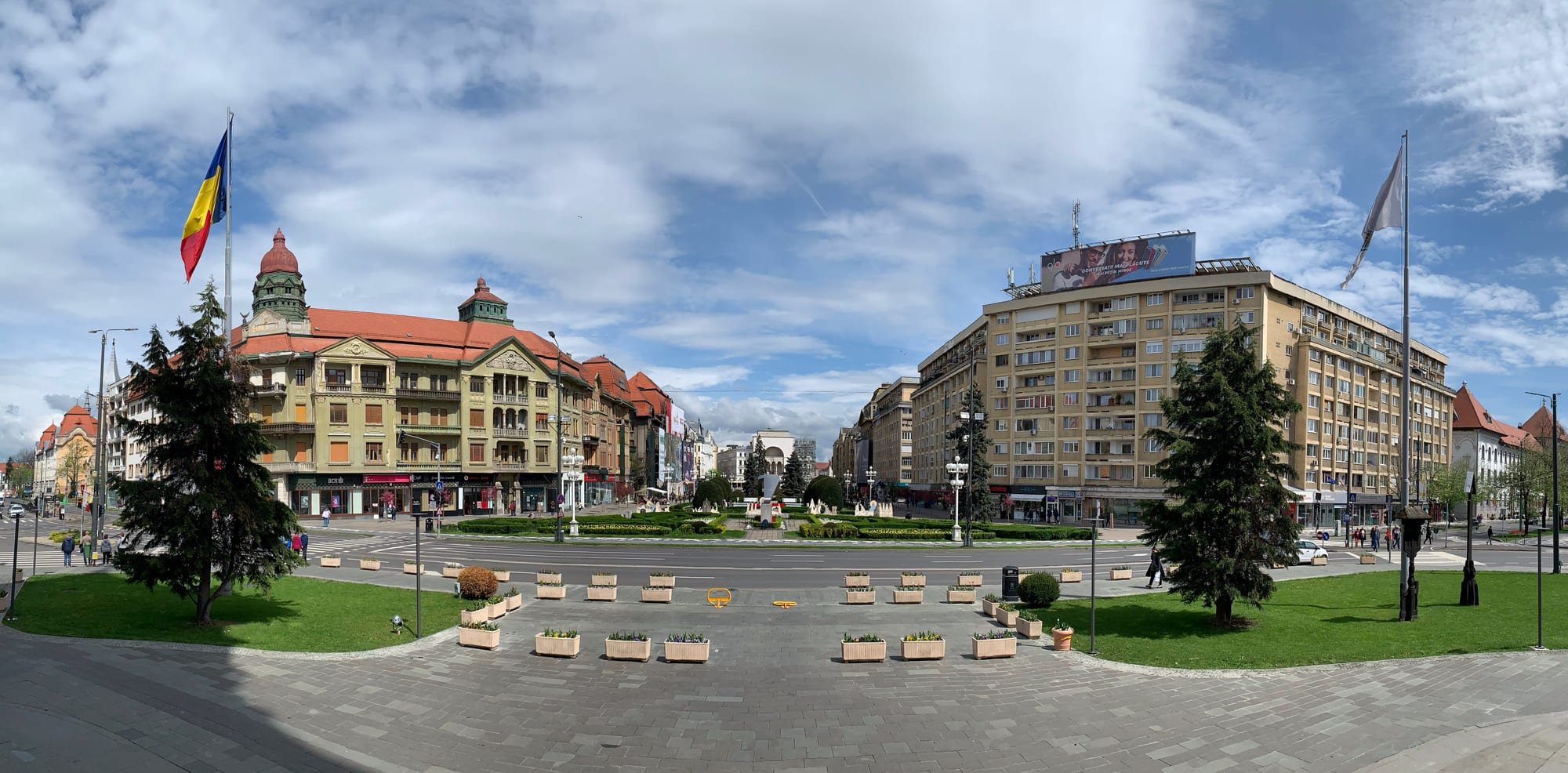
A wide paved square lined with ornate early 20th-century buildings and a modern block, with flags and trees under a cloudy blue sky

Romania

Banat

Victory Square in Timișoara, the city's central square and the scene of the 1989 protests. (Chainwit. / Wikimedia Commons · CC BY 4.0)

Romania's western corner, running from the flat, fertile plain around Timișoara and Arad south into the Banat Mountains and the Danube gorge — a Habsburg-shaped frontier land of Romanians, Swabians, Hungarians, Serbs and Czechs, where the 1989 revolution began, with limestone gorges and an old imperial spa.

Explore Banat

History

The Banat takes its name from a frontier province governed by a ban. In Roman times its southern mountains belonged to Dacia, and the springs of Băile Herculane were known as the Baths of Hercules. In the Middle Ages the region was part of Hungary, and King Charles I briefly kept his court at Timișoara (Temesvár) in the early 14th century. The Ottomans took the city in 1552 and held it as the seat of a province for more than 160 years.

In 1716 Prince Eugene of Savoy captured Timișoara for the Habsburgs, and the Banat was governed as a separate Habsburg province. The empire drained the marshes, dug the Bega canal and settled the plain with German-speaking Catholic colonists, the Danube Swabians, alongside Serbs, Hungarians, Slovaks, Czechs and Catholic Bulgarians, creating one of Europe's most mixed regions. Reșița's ironworks date from the 1770s, and Timișoara became, in 1884, the first city in mainland Europe to light its streets with electricity. Arad, on the Mureș, was a Hungarian stronghold in 1848–49, and the Austrians executed thirteen rebel generals there in October 1849.

After the First World War the Banat was divided between Romania, Yugoslavia and Hungary. Many Swabians were deported to Soviet labour camps in 1945 and to the Bărăgan plain in 1951, and most left for Germany in the late 20th century. In December 1989 protests in Timișoara in support of the Hungarian pastor László Tőkés turned into a mass uprising that spread to Bucharest and brought down Ceaușescu.

Culture & Customs

Banat people see themselves as more Western, more orderly and more tolerant than the rest of Romania, a self-image rooted in the Habsburg past and the region's mix of peoples. Their Romanian dialect is instantly recognisable, with softened consonants and Serbian and Hungarian words, and it features in popular humour. Timișoara still has Hungarian and German theatres, a Serbian Orthodox cathedral beside the Romanian one, and a synagogue, and villages in the mountains are home to Czech communities founded in the 19th century.

Religion is mixed: Romanian Orthodox and Greek Catholic, Roman Catholic among Hungarians, Swabians and Bulgarians, Serbian Orthodox, and Protestant churches. The Swabian heritage survives in Kirchweih, the church-dedication festival, now kept up by small communities and returning emigrants. The Nobel prize-winning writer Herta Müller grew up in a Swabian village in Timiș.

Music leans towards the Serbian and Hungarian with brass and fast dances.

Daily Life

Timișoara, with about 250,000 people, is one of Romania's largest and richest cities, with a technical university, software companies and foreign manufacturers of car parts and electronics; it was a European Capital of Culture in 2023. Arad, with about 145,000, has railway wagon works and other industry, while Reșița, Lugoj and Caransebeș are smaller towns hit by the decline of heavy industry.

The flat, fertile plain grows wheat, maize and sunflowers, and many former Swabian villages are now home to Romanians from other regions who moved in after the Germans left. The mountains of Caraș-Severin are thinly populated and among the poorest parts of the region.

Life in Timișoara revolves around the squares and the café terraces of Unirii and Victory squares, the parks along the Bega and the university. Commuting from the growing suburbs, the renovation of the old Secession buildings and a shortage of workers are the local concerns.

Food

Banat food mixes Romanian, Swabian, Hungarian and Serbian traditions. Paprika stews called papricaș, grilled meats in the Serbian style, smoked sausages, dumpling soups and cabbage dishes are common, and Swabian baking has left strudels and layered cream cakes in the pastry shops. Pită de Pecica, a large round wheat loaf baked directly on the oven hearth in the Arad county town of Pecica, has been put forward for EU protected status.

The Timișoreana brewery traces its history to 1718, one of the oldest in the country, and beer is taken seriously in Timișoara's pubs and gardens. Fruit brandy, often apricot or plum, is made in the villages.

The region has two notable wine areas. Recaș, east of Timișoara, is home to one of Romania's largest and best-known wineries, and the Miniș-Măderat hills near Arad are known for red wines from the old Cadarcă grape.

Attractions & Natural Wonders

Timișoara's centre is organised around three squares. Victory Square runs from the National Theatre and Opera to the Orthodox Metropolitan Cathedral, lined with early 20th-century Secession palaces; Union Square has the Baroque Roman Catholic and Serbian Orthodox cathedrals; and Liberty Square links the two. The Bega canal, the rose garden and the Banat Village Museum add green space. Arad has its neo-Renaissance town hall, the Cultural Palace, the Vauban-style fortress and the Reconciliation Park memorial to the thirteen generals.

The mountains lie to the south-east. The Cheile Nerei–Beușnița National Park protects the Nera gorges, where a path through rock tunnels follows the river, the turquoise Ochiul Bei lake, the Beușnița waterfall and the Devil's Lake; Sasca Montană is the usual starting point. Nearby is the Bigăr waterfall, whose moss-covered rock partly collapsed in 2021. The Anina–Oravița railway winds through the Banat Mountains to Oravița, whose theatre, opened in 1817, is the oldest in the Banat, and the Semenic plateau has forests and a small ski area.

Băile Herculane sits in the Cerna valley, with ornate 19th-century bathhouses and hotels, many in decay, and trails into the Domogled–Valea Cernei National Park. Along the Danube, the road east from Moldova Nouă follows the upper part of the gorge towards the Iron Gates.

Cities in Banat

Planning basics

Budget

Timișoara is one of Romania's more expensive cities, with prices close to those of Cluj, but still moderate by Western standards. Arad, Lugoj and Reșița are cheaper, and the guesthouses in the Nera and Cerna valleys are simple and inexpensive. Băile Herculane ranges from tired state-era hotels to newer spa hotels.

Daily Budget Midrange
USD 85–170 (mid-range city or spa hotel, restaurant meals, museum entries, a hire car for the mountains)
Daily Budget Shoestring
USD 35–55 (hostel or guesthouse, local restaurants, trains and buses)

Base mountain trips in Sasca Montană or the Cerna valley rather than Timișoara, as the gorges are several hours' drive from the city.

Safety

Banat is safe for visitors. In the mountains the risks are flash floods in the narrow gorges after heavy rain, slippery limestone paths, snakes including the nose-horned viper on warm rocks, and poor mobile coverage. Parts of Băile Herculane's historic buildings are derelict and unsafe to enter.

Keep to marked paths in the gorges, avoid the river after storms, and stay out of Herculane's ruined bathhouses. Check current official travel advice before travelling.

Climate

The plain around Timișoara and Arad has hot summers and relatively mild winters, with some Mediterranean influence from the south-west. The Banat Mountains and the Danube gorge are greener and wetter, and the Nera and Cerna valleys are sheltered and warm, while the Semenic mountains are snowy in winter.

Summer
hot on the plain, 28–35°C; warm and humid in the gorges
Winter
around −3 to 5°C on the plain, often foggy; snow on the Semenic

Transportation

Timișoara has the region's main airport and is linked by motorway to Arad and east towards Deva, with the Hungarian border close by. The railway from Timișoara to Bucharest passes Caransebeș and Băile Herculane. Buses and minibuses serve the mountain towns, but the Nera gorges, Bigăr and the Danube road are best reached by car.

Walk the Nera gorge path with a torch for the tunnels, and check whether the river crossings are passable after rain.

Best Time to Visit

April to June and September to October are best for Timișoara, Arad and hiking the Nera and Cerna gorges, when the forests are green or turning. July and August suit swimming in the Nera and the lakes, though the plain is hot. Winter brings skiing on the Semenic and Timișoara's Christmas market.