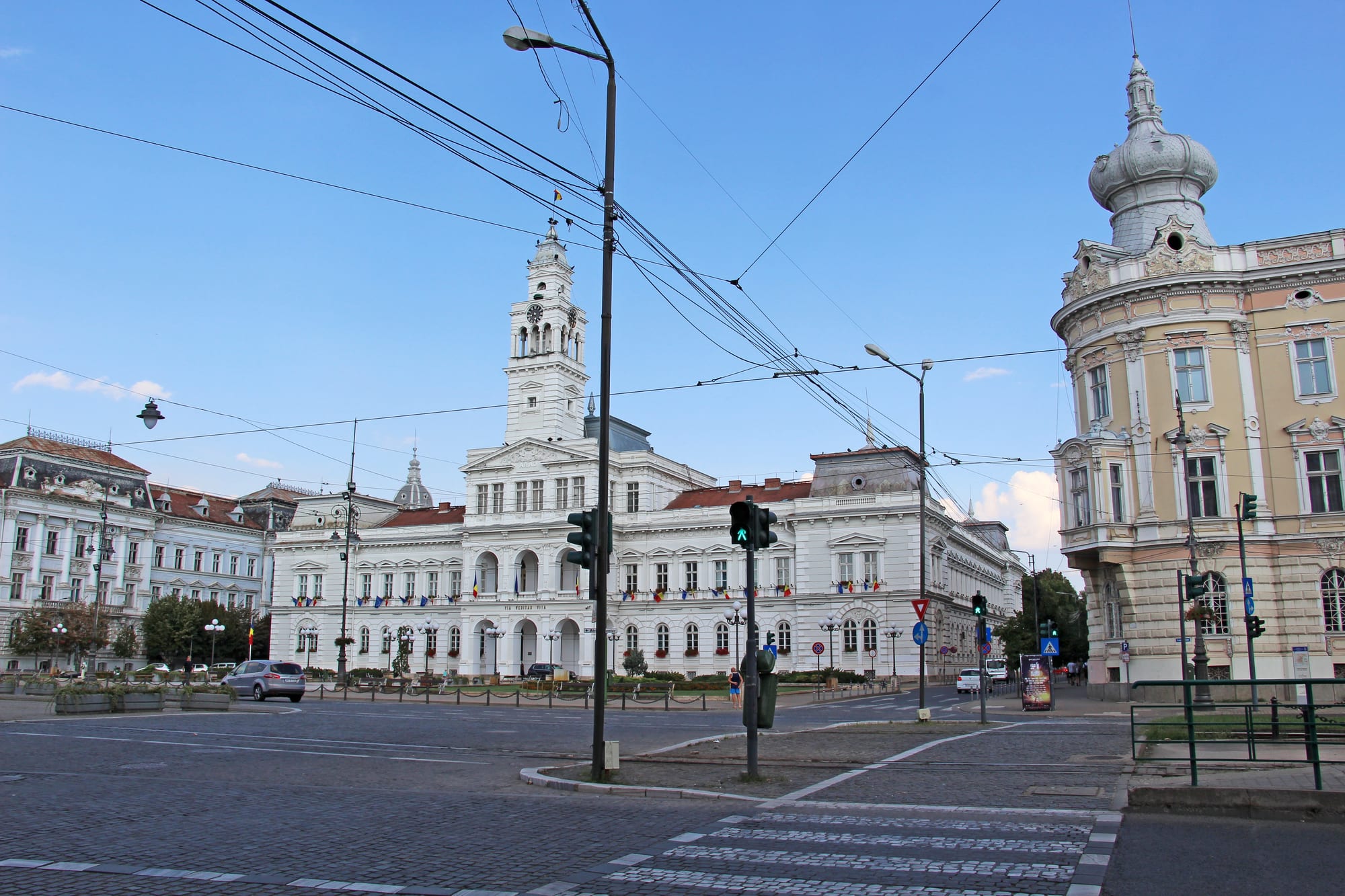
A long white palace with a tall central clock tower beside a cobbled street junction and an ornate domed corner building

Banat, Romania

Arad

The Administrative Palace on Revoluției Boulevard, Arad's city hall since the 1870s. (Fred Romero from Paris, France / Wikimedia Commons · CC BY 2.0)

The capital of Arad County, on the Mureș River at the meeting of Crișana and the Banat, close to the Hungarian border. A Habsburg frontier fortress town where thirteen Hungarian generals were executed in 1849, it grew rich on railway wagons and cars, and today has a long boulevard of 19th-century palaces, a riverside beach and vineyards nearby.

Neighbourhoods

  • The centre and Revoluției Boulevard
    • First-time visitors
    • Architecture
    • Best for food

    The main boulevard, home to the Administrative Palace and the Red Church, with palaces of the late 19th and early 20th centuries in the streets around. Most of the sights, cafés, restaurants and places to stay are a short walk from the city hall.

    Open in Maps
  • The Mureș riverfront
    • Parks
    • Swimming
    • Walks

    Just east of the Cultural Palace the river has a promenade and a children's playground, and on its banks the Neptun lido is one of the largest riverside bathing places in Europe. The iron Trajan Bridge of 1910–13 carries road and tram traffic across the water.

    Open in Maps
  • Aradu Nou
    • Quiet and residential
    • History

    New Arad, on the south bank across the Trajan Bridge, grew from the works the Ottomans built to besiege the fortress, and German settlers from Franconia arrived in 1724. A Roman fort once stood here; today it is a largely residential district.

    Open in Maps
  • The fortress area
    • History

    The star-shaped Habsburg fortress stands on the east side of the river. It is still a military area, so most of it, including the ruins of its Franciscan church, is closed to visitors.

    Open in Maps

Things to do

Landmarks and architecture

  • Administrative Palacelandmark

    The city hall and county prefecture, built in 1872–76 in a style drawn from the Flemish Renaissance, with a clock tower over Revoluției Boulevard whose Swiss clock dates from its inauguration in 1877.

    Open in Maps
  • Ioan Slavici Classical Theatrelandmark

    A neoclassical theatre completed in 1874 to designs by Anton Czigler, named after the writer Ioan Slavici.

    Open in Maps
  • Avram Iancu Squarelandmark

    The main square, with a central garden, a monument to the Unknown Soldier, the theatre to the north and the Art Nouveau Nádasdy House to the west.

    Open in Maps
  • Old Theatrelandmark

    The theatre built by Jacob Hirschl in 1817, considered the oldest stone theatre in Romania.

    Open in Maps
  • House with the Locked Loglandmark

    Casa cu lacăt, built in 1815 by the Viennese merchant Iosif Winkler and named after its metal-clad log, modelled on Vienna's Stock-im-Eisen, on which travelling journeymen left the mark of their guild; after a theft in 1994 the log was moved to the art museum.

    Open in Maps
  • Trajan Bridgelandmark

    An iron bridge over the Mureș from 1910–13, carrying road and tramway, restored for its centenary in 2010.

    Open in Maps
  • Fortress of Aradlandmark

    The star-shaped fortress built in the 18th century on Maria Theresa's orders, outside whose walls the 13 generals were executed in 1849; it is the headquarters of an army battalion and closed to the public.

    Open in Maps

Churches and synagogue

  • Red Churchlandmark

    The Lutheran church on Revoluției Boulevard, built in 1906 in Gothic Revival style.

    Open in Maps
  • Holy Trinity Cathedrallandmark

    The large Orthodox cathedral of the Archdiocese of Arad, built between 1991 and 2006.

    Open in Maps
  • St Anthony of Padua Churchlandmark

    A Roman Catholic church built in 1904 in neo-Renaissance style by the Minorite friars.

    Open in Maps
  • Serbian Church of Saints Peter and Paullandmark

    A Serbian Orthodox church built in 1698–1702 in early Baroque style.

    Open in Maps
  • Synagoguelandmark

    The Neolog synagogue, built in 1834 in a style drawing on Greek and Tuscan models.

    Open in Maps

Museums and memorials

  • Arad Museum Complexmuseum

    History, archaeology, fine art and natural sciences in the Cultural Palace of 1913, with finds from the Dacian and Migration periods and relics of the 1848–49 revolution.

    Open in Maps
  • Reconciliation Parkpark

    A memorial park to the thirteen Hungarian generals executed in Arad in October 1849.

    Open in Maps

Rivers and green space

  • Neptun Lidopark

    Ștrandul Neptun, a huge riverside bathing complex on the Mureș that draws millions of visitors a year.

    Open in Maps
  • Mureș Floodplain Natural Parkpark

    A protected floodplain of 17,455 hectares, set aside in 2005, that follows the Mureș from the city west to the Hungarian border; a Ramsar wetland rich in birds.

    Open in Maps

Short trips from the city

  • Pecicaattraction

    A town west of Arad on the site of the Dacian fortress of Ziridava, today an important archaeological site.

    Open in Maps
  • Miniș-Măderat vineyardsattraction

    The wine hills east of the city, home of Cadarcă, a traditional grape first made into red wine here in 1744.

    Open in Maps

Eat and drink

Long-standing places and food districts in Arad. Hours, ratings and directions come from your maps app, always current.

Arad eating out

  • Revoluției Boulevardneighborhood

    Strings of cafés, restaurants and bars line the main boulevard just south of the city hall, the centre of the city's eating out.

    Open in Maps
  • Mureș riversideneighborhood

    The promenade and the Neptun lido area by the river, busiest on summer days and evenings.

    Open in Maps
  • Miniș-Măderat wine cellarsneighborhood

    Wineries in the hills east of the city, known for Cadarcă reds.

    Open in Maps

Experience Arad

History

People have lived on the banks of the Mureș for thousands of years, and in the 2nd century the Romans built a fort where the district of Aradul Nou now stands. The town was first recorded as Orod around 1078–81. Ottoman forces took the region in 1551 and built the city's first fortress in 1553–55; Habsburg troops captured it in 1687, and after the Peace of Karlowitz in 1699 the Mureș became the frontier between the two empires. In 1720 the town had 177 Romanian, 162 Serbian and 35 Hungarian families, and German settlers from Franconia founded Neu Arad on the south bank in 1724.

Between 1763 and 1783 Maria Theresa had a new star-shaped fortress built. In 1849 it fell to the Hungarian revolutionaries, who made Arad their headquarters; Lajos Kossuth issued his proclamation here before handing power to Artúr Görgey. After the surrender at Világos, the Austrians executed thirteen rebel generals at the fortress on 6 October 1849, and Hungarians have called Arad their Golgotha ever since. The 19th century also made Arad a centre of learning: the Preparandia, founded in 1812, was the first Romanian teacher training school in Transylvania.

Industry followed. The Weitzer factory began building railway wagons in 1892, MARTA made the first cars in Hungary, and in 1921 the two merged as Astra Arad, which by the 1980s was Europe's largest maker of freight wagons. In 1910 nearly three-quarters of the 63,000 inhabitants were Hungarian; during the First World War some 4,000 Serb internees died in the fortress, and in 1920 the city became part of Romania.

Culture & Customs

Arad's culture shows its border-town past. Hungarian heritage is visible in the memorials of 1848–49 — the Statue of Liberty of 1890 honours the heroes of the Hungarian revolutionary army and the 13 Martyrs — while an arch of triumph of 2004 honours the Romanians who fought on the other side, and Reconciliation Park remembers the executed generals. Romanian, Serbian, Hungarian, German and Jewish communities have all left churches, schools and a synagogue, and Hungarian- and German-language high schools still teach today.

The city has a long musical and theatrical tradition. It hosted one of the first music conservatories in Europe; Franz Liszt performed here in 1846, and Béla Bartók in 1924; and the young poet Mihai Eminescu came as a prompter with a touring theatre company in 1868. The Hirschl theatre of 1817 is considered the oldest stone theatre in Romania, the Ioan Slavici Classical Theatre hosts an annual classical theatre festival, and the philharmonic plays in the Cultural Palace. There is also an international festival of underground theatre.

Sport has deep roots too: the first official football match was played in 1899, UTA Arad has won six Romanian football championships, and Astra Arad plays first-division water polo.

Daily Life

Arad had about 145,000 people at the 2021 census, the third largest city in western Romania after Timișoara and Oradea. Like many Romanian cities it has lost residents to bigger cities and to the suburbs, where nearby villages are growing fast.

Railway wagons remain one of the main industries. Astra Arad was split in the 1990s into separate companies making freight wagons, passenger cars and buses, and since 2016 freight wagons have been built by the Greenbrier-Astra Rail joint venture; the city is also a transport hub on the road and railway between Budapest and Bucharest, and its airport has the largest cargo terminal in western Romania. The city has two universities, the private Vasile Goldiș Western University and the public Aurel Vlaicu University.

Life centres on Revoluției Boulevard, where trams, cafés and shops meet, and in summer on the Mureș, where the Neptun lido draws millions of visits a year. The city has two market areas for fruit and basic food, and its nearness to Hungary means some residents cross the border to shop.

Food

Arad's food is the food of the Banat and Crișana, mixing Romanian, Hungarian, Swabian and Serbian traditions. Mămăligă, the maize-flour porridge eaten with cheese and sour cream, and sarmale, cabbage leaves rolled round minced meat and rice, sit beside Hungarian goulash, the paprika-seasoned meat-and-vegetable dish, and grilled mici, rolls of spiced minced beef, lamb and pork often served with mustard. Ciorbă, the family of sour soups, starts many meals, and tochitură, cubes of pork cooked slowly in their own fat and served with mămăligă and eggs, is another traditional Romanian dish.

Sweet breads such as cozonac, filled with walnuts or poppy seeds, appear at holidays, and papanași, a fresh-cheese dessert topped with sour cream and fruit preserve, are a traditional sweet.

Wine comes from the Miniș-Măderat hills east of the city, whose traditional Cadarcă grape has made red wine there since at least 1744, while the Mustoasă de Măderat grape gives fresh white wines. In town, Revoluției Boulevard holds many of the cafés, bars and restaurants.

Planning tools

Budget

Arad has moderately priced hotels, guesthouses and local restaurants, though shopping in the city centre is relatively expensive. Most of the sights are free to see from the street.

Daily Budget Midrange
USD 80–160 (central hotel, restaurant meals, museum entries, a hire car for the vineyards)
Daily Budget Shoestring
USD 35–55 (guesthouse or budget hotel, local restaurants, trams and buses)

A car or a day tour opens up the vineyards, monasteries and fortresses east of the city, which are hard to reach by public transport.

Best Time to Visit

April to June and September to October are the most comfortable months for walking the boulevard and the riverside. July and August are hot, when the Neptun lido and the Mureș banks fill with swimmers.

Suggested Number of Days

One or two days are enough for the city itself. Allow three to include the wine hills and the floodplain park outside town, which are easiest to reach with a car.

First Visit
1–2 days
With Surroundings
3 days

Transportation

Arad has an extensive tram network and several bus lines covering most neighbourhoods and the suburbs. Taxis and car hire are easy to find.

Use a hire car or a taxi app to reach the vineyards and monasteries outside the city.

Airport & Station Connections

Arad International Airport lies 4 km west of the city but has few scheduled flights; most air travellers use Timișoara's airport to the south. The main railway station is about 2 km north of the centre, with direct trains to Budapest in about four and a half hours and regular trains and buses to Timișoara. The A1 motorway passes the city.

Walkability

The centre is flat and compact. Most sights, cafés and places to stay are within a short walk of the city hall, the riverside promenade is just beyond the Cultural Palace, and the railway and bus stations are a tram ride north along the boulevard.

Safety

Romania is a safe country with low violent crime. Arad is an orderly provincial city where crime against visitors is uncommon; the usual risks are petty theft and traffic, and swimmers should take care in the Mureș.

Swim only at supervised places on the river, keep an eye on bags in busy spots, and drive defensively on two-lane roads outside the city. Check current official travel advice before travelling.

Climate

Continental-moderate, with slight Mediterranean influences. Summers are warm to hot and winters cold, with spring and autumn the mildest seasons.

Summer
warm — the summer average is about 21°C
Winter
cold — the winter average is about −1°C

Local Customs

Arad has long been a city of several peoples, and Hungarian- and German-language high schools, Serbian and Orthodox churches and a synagogue still reflect that. The 1849 executions are remembered by Hungarians, who call Arad the "Hungarian Golgotha".

Dress modestly in churches, and treat the memorials to 1848–49, which carry different meanings for Romanians and Hungarians, with respect.

Common Payment Methods

The currency is the Romanian leu (RON). Cards are widely accepted, and there are ATMs and exchange offices in the centre and by the railway station. Carry some cash for markets and small cafés.