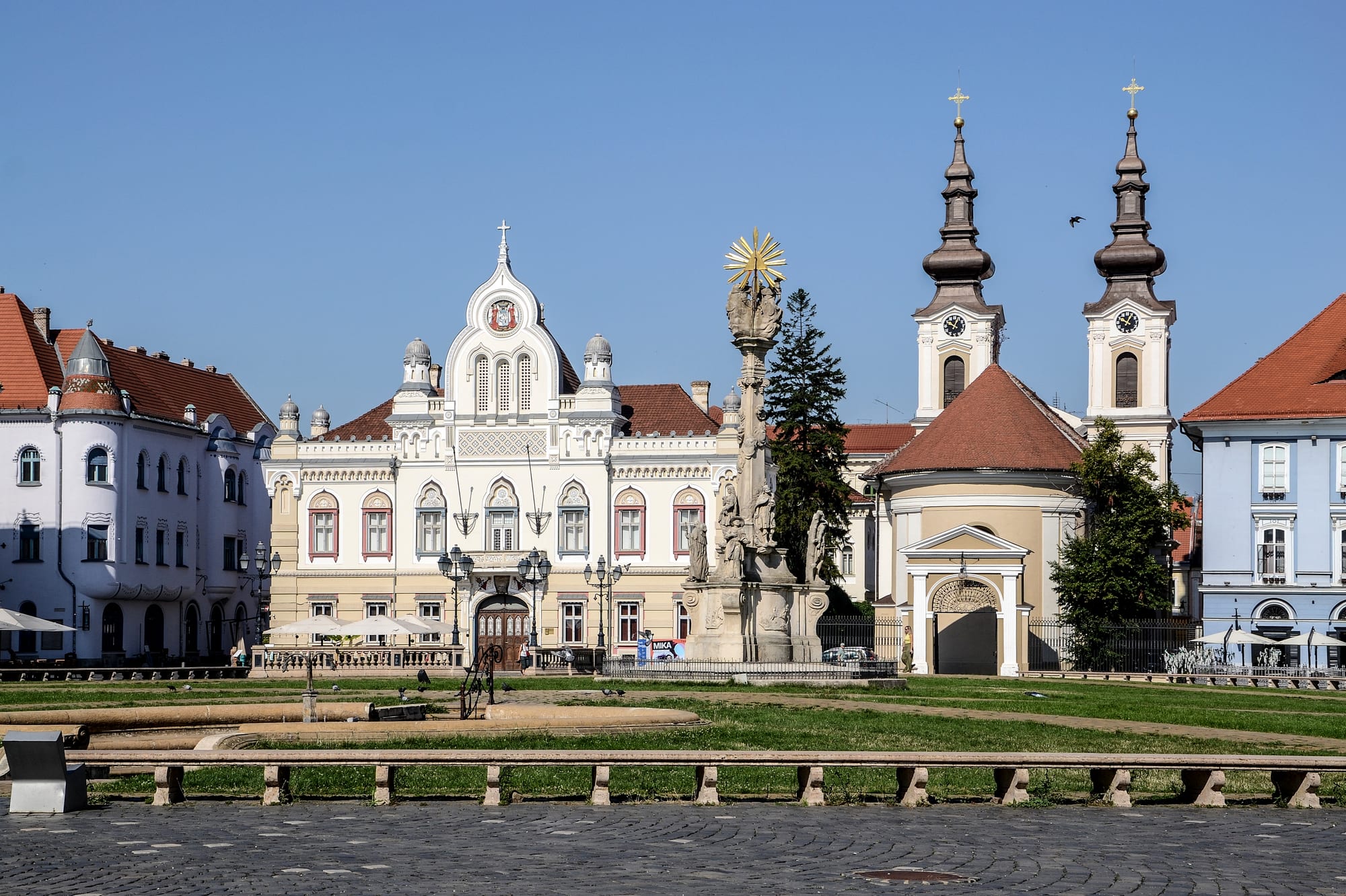
A Baroque square with a stone plague column, a white palace and a twin-towered church under a clear blue sky

Banat, Romania

Timișoara

Union Square in Timișoara, with the Holy Trinity column, the Serbian Orthodox Episcopal Palace and the Serbian Orthodox Cathedral. (Pudelek / Wikimedia Commons · CC BY-SA 4.0)

The informal capital of the Banat, on the Bega Canal in Romania's far west. Ottoman for 164 years and then a Habsburg fortress city settled by Swabians, Serbs and Hungarians, it was the first European city with electric street lighting and the place where the 1989 revolution began. Today it is a university and technology city of baroque squares, parks and café terraces.

Neighbourhoods

  • Cetate
    • First-time visitors
    • Historic district
    • Cafés

    The old centre, built on the site of the Habsburg fortress and the heart of the city. Its three linked squares — Baroque Union Square, Liberty Square and Victory Square — hold the cathedrals, the opera, the museums and most of the café terraces.

    Open in Maps
  • Fabric
    • Historic district
    • Architecture
    • Beer

    One of the oldest districts, east of the centre, named after the workshops and manufactories set up here in the 18th century, where Swabian settlers developed their crafts. The buildings around its main squares, Trajan Square and Romans' Square, are protected urban sites, and the district is bounded by the Neptune Baths, the waterworks and the Timișoreana brewery.

    Open in Maps
  • Iosefin
    • Architecture
    • Close to public transport

    A historic district to the west, founded as a village of German settlers in the 18th century. Most of its buildings date from around 1900, many in Art Nouveau and Secession styles, and the city's first railway station was built just north of it in 1857.

    Open in Maps
  • Elisabetin
    • Quiet and residential
    • Parks
    • Architecture

    A residential district that first grew up between 1750 and 1770 south of the fortress esplanade, known for its large reserve of 1900s-style architecture and its many parks. Small squares such as Pleven Square are ringed by Art Nouveau houses.

    Open in Maps
  • Along the Bega
    • Parks
    • Walks and cycling
    • Nightlife

    The canal that runs through the city is lined with parks, footpaths and a cycle path towards Serbia. Roses Park lies just north of the water, and in summer bars and terraces open along the water.

    Open in Maps

Things to do

Squares and landmarks

  • Union Squarelandmark

    The oldest square in the city and its most important Baroque ensemble, with the Roman Catholic and Serbian Orthodox cathedrals, the Baroque Palace and the Plague Column.

    Open in Maps
  • Victory Squarelandmark

    The central square between the opera and the Orthodox cathedral, lined with early 20th-century palaces, where Timișoara was declared the first city free of communism on 20 December 1989.

    Open in Maps
  • Metropolitan Cathedrallandmark

    The Orthodox cathedral at the end of Victory Square, with eleven towers; the central one, 90.5 m high, makes it the second tallest church in Romania.

    Open in Maps
  • St George Cathedrallandmark

    The Roman Catholic cathedral on Union Square, known locally as the Dome, the second largest Baroque religious building in south-east Europe after the cathedral of Oradea.

    Open in Maps
  • Serbian Orthodox Cathedrallandmark

    The cathedral of the city's Serbian community on Union Square, beside the Serbian Orthodox Bishop's Palace and the House of the Serb Community.

    Open in Maps
  • Theresia Bastionlandmark

    The largest surviving section of the Habsburg fortress walls, named after Maria Theresa and covering about 1.7 hectares of the centre.

    Open in Maps
  • Cetate Synagoguelandmark

    A Neolog synagogue designed by Carl Schumann in an eclectic style; closed in 1985 and used as a concert hall, it reopened as a synagogue and visitor attraction in 2022.

    Open in Maps

Museums

  • Huniade Castlemuseum

    The oldest building in the city, built in 1443–47 by John Hunyadi over an older royal castle and home since 1947 of the National Museum of Banat, founded in 1877.

    Open in Maps
  • Art Museummuseum

    The city's art museum, housed in the Late Baroque palace on the south side of Union Square, designed after the Palais Kinsky in Vienna.

    Open in Maps
  • Revolution Memorialmuseum

    A memorial with written, audio and video records of the days of December 1989 when the uprising that overthrew the communist regime began in Timișoara.

    Open in Maps
  • Banat Village Museummuseum

    An open-air ethnographic museum of 17 hectares at the edge of the Green Forest, laid out as a traditional Banat village with farmhouses of the region's different peoples.

    Open in Maps
  • Corneliu Miklosi Public Transport Museummuseum

    The museum of the city's public transport company.

    Open in Maps

Parks and the Bega

  • Roses Parkpark

    An urban park north of the Bega, one of the city's landmarks and part of the reason for the nickname 'City of Roses'.

    Open in Maps
  • Bega Canaltrail

    The first navigable canal built on the territory of present-day Romania, begun in 1728, whose banks carry footpaths and a cycle path that continues towards the Serbian border.

    Open in Maps
  • Green Forestpark

    Pădurea Verde, a forest of about 724 hectares within the city limits, laid out in regular squares and home to the Banat Village Museum.

    Open in Maps

Music, theatre and nights out

  • National Theatre and Operaattraction

    The Palace of Culture on Victory Square, built in 1871–75 to plans by Fellner and Helmer, houses the Romanian National Opera and three state theatres playing in Romanian, German and Hungarian.

    Open in Maps

Short trips from the city

  • Bazoș Dendrological Parkpark

    An arboretum about 20 km south-east of the city, protected since 1994, whose first trees came from the Harvard University nursery in 1909.

    Open in Maps
  • Buziașattraction

    A spa town about 30 km from the city, known to the Romans as Ahibis and valued for its healing mineral waters.

    Open in Maps

Seasonal events

  • Easter Fairspring, around Easter

    A seasonal fair held in Victory Square for the Easter holidays.

  • Christmas FairDecember

    The Christmas market held in Victory Square over the festive season.

Eat and drink

Long-standing places and food districts in Timișoara. Hours, ratings and directions come from your maps app, always current.

Squares and terraces

  • Union Square caféscafe

    Terraces and cafés around the Baroque square, the classic place for coffee in the old centre.

    Open in Maps
  • Victory Square terracescafe

    Sidewalk cafés and shops along the square between the opera and the cathedral.

    Open in Maps

Beer and the riverside

  • Fabric and the Timișoreana breweryneighborhood

    The old industrial district beside the brewery that makes Timișoreana beer, with a beer restaurant near the factory known for grilled meat and cold local beer.

    Open in Maps
  • Bega riverside barsneighborhood

    In summer, clubs and bars set up terraces along the canal banks, a favourite place for evenings out.

    Open in Maps

Experience Timișoara

History

Timișoara grew up in the marshes where the Timiș and Bega rivers part. From 1316 to 1323 King Charles I of Hungary made it his royal seat, and by the 15th century it was a frontier fortress against the Ottomans: John Hunyadi rebuilt its castle in 1443–47. In 1552 an Ottoman army took the city, and for 164 years it was the capital of an Ottoman province, with mosques, hammams and bazaars and a largely Muslim population.

In 1716 Prince Eugene of Savoy captured it for the Habsburgs after a 48-day siege. Vienna rebuilt the fortress, canalised the Bega from 1728 and brought in German Catholic colonists, the Banat Swabians, who settled especially in Fabric. The city became a laboratory of modernity: it was the first in the Habsburg monarchy with street lighting, in 1760, horse-drawn trams ran from 1869, and in 1884 it became the first European city lit by electric street lamps. The walls came down from 1899, and Art Nouveau buildings rose in the centre and in Iosefin and Elisabetin.

After a Serbian occupation in 1918–19 the city came under Romanian administration and grew rapidly as an industrial and university centre; its population tripled between 1948 and 1992. In December 1989 protests in support of the pastor László Tőkés became a mass uprising; after days of bloodshed, Timișoara was declared the first city free of communism on 20 December, and the revolution spread to Bucharest. In 2016 it was Romania's first Youth Capital, and in 2023 a European Capital of Culture.

Culture & Customs

Timișoara is proud of its mix of peoples, and nicknames such as "Little Vienna" reflect its Habsburg look. It is the only city in Europe with state theatres in three languages — Romanian, German and Hungarian — all housed with the national opera in the Palace of Culture on Victory Square, and a Serbian-language theatre has worked within the puppet theatre since 2019. The city has around 80 churches, among them Orthodox, Roman Catholic and Serbian Orthodox cathedrals, and two synagogues still hold regular services.

The calendar is crowded with festivals of music, film and theatre, from JazzTM and the Opera and Operetta Festival in Victory Square to student events; StudentFest is billed as the largest international student art and culture festival in south-east Europe.

The 1989 revolution is a central part of local identity: Victory Square, where the city was proclaimed free of communism, and the Revolution Memorial keep its memory. Locals also take pride in the city's 36 parks and green spaces; Roses Park helped earn it the nickname "City of Roses".

Daily Life

Timișoara had about 251,000 people at the 2021 census, making it Romania's fifth largest city, though local authorities argue the true figure is well over 300,000; around 400,000 live in the metropolitan area. Almost half the residents were born elsewhere, drawn by work and study, and the four public universities and two private ones have about 40,000 students.

The economy boomed after 2000 on foreign investment. Car-parts and electronics manufacturers such as Continental, Dräxlmaier and Flex run large plants, and technology companies including Nokia, Microsoft and Bitdefender have offices here, making the city one of Romania's main IT hubs. Housing has boomed too, with new high-rise estates and suburbs alongside the prefabricated apartment districts built between 1974 and 1988.

People live in the old districts around the centre and in the large estates beyond, and get about by tram, trolleybus, bicycle and car. Evenings centre on the terraces of Union and Victory squares and the banks of the Bega, and in 2026 the city was named Romania's destination of the year.

Food

Timișoara's cooking has been shaped above all by Austro-Hungarian traditions, with Greek, Italian, Turkish and French influences, and events such as Banat Brunch celebrate the regional kitchen. Sauces are often thickened with rântaș, a flour-based roux, and dishes are generously seasoned with paprika, thyme, rosemary, cumin and pepper.

Typical dishes include fish in brine, plachie, drob, soups and broths, sarmale — cabbage leaves rolled round minced meat and rice — schnitzel, and a whole repertoire of pork products: sausages, caltaboș, ham, slănină cured fat and jumări cracklings. Fresh cheeses such as caș, telemea and urdă are everywhere, and desserts include gomboți, crempita and cozonac, the sweet holiday bread often filled with walnuts or poppy seed. Goulash, paprikash, burek, lángos and dobos torte also have their place on the city's tables.

Beer is taken seriously: the Timișoreana brewery in Fabric, now owned by Ursus Breweries, traces its history to 1718. Recaș, east of the city, is best known for the wine of its surrounding hills.

Planning tools

Budget

Timișoara is moderately priced by Western standards. Rooms are the main cost; cafés, beer and Banat home cooking are good value, and the parks, squares and canal walks are free.

Daily Budget Midrange
USD 85–170 (central hotel, restaurant meals, museum entries, opera or theatre tickets, taxis by app)
Daily Budget Shoestring
USD 35–60 (hostel or guesthouse, local restaurants, trams and trolleybuses)

Use the trams and the canal paths rather than taxis in the centre, where most sights are within walking distance.

Best Time to Visit

April to June and September to October are the most comfortable months, when the parks are green and café terraces fill the squares. July and August are hot, with about 45 days a year above 30°C. Winter is cold, brightened by the Christmas fair in Victory Square.

Suggested Number of Days

Two or three days cover the historic districts, museums and parks at an easy pace. Allow four or five to include the spa towns and arboretum nearby or an evening at the opera or theatre; trips to the Banat mountains need longer.

First Visit
2–3 days
With Surroundings
4–5 days

Transportation

The STPT network has nine tram lines, eight trolleybus lines and 31 bus lines, and water buses run on the Bega Canal. There are more than 100 km of bike lanes, including the canal cycle path towards Serbia. Taxis are plentiful, and ride-hailing apps such as Uber and Bolt operate.

Use licensed company taxis — they carry a black oval sticker on the rear doors — or an app, and turn down drivers who approach on foot.

Airport & Station Connections

Traian Vuia International Airport, a base for Wizz Air, lies 12 km north-east of the centre, and is reached by taxi or bus. Timișoara North is the main railway station and the largest in western Romania. The A1 motorway skirts the city to the north-east and continues into Hungary, and the borders with Hungary and Serbia are close.

Walkability

The historic centre is flat and compact: Union, Liberty and Victory squares form a single chain, and Roses Park and the canal are a few minutes' walk away. Fabric, Iosefin and Elisabetin are walkable from the centre, and trams cover the longer distances.

Safety

Romania is a safe country with low violent crime. Despite a fairly high local count of reported offences, Timișoara ranks among the safest urban areas in Romania. The main nuisance for visitors is overcharging by unlicensed taxis.

Book taxis through a licensed company or an app, watch bags on crowded trams and at festivals, and take care on cycle paths shared with pedestrians. Check current official travel advice before travelling.

Climate

A transitional climate between humid continental and humid subtropical, with some sub-Mediterranean influence. The annual average is about 11.8°C, summers are hot, and from September to February cold air from the east brings frosts on about 80 days a year.

Summer
hot — July averages about 22.7°C, with about 45 days a year above 30°C
Winter
cold — January averages about 1.0°C

Local Customs

Romanian is the main language, but Hungarian, German and Serbian are heard and have their own theatres, schools and churches; the city has around 80 churches and two synagogues holding regular services. Café life on the squares is a local institution.

Dress modestly in churches and synagogues, and treat the 1989 memorial sites with respect.

Common Payment Methods

The currency is the Romanian leu (RON). Cards and contactless payment are accepted almost everywhere in the city, and ATMs are easy to find. Carry some cash for markets, small cafés and fairs.