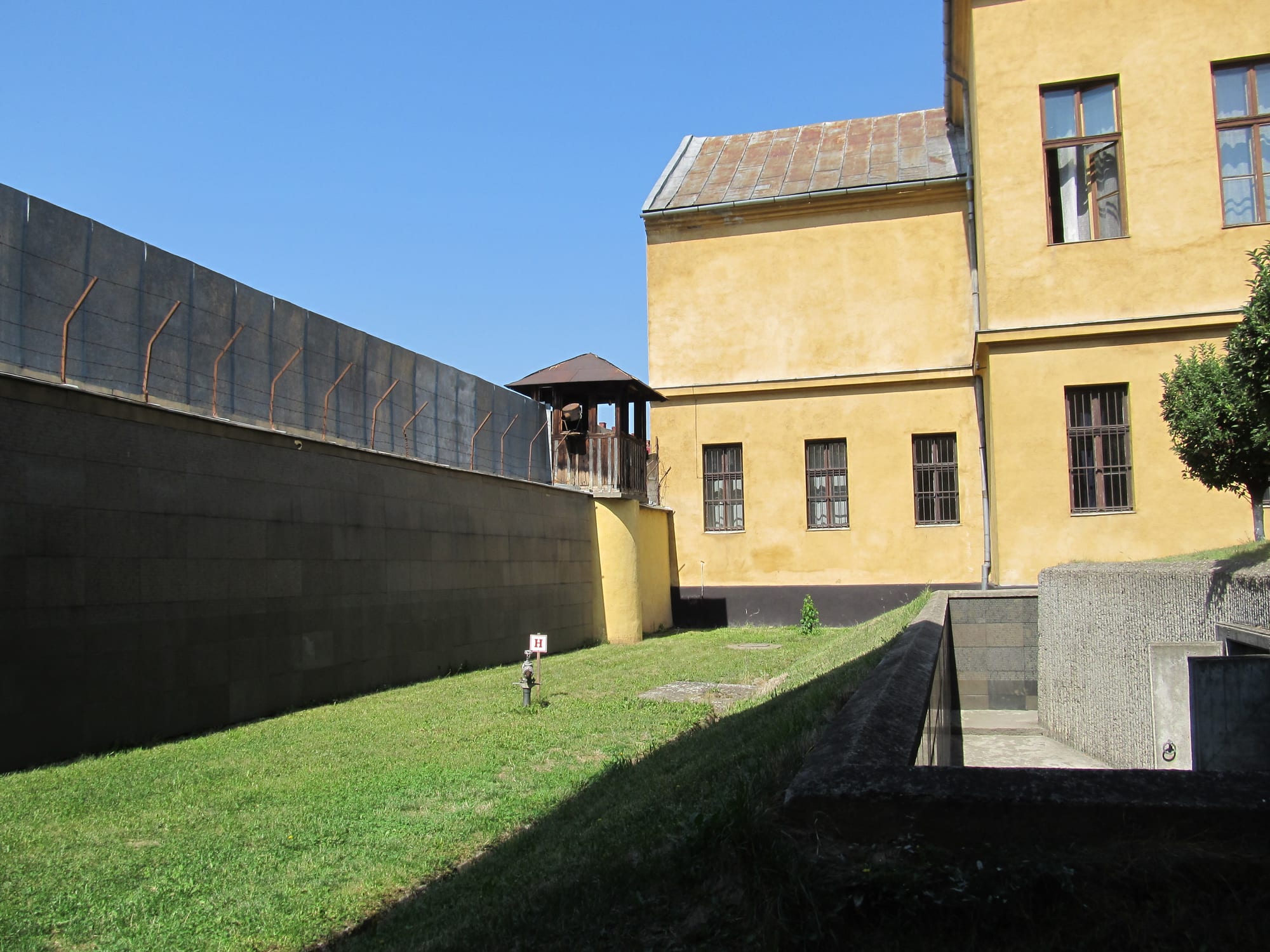
A grassy prison yard between a high grey wall topped with wire and a yellow two-storey building, with a wooden guard post

Maramureș & Crișana, Romania

Sighetu Marmației

The inner yard of the former Sighet prison, now the Memorial of the Victims of Communism and of the Resistance. (Nenea hartia / Wikimedia Commons · CC BY-SA 4.0)

A small town on the Tisa at Romania's border with Ukraine, the old capital of Maramureș. Once a largely Hungarian and Jewish town and the birthplace of Elie Wiesel, it is known today for the former communist prison that is now a national memorial, and as the base for the Merry Cemetery at Săpânța and the wooden churches of the surrounding valleys.

Neighbourhoods

  • The town centre
    • First-time visitors
    • Historic district
    • Museums

    The compact centre, where the main sights — the memorial prison, the Maramureș Museum, the Elie Wiesel house, the Reformed church and the Cultural Palace of 1912–13, built to look like a medieval castle — are all within walking distance. The main street holds most of the cafés and bars.

    Open in Maps
  • The Tisa and the border
    • Walks
    • Crossing to Ukraine

    The town runs down to the Tisa, which forms the border with Ukraine; an old bridge across the river leads to Solotvyno on the far bank, and the crossing is open to pedestrians and cyclists as well as cars.

    Open in Maps
  • The Iza and Mara valley villages
    • Village life
    • Wooden churches

    Just outside town, villages such as Vadu Izei on the Iza lead into the valleys where Maramureș's carved wooden gates, haystacks and wooden churches are best preserved. Village guesthouses here are a common alternative to staying in town.

    Open in Maps

Things to do

In the town

  • Sighet Memorialmuseum

    The prison built in 1896–97, where the communist Securitate held politicians, bishops and other 'class enemies' in the 1950s and 1960s; former prime minister Iuliu Maniu died here. It is now a museum, part of the Memorial of the Victims of Communism and of the Resistance.

    Open in Maps
  • Paupers' Cemeterylandmark

    Cimitirul Săracilor, at the edge of town by the Ukrainian border, where political prisoners of the Sighet prison were buried, singly or in common graves, between 1950 and 1954.

    Open in Maps
  • Elie Wiesel Housemuseum

    The house where the Nobel Peace Prize laureate was born in 1928, now the Museum of Jewish Culture and Civilisation, with an exhibition devoted to Wiesel.

    Open in Maps
  • Maramureș Village Museummuseum

    An open-air museum about 3 km from the centre, with more than 30 wooden houses from the 17th to 19th centuries and a 16th-century wooden church.

    Open in Maps
  • Maramureș Museummuseum

    The town's ethnographic museum, first opened in the Cultural Palace in 1926.

    Open in Maps
  • Reformed Churchlandmark

    A Reformed church since the mid-16th century, whose tower, with a Gothic sanctuary and belfry of the 14th–15th centuries, is the oldest structure in the town.

    Open in Maps

Short trips into Maramureș

  • Merry Cemeteryattraction

    In the village of Săpânța, a cemetery of brightly coloured wooden crosses painted with naive scenes and humorous verses about the lives of the people buried beneath them.

    Open in Maps
  • Săpânța-Peri Monasterylandmark

    The church of the Archangel Michael at Săpânța, described as the tallest wooden church in the world, continuing the tradition of the old monastery of Peri.

    Open in Maps
  • Bârsana wooden churchlandmark

    A wooden church of 1720 in Bârsana, part of the wooden churches of Maramureș World Heritage Site, known for its Baroque interior murals.

    Open in Maps
  • Ieudattraction

    A village on a tributary of the Iza whose wooden church is one of the eight in Maramureș listed by UNESCO in 1999.

    Open in Maps
  • Mocănițaattraction

    The narrow-gauge forestry railway from Vișeu de Sus, whose steam trains run up the Vaser valley towards the Ukrainian border.

    Open in Maps

Seasonal events

  • Marmația Winter Customs Festival27 December

    A festival of winter traditions and customs held every year on the town's streets.

  • Aeternus Maramorosiensisearly August

    An annual festival of antiquity and the Middle Ages held in the town.

Eat and drink

Long-standing places and food districts in Sighetu Marmației. Hours, ratings and directions come from your maps app, always current.

Food in Sighet

  • Central Marketmarket

    The daily market where traders sell vegetables, fruit, dairy produce and handicrafts from the surrounding villages.

    Open in Maps
  • Cafés on the main streetneighborhood

    The town has few sit-down restaurants; most places to eat and drink are cafés, bars and quick-food places along the main street in the centre.

    Open in Maps
  • Village guesthouse kitchensneighborhood

    Guesthouses in the nearby Iza valley villages such as Vadu Izei, a setting for simple home cooking and horincă, the strong double-distilled fruit brandy of the region.

    Open in Maps

Experience Sighetu Marmației

History

Sighet lies at the confluence of the Iza and the Tisa, in the historical region of Maramureș. A settlement is recorded from the 11th century and the town itself from 1326; by 1352 it was a free royal town and the capital of Máramaros County in the Kingdom of Hungary. It later belonged to the Principality of Transylvania and returned to Habsburg Hungary in 1711. In 1910 it had about 21,000 inhabitants, most of them Hungarian speakers, and almost 8,000 Jews; in 1920 Jews were the largest single group, and Hasidic rabbis of the Teitelbaum dynasty, later leaders of the Satmar movement, were born or served here.

On 22 November 1918 an assembly of Maramureș Romanians met in the central square and sent delegates to Alba Iulia to vote for union with Romania; the Romanian army arrived in 1919 and the Treaty of Trianon confirmed the change in 1920. The Second Vienna Award gave the town to Hungary in 1940. Jews were deported in 1941, and after Passover 1944 almost 13,000 were crowded into a ghetto and sent to Auschwitz in four transports in May; among them was the teenage Elie Wiesel, born here in 1928. Romanian and Soviet forces took the town in October 1944.

Under communism the prison became a place of political repression: in the 1950s and 1960s the Securitate held former ministers, bishops and other "class enemies" there, and many died, among them the former prime minister Iuliu Maniu. Apartment blocks went up from 1960 and a large wood-processing plant, opened in 1962, employed over 6,000 people, but it declined after 1989.

Culture & Customs

Sighet is a meeting point of peoples. Romanians are the majority, with smaller Hungarian, Ukrainian and Roma communities, and the town has Orthodox, Greek Catholic, Roman Catholic, Reformed and Ukrainian Orthodox churches. Its Jewish past is remembered through the synagogue that remains in use, the Jewish cemetery and the museum in Elie Wiesel's childhood home, and in 2014 the town marked 70 years since the deportations with a klezmer concert, services and a memorial gathering.

The memorial in the old prison, part of the same national memorial as the International Centre for Studies into Communism in Bucharest, has made the town a place of national remembrance. Beside it, the open-air village museum keeps more than 30 wooden houses of the 17th to 19th centuries and a 16th-century wooden church from the Maramureș villages.

Those customs are the high point of the year. Late December brings carolling and masked processions to the Maramureș villages, and on 27 December the town's Marmația festival of winter customs fills its streets. In early August the town holds a festival of antiquity and the Middle Ages.

Daily Life

Sighetu Marmației had about 32,800 people at the 2021 census, down from about 37,600 in 2011. Romanians make up around seven in ten of the population, with Hungarians, Ukrainians and Roma among the minorities, and the town administers five outlying villages.

Sighet is considered the cultural and economic centre of historical Maramureș. The wood industry that dominated the communist-era economy has shrunk to smaller private firms, which employed some 3,500 people in 2012. Shops cluster along the main street and in supermarkets at the edge of town, and the daily central market brings in produce and crafts from the villages; a livestock market is held on the first Monday of each month.

The border is part of everyday life. The old bridge over the Tisa links Sighet with Solotvyno in Ukraine, a crossing open to pedestrians and cyclists. In the surrounding villages farm work and church and family feasts set the rhythm of the year.

Food

Maramureș cooking is mountain food built on milk, pork, potatoes and cornmeal. Mămăligă, the maize-flour porridge that is a staple across Romania, is eaten with sheep's cheese and sour cream, and slănină — salt-cured pork fat, sometimes seasoned with paprika — is a standby of the village table. Sarmale, cabbage leaves rolled round a filling of minced meat and rice, are Romania's national dish.

Tochitură, pork cut into small cubes and cooked slowly in its own fat and juices, usually in a cast-iron pot, is served with mămăligă and eggs, and the sour soups called ciorbă begin many meals. Village guesthouses are the place to try home cooking.

The drink is horincă, the local name for plum brandy, often distilled twice and very strong. In town, the choice is mostly cafés, bars and quick food along the main street, while the market sells fresh cheese and produce from the villages.

Planning tools

Budget

Sighet and the Maramureș villages are inexpensive. Rooms in town and in village guesthouses are inexpensive, and meals are simple and filling. A car is the biggest cost, since buses between the villages are sparse.

Daily Budget Midrange
USD 70–150 (comfortable guesthouse, restaurant meals, museum tickets, a hire car)
Daily Budget Shoestring
USD 30–55 (village guesthouse with meals, minibuses and trains)

Carry cash for guesthouses, church entry, the market and craft purchases in the villages.

Best Time to Visit

June to September is the main season for Maramureș, with the warmest weather for the villages and the valleys. Late December brings the carols and masked processions of the winter customs, with the town's own festival on 27 December, though it is cold and often snowy.

Suggested Number of Days

The town itself needs a day or two. Three or four days allow time for the villages and wooden churches of the surrounding valleys, which are far easier to reach with a car.

First Visit
1–2 days
With Surroundings
3–4 days

Transportation

The town's sights can all be reached on foot, though the village museum is about 3 km out. Minibuses connect Sighet with Baia Mare and nearby towns, but buses to the villages are infrequent, and most visitors hire a car or arrange a driver for the Iza and Mara valleys and Săpânța.

Drive slowly through the villages, where roads are narrow and shared with horse carts and pedestrians, and avoid mountain passes in heavy snow.

Airport & Station Connections

The nearest airport is Maramureș International near Baia Mare, 10 km west of that city; Cluj-Napoca has many more flights. Minibuses from Baia Mare take about an hour and three quarters. Trains run from several Romanian cities, with one direct connection to Budapest, and from Ukraine travellers cross the Tisa bridge from Solotvyno.

Walkability

Sighet is small and flat, and everything in the centre — the memorial, the museums, the churches and the cafés — is within a short walk. The village museum is a longer walk or a short drive out of the centre.

Safety

Romania is a safe country with low violent crime. Sighet is a quiet provincial town where crime against visitors is rare. The main hazards are on the roads — winter driving on mountain passes and unlit country roads with carts and pedestrians at night — and bears in the surrounding mountains.

Drive carefully after dark on rural roads, keep to marked trails in the mountains, and never approach or feed bears. Check current official travel advice before travelling.

Climate

Sighet lies in the mountain-ringed region of Maramureș, with cold, snowy winters and warm summers with frequent rain.

Summer
warm, with frequent showers; average summer highs across Romania are about 22–24°C
Winter
cold and snowy; January averages in Romania fall to about −6°C in the mountain basins

Local Customs

Maramureș is deeply religious, with Orthodox and Greek Catholic parishes, and Ukrainian- and Hungarian-speaking minorities live in the town. Village hospitality is strong, and guests are often offered horincă, the local plum brandy.

Dress modestly in churches, ask before photographing people in the villages, and treat the memorial and the cemeteries with respect.

Common Payment Methods

The currency is the Romanian leu (RON). Cards are accepted in the supermarkets and many town businesses, and there are ATMs in the centre, but cash is needed for village guesthouses, markets and church entry.