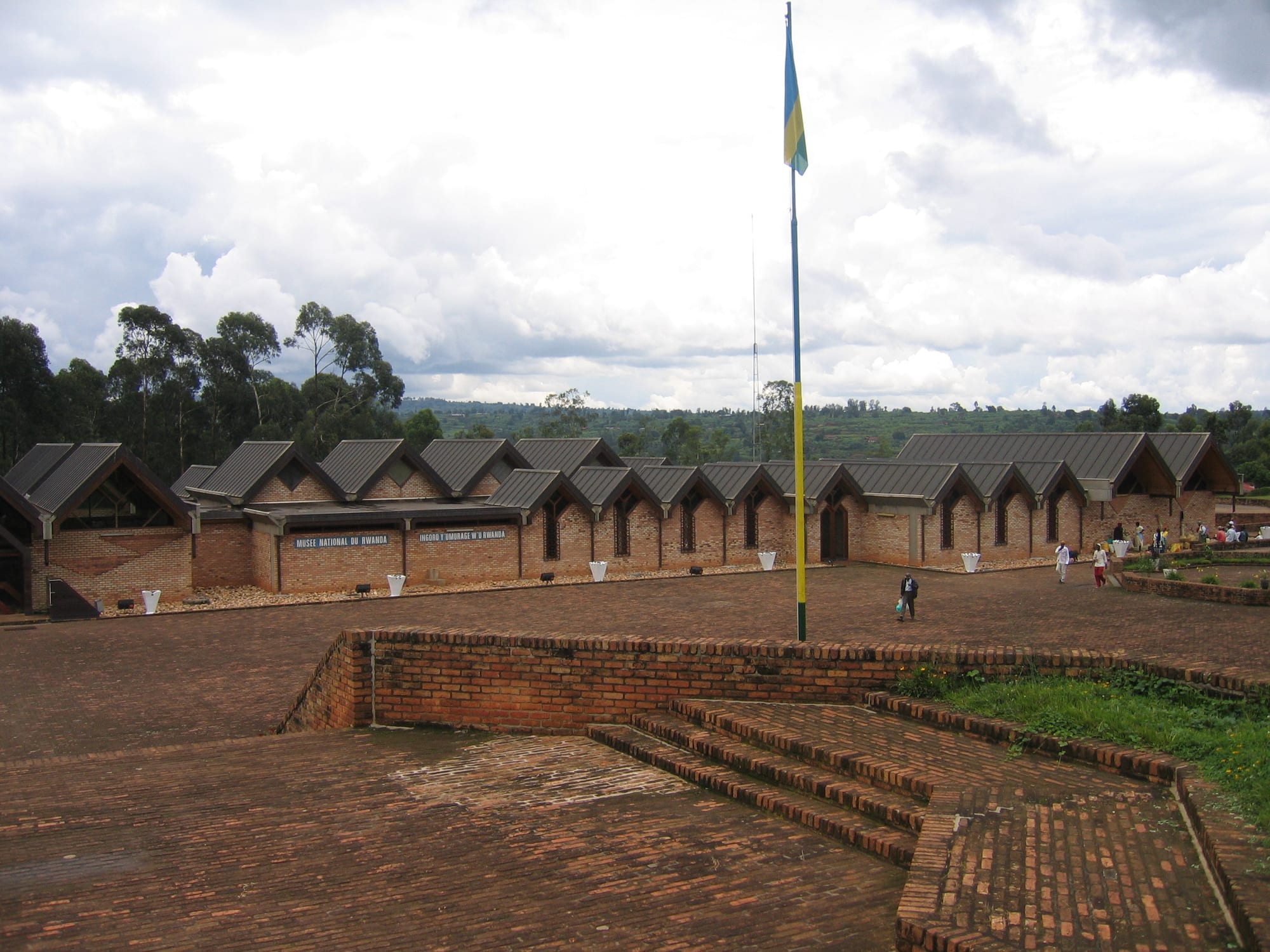
A long low brick museum building with a row of steep tiled gables, a Rwandan flag on a tall pole and brick terraces in front under a cloudy sky

Rwanda

Butare

The national museum of ethnography in Butare, southern Rwanda. (Amakuru / Wikimedia Commons · CC BY-SA 3.0)

A southern Rwandan town, also known as Huye, established by the Belgian colonial rulers in the 1920s as Astrida and long regarded as the country's intellectual capital. It holds the national university, founded in 1963, and the national museum of ethnography, and sits on the main road south-west towards the Nyungwe rainforest.

Neighbourhoods

  • The town centre
    • First-time visitors
    • Best for food
    • Transport links

    A single long avenue lined with jacaranda and eucalyptus, with the shops, banks, bars, market and bus stand strung along it. It is flat, quiet and easily walked, and almost everything in the town lies within a few minutes of the main road.

    Open in Maps
  • The university quarter
    • Students and nightlife
    • Quiet and residential
    • Walks

    The campus and the streets around it at the southern end of town, with the arboretum, staff housing, bookshops and cheap student eating places. Term time makes it the liveliest part of Butare; the holidays empty it.

    Open in Maps
  • The museum and northern approach
    • Museums
    • Historic district
    • Quiet and residential

    The northern end of the town, where the national museum stands beside the main road north. Colonial-era brick buildings and churches are scattered through the older parts of town among large gardens.

    Open in Maps

Things to do

Museums and landmarks

  • Ethnographic Museummuseum

    The national museum of Rwandan ethnography, formerly the National Museum of Rwanda, built with Belgian help and opened in 1989, with collections on the cultural history of the country and the region.

    Open in Maps
  • University of Rwanda, Huye campusattraction

    The largest campus of the University of Rwanda, opened here in 1963 as the National University of Rwanda and merged into the new national university in 2013.

    Open in Maps

Parks and landmarks

  • Arboretum of Ruhandepark

    A botanical garden of some 500 acres on Ruhande Hill within the university's Huye campus, planted with native and introduced trees.

    Open in Maps
  • Butare Cathedrallandmark

    The cathedral of Our Lady of Wisdom, the largest in the country, built in the 1930s in memory of Queen Astrid and the seat of the Catholic diocese of Butare since 1961.

    Open in Maps

Short trips from the town

  • King's Palace Museummuseum

    At Nyanza, north of the town, a reconstruction of the thatched royal residence beside the palace of 1930–1933, with the long-horned inyambo cattle whose keepers still tend and sing to them.

    Open in Maps
  • Murambi Genocide Memorialmuseum

    A place of remembrance west of the town, one of Rwanda's six major genocide memorial centres, on the site of the technical school where many thousands of Tutsi who had been sent there for refuge were killed in April 1994.

    Open in Maps
  • Nyungwe National Parkpark

    A national park of montane rainforest, bamboo and bogs west of the town, added to the UNESCO World Heritage list in 2023, home to chimpanzees and thirteen primate species.

    Open in Maps

Seasonal events

  • Kwibuka commemorationfrom 7 April

    The national commemoration of the 1994 genocide against the Tutsi, opening with a week of mourning from 7 to 13 April and marked at Murambi and in local ceremonies.

  • Umugandalast Saturday of each month

    The compulsory morning of community work observed across Rwanda, from 8 to 11 a.m., when traffic stops and the roads fall quiet.

  • University termacademic year, roughly September to July

    Not an event so much as the town's calendar — bars, bookshops and eating places fill when students return and go quiet in the holidays.

Eat and drink

Long-standing places and food districts in Butare. Hours, ratings and directions come from your maps app, always current.

Butare classics

  • Brochettes and buffet lunchesneighborhood

    Charcoal-grilled goat skewers with plantain in the evening, and by day the Rwandan plate of rice, beans, cooked banana, cassava leaf and a little stew, sold along the main avenue.

    Open in Maps
  • Student eating placesneighborhood

    Cheap canteens, chapati and sambusa stands and bars around the campus at the south end of town, busiest in term time.

    Open in Maps

Markets and coffee

  • Huye marketmarket

    The town's produce market, with bananas, beans, sweet potato, greens and dried fish from the hills and lakes, and fabric and household goods under cover.

    Open in Maps
  • Local coffeecafe

    Rwandan arabica, one of the country's cash crops, served and sold in cafés in the town.

    Open in Maps

Experience Butare

History

Butare is a colonial creation rather than an old Rwandan settlement. The Belgian colonial rulers established a new town here in the 1920s and named it Astrida, after the Swedish-born Queen Astrid of the Belgians, on a high, cool site in the south. It became an administrative and educational centre: the Groupe Scolaire d'Astrida, founded by the Brothers of Charity in 1929, trained the chiefs and the medical, agricultural and veterinary assistants of the Belgian administration, drawing students from Rwanda and Burundi alike, and gave the town an influence far beyond its size.

Independence changed its position. The National University of Rwanda opened here in 1963, confirming the town as the country's intellectual capital, and the national museum followed, but the transfer of government to Kigali left Astrida — renamed Butare — a provincial town rather than a rival capital. Through the 1970s and 1980s it remained the seat of the university, the cathedral and the national research institute.

During the genocide against the Tutsi in 1994, Butare prefecture at first saw few killings: its prefect, Jean-Baptiste Habyalimana, the only Tutsi prefect in the country, refused to authorise them, and for a while it became a sanctuary for Tutsi refugees. He was dismissed on 17 April and later killed, militia were brought in from Kigali, and the killing that followed was severe; the university and the town lost a great part of their staff and population. Reconstruction followed, and Butare is now the capital of Huye District, a name used interchangeably with the old one. In 2013 the country's public institutions were merged into a single University of Rwanda, whose Huye campus is its largest.

Culture & Customs

Butare's identity is academic. The university and the research institutes give the town bookshops, seminars, choirs and a student population that fills the bars and canteens in term and vanishes in the holidays, and a reputation across Rwanda for being serious, quiet and a little formal. Kinyarwanda is universal; French is still widely understood, alongside English.

The town is also the guardian of a good deal of Rwandan tradition. The ethnographic museum is a leading source on the cultural history of the country and the region, and intore, the old war dance performed by men to an ensemble of seven to nine drums, belongs to the same tradition. The royal palace at Nyanza, a short way north, keeps the ceremonial long-horned inyambo cattle, once one of the symbols of the king's prestige.

Religion is prominent: the cathedral and the seminaries make this one of the centres of Rwandan Catholicism, and Sunday mornings are busy. The national customs hold as everywhere — umuganda on the last Saturday of the month, Kwibuka in April — and the proximity of Murambi means April is felt particularly strongly here. Rwandan crafts such as agaseke baskets and imigongo, the geometric cow-dung painting revived in eastern Rwanda, are sold in town.

Daily Life

About 63,000 people lived in the town at the 2022 census, the seventh-largest in Rwanda, with some 382,000 in the surrounding district, which makes it modest in size but disproportionate in importance. The university, the schools, the research institutes, the hospital and local government are the main employers, and their staff and students shape the town's economy; around them are the market traders, moto drivers, tailors and small workshops found in any Rwandan town of the size.

The hills around Butare are farmed intensively for bananas, beans, sweet potato, cassava and maize, with coffee grown as a cash crop, and the town is a collection point for produce moving north to Kigali and south towards Burundi.

Daily rhythm follows the university and the road. Students and staff walk the avenue between campus and centre, minibuses load and leave for Kigali and Gikongoro all day, and the market is busiest in the morning. Evenings are early and quiet outside term. The town's long-standing concerns are the ones common to provincial Rwanda: land pressure on small plots, employment for graduates, and the cost of housing in a town that grows steadily but slowly compared with the capital.

Food

Eating in Butare is plain, cheap and student-shaped. The midday buffet is the institution: a plate or a weighed helping of rice, beans, cooked green banana, cassava, sweet potato, greens and isombe — cassava leaves pounded and simmered with groundnut — with a spoonful of goat or beef stew, sold in the canteens along the avenue and around the campus.

Evenings mean brochettes, cubes of goat or beef grilled over charcoal and served with grilled plantain and a raw tomato-and-onion relish, at open-fronted bars with Primus or Mützig beer; fried pork is a weekend favourite. Chapati, sambusa, grilled maize and doughnut-like mandazi are sold from stalls and by hawkers near the bus stand, and dried fish brought from the lakes appears in the market and in stews.

The south is good farming country, and the market reflects it — avocado, passion fruit, tree tomato, pineapple, sweet potato and beans in many varieties. Coffee is a cash crop in the district, arabica grown on the surrounding hills, and cafés in town serve Rwandan coffee. Fermented milk, ikivuguto, and banana beer made in the villages are the traditional drinks, the latter rarely found in restaurants but central to ceremonies in the district.

Planning tools

Budget

Butare is among the cheapest towns in Rwanda to spend time in. It is a student town, so guesthouses, canteens and bars are priced accordingly, and museum entry is modest. The larger costs are transport out to Nyanza, Murambi and the rainforest, and the park fees at Nyungwe.

Daily Budget Midrange
USD 120–250 (mid-range hotel, restaurants, a car with driver, museum and park entry)
Daily Budget Shoestring
USD 30–55 (guesthouse, local eateries, minibuses and moto-taxis)

Minibuses run to Nyanza and Gikongoro cheaply and often, so a car with driver is only needed for the forest; Nyungwe's activity fees are far lower than the gorilla permit.

Best Time to Visit

June to September, the long dry season, gives the firmest roads and the best conditions for the forest, with a shorter drier spell from late December to February. The southern hills are wetter than the rest of the country, and the rains of March–May and October–December bring heavy afternoon storms. Term time makes the town livelier.

Suggested Number of Days

One or two days suit the museum, the campus and the avenue at a reasonable pace. Longer stays are for the royal palace, the memorial at Murambi and the rainforest further south-west. Most travellers pass through on the way between the capital and Nyungwe.

First Visit
1–2 days
With Surroundings
3 days

Transportation

The town is small and strung along one avenue, so walking covers most of it and moto-taxis handle the rest for very little. Shared minibuses leave the bus stand through the day for Kigali, Nyanza, Gikongoro and the villages, and coaches run to the capital and on towards the Burundian border. Reaching Nyungwe means an early bus or a hired car.

Buses for Nyungwe and the west leave in the morning; for the forest trails a hired vehicle saves a great deal of waiting.

Airport & Station Connections

Butare lies south-west of Kigali, about 80 km as the crow flies and further by road, generally two to three hours by coach, with frequent scheduled services through the day. The Burundian border lies further south, and Nyungwe National Park to the west. There is no railway; the town has only a small civilian airport, and the nearest international airport is Kigali.

Walkability

One of the easiest Rwandan towns to walk. The centre is flat and laid out along a single tree-lined avenue, with the museum at one end and the university at the other, a walk of some twenty to thirty minutes between them. Pavements are reasonable in the centre and rough on the side roads, and there is little street lighting once the shops close.

Safety

Rwanda is one of the safest countries in Africa for visitors, with very low crime and a visible, disciplined police presence. Butare is a quiet university town where crime against visitors is rare and walking in the centre in the evening is normal. Petty theft in the market and on minibuses is the main risk, along with traffic on the main road and slippery ground after rain.

Rwanda is one of the safest countries in Africa for visitors, with very low crime and a visible, disciplined police presence. Treat the genocide memorials as places of remembrance, observing their photography rules and dressing modestly, avoid public criticism of the government, and do not photograph officials, military or police. Check current official travel advice before travelling.

Climate

At about 1,750 metres the climate is mild and green, generally 14–27°C through the year, with the southern hills wetter than the centre of the country. Rain falls mostly March–May and October–December in heavy afternoon storms; June–September is the driest stretch. Evenings are cool enough for a light jacket all year.

Summer
The driest months, June to September, bring days around 25–27°C with cool, clear nights near 14°C and dust on the side roads
Winter
There is no cold season; the wet months of March–May and October–December are slightly cooler by day at about 23–25°C, with mud, mist and heavy afternoon rain

Local Customs

Manners are formal and quiet, as elsewhere in Rwanda: unhurried greetings, modest dress, restrained public behaviour. The plastic-bag ban applies nationwide. This is a town of students and academics, and conversation is wide-ranging, but ethnicity remains a legally and socially sensitive subject, and the memorials nearby are places of mourning for families in the district rather than sights.

Ask before photographing people, and never photograph soldiers, police or government buildings. Dress modestly and keep silence at the memorials. Tipping is not expected but small amounts are welcomed in restaurants and for guides.

Common Payment Methods

The currency is the Rwandan franc. A few hotels take cards, but the town runs on cash and mobile money: the market, minibuses, moto-taxis and most restaurants take nothing else. There are ATMs on the main avenue, though they are not always stocked, so drawing money in Kigali beforehand is sensible.