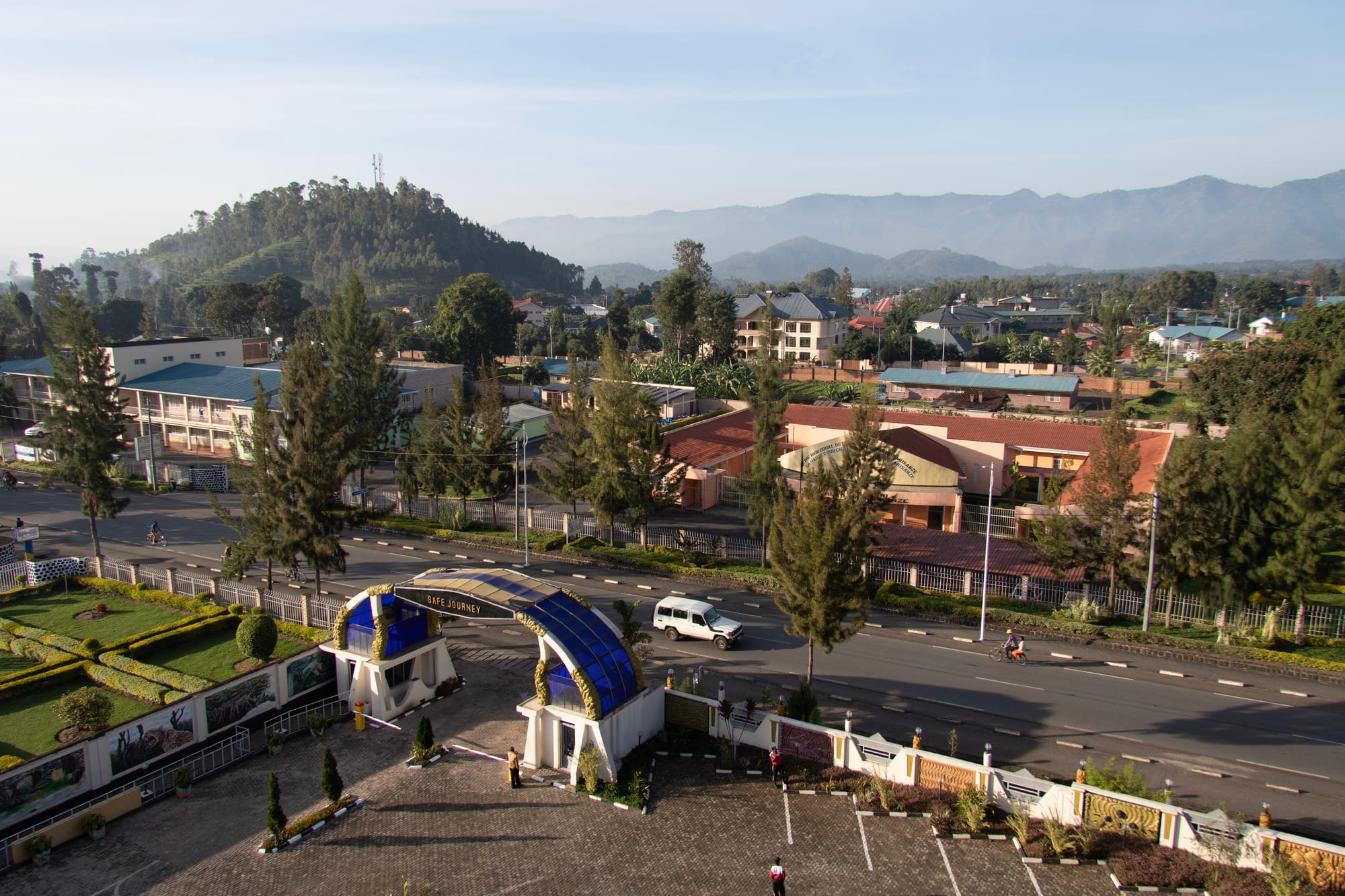
Musanze from above, with a wide tarmac road, low tin-roofed buildings and lines of trees below green hills and a distant mountain ridge

Rwanda

Musanze

The town of Musanze, formerly Ruhengeri, spread below the hills of northern Rwanda. (Andrew Moore from Johannesburg, South Africa / Wikimedia Commons · CC BY-SA 2.0)

A northern Rwandan city directly below the Virunga volcanoes and long known by its earlier name, Ruhengeri. It grew as a colonial and provincial administrative centre on the road between Kigali and Lake Kivu, and is now the base for gorilla trekking in Volcanoes National Park, with lava caves, crater lakes and volcano climbs close by.

Neighbourhoods

  • Musanze town centre
    • First-time visitors
    • Best for food
    • Transport links

    The grid of streets around the main road, with the market, banks, the bus stand, guesthouses and most of the town's restaurants and bars. It is flat, compact and easily walked, and the volcanoes stand at the end of several streets.

    Open in Maps
  • Kinigi
    • Gorilla trekking
    • Lodges
    • Mountain views

    A rural sector north of town at the park boundary, where the head office of Volcanoes National Park sits and treks are briefed and allocated each morning. Potato farms run right up to the forest edge, and the air is noticeably colder.

    Open in Maps
  • The Burera and Ruhondo lakesides
    • Quiet and residential
    • Views
    • Walks

    Rolling farmland north-east of the town, around two lakes formed when lava dammed a river valley. Small hillside settlements, terraced plots and a few lodges look down on the water, and the roads are rough but the outlook is the finest in the district.

    Open in Maps

Things to do

The volcanoes and their wildlife

  • Volcanoes National Parkpark

    The Rwandan section of the Virunga range, protected since 1925, home to mountain gorillas tracked on strictly limited daily permits, along with golden monkeys and montane forest.

    Open in Maps
  • Mount Bisoketrail

    A volcano straddling the border with the Democratic Republic of the Congo, its summit in Rwanda, with two crater lakes, one the largest in the range; it can be climbed in a day from the Rwandan side.

    Open in Maps
  • Mount Sabyinyotrail

    A 3,669-metre volcano whose summit marks the meeting point of the borders of Rwanda, Uganda and the Democratic Republic of the Congo.

    Open in Maps
  • Karisoke Research Centerattraction

    The gorilla research station founded by Dian Fossey in 1967 between Karisimbi and Bisoke, where she is buried; since 2022 the research centre has been based at the Dian Fossey Gorilla Fund's Ellen DeGeneres Campus.

    Open in Maps

In and around the town

  • Musanze Cavesattraction

    Caves formed by past volcanic activity, counted within the limits of Volcanoes National Park.

    Open in Maps
  • Buhanga Eco-Parkpark

    An ancient woodland rich in Rwandan folklore, also counted within the limits of Volcanoes National Park.

    Open in Maps

Short trips from the town

  • Lake Bureraattraction

    A 55-square-kilometre lake about 25 km north-east, the second largest lying entirely in Rwanda, formed when lava dammed a river valley.

    Open in Maps
  • Lake Ruhondoattraction

    The smaller of the twin lakes, on the outskirts of Musanze, fed by Burera across a narrow strip of land and a drop of about 100 metres.

    Open in Maps
  • Gisenyiattraction

    The Lake Kivu town to the west, with a lakeshore resort and sandy beaches; governments advise against travel to the immediate border areas around Rubavu, its district, because of the conflict in eastern DRC.

    Open in Maps

Seasonal events

  • Kwita Izinaannually

    The annual ceremony, launched in 2005, at which gorilla infants are given names, adapted from the traditional Rwandan ceremony for naming a newborn child.

  • Kwibuka commemorationfrom 7 April

    The national remembrance for the 1994 genocide against the Tutsi, marked at the district memorial and in local ceremonies.

  • Umugandalast Saturday of each month

    The compulsory morning of community work observed across Rwanda, from 8 to 11 am; most normal services close and public transport is limited.

Eat and drink

Long-standing places and food districts in Musanze. Hours, ratings and directions come from your maps app, always current.

Musanze classics

  • Brochettes and grilled potatoneighborhood

    Goat skewers grilled over charcoal with the district's own potatoes and grilled plantain, sold at open-fronted bars around the town centre.

    Open in Maps
  • Buffet lunchesneighborhood

    The standard midday plate of rice, beans, cooked banana, cassava leaf and a little stew, served in cafés along the main streets and at the bus stand.

    Open in Maps

Markets

  • Musanze marketmarket

    The district's produce market, piled with potatoes, beans, carrots, passion fruit and tree tomato from the volcanic soils, with fabric and household goods in the covered halls.

    Open in Maps

Experience Musanze

History

The settlement that became Musanze grew up in the high, fertile country below the Virunga volcanoes, an area of dense population and heavy rainfall long before any colonial administration arrived. Under German and then Belgian rule it developed as Ruhengeri, an administrative and mission post on the road linking the centre of the country to Lake Kivu, and it gave its name to the surrounding province. The protection of the volcanoes began in 1925, when the colonial authorities created a reserve for the mountain gorillas, the first national park in Africa, of which the Rwandan portion became Volcanoes National Park.

The town's modern reputation was made in the forest above it. Dian Fossey established the Karisoke research camp on the saddle between Karisimbi and Bisoke in 1967 and spent almost two decades studying the gorillas there before her murder at the site in 1985; her work, and the film made from her book, turned a remote Rwandan district into a name known worldwide.

The same position made the town a front line. Ruhengeri sat close to the Ugandan border where the civil war of 1990–94 was fought, and was briefly held by the Rwandan Patriotic Front in January 1991; in the months that followed, up to 1,000 Tutsi were killed in attacks in the area authorised by local officials, before the 1994 genocide against the Tutsi. The wars of the 1990s in the region halted tourism, and gorilla trekking did not resume until 1999. After the 2006 administrative reform abolished the old provinces, the town became the capital of Musanze District and of the Northern Province, and it has since grown quickly on the back of park tourism and an intensive potato economy.

Culture & Customs

Musanze is a farming town with an international visitor trade grafted onto it, and the two sit side by side on the same streets. Kinyarwanda is universal, English and French are spoken in the tourism business, and a good deal of Swahili and some Lingala are heard because of the closeness of the Ugandan and Congolese borders and the trade that crosses them.

Conservation has become part of local identity rather than simply an industry. Kwita Izina, held each year since 2005, borrows the Rwandan ceremony of naming a child and applies it to gorilla infants, with dancing, speeches and crowds from the surrounding hills; a share of park revenue is directed to community projects in the villages around the boundary, and porters, trackers and guides are drawn from them. Intore dance troupes and drumming groups perform at the ceremony and at cultural villages set up near the park gate.

Everyday customs are those of the Rwandan countryside: formal greetings, deference to age, modest dress, church on Sunday for a largely Catholic and Protestant population, and umuganda on the last Saturday of the month, when the town turns out to clear drains and repair paths. The district is cool and often wet, so people dress warmly in a way that surprises visitors who expect equatorial heat, and the day ends early.

Daily Life

Musanze had a population of about 153,000 at the 2022 census, making it the third-largest city in Rwanda and the capital of the Northern Province. The volcanic soils are among the most productive in the country, and agriculture is the base of the economy: Irish potatoes above all, along with maize and beans, and a national programme aims to turn the potato trade of the district and its neighbours into an export business.

Tourism is the second pillar and the visible one. Lodges, guesthouses, tour operators, craft cooperatives and restaurants have multiplied since the return of trekking, and park work — guiding, tracking, portering, research — supports a large number of households. Schools and colleges bring students into the town, and in 2022 the Dian Fossey Gorilla Fund opened its Ellen DeGeneres Campus in Rwanda as a permanent base for gorilla conservation.

Daily rhythm is early and agricultural. Trekkers assemble at Kinigi before seven, farmers are in the fields at first light, and the market is busiest in the morning. The town centre is flat and low-built, with a few storeys of shops and offices along the main road, while housing spreads up the surrounding slopes. Land pressure, crop-raiding by animals from the park, and the cost of housing in a town that has grown fast are the constant local concerns.

Food

The food of Musanze is Rwandan food with the district's own produce at its centre. Potatoes are everywhere: boiled with beans, fried as chips beside a skewer of goat, or cooked into the thick stew of potato, beans and vegetables that is standard farmhouse eating. The midday buffet, sold by plate in the town's cafés, carries rice, beans, cooked green banana, cassava and sweet potato, isombe of pounded cassava leaf with groundnut, and a modest amount of meat.

Evening eating means brochettes — goat, beef or occasionally fish, grilled over charcoal and served with grilled plantain and a sharp raw tomato-and-onion relish — at bars around the centre, with Primus or Mützig beer or a soft drink. Fried pork is a weekend favourite, and sambusa, chapati and grilled maize are sold from stalls on the main street.

The volcanic soils produce vegetables and fruit of unusual quality for the region, and the market fills with carrots, cabbage, peas, passion fruit, tree tomato and avocado. Dairy is important in this cattle-keeping area, drunk fresh or as the fermented ikivuguto, and milk bars are a normal part of a town street. Arabica coffee is grown on the lower slopes of the district and tea further west, and a few cafés in the centre roast and serve Rwandan coffee for the visitor trade.

Planning tools

Budget

The town itself is cheap — guesthouses, local restaurants and shared minibuses cost little — but the reason most visitors come is not. The gorilla permit is priced deliberately high, and the lodges around Kinigi are among the most expensive accommodation in Rwanda. Golden monkey tracking and the volcano climbs cost a fraction of the gorilla fee.

Daily Budget Midrange
USD 120–300 (mid-range hotel or lodge, restaurants, a car with driver, park activities) — before the gorilla permit
Daily Budget Shoestring
USD 35–60 (guesthouse in town, local eateries, minibuses and moto-taxis) — before any park fees

Gorilla permits are booked months ahead through the Rwanda Development Board; staying in the town rather than at Kinigi cuts costs sharply, though it means an early start.

Best Time to Visit

June to September is the main dry season and the easiest time on the forest trails, with a shorter drier spell from late December to February. The gorillas are tracked all year, but the rains of March–May and October– December make the climbs slippery and the volcano summits are often in cloud.

Suggested Number of Days

Two days are enough for one park activity and the sights at the edge of town. Three or four allow a second trek, a volcano climb and the lakes. Treks start very early and take most of a day, so one activity a day is the realistic pace.

First Visit
2 days
With Surroundings
3–4 days

Transportation

The town centre is walkable end to end. Moto-taxis are the usual way to reach the outskirts, and shared minibuses run from the bus stand to Kigali, Gisenyi and the district villages through the day. Reaching Kinigi, the caves or the lakes early in the morning generally means a hired car or a lodge transfer, as minibuses start later than the park briefing.

Roads to the lakes and some lodges are unsurfaced and steep; a four-wheel-drive vehicle is worth having in the rains.

Airport & Station Connections

Musanze lies north-west of Kigali on a good tarmac road, a few hours by coach or car through the hills, with frequent scheduled coaches from the capital. Gisenyi on Lake Kivu lies to the west. The Cyanika border post with Uganda lies to the north, close to the park. There is no railway and no commercial airport.

Walkability

The centre is flat by Rwandan standards and laid out on straight streets, so the market, the bus stand, the restaurants and the guesthouses are all within a few minutes of each other on foot, and walking after dark is normal. Everything beyond the town — the park gate, the caves, the lakes — is a drive or a long uphill walk on unsurfaced roads.

Safety

Rwanda is one of the safest countries in Africa for visitors, with very low crime and a visible, disciplined police presence. Musanze is a quiet provincial town where crime against visitors is rare. The real risks are physical: cold, wet and very steep trails in the park, altitude above 3,000 metres on the volcano climbs, and rough roads. Park activities are accompanied by guides and armed rangers as standard.

Rwanda is one of the safest countries in Africa for visitors, with very low crime and a visible, disciplined police presence. Prepare for cold, wet, steep conditions on gorilla and volcano treks, keep to the guides' instructions near the animals, and avoid public criticism of the government or photography of officials, military and police. Check current official travel advice before travelling.

Climate

Close below the volcanoes, and higher still at the park gate, Musanze is cooler and wetter than Kigali — generally 12–25°C, with mist and cloud on the volcanoes for much of the year. The rains fall roughly March–May and October–December; June–September is the driest stretch. Nights are cold enough for a fleece all year.

Summer
The driest months, June to September, bring days around 23–25°C, clearer views of the volcanoes and firmer trails, with nights near 12°C
Winter
There is no cold season, but the wet months of March–May and October–December are damp and cloudy, days around 21–23°C and the forest trails deep in mud

Local Customs

Manners are those of rural Rwanda: unhurried greetings, modest dress, and quiet public behaviour. The plastic-bag ban applies nationwide. Farmland runs right up to the park boundary, and walking across cultivated plots or photographing people at work without asking is resented. Gorilla trekking has its own rules, briefed each morning and strictly enforced.

Ask before photographing people, and never photograph soldiers, police or government buildings. Keep the required distance from the gorillas, do not trek with a cold or flu, and tip guides, trackers and porters as is customary; hiring a porter is an established way for local households to earn from the park.

Common Payment Methods

The currency is the Rwandan franc. Lodges and the park office take cards and permits are paid for online in advance, but the town runs on cash and mobile money: the market, minibuses, moto-taxis and most restaurants take nothing else. There are ATMs in the centre, though they are not always stocked, so drawing money in Kigali first is prudent.