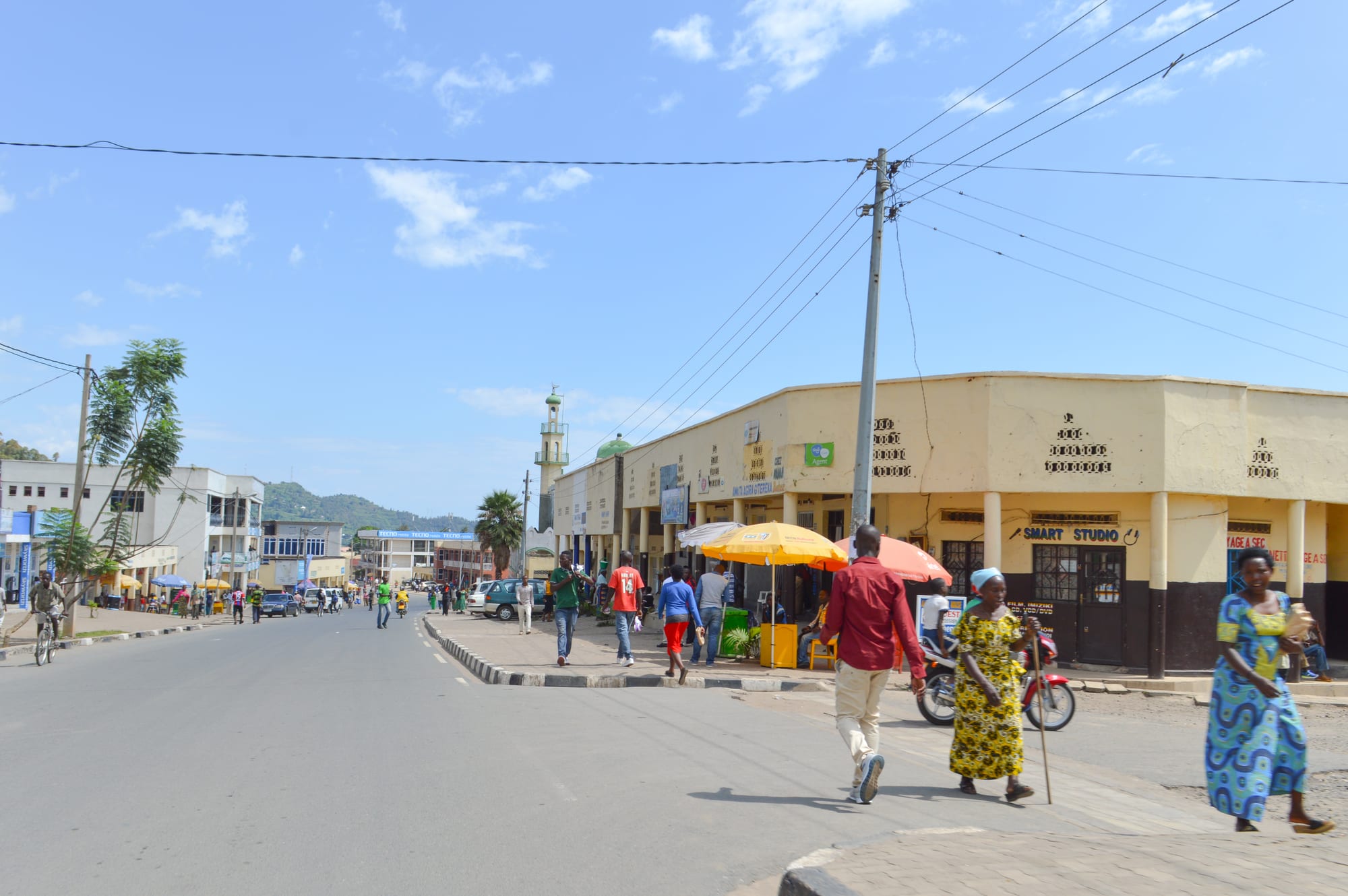
A wide street in Gisenyi lined with low shops and painted arcades, a green-domed minaret behind and hills in the distance

Rwanda

Gisenyi

A main street in Gisenyi, also known as Rubavu, in western Rwanda. (Francisco Anzola from United States / Wikimedia Commons · CC BY 2.0)

A town on the northern shore of Lake Kivu in western Rwanda, also known as Rubavu, at the foot of the Virunga volcanoes. Rwanda's second-largest city, it is a lakeside resort with sandy beaches as well as a trading and brewing town, a weekend destination for Rwandans and the northern end of the Congo Nile Trail.

Neighbourhoods

  • The lakeshore and the beach
    • Beaches
    • First-time visitors
    • Swimming

    A strip of sand and grass along the water at the western edge of town, backed by an avenue of palms and eucalyptus and by the older hotels. It is where the town relaxes at weekends, with swimming, footballs, drinks and rented boats.

    Open in Maps
  • The town centre
    • Local life
    • Best for food
    • Transport links

    A grid of streets set back from the water around the market, the mosque, the banks and the bus stand. It is workaday rather than scenic — shops, bars, tailors and small hotels — and the cheapest part of town to eat and sleep in.

    Open in Maps
  • Rubona
    • Quiet and residential
    • Local life

    The quarter on the south side of the town, quieter and more residential than the centre and the lakeshore, and on the way out towards the hot springs further along the lake.

    Open in Maps

Things to do

The lakeshore

  • Gisenyi public beachbeach

    The town's sandy shore on Lake Kivu, one of three sandy beaches in Gisenyi, with an avenue of palms behind it and the hills of the far shore in view.

    Open in Maps
  • Nyamyumba hot springsattraction

    Natural hot pools on the eastern shore of the lake about 7 km from the town, known locally as Amashyuza, reputed to have healing properties and used by local bathers.

    Open in Maps

Walks and trails

  • Congo Nile Trailtrail

    A walking and cycling route of some 227 km along the Rwandan shore of Lake Kivu, running south from Rubavu through Rutsiro, Karongi and Nyamasheke to Rusizi.

    Open in Maps

Short trips from the town

  • Lake Kivuattraction

    One of the African Great Lakes, lying in a rift valley between Rwanda and the Democratic Republic of the Congo at 1,460 metres, with islands and steep green shores.

    Open in Maps
  • Volcanoes National Parkpark

    The Virunga forest reserve north-east of the town, protected since 1925 for its mountain gorillas, with the Musanze Caves inside its limits.

    Open in Maps
  • Musanzeattraction

    The town below the volcanoes about 50 km east, also called Ruhengeri, the gateway to the gorilla park and near the twin lakes of Burera and Ruhondo.

    Open in Maps

Seasonal events

  • Kwibuka commemorationfrom 7 April

    The national commemoration of the 1994 genocide against the Tutsi, opening with a week of mourning from 7 to 13 April and marked in local ceremonies.

  • Umugandalast Saturday of each month

    The compulsory morning of community work observed across Rwanda, from 8 to 11 a.m., when traffic stops and the roads fall quiet.

  • Lakeside holiday weekendsDecember to February and July to August

    Rwandan holidays and the drier months fill the beach, the bars and the hotels with visitors from Kigali, and rooms are hardest to find then.

Eat and drink

Long-standing places and food districts in Gisenyi. Hours, ratings and directions come from your maps app, always current.

Gisenyi classics

  • Lake Kivu fishneighborhood

    Tiny sambaza, fried whole and eaten by the handful, and grilled or stewed tilapia, served at the lakeside bars.

    Open in Maps
  • Brochettes and buffet lunchesneighborhood

    Charcoal-grilled goat skewers with plantain in the evening, and by day the usual Rwandan plate of rice, beans, cooked banana, cassava leaf and a little stew.

    Open in Maps

Markets

  • Gisenyi marketmarket

    The town's produce market, selling fish from the lake, bananas, beans and vegetables from the hills, with cloth and household goods under cover.

    Open in Maps

Experience Gisenyi

History

Gisenyi, historically written Kisenyi, grew up in the colonial era on the flat northern shore of Lake Kivu, a plain of old lava flows from Mount Nyiragongo. In 1906 officers of the Congo Free State set up a post at Goma, directly opposite, and the two towns developed facing each other across the frontier, joined by two border crossings. The Rwandan side became a lakeside resort, with hotels along its sandy beaches.

Through the 1960s, 1970s and 1980s it kept that character, a modest holiday town where Rwandan officials and expatriates came for the beach, while the Bralirwa brewery, opened in 1959, and the border trade gave it an economy of its own. The American writer and farmer Rosamond Carr, who grew pyrethrum at Mugongo for decades, founded the Imbabazi Orphanage in 1994; it moved to Gisenyi after 1997.

During the 1994 genocide against the Tutsi the interim government relocated to Gisenyi in June, and when the Rwandan Patriotic Front took the town on 18 July it fled into Zaire; hundreds of thousands of refugees crossed the border to Goma, and cross-border insecurity persisted for years afterwards. The 2002 eruption of Mount Nyiragongo sent lava through Goma next door, and some 400,000 people were evacuated across the border into Gisenyi; a further eruption followed in 2021. Tourism returned in the 2000s, and the town, the seat of Rubavu District and often called Rubavu, has grown as a weekend destination and as the northern end of the lakeside trail.

Culture & Customs

The lake sets the tone. Gisenyi is where Rwandans come to swim, and it is the one place in an otherwise reserved country where public leisure is on show: families and students on the sand at weekends, footballs and volleyball nets, groups drinking on the grass under the palms, boats going out in the late afternoon. Weekend evenings are livelier here than in most Rwandan towns of the size.

It is also a border town, and that shapes its culture. Kinyarwanda is universal, but Swahili and Lingala are heard in the market and among traders, and goods, music and people have crossed the frontier for a century. The town has a long-established Muslim community, its mosque a landmark of the centre, alongside the Catholic and Protestant churches that dominate Sunday.

Fishing gives the shore its own rhythm: crews go out on the lake in wooden boats and bring back the tiny sambaza, or isambaza, a sardine introduced to the lake that is its best-known catch. Onshore, the national customs hold — umuganda on the last Saturday of the month, Kwibuka in April, formal greetings, modest dress away from the water — and visitors who treat the beach as a resort rather than as part of a small provincial town tend to be noticed.

Daily Life

Gisenyi is Rwanda's second-largest city: the Rubavu urban area, which includes it, counted about 547,000 people at the 2022 census, in a district of more than 1,000 people per square kilometre. Fishing, cross-border trade, farming in the hills behind and tourism are the mainstays, along with the brewery of Bralirwa, Rwanda's largest brewer and soft-drinks company, which has worked here since 1959.

The lake itself is an industry. It holds large quantities of dissolved methane, which long fired the brewery's boilers here and is now extracted from offshore platforms to generate electricity for the national grid. The rich volcanic soils in the north-west of the district are farmed intensively and supply the town's market.

Daily life divides between the two halves of the town. Along the shore are the hotels, the beach and the quiet avenues; behind them is a busy working centre of market stalls, bars, workshops and bus queues that has grown quickly and untidily as people have moved in from the countryside. Cross-border trade with the Congolese side is a mainstay of the district's economy, and the conflict in eastern Congo, which worsened sharply in early 2025, is felt directly here in movement across the border and in the fortunes of the market.

Food

Gisenyi eats from the lake. Sambaza — small silvery sardines from the lake — are fried whole and crisp and eaten by the handful with a squeeze of lime and a beer, and are the dish visitors are told to try first. Tilapia is the larger catch, grilled over charcoal or stewed with tomato and onion and served with chips, rice or cooked banana, and is the standard sit-down meal at the lakeside bars.

Away from the water the food is that of the country: the midday buffet of rice, beans, cooked green banana, cassava, sweet potato and isombe, the cassava leaf pounded with groundnut; brochettes of goat grilled to order in the evening with grilled plantain and a raw tomato-and-onion relish; fried pork at weekends; and sambusa, chapati and grilled maize from street stalls.

The town has a brewer's reputation, since Bralirwa brews Primus, Mützig and other beers here, and they are drunk cold everywhere alongside the national soft drinks. Rwandan tea and coffee are both sold locally, and the market fills each morning with passion fruit, tree tomato, avocado and pineapple alongside the day's fish.

Planning tools

Budget

Gisenyi is one of the cheaper places to spend time in Rwanda, with guesthouses in the town centre, local restaurants and shared minibuses all inexpensive; the lakeside hotels cost considerably more for the position. Boat hire, bicycles for the trail and drivers are the main extras. Weekends and Rwandan holidays push room prices up.

Daily Budget Midrange
USD 120–250 (lakeside hotel, restaurants, boat trips, a car with driver)
Daily Budget Shoestring
USD 30–60 (guesthouse in town, local eateries, minibuses and moto-taxis)

Rooms a few streets back from the water cost a fraction of those on it, and the beach itself is free; book ahead for weekends and the December–February holidays.

Best Time to Visit

June to September, the long dry season, gives the most reliable weather for the beach, boats and the trail, with a second drier spell from late December to February that coincides with the Rwandan holidays. The rains of March–May and October–December come mostly as heavy afternoon storms and leave the hills green and the unpaved sections of the trail muddy.

Suggested Number of Days

One or two days suit the town, its shore and a boat trip at an unhurried pace. Longer stays are for cycling a stretch of the lakeside trail or visiting the hills inland. Many travellers stop here for a night between the volcanoes and the rest of the lake.

First Visit
1–2 days
With Surroundings
3 days

Transportation

The town is small enough to cross on foot, and moto-taxis cover anything further, including the run out to Rubona. Shared minibuses leave the bus stand for Musanze, Kigali and the villages along the lake, and coaches run to the capital several times a day. Boats can be hired at the harbour, and bicycles for the lakeside trail.

The lakeshore road south is partly unsurfaced and slow; allow far more time than the distance suggests, and hire a four-wheel-drive vehicle in the rains.

Airport & Station Connections

Gisenyi lies about 155 km north-west of Kigali on a good but winding tarmac road, generally three to four hours by coach or car, with frequent scheduled services. Musanze is about 50 km east. There is no railway and no commercial airport; the nearest international airport is Kigali.

Walkability

A walkable town. The lakeshore avenue, the beach and the older hotels form a flat, shaded promenade, and the centre is a short, gently uphill walk inland from it. Rubona, on the south side of town, is a moto ride rather than a stroll. Pavements are patchy away from the shore and there is little street lighting.

Safety

Rwanda is one of the safest countries in Africa for visitors, with very low crime and a visible, disciplined police presence. The town itself is quiet and petty theft on the beach is the main everyday risk. The important caveat is its position: governments advise against travel to the immediate border areas around Rubavu because of the conflict in eastern Congo, which worsened sharply in early 2025, and the Congolese city of Goma lies directly across the frontier.

Rwanda is one of the safest countries in Africa for visitors, with very low crime and a visible, disciplined police presence. Take malaria precautions at this lower altitude, do not photograph the border, soldiers or police, and take boats only with operators who provide lifejackets. Check current official travel advice before travelling.

Climate

At about 1,460 metres, lower and warmer than Kigali, with the lake moderating the temperature — generally 16–28°C through the year. The rains fall roughly March–May and October–December, heaviest in April and November; June–September is the driest stretch. Mornings on the water are often still and misty.

Summer
The driest months, June to September, bring warm, clear days around 26–28°C, cooler nights near 16°C and calm water
Winter
There is no cold season; the wet months of March–May and October–December are a little cooler by day at about 24–26°C, with green hills and heavy afternoon storms

Local Customs

Behaviour is quiet and manners formal, as elsewhere in Rwanda: unhurried greetings, modest dress, and swimwear kept to the beach rather than worn into town. The plastic-bag ban applies nationwide. This is a border town with a long history of movement across the frontier, and the conflict on the Congolese side is a sensitive subject best left to residents to raise.

Ask before photographing people, and never photograph the border post, soldiers, police or government buildings. Tipping is not expected but is welcomed in restaurants and for boat crews and guides.

Common Payment Methods

The currency is the Rwandan franc. The lakeside hotels take cards; the market, minibuses, moto-taxis, boat hire and most restaurants take cash or mobile money only. There are ATMs in the town centre, but they are not always stocked, so it is worth arriving with enough cash for a few days.