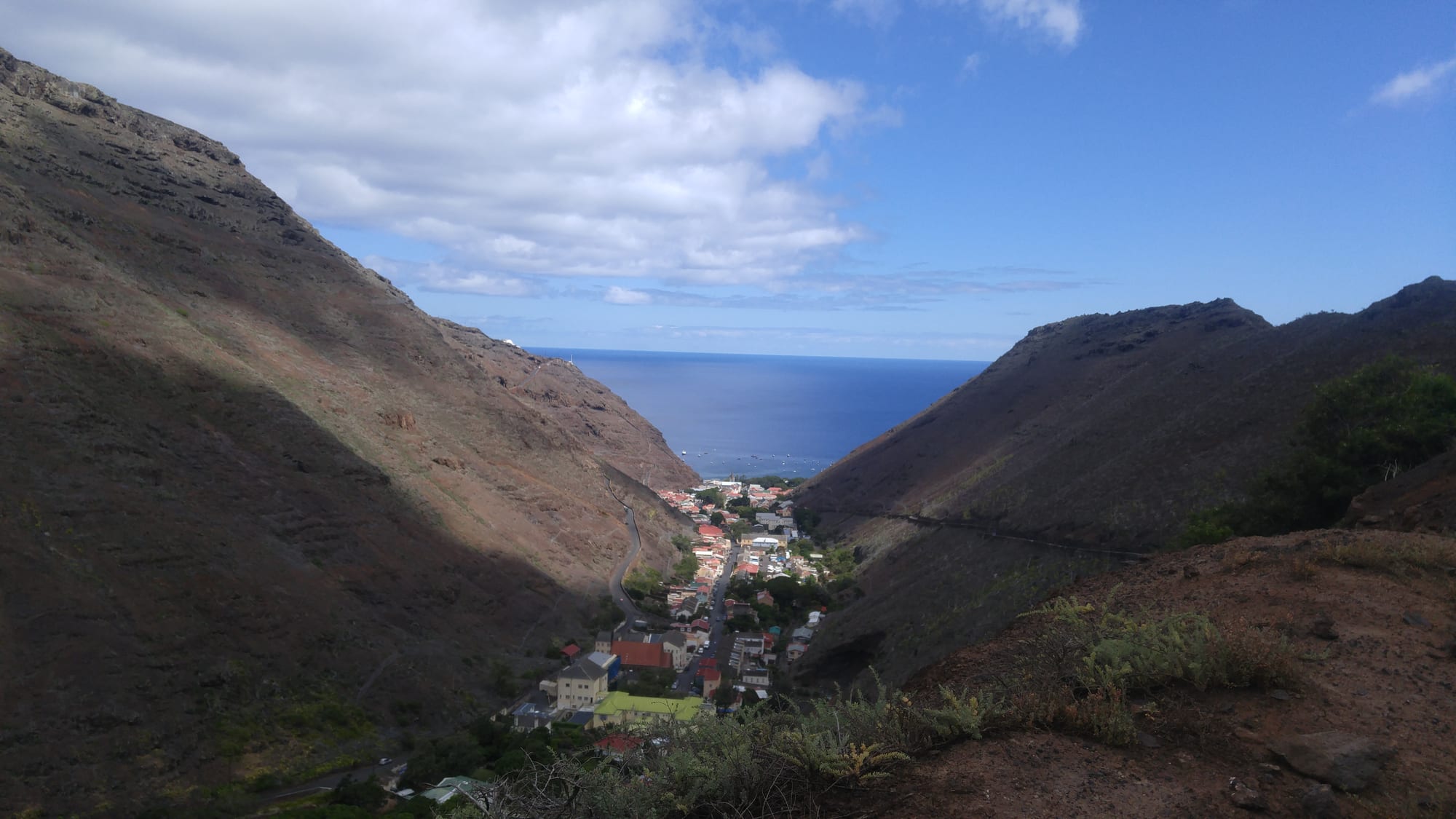
A town of small pale houses filling the floor of a deep, bare brown valley that opens onto the blue Atlantic

Saint Helena

Jamestown

Jamestown filling the floor of James Valley between steep volcanic hillsides on the north-west coast of Saint Helena. (Kevstan / Wikimedia Commons · CC BY-SA 4.0)

The capital of Saint Helena, founded by the English East India Company in 1659 and wedged into a narrow valley between bare volcanic cliffs on the leeward coast. Its Georgian main street, the Castle, the 699 steps of Jacob's Ladder and the wharf still shape a town of a few hundred people in the mid-Atlantic.

Neighbourhoods

  • Main Street and the Castle
    • First-time visitors
    • Historic district

    The Georgian heart of the town, a single street of shops, offices, the Anglican parish church described as the oldest in the Southern Hemisphere, and the Castle, built on the site of the East India Company's fort, running inland from the seafront. Almost everything official on the island happens within a few hundred metres of it.

    Open in Maps
  • The wharf and the seafront
    • Walks
    • Local life

    The landing steps and seafront at the mouth of James Valley, the island's only port until the development of Rupert's Bay. Swimming is off the rocks and slipways rather than a beach.

    Open in Maps
  • Upper Jamestown and Rupert's Valley
    • Quiet and residential
    • Local life

    The inland end of the valley, mostly housing, and the neighbouring Rupert's Valley, part of the town though not linked to it by road, which holds the power station, the fuel storage and a wharf completed in 2016, and where about 5,000 liberated Africans were buried in the nineteenth century.

    Open in Maps
  • Half Tree Hollow and Ladder Hill
    • Quiet and residential
    • Viewpoints

    The largest residential district on the island, on the plateau at the top of Jacob's Ladder and the zigzag Ladder Hill Road. It looks down over the town, the anchorage and the sea.

    Open in Maps

Things to do

The town

  • Jacob's Ladderlandmark

    A straight flight of 699 stone steps climbing the valley wall to Ladder Hill, built in 1829 as the pedestrian stair of an inclined cable railway that carried cargo between the town and the fort; the rails were removed in 1871.

    Open in Maps
  • Museum of Saint Helenamuseum

    The island's museum, opened in its present building at the foot of Jacob's Ladder in 2002, with collections on the maritime, military and social history of the island, including finds from shipwrecks.

    Open in Maps
  • High Knoll Fortlandmark

    A walled hilltop fort about a mile south of lower Jamestown, rebuilt in 1874 around a tower of 1799 as a redoubt for the islanders against a possible French invasion.

    Open in Maps
  • St James' Churchlandmark

    The Anglican parish church near the Castle, the oldest Anglican church in the southern hemisphere; the present building dates from 1774.

    Open in Maps
  • The Castlelandmark

    The main government building, begun in 1708 on the site of the East India Company's James Fort and largely rebuilt in the 1860s; only the foyer is open to the public.

    Open in Maps

Napoleon's exile

  • Longwood Housemuseum

    The former East India Company farmhouse about three miles inland where Napoleon lived from December 1815 until his death in 1821; owned by the French government since 1858 and kept as a museum, together with the nearby Valley of the Tomb.

    Open in Maps
  • The Briarslandmark

    The pavilion a short way inland from Jamestown where Napoleon spent his first weeks on the island before Longwood was ready, now also in French hands.

    Open in Maps

Short trips from the town

  • Plantation Houselandmark

    The Governor's official residence about two miles south of town, a house of 1791–2 whose paddock is home to Jonathan, a Seychelles giant tortoise brought to the island in 1882 and described as the world's oldest known living land animal.

    Open in Maps
  • Diana's Peak National Parkpark

    The island's central ridge about three miles inland, the island's first national park since 1996, with endangered endemic plants such as tree ferns and cabbage trees on its three highest peaks, Diana's Peak reaching 818 metres.

    Open in Maps
  • Sandy Baybeach

    A bay on the south-east coast about four miles from town, with the island's largest beaches, exposed to heavy seas, and the remains of the batteries and the Sandy Bay Line that once guarded it.

    Open in Maps
  • Saint Helena Airporttransit hub

    The island's airport on Prosperous Bay Plain, about five miles from Jamestown, opened in 2016 and served since 2017 by the scheduled flight from Johannesburg.

    Open in Maps

Seasonal events

  • Saint Helena DayMay

    Held on 21 May, the traditional date of the island's discovery in 1502, with events in and around the town.

  • Festival of Runningautumn

    A series of races over the island's hills, including a run up the 699 steps, which draws entrants from overseas as well as islanders.

  • Governor's Cup arrivalsDecember and January in race years

    The yacht race between Cape Town and Saint Helena, held every two years, brings its fleet into James Bay and the town fills with crews.

  • Boxing Day and New Year sportslate December

    Cricket, football and community events run through the holiday period, when Saints working overseas are most likely to be home.

Eat and drink

Long-standing places and food districts in Jamestown. Hours, ratings and directions come from your maps app, always current.

Saint Helenian classics

  • Plo and fishcakesrestaurant

    Plo, the island's curried pilau of rice, and fishcakes bound with egg and spiced with chilli are the island's staples, cooked at home and served in the town's cafés.

    Open in Maps
  • Saint Helena coffeecafe

    The island's own coffee, exported as one of the most expensive in the world, is served in the town's cafés and sold to take home.

    Open in Maps
  • Tungicafe

    A spirit distilled on the island from prickly pear, the local drink alongside imported beer in the bars along Main Street.

    Open in Maps

Where to look for food

  • Main Streetneighborhood

    The town's cafés, bars, hotel dining rooms and takeaways are strung along the one street, with the island's general stores for self-catering.

    Open in Maps

Experience Jamestown

History

Jamestown was founded in 1659, when the English East India Company fortified the landing on an island that Portuguese ships had found uninhabited in 1502. The valley offered fresh water and a place for boats to come ashore, and the town was named for James, Duke of York. Its purpose was to water and provision ships on the long haul between Europe and Asia, and at the peak about 1,000 ships a year called here.

The town grew as a fortified funnel: fortifications across the seafront, batteries on the heights, and a single street of Georgian houses, stores, church and Castle running inland. Enslaved people worked the wharf and the plantations, and their emancipation began in 1827. From 1840 the island was a base for the Royal Navy's campaign against the slave trade: by the 1870s an estimated 25,000 Africans had been freed from intercepted ships and landed in neighbouring Rupert's Valley, where about 5,000 died and were buried; their graves were rediscovered in 2006 during preliminary digging for the airport. In 1829 Jacob's Ladder was built up the valley side to carry goods to the garrison on Ladder Hill.

Napoleon arrived in 1815 and spent his first weeks at the Briars above the town before moving inland to Longwood. Later the island held the Zulu king Dinuzulu, in 1890–1897, and in 1900 and 1901 more than 6,000 Boer prisoners of war. The opening of the Suez Canal and the shift to steam took away the passing trade, and Jamestown settled into a long quiet decline, its population drifting overseas for work. The airport opened in 2016, with scheduled flights from 2017, and the mail ship RMS St Helena made her last sailing in 2018.

Culture & Customs

Jamestown is the meeting point of a community of some 4,400 people who call themselves Saints, descended from English settlers, enslaved and liberated Africans, Chinese labourers and Malagasy and Indian arrivals. English is the only language, spoken with an accent and turns of phrase found nowhere else, and nearly everyone on the island passes through the town's single street in the course of a week.

Life is church- and family-centred. The Anglican Church is the largest denomination, with Catholic, Baptist and Adventist congregations alongside it, and Sunday is quiet. In a small community the same people meet at work, in church and in the island's clubs. Drivers wave to every car they pass, and a stranger who does not greet back is noticed.

The calendar gives the town its rhythm — Saint Helena Day in May, the Festival of Running in the autumn, the arrival of the Governor's Cup yachts in James Bay, cricket and football through the holidays. Flax and rope-making were the twentieth-century industry until the mills closed in 1965. Attitudes are conservative and courteous, and news travels faster than any official announcement.

Daily Life

About 600 people live in Jamestown itself, with the larger residential district of Half Tree Hollow on the plateau directly above, reached by the Ladder Hill road or the 699 steps. The town is the island's only real centre: government offices, the hospital, the bank and the main shops are all within a few hundred metres of each other.

The public sector, much of it funded by the United Kingdom, employs a large share of the workforce; tourism has grown since the airport opened, and fishing, the island's coffee and construction make up much of the rest. Prices are high because nearly everything arrives on the regular cargo ship from Cape Town, and the arrival of the vessel changes what is on the shelves. Proper broadband reached the island in 2023 with the Equiano submarine cable.

Days start early and the town empties in the late afternoon, when people drive back to the villages and the plateau. Young Saints still leave for work in the United Kingdom and on Ascension and the Falklands, an outflow that has left an ageing population and a shortage of skilled workers — the central concern of island politics, alongside the reliability of the flight and the cost of living.

Food

Saint Helenian cooking is British home food shaped by the sea and by a long history of imports. Plo, a spiced pilau of meat and rice, is the dish the island claims as its own and the standard offering at any gathering. Tuna is everywhere — in fishcakes, curried, grilled or cold with salad — because it is landed here and much of the rest of the larder is frozen.

Curry is common, a legacy of the East India Company and of the island's Asian arrivals, and Sunday roasts and other British home cooking fill out a repertoire that is more domestic than commercial. Fresh vegetables and fruit depend on the season and the local growers, and the shops sell them when there are any; between ships, choice narrows sharply.

Two island products stand out. Saint Helena coffee is produced in small quantities and exported as one of the most expensive coffees in the world. Tungi, a spirit distilled from the fruit of the prickly pear that covers the dry hillsides, is the local drink, made in the island's distillery alongside coffee liqueur, gin and rum. The cafés and bars of Main Street and the hotel dining rooms are where visitors meet both.

Planning tools

Budget

Getting to Saint Helena is the expense; once there, costs are modest and choices are few. Accommodation is a handful of small hotels, bed-and-breakfasts and self-catering cottages, most of them in or just above Jamestown, and a hire car is close to essential.

Daily Budget Midrange
USD 170–290 (small hotel or guesthouse, meals out, a hire car and fuel)
Daily Budget Shoestring
USD 80–130 (a simple room or self-catering cottage, groceries and cafés, shared transport)

Book rooms and the weekly flight together and months ahead, as capacity on both is very small, and bring sterling cash for a largely cash economy.

Best Time to Visit

Any month works. It is warmest and a little wetter from January to April and cooler and windier from July to October, and whale sharks visit seasonally. In practice the flight schedule matters far more than the weather, and the highlands are cloudier than the coast all year.

Suggested Number of Days

The flight schedule sets the length of a stay: visitors generally arrive and leave a week apart. That is comfortable for the town, the island's historic sites and some walking; longer suits diving, fishing or a slower pace.

First Visit
5–7 days
With Surroundings
7–10 days

Transportation

Most visitors hire a car, driving on the left on steep, narrow and winding roads with frequent passing places; a horn blast at blind corners is normal. A small village bus service runs on set days rather than a frequent timetable, and taxis can be arranged. Distances are short but journey times are long.

Drivers wave or nod to everyone they pass, and the courtesy is expected; allow far more time than the mileage suggests.

Airport & Station Connections

Saint Helena Airport, on Prosperous Bay Plain about five miles from Jamestown, is served by a scheduled Airlink flight from Johannesburg, weekly and at times twice weekly, routed via Walvis Bay in Namibia. There is no scheduled passenger ship: the cargo vessel that serves the island carries only a few passengers, and cruise calls are rare.

Walkability

Jamestown itself is walked end to end in fifteen minutes, and everything in the town centre is within a few hundred metres. Leaving the valley means climbing: Jacob's Ladder climbs the valley wall in 699 steps, and the roads out are steep in every direction. Beyond the town, walking means the island's network of marked post-box walks rather than pavements.

Safety

Jamestown is extremely safe, with almost no crime, and visitors are quickly known by name. The hazards are environmental: steep unfenced drops above the town, sudden swells and rip currents on a coast with few beaches, and demanding roads. The island hospital is small, and anything serious means an air evacuation to South Africa or the United Kingdom.

Take out comprehensive medical and evacuation insurance, take care near cliff edges and on the coast, and drive cautiously on the mountain roads. Check current official travel advice before travelling.

Climate

Tropical but mild and marine, moderated by the Benguela Current and the trade winds, with no hurricane risk. The town, on the sheltered leeward coast, is warmer and drier than the island's interior, which is several degrees cooler, greener and often wrapped in cloud.

Summer
January–April, the warmer and slightly wetter season, about 21–28°C in the town
Winter
July–October, cooler and windier, about 17–24°C in the town and noticeably cooler in the highlands

Local Customs

English is the only language, spoken in a distinctive Saint Helenian accent. Greeting people is expected — in the street, in shops and from cars — and privacy is limited in a community of a few thousand. The Anglican Church is the largest denomination and Sunday is quiet; dress is casual but tidy, and swimwear stays at the shore.

Tipping is not customary; ask before photographing people, and treat the Napoleonic properties, which belong to France, with the formality their staff expect.

Common Payment Methods

The Saint Helena pound is used, pegged one-to-one to sterling, and UK notes and coins circulate alongside it; the local currency is shared only with Ascension. Card acceptance is limited, the Bank of St Helena is the only bank, and there are no international ATMs, so sterling cash is the practical way to pay.