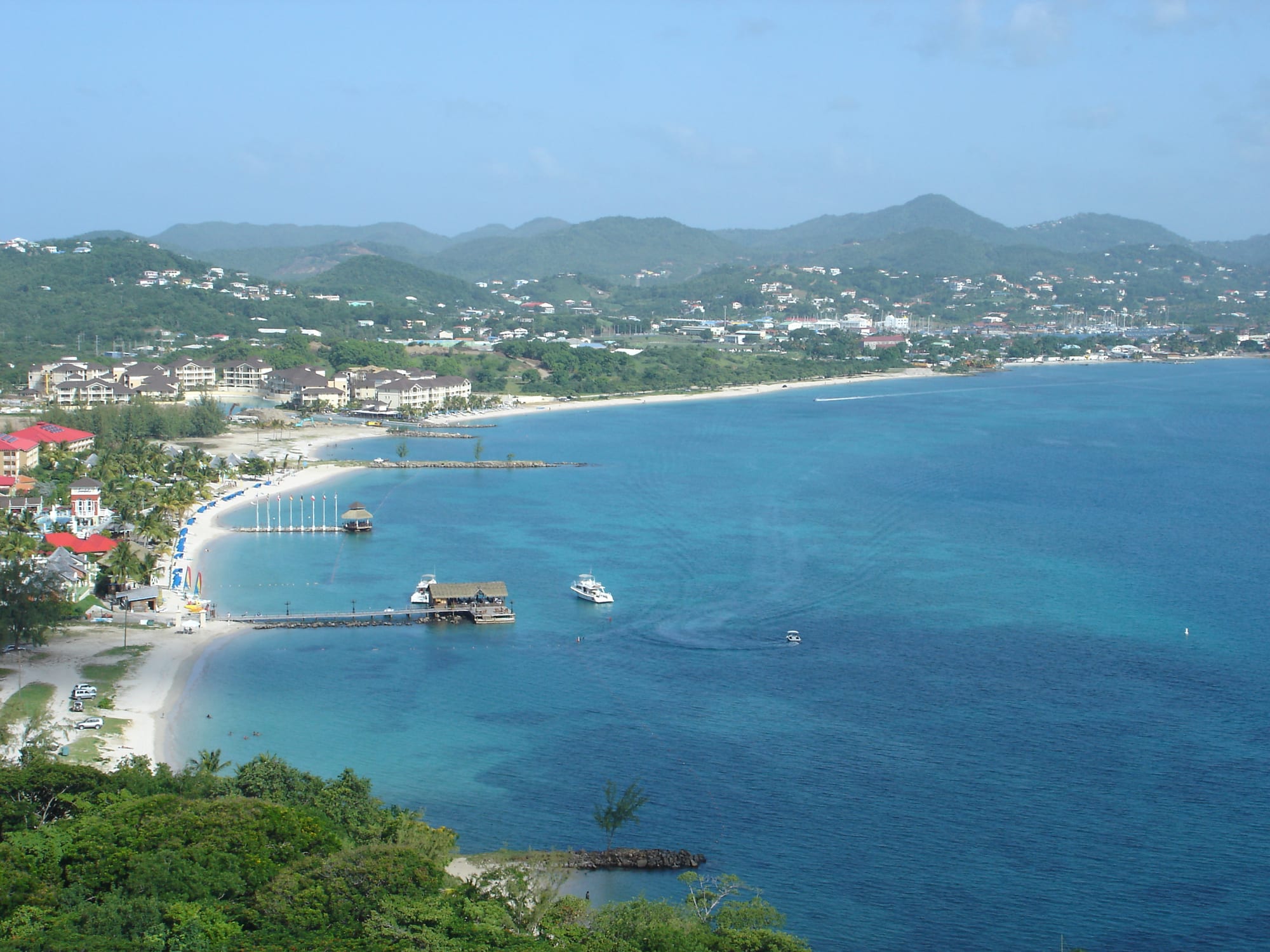
A long curve of pale sand and turquoise water around Rodney Bay, with jetties, low buildings and green hills behind

Saint Lucia

Gros Islet

Rodney Bay and Reduit Beach seen from the top of Pigeon Island, Gros Islet. (Lii / Wikimedia Commons · Public domain)

A former fishing village near the northern tip of Saint Lucia, beside the horseshoe of Rodney Bay, its marina and Reduit Beach. A British naval base in the 18th century and a US air station in the Second World War, it grew fast from the 1990s into one of the island's most popular tourist areas, known for its Friday-night street party and the forts of Pigeon Island.

Neighbourhoods

  • Gros Islet village
    • Local life
    • Nightlife
    • Best for food

    The old fishing village on the north side of the marina entrance, small streets with a narrow beach on its seafront. Quiet most of the week, it fills on Friday evenings when the streets close to cars for the street party.

    Open in Maps
  • Rodney Bay and Reduit Beach
    • Beaches
    • Nightlife
    • First-time visitors

    The resort and entertainment area around the horseshoe bay and its man-made lagoon, with the marina, the island's two largest shopping malls, hotels and rentals, and a strip of restaurants and nightclubs along Reduit Beach Avenue behind the island's most popular beach.

    Open in Maps
  • Pigeon Island and Pigeon Point
    • History
    • Walks
    • Beaches

    North of the village, the causeway leads to the former island and its forts; the beach of Pigeon Point runs north of town, its first half undeveloped and quiet except at weekends.

    Open in Maps
  • The Atlantic coast
    • Kitesurfing
    • Quiet beaches

    East of the village, an occasionally unpaved road leads to the wind-blown beaches of Cas-en-Bas and Anse Lavoutte, largely untouched and popular with kitesurfers and locals.

    Open in Maps

Things to do

History and viewpoints

  • Pigeon Islandpark

    A 44-acre former island joined to the mainland by a causeway in the early 1970s, a national park since 1979 and a national landmark since 1992, with the ruins of Fort Rodney, 1808 barracks and trails up to views of Martinique.

    Open in Maps

Beaches and the bay

  • Reduit Beachbeach

    The long white-sand beach of Rodney Bay, the most popular on the island and the best equipped on the west coast, with a water park of floating obstacle courses offshore.

    Open in Maps
  • Gros Islet Beachbeach

    A narrow beach along the seafront of the old village.

    Open in Maps
  • Pigeon Point Beachbeach

    A stretch of sand north of the village, its undeveloped first half quiet except at weekends.

    Open in Maps
  • Cas-en-Basbeach

    A largely untouched beach on the Atlantic coast, with a couple of restaurants and a kitesurfing school.

    Open in Maps
  • Rodney Bay Marinaattraction

    The island's main yacht marina, dredged from a mangrove swamp, where the transatlantic Atlantic Rally for Cruisers finishes each December.

    Open in Maps

Sport and nights out

  • Gros Islet Street Partyattraction

    Every Friday evening the village streets close to cars for 'the Jump-up', with bars open late and stalls selling local food.

    Open in Maps
  • Daren Sammy Cricket Groundattraction

    The island's international cricket ground on the edge of Rodney Bay, opened in 2002 as Beausejour, a 2007 World Cup venue and renamed in 2016 after the West Indies' twice world-champion captain.

    Open in Maps

Seasonal events

  • Gros Islet Street Partyevery Friday evening, all year

    The weekly 'Jump-up', when the village streets fill with music, bars and food stalls.

  • Saint Lucia Jazz and Arts FestivalMay

    The island's main music festival, begun in 1992, whose main stage is on Pigeon Island.

  • Atlantic Rally for CruisersDecember, before Christmas

    The world's largest trans-ocean sailing event, which sets out from Gran Canaria in late November and ends at Rodney Bay, filling the marina with yachts and crews.

Eat and drink

Long-standing places and food districts in Gros Islet. Hours, ratings and directions come from your maps app, always current.

Gros Islet classics

  • Friday night street foodneighborhood

    On Friday evenings stalls in the village streets sell local food among the crowds and the music.

    Open in Maps

Food districts

  • Reduit Beach Avenueneighborhood

    A strip of restaurants and nightclubs behind Reduit Beach, popular with visitors and Saint Lucians alike, in an area whose restaurants include Indian and French cooking.

    Open in Maps
  • Rodney Bay Marina cafésneighborhood

    Cafés serving European food around the yacht berths of the island's main marina.

    Open in Maps

Experience Gros Islet

History

The Caribs, and possibly the Arawaks before them, lived around the bay, and the name Gros Islet first appears on a French map of 1717. The settlement grew as a Roman Catholic parish: the first priests to come to Saint Lucia settled in the village in 1749. Its good anchorage drew French and British ships, and in 1778 France and Britain went to war again. The Royal Navy captured Saint Lucia, and Admiral George Rodney fortified Pigeon Island between 1779 and 1782, cutting down its trees so that lookouts on Signal Hill could watch the French naval base on Martinique; in 1782 he sailed from here to defeat the French fleet at the Battle of the Saints. A naval base was built at Gros Islet Bay, and for a time the place was renamed Fort Rodney.

Barracks were added on Pigeon Island in 1808 and used until 1901. In 1941, under the Destroyers for Bases Agreement, the United States Navy built an air station at Reduit, from which Catalina flying boats patrolled for German submarines until the station closed in 1947.

The modern town took shape after a mangrove swamp was dredged to form Rodney Bay Marina; the excavated earth built the causeway that joined Pigeon Island to the mainland in the early 1970s. Hotels, resorts and villas followed, and between 1991 and 2001 the population rose by 54 per cent, the fastest growth in the country. Pigeon Island became a national park in 1979 and a national landmark in 1992.

Culture & Customs

Gros Islet is best known for its Friday-night street party, the "Jump-up", when the streets of the old village are closed to cars, bars stay open late and stalls sell local food.

Music on a larger scale comes to Pigeon Island, the home and a major venue of the Saint Lucia Jazz and Arts Festival, held since 1992. Cricket is followed closely: the Daren Sammy Cricket Ground just outside the town hosted matches in the 2007 World Cup, is the home of the Windward Islands team, and was renamed in 2016 after the Saint Lucian who twice captained the West Indies to the World Twenty20 title.

The sea shapes the rest. Each December the Atlantic Rally for Cruisers, the world's largest trans-ocean sailing event, ends at Rodney Bay, bringing hundreds of crews to the marina, and the windy Atlantic beaches to the east are popular with kitesurfers. Through it all the village remains Creole-speaking and Catholic, a former fishing community that has kept its own character beside the resort strip.

Daily Life

About 19,400 people lived in Gros Islet at the 2001 census, making it the second-most populous community in Saint Lucia, up from about 13,500 in 1991. It is the newest of the island's towns, the most recent to be promoted from village status, and an important administrative centre for its district, while Rodney Bay has become the district's main financial centre.

Tourism shapes working life. The hotels, resorts and villas around the bay and further north, the marina — one of the largest yachting centres in the Caribbean — the two biggest shopping malls on the island, the restaurants and the nightclubs of Reduit Beach Avenue all employ people from the town and beyond.

The town runs at two speeds. The old village remains a flourishing district of its own, while Rodney Bay, known as the island's entertainment and recreation centre, has its malls, supermarket, casino and restaurants. Minibuses on route 1A link the town with Castries every few minutes, and on Friday nights the village fills for the street party.

Food

Gros Islet eats the island's Creole food: green figs — green bananas — with saltfish, the national dish; bouyon, a thick one-pot soup of red beans, meat, ground provisions and vegetables; accra (saltfish fritters); callaloo soup; breadfruit; and bakes (fried bread). The island's cooking draws on French, East Indian and British influences, with spices such as garlic, cinnamon, nutmeg, cloves and allspice.

The Friday street party is the best place to eat as the village does, with stalls selling local food such as steamed fish and barbecue chicken. For sit-down meals, the strip along Reduit Beach Avenue in Rodney Bay is lined with restaurants and nightclubs, the area's restaurants include Indian and French cooking, and cafés around the marina serve European food to the sailing crowd.

To drink there is cocoa tea, a traditional spiced hot drink, at breakfast, and juices of local fruit by day; Piton, the pilsner brewed on the island since 1992, and rum are the drinks of the Friday night.

Planning tools

Budget

Gros Islet ranges from cheap village eateries and Friday street food to the large resorts around Rodney Bay and further north. Rooms are the main cost; buses into Castries are cheap, while taxis and marina-side cafés are noticeably dearer.

Daily Budget Midrange
USD 170–400 (mid-range hotel, restaurants on Reduit Beach Avenue, taxis or a hire car, tours)
Daily Budget Shoestring
USD 60–110 (guesthouse, street food and local eateries, minibuses)

Agree taxi fares before setting off; the 1A minibus to Castries is the cheapest way to travel.

Best Time to Visit

December to April is the busiest season, and April is usually the driest month; December brings the transatlantic yachts to the marina and May the jazz festival on Pigeon Island. Rain falls mostly from May to December, and the hurricane season runs from June to November.

Suggested Number of Days

Two or three days cover the village, the bay and the beaches, and many visitors use Gros Islet as a base for a week or more, with longer stays for sailing or kitesurfing. The Friday street party is a reason to make sure the stay includes a Friday.

First Visit
2–3 days
With Surroundings
5–7 days

Transportation

Minibuses on route 1A run to Castries every few minutes, with 'M' at the start of their number plates. Taxis, marked with a 'TX' prefix, wait outside the resorts and in Rodney Bay. The village and Pigeon Island are walkable from each other, but reaching the Atlantic beaches needs a car.

Reduit Beach is close to the village across the marina entrance, but the walk round by road takes about half an hour.

Airport & Station Connections

George F. L. Charles Airport near Castries, which handles regional flights, is the closer of the island's two airports. Long-haul flights land at Hewanorra International Airport in the far south, a long transfer away. Yachts arrive at Rodney Bay Marina, and minibuses link the town with Castries.

Walkability

The village is small and flat, and Pigeon Island is a walk north along the causeway. The marina entrance splits the area in two, so reaching Reduit Beach and the restaurant strip on foot means a half-hour walk round by the main road and the marina. Elsewhere distances, heat and busy roads make a bus or taxi the usual choice.

Safety

Saint Lucia is a popular destination and the resort areas are generally safe, but it has a relatively high violent-crime rate for its size, with periodic spikes in gang- and drug-related homicides, and there have been robberies and some assaults affecting tourists. In Gros Islet the Friday street party draws large crowds late into the night, and the Atlantic beaches are exposed to strong wind and currents.

Avoid isolated beaches and walking alone at night, including between resorts; use licensed taxis, leave nothing on the beach, and swim on the calm Caribbean side. Check current official travel advice before travelling.

Climate

Warm year-round and tempered by the trade winds. Around Rodney Bay January is the coolest month and August the hottest; rain falls mostly from May to December, with December the wettest month and April the driest. The hurricane season runs from June to November.

Summer
June to November — hot and humid, with showers and the risk of hurricanes; across the island days average about 30°C and nights about 24°C
Winter
December to May — breezy, and drier from January to April, with similar temperatures of about 30°C by day and 24°C at night

Local Customs

English is spoken everywhere, while Kwéyòl is widely spoken in the village. Gros Islet grew up as a Roman Catholic parish, and the village keeps its own life alongside the resort strip. The Friday street party is a local tradition that welcomes visitors as well as Saint Lucians.

Keep beachwear for the beach and dress modestly in the village and in church; ask before photographing people.

Common Payment Methods

The currency is the Eastern Caribbean dollar (EC$), pegged to the US dollar at 2.70. US dollars are widely accepted, cards work at hotels, the malls and larger restaurants. Cash is needed for buses and the Friday street stalls.